Alphin’s 14-slide Series A deck is a textbook example of vertical SaaS positioning. By framing the local business marketing sector as a 'blue ocean' compared to crowded spaces like POS and Delivery, Alphin successfully raised $6M in 2022. The deck leans heavily on the narrative of the 'marketing amateur' business owner, offering a consolidated suite of tools—from influencer automation to CRM—to solve the lack of expertise and time inherent in SMBs. While the deck uses some redacted figures for public consumption, the structural flow from a massive €200bn market opportunity (Slide 7) to a high…
Key takeaways
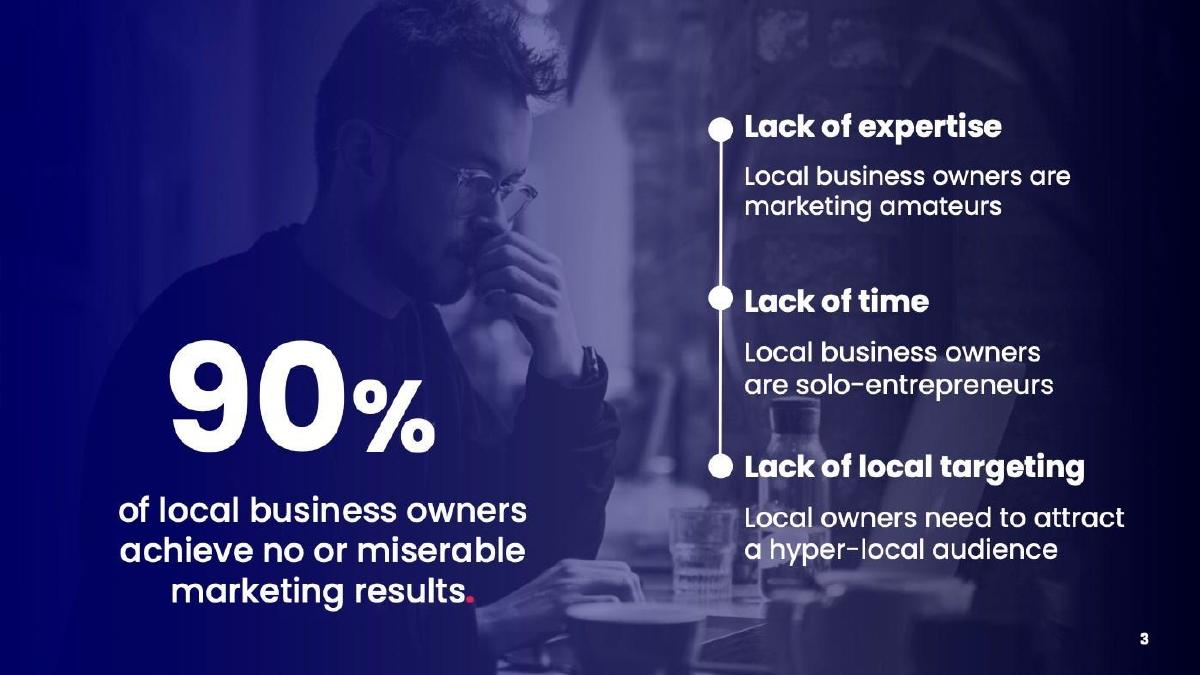
- Alphin identifies a specific pain point where 90% of local business owners achieve poor marketing results due to lack of expertise and time (Slide 3).
- The company positions itself as a 'Hubspot for local businesses,' aiming for a target MRR of €750 per client (Slide 11).
- Market size is quantified at over 50 million local businesses worldwide with a combined marketing spend exceeding €200bn (Slide 7).
- The deck uses a 'Value Chain' comparison to show that while Procurement, POS, and Delivery are digitized by multi-billion dollar firms, Marketing remains an open 'blue ocean' (Slide 9).
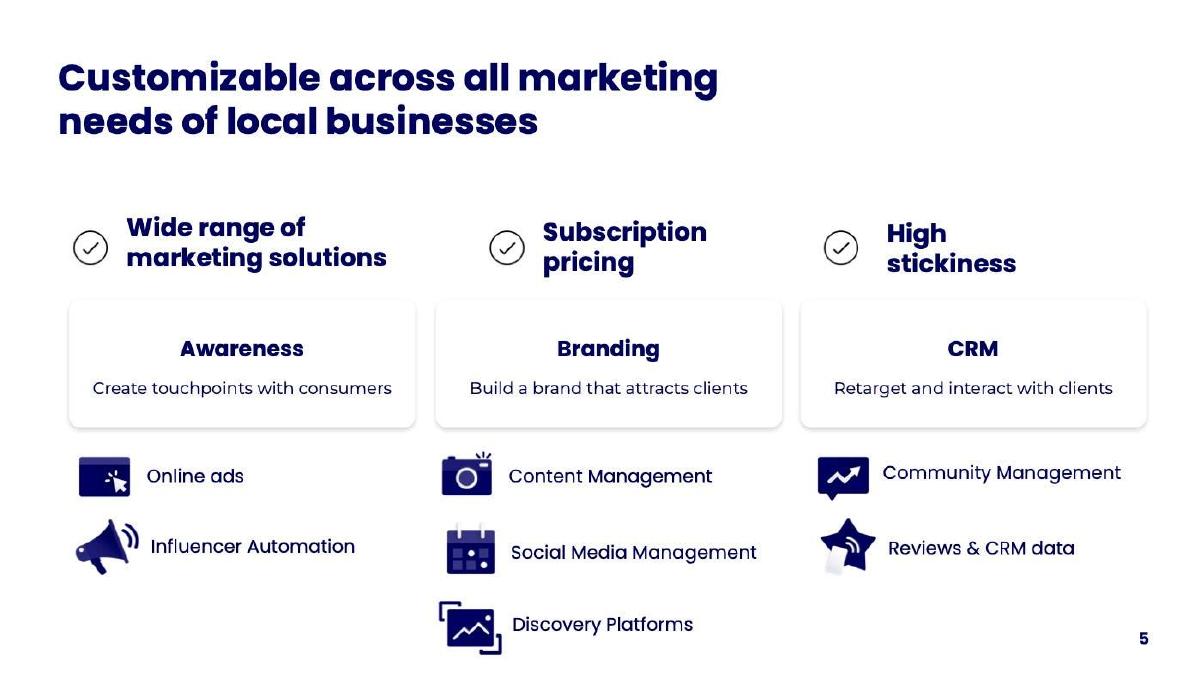
- The product suite is broad, covering Online Ads, Influencer Automation, Content Management, and CRM data (Slide 5).
- The team slide highlights significant pedigree, featuring former leads from Helpling, Quandoo, and DailyDeal, alongside investors like HV Capital and Partech (Slide 13).
- Alphin emphasizes 'High Stickiness' through a subscription pricing model that integrates reviews and CRM data to retarget clients (Slide 5).
- The roadmap includes moving from a marketing suite to a full CRM tool to capture the merchant's entire marketing spend (Slide 11).
Introduction: The Local Business Digitization Gap
Alphin’s pitch deck for their 2022 Series A round is a focused argument for the professionalization of SMB marketing. Based in Berlin, the startup raised $6M to tackle a problem that has long plagued local brick-and-mortar shops: they are great at their craft but generally poor at digital marketing. The deck, consisting of 14 slides, follows a logical progression from the 'amateur' status of the current market to a vision of a consolidated, automated platform that acts as the operating system for local growth.
Slide 1-2: Branding and Confidentiality
The deck opens with a clean, professional title slide featuring the Alphin logo and the tagline "The marketing platform for local businesses." The background image of Berlin, complete with the iconic TV Tower and location pins, immediately grounds the company in its geographic and functional context. Slide 2 is a repeat of the title, likely used as a transition or placeholder in the original presentation.
Slide 3: The Problem – The 90% Failure Rate
Slide 3 presents a stark statistic: "90% of local business owners achieve no or miserable marketing results." This is the 'villain' of the story. The slide breaks down the 'why' into three clear pillars:
Lack of expertise: Owners are marketing amateurs. · Lack of time: Owners are solo-entrepreneurs. · Lack of local targeting: The need for hyper-local audiences is unmet by generic tools.
This slide is effective because it doesn't just say marketing is hard; it explains the structural reasons why SMBs fail, setting the stage for a solution that must be automated and easy to use.
Slide 5: The Solution – A Customizable Suite
Slide 5 introduces the Alphin platform as "Customizable across all marketing needs of local businesses." It categorizes its offerings into three value buckets: Awareness, Branding, and CRM. The specific features listed include Online Ads, Influencer Automation, Content Management, Social Media Management, Discovery Platforms, Community Management, and Reviews. By highlighting "Subscription pricing" and "High stickiness," Alphin signals to investors that this is a scalable SaaS model, not a service agency.
Slide 7: Market Size – The €200bn Opportunity
To prove the venture-scale potential, Slide 7 quantifies the market. It claims there are ">50m Local businesses worldwide" with a "€200+bn Marketing spend." The use of a busy restaurant background reinforces the 'brick-and-mortar' focus. This slide is intended to move the conversation from 'helping small shops' to 'capturing a massive, fragmented global market.'
Slide 9: The Strategic 'Blue Ocean' Comparison
This is arguably the most important slide in the deck. Alphin maps out the 'Local business value chain' and shows how other segments have already produced unicorns:
Procurement: Choco (Valued at $600m). · PoS: Toast (IPO valuation $4.6bn). · Delivery: Just Eat (IPO valuation $17bn).
By placing Alphin in the "Marketing" box and labeling it a "massively under digitised $200bn blue ocean," they create a sense of inevitability. The message is clear: every other part of the shop has been digitized; marketing is the last remaining frontier.
Slide 11: Product Strategy and The 'Hubspot' Vision
Slide 11 outlines the roadmap. They describe themselves as the "Hubspot for local businesses." Key details include:
A powerful tech team of 17 enthusiasts. · A current "all time average" MRR (redacted in this version). · A future target of "€750 MRR per client" by enhancing the suite with a CRM tool.
This slide shows the evolution from a simple tool to an 'irreplaceable' platform that captures the merchant's full marketing spend through data-driven automation.
Slide 13: The Team and Backing
The deck concludes its narrative with a heavy-hitting team slide. The three co-founders—Mario Geiß (CEO/CFO), Steffen Allesch (CEO/CSO), and Lukas Krieger (CPO)—bring backgrounds in finance, investment banking, and IT strategy. The broader leadership team includes former directors and leads from Rocket Internet, Goldman Sachs, Helpling, Quandoo, and Foodora. The presence of logos for HV Capital, Partech, and Speedinvest (implied by the 'S' logo) provides the final stamp of institutional credibility.
What Alphin Does Well
Alphin excels at contextual positioning . By using Slide 9 to compare themselves to Toast and Just Eat, they bypass the 'small business tools are hard to scale' objection. They aren't just selling a social media scheduler; they are claiming a specific, unoccupied territory in the SMB tech stack. This 'Value Chain' argument is a powerful way to frame a Series A raise, as it suggests that the winner of this category will reach a multi-billion dollar valuation simply by following the path of POS and Delivery companies.
Furthermore, the problem definition on Slide 3 is excellent. It identifies the 'solo-entrepreneur' as the primary user, which dictates the product requirements: it must be automated because the user has no time, and it must be 'expert-in-a-box' because the user has no training. This alignment between the user's reality and the product's features is a hallmark of a strong pitch.
What is Missing from the Deck
The most notable omission in this public version of the deck is specific unit economics . While Slide 11 mentions a target of €750 MRR, the actual current MRR, Customer Acquisition Cost (CAC), and Churn rates are not visible. For a Series A, investors would typically require a deep dive into the 'Magic Number' or LTV/CAC ratios to prove that the $6M investment will efficiently fuel growth.
Additionally, there is no Competitive Landscape slide beyond the value chain comparison. While they claim marketing is a 'blue ocean,' there are numerous local SEO tools, social media managers, and agencies. A slide addressing how Alphin wins against local agencies or DIY tools like Canva/Meta Business Suite would have strengthened the 'defensibility' argument.
Founder's Guide: What to Copy
Founders should emulate Alphin's "Category Comparison" strategy. If you are entering a fragmented market, don't just list your features. Instead, show a map of the industry's value chain and highlight the 'empty' box you are filling. This helps investors visualize your company as a future category leader rather than just another utility tool.
Another takeaway is the Team Pedigree presentation. Alphin doesn't just list names; they list the specific 'Selected experiences' (Rocket Internet, Oracle, etc.) that are relevant to scaling a high-growth startup. If your team has worked at companies that the VCs already know and trust, use those logos prominently to borrow that established credibility.
Frequently asked questions
- What is Alphin's core value proposition?
- Alphin provides an automated marketing platform specifically designed for local, brick-and-mortar businesses. They solve the three main hurdles these owners face: lack of marketing expertise, lack of time as solo entrepreneurs, and the difficulty of hyper-local targeting. By offering a subscription-based 'all-in-one' suite, they aim to replace fragmented tools with a single, sticky solution.
- How does Alphin justify its market opportunity?
- On Slide 9, Alphin compares the marketing sector to other digitized parts of the local business value chain. They point to multi-billion dollar successes in Procurement (Choco), POS (Toast), and Delivery (Just Eat). By showing that these areas are already 'conquered,' they frame marketing as a massive, under-digitized €200bn opportunity where they can be the dominant player.
- What specific products does Alphin offer?
- According to Slide 5 and Slide 11, their suite includes Online Ads, Influencer Automation, Content Management, Social Media Management (specifically Instagram), Discovery Platforms, Community Management, and Review/CRM management. They also mention upcoming features like a Website Builder and a more robust CRM tool to drive higher revenue per client.
- Who are the investors behind Alphin?
- Slide 13 lists several prominent European venture capital firms that participated in their funding, including HV Capital (formerly Holtzbrinck Ventures), Partech (via their seed fund), and signals from the logos of Rocket Internet and others in the team's professional history. The publisher reports a $6M Series A raise in 2022.
- What are the key metrics mentioned in the deck?
- The deck highlights a global market of over 50 million businesses and a €200bn spend. On the unit economics side, Slide 11 mentions a 'High share of wallet' with an all-time average MRR (redacted as €XXX) and a future target of €750 MRR per client as they expand their CRM and automation features.