"#1" and "Market Leader" Claims: 11 Real Pitch Deck Slides
How to back up a "#1", "largest" or "market leader" claim on a pitch deck: name the market, the measure, the source and the date. Eleven real slides compared.
"#1" and "Market Leader" Claims in a Pitch Deck: Say Leader of What, by Which Measure
"#1", "the leading", "largest" and "market leader" appear on many pitch decks, often on the summary slide. An investor reads each one as a question: leader of which market, measured how, according to whom, and when? This guide compares eleven real slides on how well they answer it.
TL;DR
A leadership claim needs four things: the market it covers, the measure (revenue, users, downloads, share), a source and a date. None of the eleven slides here gives all four. Little Lunch comes closest on scope — shelf-stable organic soup in Germany, Austria and Switzerland — and Hopper pairs "largest" with a download count. 100Plus and Hinge Health sit their claims next to strong figures that don't measure leadership. Bower, Althea and Alphin state "#1" with no market or source, BrowserStack borrows its customers' size, and Arive correctly labels "#1" as an ambition.
"#1" and "market leader" claims on real pitch deck slides
Each example shows the exact stored slide above its analysis and links to the full teardown. Most fully defined first. Claims are quoted as shown; checks are ours.
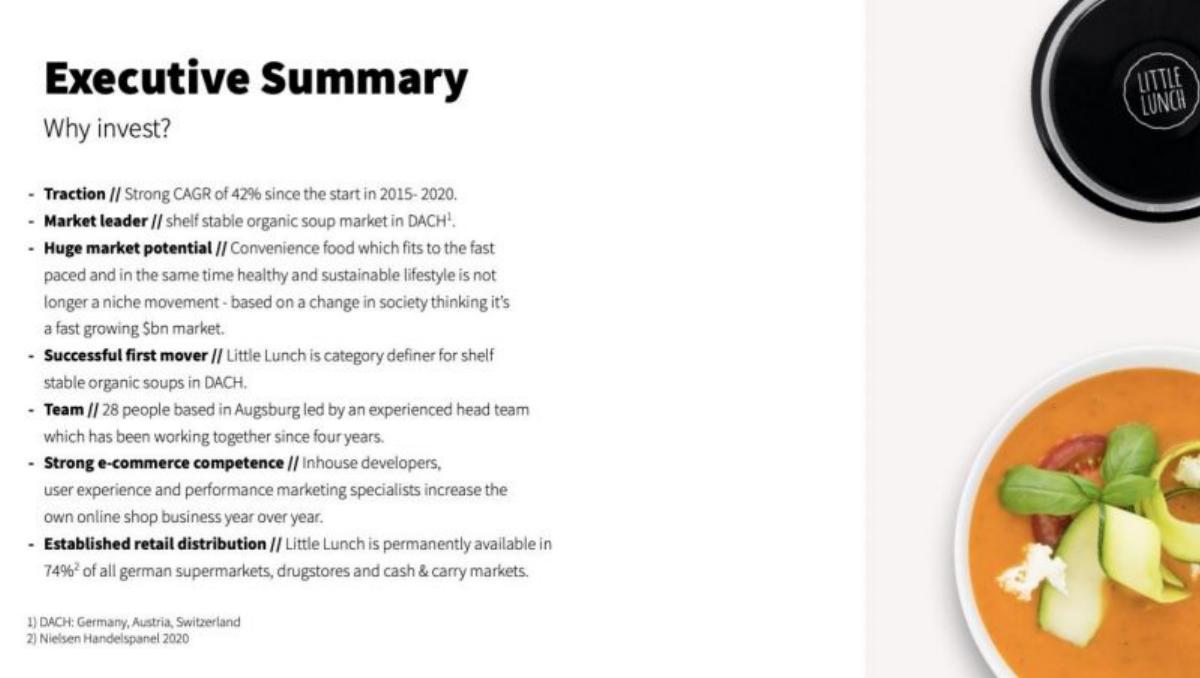
Little Lunch traction slide — slide 6
German organic soup brand. An "Executive Summary — Why invest?" slide of labelled bullets with two footnotes.
Little Lunch deck, slide 6. Exact stored slide matched to this analysis.
Our analysis: A narrowly scoped claim with no stated measure or source.
Evidence and limitation: The market is defined tightly: one product category (shelf-stable organic soup) in three named countries. That makes the claim checkable. The source footnote (Nielsen, 2020) is attached to the 74% distribution figure, not to the leadership claim, and the slide gives no share or sales figure for the leadership itself.
What a founder can adapt: "Market leader in shelf-stable organic soup, DACH: [x]% value share (Nielsen, [year])."
Supporting analysis
What the deck claims: "Market leader // shelf stable organic soup market in DACH¹." "Successful first mover // Little Lunch is category definer for shelf stable organic soups in DACH." "Established retail distribution // permanently available in 74%² of all german supermarkets, drugstores and cash & carry markets." Footnotes: "1) DACH: Germany, Austria, Switzerland"; "2) Nielsen Handelspanel 2020".
Presentation choice: A tight market definition is the part most decks skip; it turns "leader" from a boast into something a reader can verify.
When it does not fit: Don't let a footnote on a nearby figure look like the source for the leadership claim.
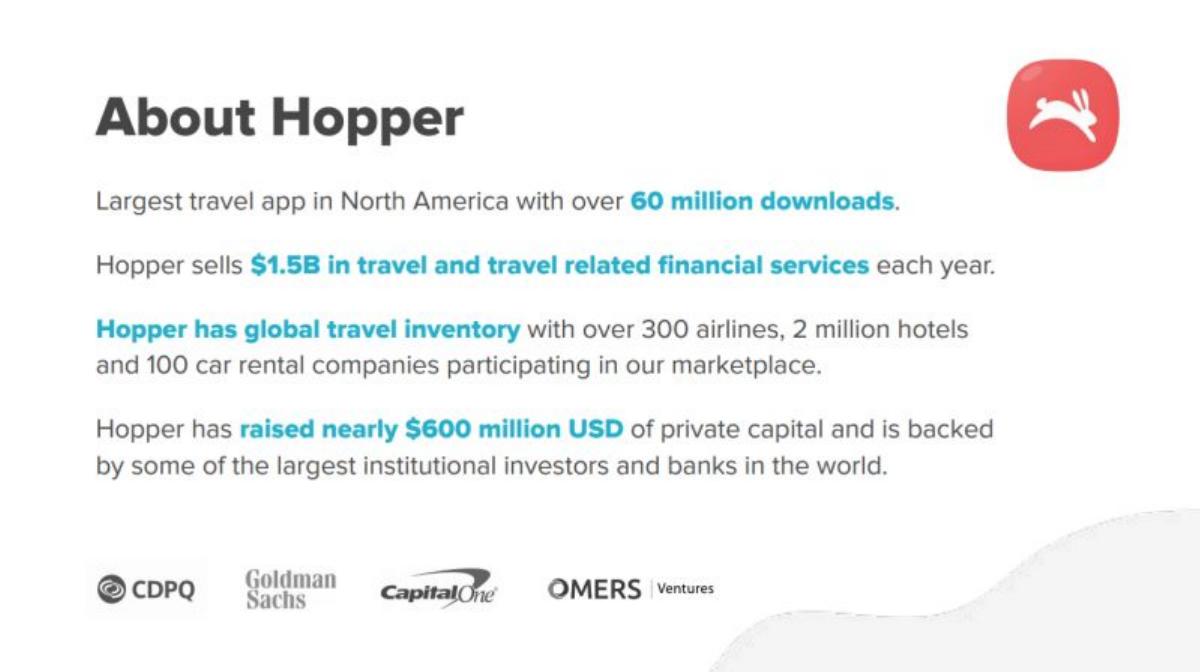
Travel booking app. An "About Hopper" slide of four statements above investor logos.
Hopper deck, slide 3. Exact stored slide matched to this analysis.
Our analysis: A regional claim with a supporting volume figure but no comparison or source.
Evidence and limitation: The claim names a region (North America) and gives a figure beside it: 60 million downloads. Downloads are cumulative and count installs, not active users, and the slide doesn't say which competitors were compared, by what source or as of when. The $1.5B is annual sales, a stronger scale figure, but it isn't presented as a comparison either.
What a founder can adapt: "Largest travel app in North America by [measure] ([source], [month year]); 60M+ downloads; $1.5B annual gross sales."
Supporting analysis
What the deck claims: "Largest travel app in North America with over 60 million downloads." "Hopper sells $1.5B in travel and travel related financial services each year." "Hopper has raised nearly $600 million USD of private capital."
Presentation choice: Putting a number next to "largest" gives a reader something concrete, even when the ranking itself isn't sourced.
When it does not fit: Don't rely on cumulative downloads alone to support "largest"; active users or sales compare better.
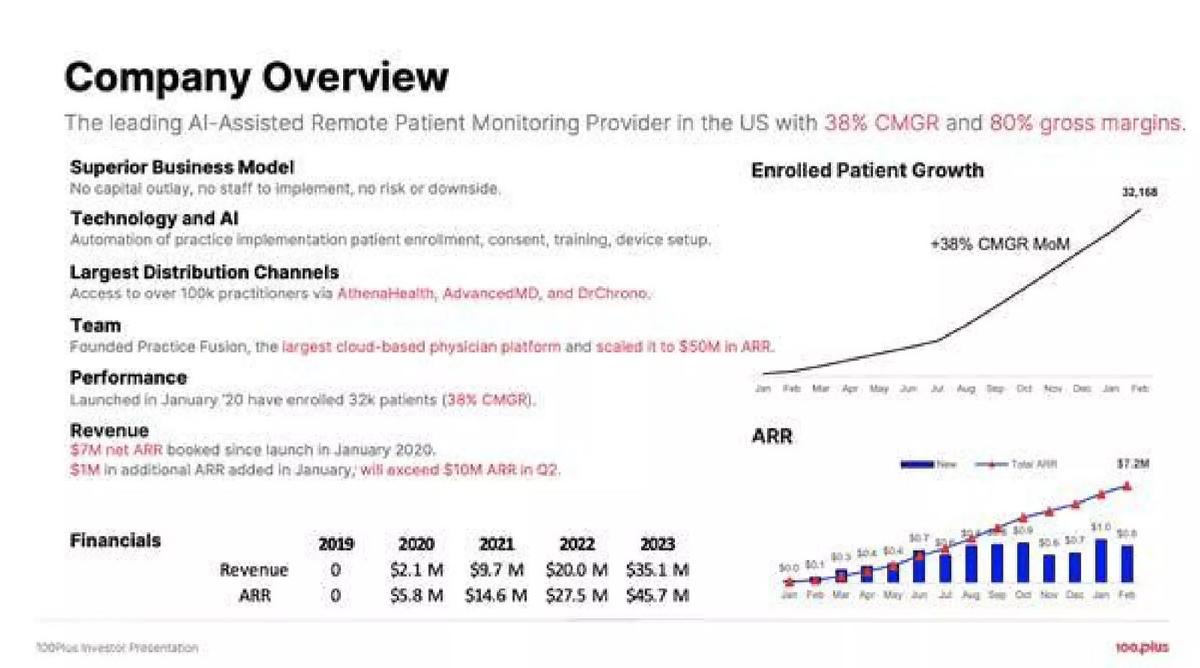
Remote patient monitoring company. A "Company Overview" slide with labelled facts, an enrolled-patient chart, an ARR chart and a financials table.
100Plus deck, slide 2. Exact stored slide matched to this analysis.
Our analysis: Strong own figures beside an unmeasured leadership claim.
Evidence and limitation: The slide is rich in figures: 32,168 enrolled patients, a 38% compound monthly growth rate and $7M booked ARR, all dated from a January 2020 launch. None of them compares 100Plus with other providers, so they show fast growth, not leadership. "Leading" is also narrowed by "AI-assisted", a sub-category the company defines itself.
What a founder can adapt: Drop "the leading" or add the comparison: "Largest AI-assisted RPM provider in the US by enrolled patients ([source], [date])."
Supporting analysis
What the deck claims: "The leading AI-Assisted Remote Patient Monitoring Provider in the US with 38% CMGR and 80% gross margins." "Launched in January '20 have enrolled 32k patients (38% CMGR)." "$7M net ARR booked since launch in January 2020." The patient chart ends at 32,168.
Presentation choice: Readers will credit the numbers; the word "leading" adds nothing unless it is measured against others.
When it does not fit: Don't let a growth rate stand in for a market ranking.
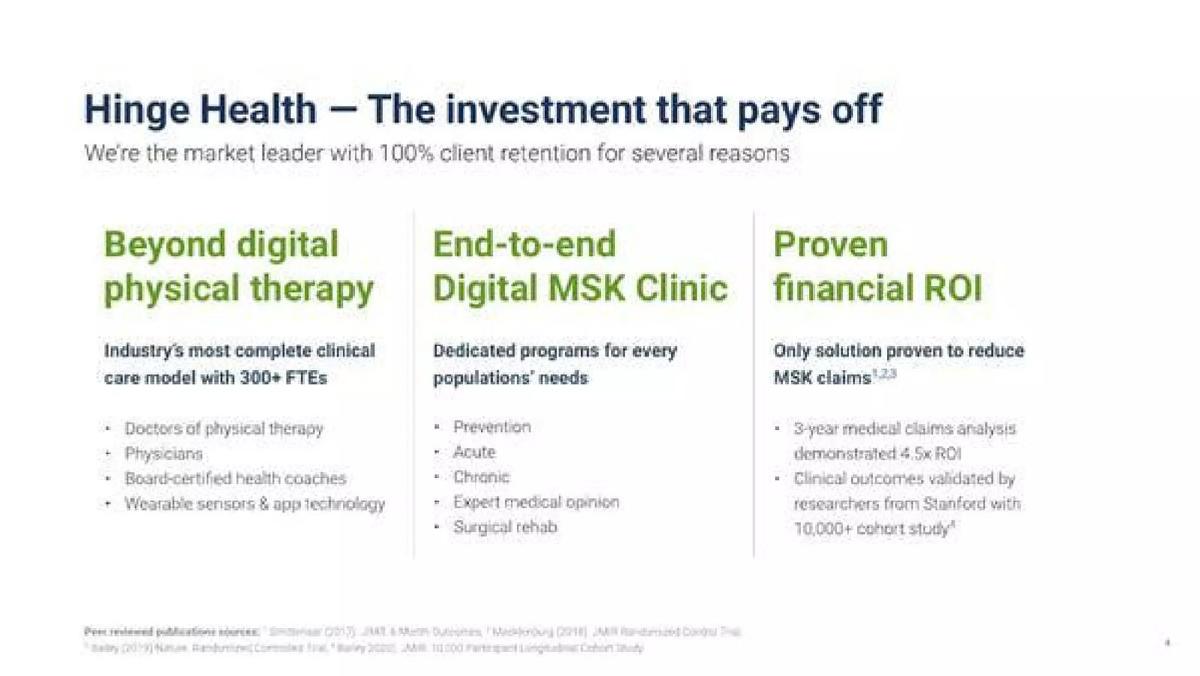
Digital musculoskeletal care company. A three-column "The investment that pays off" slide with peer-reviewed sources in the footer.
Hinge Health deck, slide 4. Exact stored slide matched to this analysis.
Our analysis: Well-sourced outcome claims with an unsourced leadership headline.
Evidence and limitation: The clinical and financial claims are footnoted to named peer-reviewed studies, which is unusually well sourced. The leadership claim is not: 100% client retention measures how many customers stayed, not how Hinge Health compares with rivals, and the slide gives no share, client count or date.
What a founder can adapt: "Market leader in digital MSK by [employer clients / members] ([source], [year]); 100% client retention in [year]."
Supporting analysis
What the deck claims: "We're the market leader with 100% client retention for several reasons." Columns: "Industry's most complete clinical care model with 300+ FTEs"; "Dedicated programs for every populations' needs"; "Only solution proven to reduce MSK claims", citing a "3-year medical claims analysis" showing "4.5x ROI".
Presentation choice: The sourcing on the rest of the slide raises the bar; an unsourced headline stands out against it.
When it does not fit: Don't use retention, a loyalty measure, as evidence of market position.
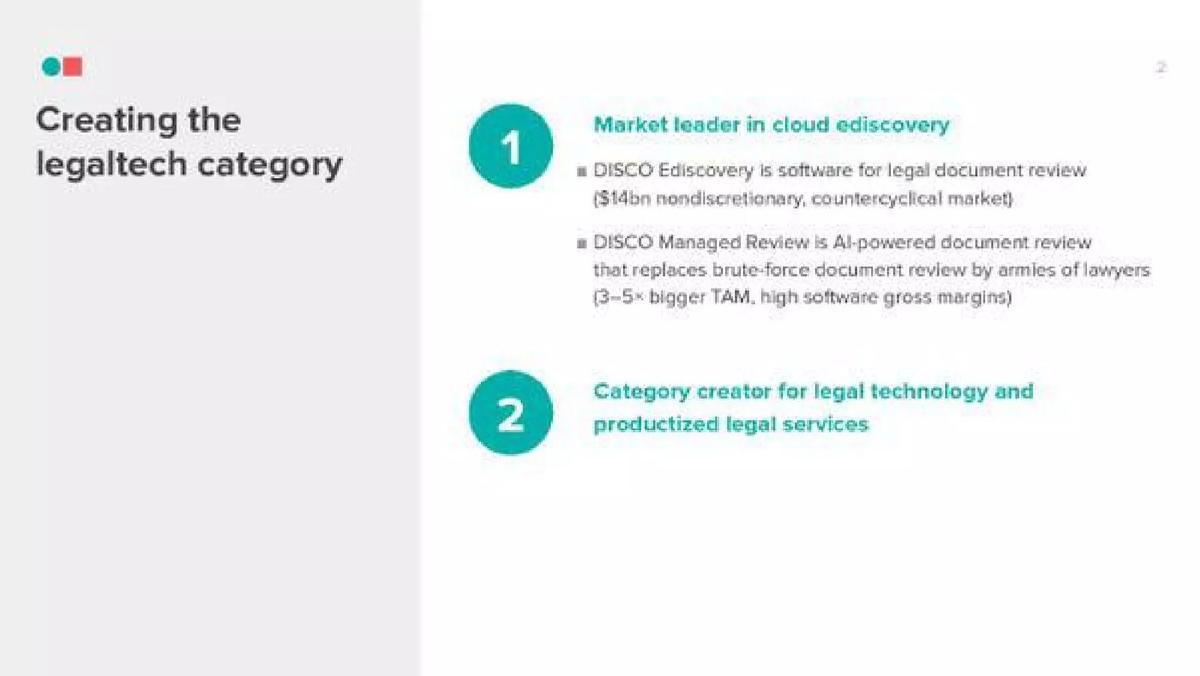
Legal technology company. A "Creating the legaltech category" slide with two numbered claims.
DISCO deck, slide 2. Exact stored slide matched to this analysis.
Our analysis: A named sub-market with a market size in place of a share.
Evidence and limitation: The market is named (cloud ediscovery) and sized ($14bn), but the size describes the whole market, not DISCO's position in it. No share, revenue or ranking source is shown. "Category creator" is a second leadership-style claim with no figure.
What a founder can adapt: "Market leader in cloud ediscovery: [x]% of [segment] revenue ([source], [year]) in a $14bn market."
Supporting analysis
What the deck claims: "Market leader in cloud ediscovery." "DISCO Ediscovery is software for legal document review ($14bn nondiscretionary, countercyclical market)." "Category creator for legal technology and productized legal services."
Presentation choice: Defining the sub-market (cloud, not all ediscovery) is useful; the market size answers a different question.
When it does not fit: Don't put a market size where a reader expects your share of it.
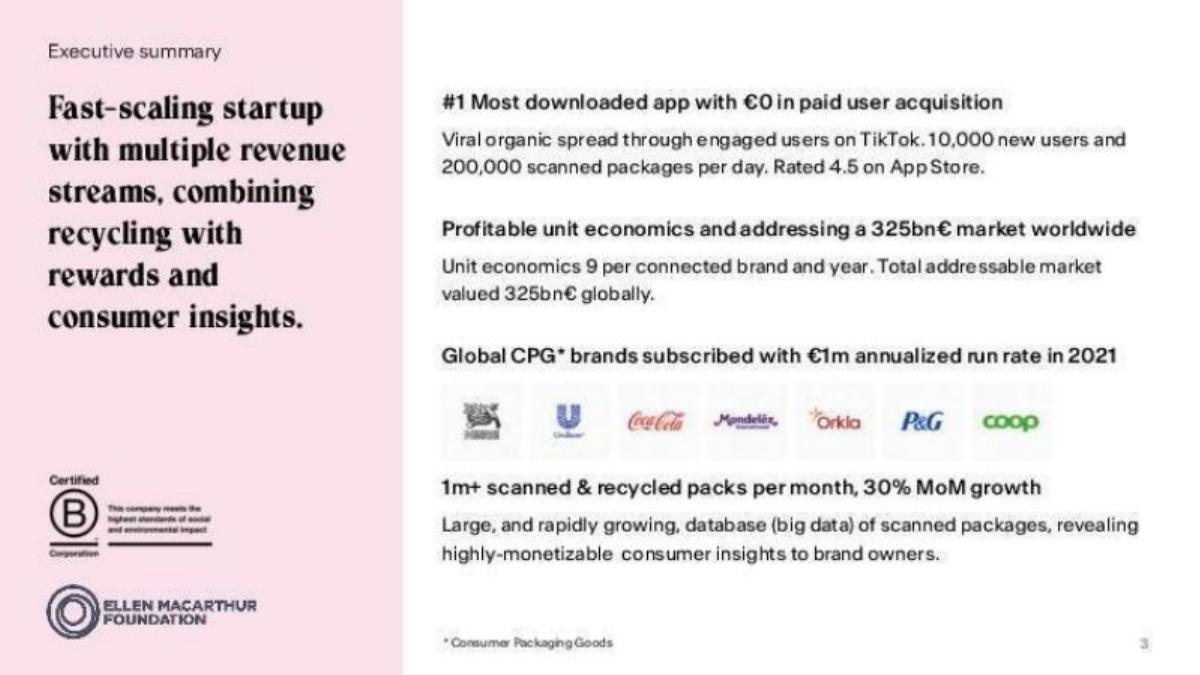
Recycling rewards app. An "Executive summary" slide of four headed claims.
Bower deck, slide 3. Exact stored slide matched to this analysis.
Our analysis: An unscoped ranking beside specific but inconsistent usage figures.
Evidence and limitation: "#1 most downloaded" names no app store, country, category or date, so it can't be checked. The figures below it are specific: 10,000 new users a day implies about 300,000 a month. The slide also says 200,000 scanned packages per day and "1m+" per month; 200,000 × 30 = 6 million, so the two figures likely cover different periods and aren't comparable as shown.
What a founder can adapt: "#1 in [store], [category], [country], [date]; 10,000 new users a day, no paid acquisition."
Supporting analysis
What the deck claims: "#1 Most downloaded app with €0 in paid user acquisition." "10,000 new users and 200,000 scanned packages per day. Rated 4.5 on App Store." "1m+ scanned & recycled packs per month, 30% MoM growth."
Presentation choice: App store rankings are easy to cite precisely; leaving out the store and date makes a real achievement look unverifiable.
When it does not fit: Don't put daily and monthly figures on one slide unless they reconcile.
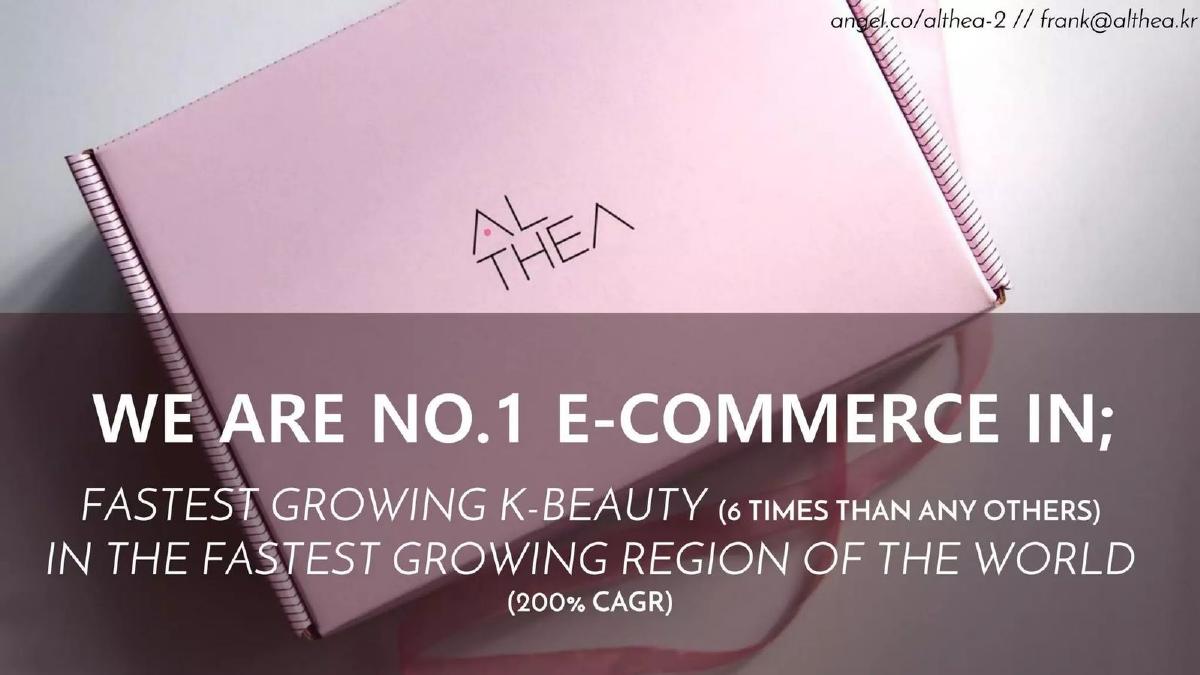
Korean beauty e-commerce company. A full-bleed photo with a headline.
Althea deck, slide 2. Exact stored slide matched to this analysis.
Our analysis: A headline claim with a comparison but no measure, period or source.
Evidence and limitation: The sentence is hard to parse: it seems to mean Althea is the fastest-growing K-beauty online store. "6 times than any others" gives a comparison but no measure (revenue? orders?) or period. The 200% CAGR appears to describe the region, not Althea, and has no years. No source is given.
What a founder can adapt: "Fastest-growing K-beauty online store in Southeast Asia: revenue up [x]× in [year] vs [y]× for the next competitor ([source])."
Supporting analysis
What the deck claims: "We are No.1 e-commerce in; fastest growing K-beauty (6 times than any others) in the fastest growing region of the world (200% CAGR)."
Presentation choice: A "6 times" comparison is the right instinct; without the measure it can't be tested.
When it does not fit: Don't put two growth rates in one sentence without saying which belongs to whom.
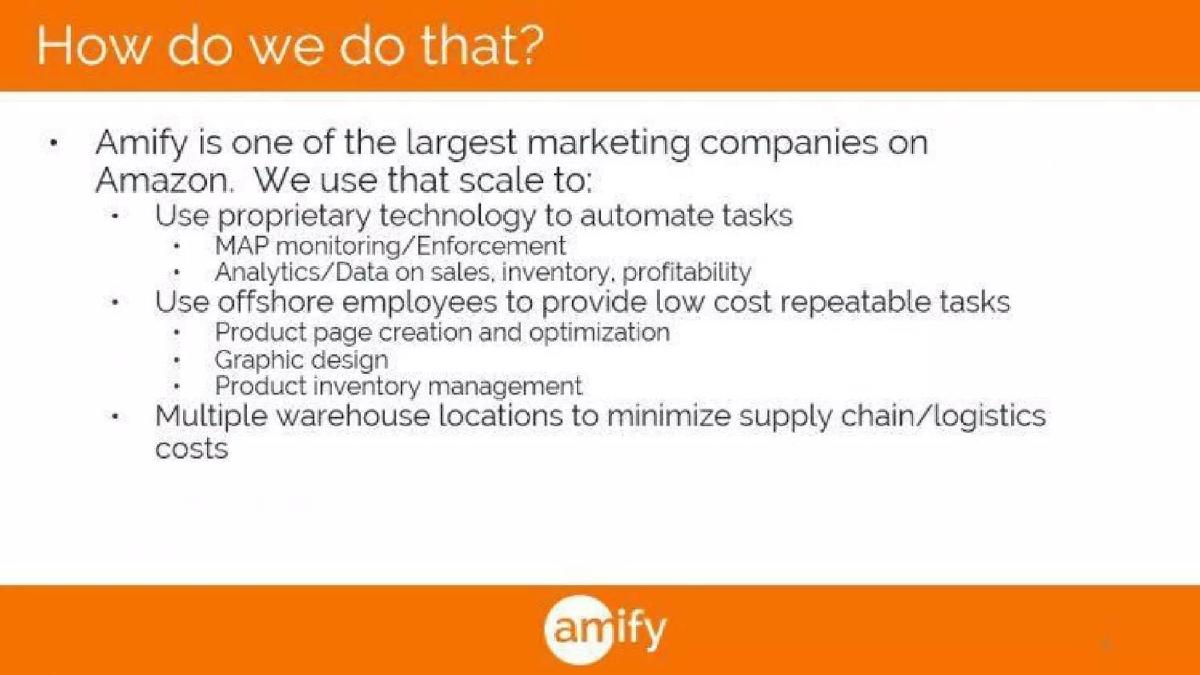
Amazon marketing agency. A "How do we do that?" bullet slide.
Amify deck, slide 5. Exact stored slide matched to this analysis.
Our analysis: A hedged size claim that the slide's argument depends on.
Evidence and limitation: "One of the largest" is a hedge: it avoids a ranking but gives no measure (clients, managed sales, staff) or figure. Since the rest of the slide rests on "that scale", the missing number matters.
What a founder can adapt: "We manage $[x]M of annual Amazon sales for [n] brands; that scale lets us:"
Supporting analysis
What the deck claims: "Amify is one of the largest marketing companies on Amazon. We use that scale to:" automate tasks, use offshore staff and run multiple warehouses.
Presentation choice: When scale is the reason your model works, the size figure is the evidence, not a detail.
When it does not fit: Don't build an argument on "one of the largest" without saying how large.
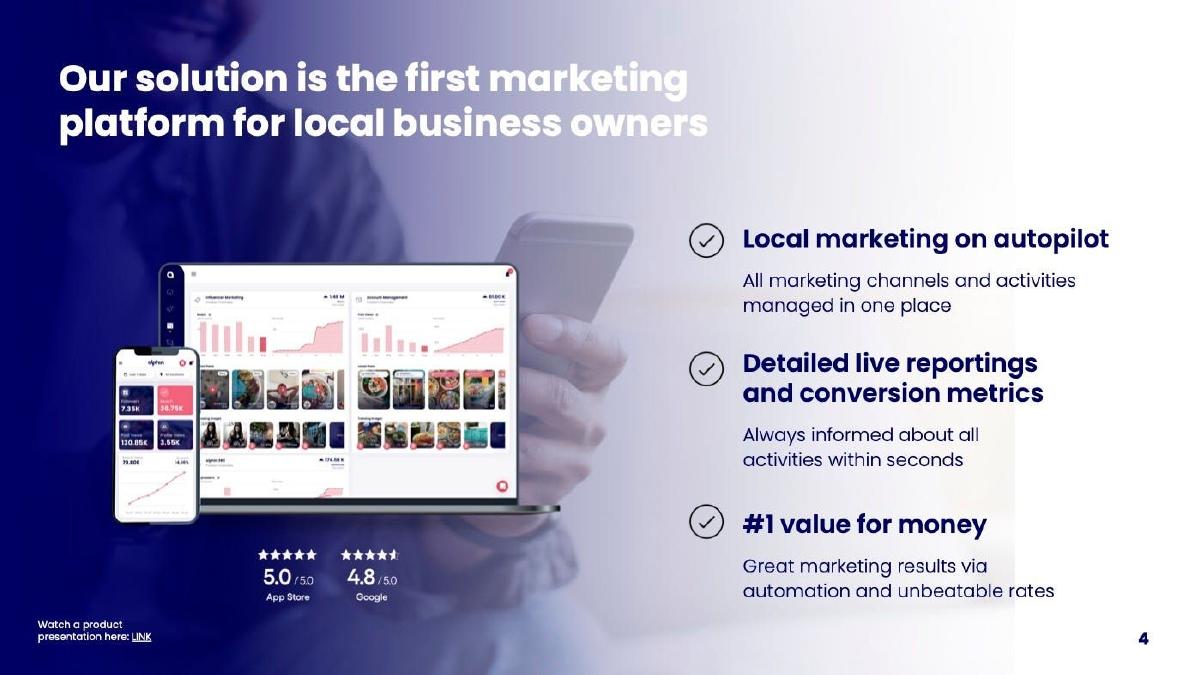
Local marketing software. A solution slide with a product image, app store ratings and three ticked claims.
Alphin deck, slide 4. Exact stored slide matched to this analysis.
Our analysis: Two unsupported rankings next to satisfaction ratings.
Evidence and limitation: "#1 value for money" and "first" are both rankings with no comparison shown. The app ratings are real figures but measure user satisfaction, not price against rivals, and the slide gives no review count or date.
What a founder can adapt: "From €[x]/month, about [y]% below [named alternatives]; rated 4.8/5 on Google ([n] reviews)."
Supporting analysis
What the deck claims: "Our solution is the first marketing platform for local business owners." "#1 value for money — Great marketing results via automation and unbeatable rates." Ratings shown: 5.0/5.0 App Store, 4.8/5.0 Google.
Presentation choice: Value-for-money is easy to show with a price comparison; the claim invites one.
When it does not fit: Don't claim "#1" on a quality that the slide never measures.
Software testing platform. A dark slide with one sentence above four logos.
BrowserStack deck, slide 6. Exact stored slide matched to this analysis.
Our analysis: Borrowed leadership: the customers are the largest, not the company.
Evidence and limitation: The superlative describes the customers, not BrowserStack. The logos are strong evidence of who uses the product, but the slide gives no contract size, product used or date, and makes no claim about BrowserStack's own market position.
What a founder can adapt: "Used by Amazon, Google, Oracle and Microsoft engineering teams since [year]."
Supporting analysis
What the deck claims: "The World's largest cloud providers rely on BrowserStack." Logos: Amazon, Google, Oracle, Microsoft.
Presentation choice: Named customers are persuasive; this is a customer slide, and reads best as one.
When it does not fit: Don't let a reader take the customers' size as your market position.
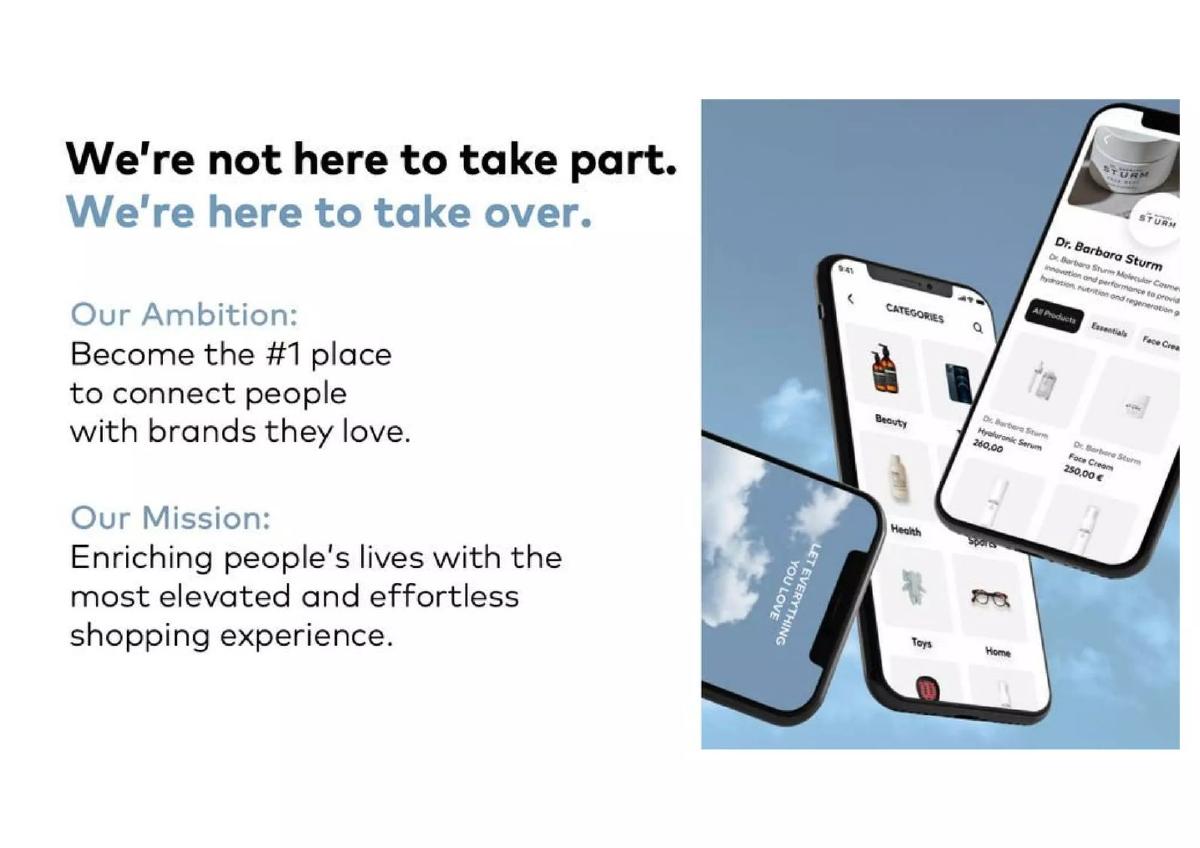
Quick-delivery shopping app. An ambition and mission slide beside phone screenshots.
Arive deck, slide 3. Exact stored slide matched to this analysis.
Our analysis: A goal correctly labelled as a goal.
Evidence and limitation: "#1" is labelled as an ambition, not a current position, so no evidence is needed on this slide. The market ("a place to connect people with brands") is too broad to measure progress against.
What a founder can adapt: "Ambition: #1 premium quick-delivery app in [city/country] by orders by [year]."
Supporting analysis
What the deck claims: "We're not here to take part. We're here to take over." "Our Ambition: Become the #1 place to connect people with brands they love."
Presentation choice: Separating ambition from achievement keeps a reader's trust for the claims that follow.
When it does not fit: Don't state an ambition in a way that could be read as a current ranking.
Whether each slide states the market, the measure, a source and a date for its claim.
Example
Claim
Market
Measure
Source / date
Main gap
Little Lunch
Market leader
Shelf-stable organic soup, DACH
Not stated
None for claim
Share figure
Hopper
Largest travel app
North America
60M+ downloads
Not stated
Comparison; date
100Plus
The leading provider
AI-assisted RPM, US
Own growth only
Since Jan 2020
Comparison
Hinge Health
Market leader
Not stated
Retention only
Studies for other claims
Share; source
DISCO
Market leader
Cloud ediscovery
Market size only
Not stated
Share
Bower
#1 most downloaded
Not stated
Downloads
Not stated
Store; date
Althea
No.1; 6× others
K-beauty e-commerce
Not stated
Not stated
Measure; period
Amify
One of the largest
Amazon marketing
Not stated
Not stated
Any figure
Alphin
#1 value for money
Local marketing
Ratings only
Not stated
Price comparison
BrowserStack
Largest providers rely on us
Customers
Logos
Not stated
Own position
Arive
Ambition: #1
Broad
n/a (goal)
n/a
Market too broad
Key Takeaways
Name the market narrowly enough to be checkable: product category, region and customer type.
Name the measure: revenue, active users, downloads, units or market share.
Cite a source a reader can look up, with the date of the data.
A strong metric beside the claim (growth, retention) is not proof of leadership unless it compares you with others.
"One of the largest" and "leading" signal that you can't prove "#1"; give the figure instead.
A goal to become #1 is fine if the slide says it's a goal.
Write your leadership line
Fill in each line before putting "#1" or "market leader" on a slide. If you can't fill in the measure and source, use the figure without the ranking.
Market. Product category, region and customer type, narrow enough to check.
Measure. Revenue, active users, units, downloads or share — pick one.
Figure. Your number on that measure, and the next competitor's if you have it.
Source. Market research firm, app store ranking, filing or your own data (say so).
Date. Month and year the ranking or data refers to.
Copyable framework: #1 in [market] by [measure]: [figure] ([source], [month year]).
Illustrative example 1 — written by us
Before: #1 Most downloaded app
After: #1 in [store], [category], [country], [month year]; 10,000 new users a day with no paid acquisition.
What improved: Our illustrative rewrite; not Bower's wording. Bracketed values are placeholders. It adds the store, category, country and date.
What this guide adds
The competition slide guide covers how to compare yourself with alternatives. The investment highlights and executive summary guides cover which points to put on a summary slide. This page covers one claim that often appears on those slides without support: that the company already leads its market.
Four parts of a checkable leadership claim
Market: "shelf-stable organic soup, Germany, Austria and Switzerland" can be checked; "e-commerce" can't.
Measure: leader by revenue, by units sold, by active users or by downloads? Each gives a different answer.
Source: a market research firm, an app store ranking or a public filing, named on the slide or in a footnote.
Date: rankings change. "#1 in the German App Store, Lifestyle, March 2021" is a fact; "#1 most downloaded" is not.
How we read each slide
We quote claims as shown on the stored slide images. We check whether each leadership claim states a market, a measure, a source and a date, and whether the figures beside it measure leadership or something else. We don't judge whether the claims are true.
Common mistakes
Leader of what?. Name the category, region and customer type.
No measure. Say whether you lead by revenue, users, units or share.
No source or date. Rankings change; cite who ranked you and when.
Wrong kind of proof. Growth and retention aren't comparisons with rivals.
Hedged superlatives. "One of the largest" invites the question: how large?
Borrowed size. Big customers show adoption, not your market position.
Diagnostic checklist
Market named narrowly: category, region, customer type.
Measure named.
Your figure on that measure shown.
Source and date given for the ranking.
Supporting metrics compare you with others, or are labelled as your own.
Goals labelled as goals.
Frequently asked questions
How we chose these examples
Corpus: published pitch deck teardowns on StartupFundraising.com. Founder-uploaded private decks are excluded.
Selection (2026-09-25): we searched stored slide text on slides 2–6 for #1, No.1, number one, market leader, the leading, largest and market share, excluding fund, bank, public-company and investor-relations decks, slides where the phrase described a problem statistic or a market size, and promotional footer text. We kept only slides with a stored slide image and inspected each image. A listed-company investment-highlights slide with a similar claim (Matterport) was not used because this guide is for startup decks.
Claims are quoted as shown in the stored slide images. We check whether each claim states a market, measure, source and date; we don't assess whether the claims are true. Calculations are ours and use only visible numbers.
Review: stored slide text and images were checked on 2026-09-25 and matched to company, deck and slide number (editorial model review). No person has yet completed an editorial review of this page. We make no claim that any slide caused a fundraising outcome.