Hinge Health’s 15-slide deck is designed for a later-stage audience, focusing heavily on market validation and clinical outcomes rather than early-stage problem-solving. The company identifies Musculoskeletal (MSK) issues as the top medical cost driver for 90% of employers, positioning their Digital MSK Clinic as the essential solution. With nearly 300 employers and health plans already onboard and a 100% client retention rate, the deck relies on momentum and social proof. The presentation is notable for its extensive team slides, showcasing a deep bench of commercial and clinical leadership.…
Key takeaways
- Musculoskeletal (MSK) conditions are cited as the top cost driver for 90% of employers on slide 9.
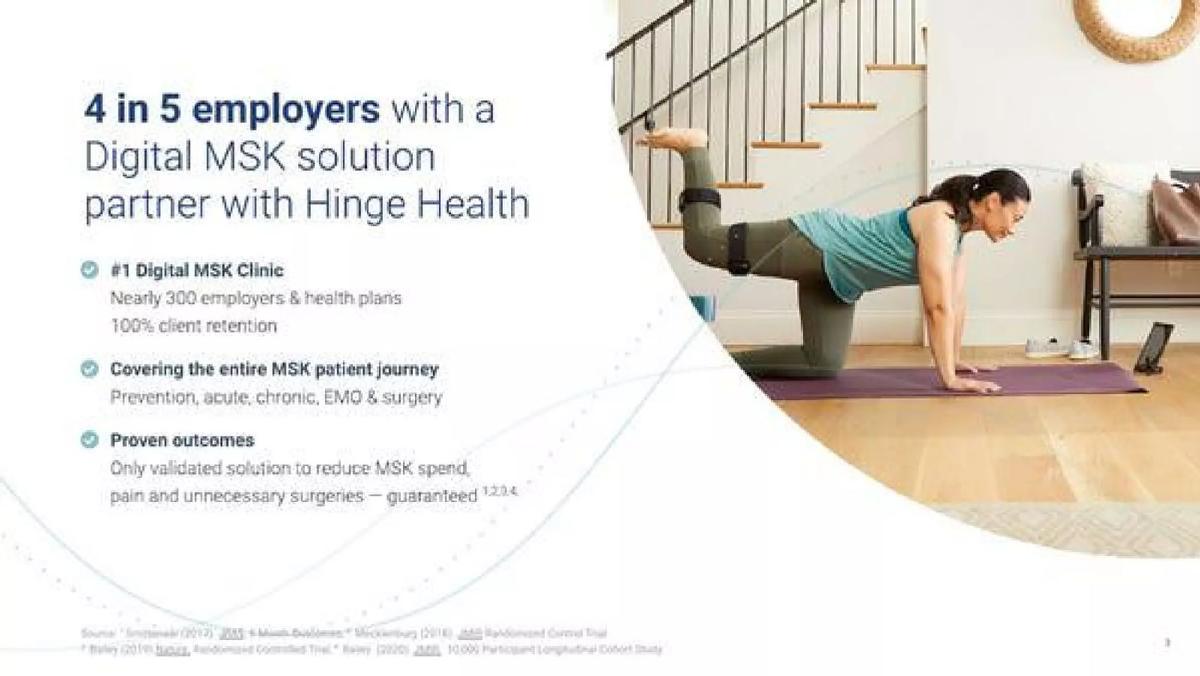
- The company claims a 100% client retention rate among nearly 300 employers and health plans on slide 3.
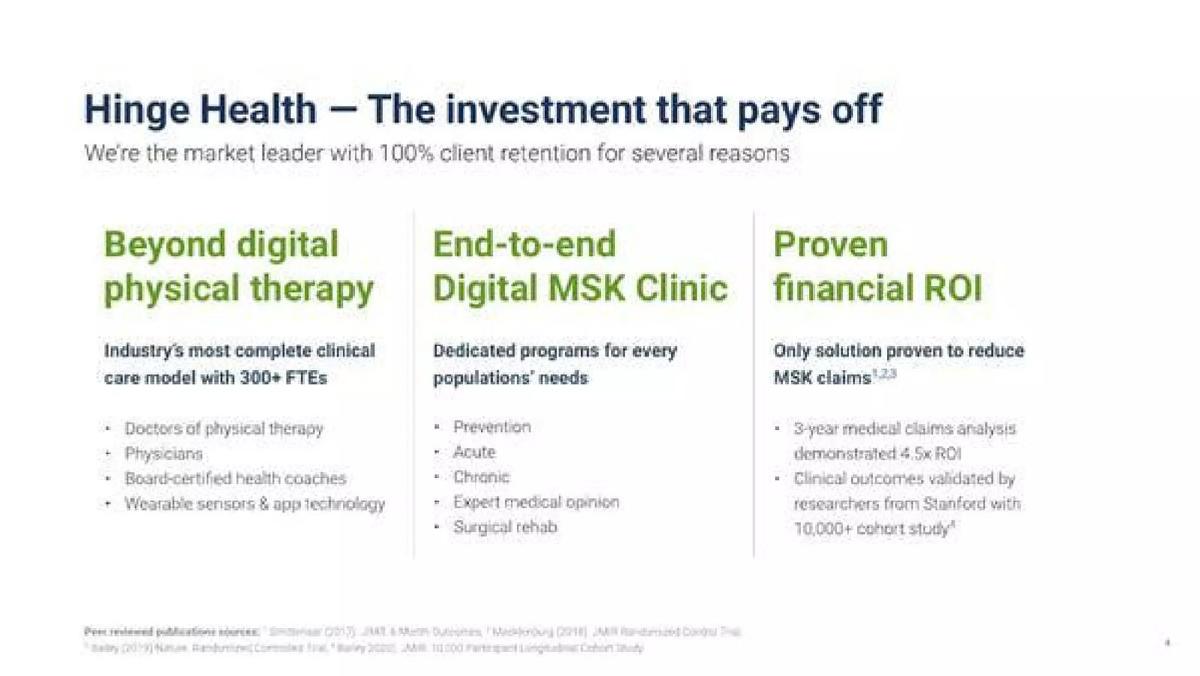
- A 3-year medical claims analysis demonstrated a 4.5x ROI for their customers, according to slide 4.
- Hinge Health captures 4 out of 5 employers who have already chosen a digital MSK solution, as stated on slide 3.
- The clinical care model is supported by over 300 FTEs, including doctors of physical therapy and physicians, shown on slide 4.
- The deck projects that 70% of employers will have a digital MSK solution by 2023, up from a small fraction in 2019, per slide 10.
- Clinical outcomes are validated by researchers from Stanford through a 10,000+ member cohort study on slide 4.
- The team section is exceptionally large, spanning four slides (5, 6, 7, and 8) to demonstrate operational and commercial scale.
Hinge Health: The Billion-Dollar Blueprint for Digital Health Dominance
Hinge Health represents one of the most significant success stories in the digital health sector, raising $1 billion in 2015 to scale its Digital Musculoskeletal (MSK) Clinic. This 15-slide deck is not a typical seed-stage presentation; it is a high-level strategic document used to solidify a market-leading position. It focuses on large-scale validation, clinical outcomes, and the massive cost burden MSK places on the American healthcare system. By the time this deck was in use, Hinge Health was no longer proving a concept—it was proving its ability to dominate a category.
The Executive Summary and Market Validation (Slides 1-4)
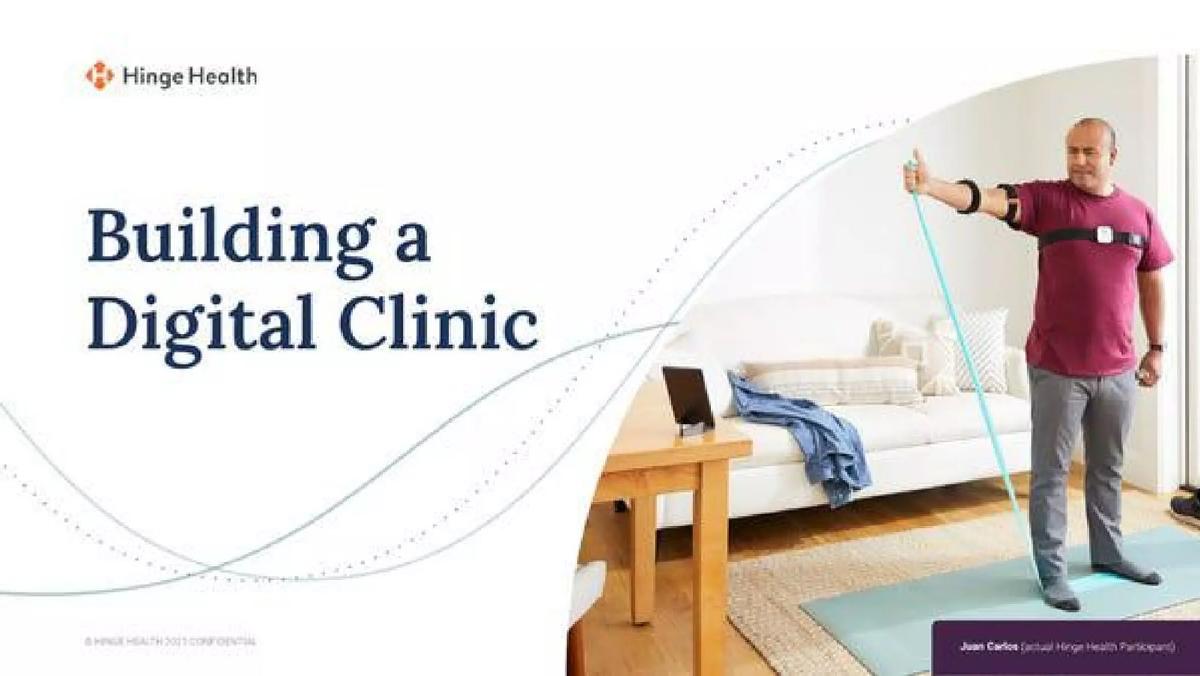
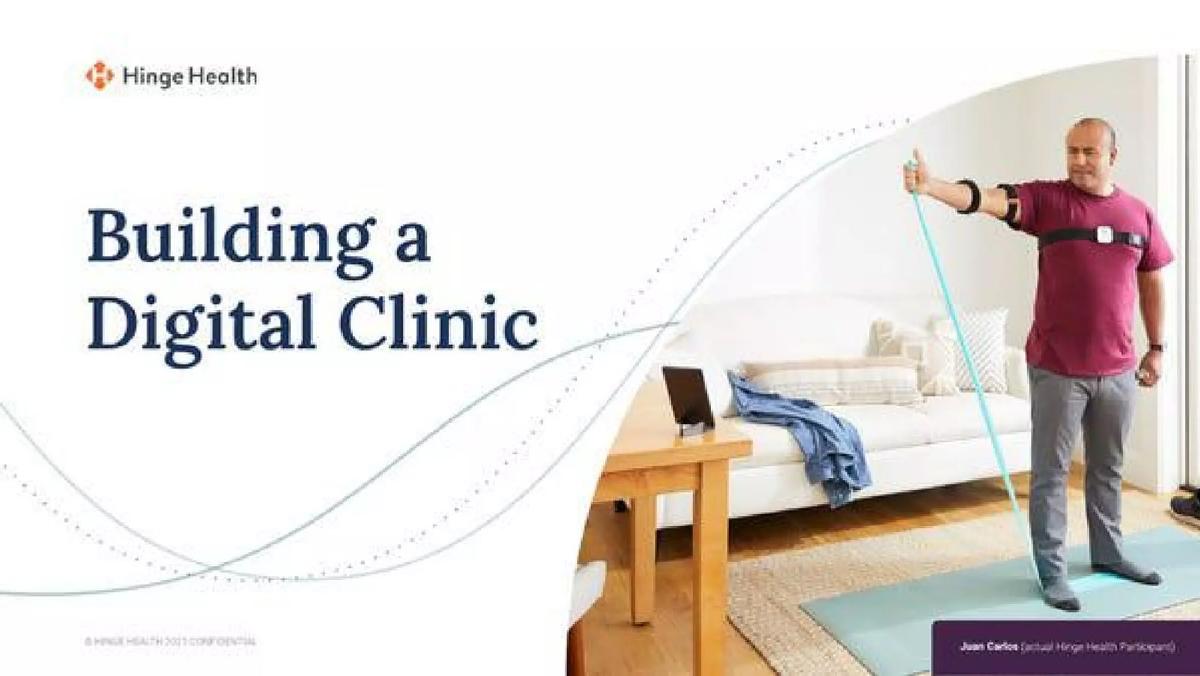
Slide 1 opens with the simple, bold mission: Building a Digital Clinic . The imagery features a participant using wearable sensors and resistance bands, immediately grounding the high-level tech in a tangible physical therapy setting. Slide 2 uses a powerful testimonial from a truck driver at US Foods who avoided surgery through the program, setting a human tone for the clinical data to follow.
Slide 3 is the 'traction' slide, and it is aggressive. It claims that 4 in 5 employers with a digital MSK solution partner with Hinge Health. It lists nearly 300 employers and health plans as clients and boasts a 100% client retention rate. This is a critical metric for later-stage investors, as it proves product-market fit and long-term sustainability. Slide 4, titled The investment that pays off , breaks down the value proposition into three pillars: going beyond digital PT, providing an end-to-end clinic, and delivering proven financial ROI. Specifically, it cites a 4.5x ROI based on a 3-year medical claims analysis and a 10,000+ member cohort study validated by Stanford researchers.
The Team: Scaling for the Enterprise (Slides 5-8)
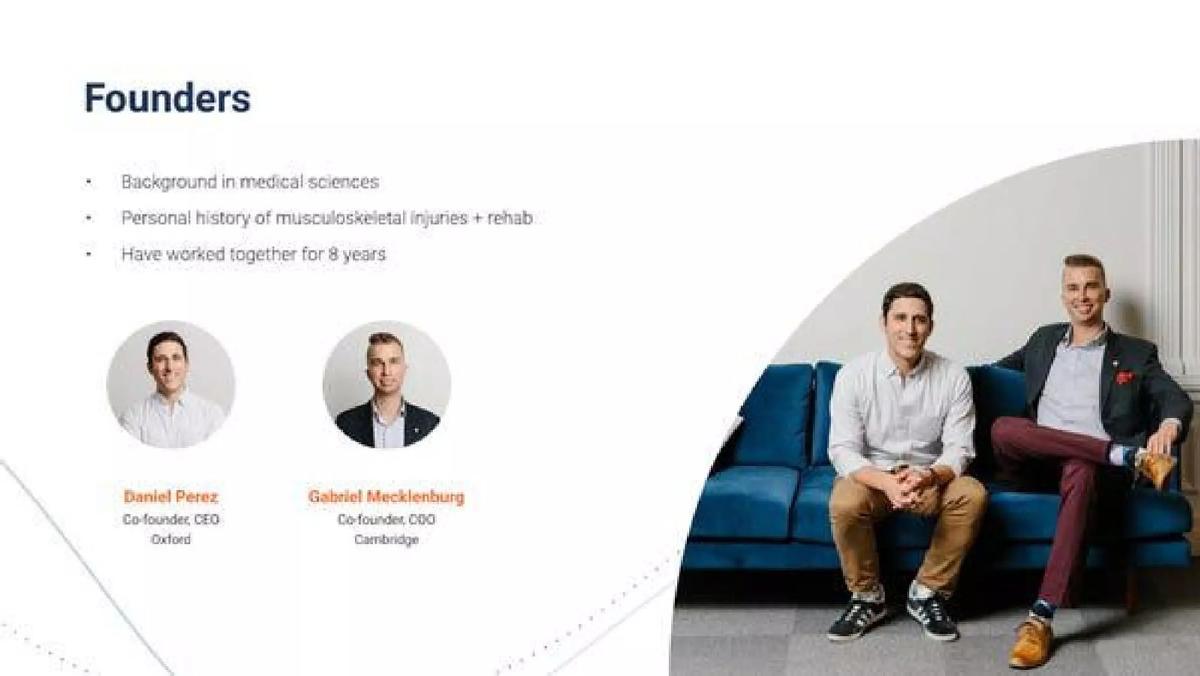
In many decks, the team is a single slide. Hinge Health dedicates four slides to its personnel, signaling that their competitive advantage lies in their human capital and operational experience. Slide 5 introduces the founders, Daniel Perez (CEO) and Gabriel Mecklenburg (COO), highlighting their medical science backgrounds and 8-year working relationship. Slide 6 focuses on Commercial Leaders , featuring VPs from Stanford, Wharton, and McKinsey. A notable detail on this slide is that Chris Forst, VP of Employer Sales, closed approximately 150 employers in 2020.
Slide 7, titled We field superstars in the field... , showcases the enterprise sales team, with members bringing 16 to 25 years of experience from companies like UnitedHealth Group (UHC) and Omada. Slide 8 rounds out the leadership with the C-suite and VPs of Engineering, Legal, and Design, featuring backgrounds from Ripple, Yahoo, Google, and Fitbit. This extensive focus on the team serves to reassure investors that the company has the 'adults in the room' necessary to manage a billion-dollar balance sheet and complex healthcare integrations.
The Market Opportunity and Problem (Slides 9-11)
Slide 9 identifies the core problem: MSK outpaces all conditions as the top cost driver . A bar chart shows that 90% of employers report MSK as their top medical claims spend, significantly higher than cancer, cardiovascular issues, or diabetes. This justifies the company's narrow focus on MSK; it is the largest 'pain point' in the budget. Slide 10 provides a growth forecast, stating that 70% of employers will have a digital MSK solution by 2023 , compared to a small fraction in 2019. This suggests a rapidly closing window for market capture, positioning Hinge Health as the incumbent leader in a booming sector.
Slide 11, Different members need different care , acknowledges the complexity of the patient journey. It categorizes users into four groups: At risk, Sprained ankle, Knee arthritis, and Back surgery. This slide transitions the deck from the 'why' (market size) to the 'how' (product versatility).
Product and Clinical Delivery (Slides 12-15)
Slide 12 is a full-bleed product shot showing the wearable sensors in action and the app interface. The app provides real-time feedback, such as rep counts and 'Hold' instructions. Slide 13 outlines the 3 steps to get the industry's highest enrollment : Awareness (multi-channel programs), Assessment (online clinical screener), and Enrollment (matching with the right program). This demonstrates that Hinge Health isn't just a clinical tool; it's a sophisticated marketing and triage engine for employers.
Slide 14 provides a comprehensive view of the Digital MSK Clinic , showing specific programs for Prevention, Acute, Chronic, and Surgery. It emphasizes that a 'Free Expert Medical Opinion' is available across all programs. Finally, Slide 15 focuses on Health coaches drive accountability . It distinguishes between behavioral health coaches (135+ board-certified employees) and the clinical escalation team (PTs, physicians, nutritionists, and pharmacists). By highlighting that these are full-time employees rather than contractors, Hinge Health emphasizes quality control and clinical rigor.
What Works in the Hinge Health Deck
The most effective element of this deck is the relentless focus on ROI and validation . In the healthcare space, 'cool tech' is secondary to 'who pays and how much do they save?' By citing a 4.5x ROI and a 100% retention rate early on, Hinge Health removes the primary risks associated with health-tech investments. The deck also does an excellent job of framing the market as a 'must-have' rather than a 'nice-to-have' by showing that MSK is the #1 cost driver for employers.
The depth of the team slides is also a strength for a later-stage raise. It shows that the company has successfully poached talent from incumbents (UHC) and tech giants (Google, Yahoo), suggesting a culture of high performance and industry respect. The visual design is clean, professional, and uses real participant imagery rather than generic stock photos, which adds to the clinical credibility.
What is Missing from the Hinge Health Deck
As a later-stage deck, it is intentionally light on certain details that a Series A investor might require. There is no detailed financial breakdown —no revenue figures, no EBITDA margins, and no specific growth targets for the next 24 months. While the 4.5x ROI for customers is mentioned, the unit economics for Hinge Health itself (CAC, LTV, payback period) are absent.
Additionally, there is no competitive landscape slide . While Hinge Health claims to be the leader, the MSK space is crowded with competitors like Sword Health and Kaia Health. A later-stage deck often skips this to project an air of 'category of one' status, but it leaves a gap for investors who want to understand how Hinge Health maintains its 80% market share against aggressive, lower-priced entrants. Finally, there is no 'Ask' slide . We know from the catalogue that they raised $1 billion, but the deck does not specify the terms or the intended use of proceeds.
What a Founder Should Copy
The 'Top Cost Driver' Slide: If you are selling to enterprises, you must show that the problem you solve is their biggest expense. Slide 9 is a perfect template for this. · Quantified ROI: Don't just say your product works. Say it has a 4.5x ROI validated by a specific institution (like Stanford). · Retention as Traction: A 100% retention rate is the ultimate proof of product-market fit. If you have it, put it on the first three slides. · Humanizing the Tech: Use real testimonials and photos of people using the product in their homes. It makes the 'Digital Clinic' concept feel safe and accessible. · Segmented Product Offerings: Slide 14 shows how one platform can serve multiple needs (Prevention to Surgery). This demonstrates a large Total Addressable Market (TAM) within a single customer account.
Frequently asked questions
- What is the primary value proposition Hinge Health offers to employers?
- Hinge Health positions itself as a cost-containment tool for large organizations. According to slide 9, MSK is the top medical claims spend for 90% of employers. Hinge Health claims to reduce this spend by providing a digital alternative to expensive surgeries and opioid use, delivering a validated 4.5x ROI over three years as noted on slide 4.
- How does Hinge Health differentiate its clinical model from standard digital physical therapy?
- Slide 4 explicitly states they go 'Beyond digital physical therapy' by offering a complete clinical care model. This includes over 300 full-time employees, including physicians and board-certified health coaches. Slide 15 further details a 'Clinical Escalation & Education Team' that includes nutritionists, mental health professionals, and ergonomists to provide a holistic approach.
- What evidence of market traction is presented in the deck?
- The deck emphasizes market leadership through high-volume adoption. Slide 3 notes that 4 in 5 employers with a digital MSK solution partner with Hinge Health. They report serving nearly 300 employers and health plans with a 100% client retention rate. Slide 6 also highlights that their VP of Employer Sales closed approximately 150 employers in 2020 alone.
- How does the technology integrate into the patient's daily routine?
- Slide 12 and 14 show the user interface, which utilizes wearable sensors and a tablet-based app to guide patients through exercises. The technology provides real-time feedback on form (e.g., 'Hold' prompts and rep counters). This is paired with human accountability from health coaches to ensure adherence, as described on slide 15.
- What is missing from this pitch deck that investors might typically expect?
- This is a later-stage deck, so it omits early-stage staples like a specific 'Ask' slide or a detailed breakdown of how the $1B will be spent. It also lacks a traditional competitor slide, choosing instead to focus on its own market share. Detailed financial projections and specific customer acquisition costs (CAC) are also absent from this version of the presentation.