AKO Smart Technologies' pitch deck is 13 slides built in PowerPoint on 25 April 2019, raising 750 million Tomans over three years for a non-invasive glucose monitor developed by three engineers based inside Tehran's Endocrinology and Metabolism Research Center. Its strongest asset is genuine: a pre-trial on 50 patients with approximately 83% accuracy, which is more measured evidence than most pre-seed hardware decks contain. The problem is that ~83% sits well below the roughly 95% agreement required by the ISO 15197 blood glucose meter standard, the deck never defines what the figure means or…
Key takeaways
- AKO Smart Technologies' pitch deck is 13 slides created in PowerPoint on 25 April 2019, presenting a non-invasive glucose monitoring device from a three-person team based inside the Endocrinology and Metabolism Research Center in Tehran, Iran.
- The deck's strongest fact is a pre-trial on 50 patients with approximately 83% accuracy — real human measurement data that most pre-seed hardware decks never contain — but the figure is never defined by reference method, error grid or patient demographics.
- Roughly 83% accuracy sits below the recognised ISO 15197 blood glucose meter standard, which requires around 95% agreement with a laboratory reference, and the deck presents the figure beside a tile reading 'Accurate & Reliable' without acknowledging the gap.
- The market slide contains a tenfold arithmetic error: it labels 1.5 million as '1% of Iran's market' when 1% of the 15 million Iranian diabetics it cites is 150,000.
- The competition slide attributes FreeStyle Libre to Roche when it is Abbott's product, and misspells Nemaura as 'Nemura' and Guardian as 'Gaurdian' — factual errors about the best-known products in the company's own category.
- The ask is 750 million Tomans over three years with no equity offered, no valuation, no instrument and no dollar conversion, in a deck otherwise written in English for an international competitive set.
- Only 5% of the three-year budget is allocated to 'Trials/IP/Clearance' for a regulated medical device, while 50% goes to human resources — and regulatory approval never appears as a step on the roadmap.
- There is no price, no cost of goods, no gross margin and no revenue forecast anywhere in the 13 slides, despite the business model slide proposing four separate revenue streams.
What this deck actually is
Thirteen slides, 960 x 540 points (16:9), built in Microsoft PowerPoint 2013 , created and last modified on 25 April 2019 . The file is a seed-stage investor deck for AKO Smart Technologies , a Tehran-based team building a non-invasive glucose monitor — a device intended to measure blood sugar without drawing blood.
Classify it before judging it. This is not a company credentials deck and not a product brochure. It has a cover, a one-line promise, a team page, a problem, a solution, a roadmap, a market, a competitive map, a business model, an ask and a contact slide. It is a genuine investor deck, and it is asking for money on slide 12: 750 million Tomans over three years .
The subject matter matters enormously to how the deck should be read. Non-invasive glucose monitoring is one of the most attempted and least successfully completed problems in medical devices. Decades of companies have promised to replace the finger prick with optics, and the graveyard is well populated — which means an investor opening this file is not asking "is this a big market?" They know it is. They are asking exactly one question: what have you measured, against what reference, in how many people?
To its credit, this deck answers that question. On slide 6 it states a pre-trial on 50 patients with approximately 83% accuracy . That single line is the most important sentence in the file, and it is also, read carefully, the reason the round is hard.
Slide-by-slide walkthrough
Slide 1 — Cover
"AKO Smart Technologies" over the sub-line "Smart Health-care Solutions." No date, no logo mark of substance, no location, no contact, no one-line description of the product.
"Smart Health-care Solutions" is a category, not a company. It could describe a hospital software vendor, a telemedicine app or a wheelchair manufacturer. The actual product — a device that reads glucose without a blood draw — is one of the most immediately compelling one-liners available in medtech, and it is withheld until slide 2. A cover slide's only job is to make the next slide unnecessary; this one makes it mandatory.
Slide 2 — "Monitor Glucose without blood drop"
A single line on an otherwise empty slide. This is the positioning statement, and as a sentence it is excellent: seven words, concrete, instantly understood by a non-specialist, and it names the exact thing 500 million diabetics dislike about their current routine.
It belongs on slide 1. Given a 13-slide deck, spending a full page on a headline that should have been the cover's subtitle is a slide the deck could not afford — as the market, competition and business model pages later demonstrate.
Slide 3 — Team
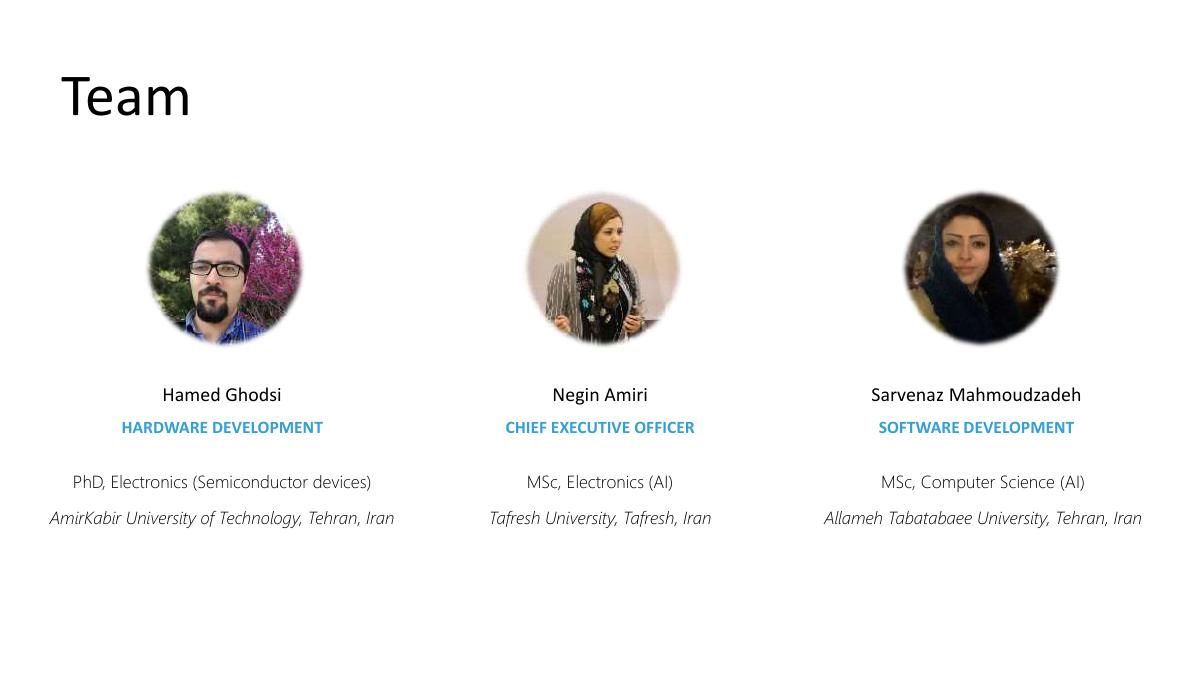
Three people, each with a role, a degree and an institution. Hamed Ghodsi , hardware development, PhD in Electronics (semiconductor devices), Amirkabir University of Technology, Tehran. Negin Amiri , Chief Executive Officer, MSc in Electronics (AI), Tafresh University. Sarvenaz Mahmoudzadeh , software development, MSc in Computer Science (AI), Allameh Tabatabaee University, Tehran.
The formatting is clean and the credentials are relevant: a semiconductor PhD is genuinely the right background for building an optical and electrical sensing front end, and two AI-trained engineers are the right people to build the model that turns raw signal into a glucose number. For a deep-tech hardware team, the technical bench is coherent.
What the slide does not contain is the reason a medical device company succeeds or fails. There is no clinician — no endocrinologist, no physician of any kind, on a team whose product must be validated against clinical reference measurements. There is no regulatory person , on a deck that promises "medical clearance" three slides later. There is no commercial person , on a deck that promises four separate revenue models on slide 11. And there is no history — not one line of what any of the three has previously built, shipped, published or patented. Degrees describe capability; prior work describes execution, and only one of those is evidence.
Slide 13 reveals that the company's address is inside the Endocrinology and Metabolism Research Center in Tehran, and slide 6 mentions collaboration with EMRI for trials. A team page that lists a clinical advisor from that institute — by name — would answer the clinician gap immediately, from a relationship the company evidently already has.
Slide 4 — "Diabates"
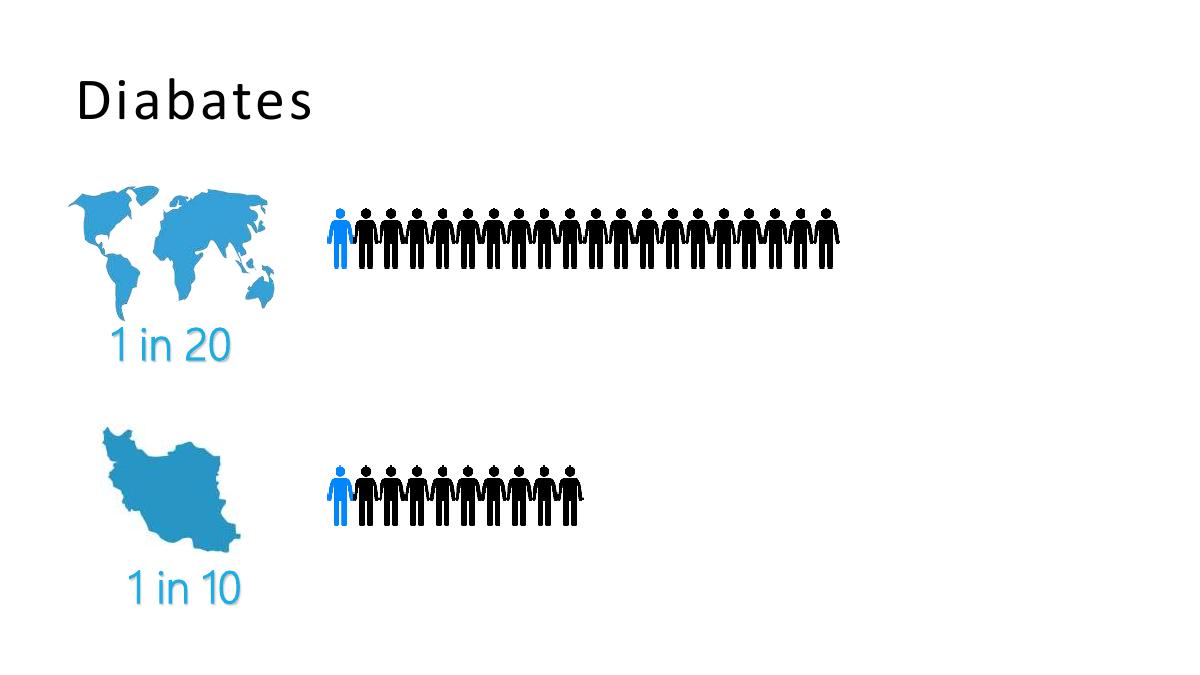
Two pictograms. A world map with 1 in 20 , and a map of Iran with 1 in 10 . No sources cited on this slide, no absolute numbers, and the title is misspelled.
The comparison is the right instinct and the best-executed graphic in the deck: it establishes in three seconds that the founders' home market has roughly double the world prevalence, which is the reason to build this company in Tehran rather than anywhere else. It is a locally grounded argument that a foreign team could not make.
What it does not do is describe a problem. Prevalence is context. The problem is what a person with diabetes actually endures — the number of finger pricks per day, the annual cost of test strips in Iranian Rials, the proportion of patients who under-test because of pain or cost, and the clinical consequence of under-testing. None of that appears anywhere in the deck. The strongest version of this slide is one diabetic person's week, costed.
The misspelling in the title of the disease the company exists to address is a small thing that is not small. In a document read by clinicians and medical investors, "Diabates" on a full-width heading is the kind of detail that shifts a reader from evaluating to auditing.
Slide 5 — Today's solutions
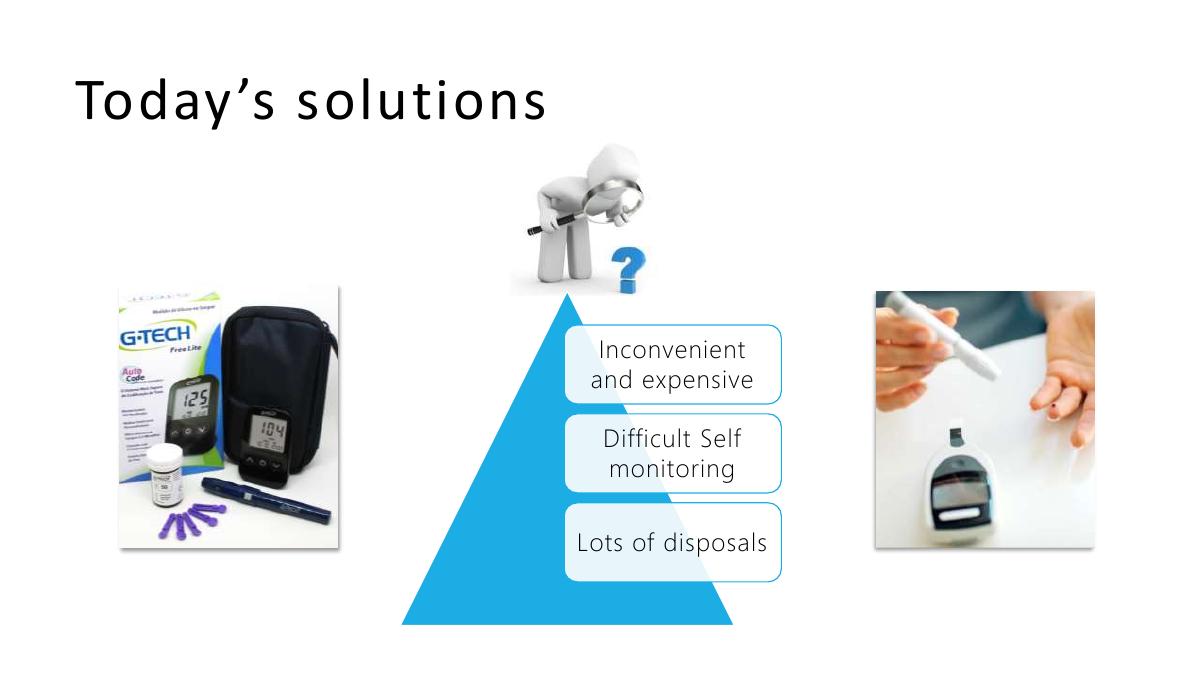
Three phrases: "Inconvenient and expensive," "Difficult self monitoring," "Lots of disposals."
These are the right three complaints. Strips and lancets are recurring costs, self-monitoring compliance is genuinely poor, and consumable waste is a real burden. But all three are stated as adjectives and none is quantified. "Expensive" is a number: what does a year of strips cost in Iran, and what fraction of median income is that? "Difficult" is a number: what percentage of patients test less often than prescribed? "Lots of disposals" is a number: how many lancets per patient per year?
Every one of those figures is publicly available or obtainable from the research centre the company shares a building with. Converting three adjectives into three cited numbers would turn the weakest slide in the deck into one of the strongest, and it costs an afternoon.
Slide 6 — Ongoing R&D and Trials
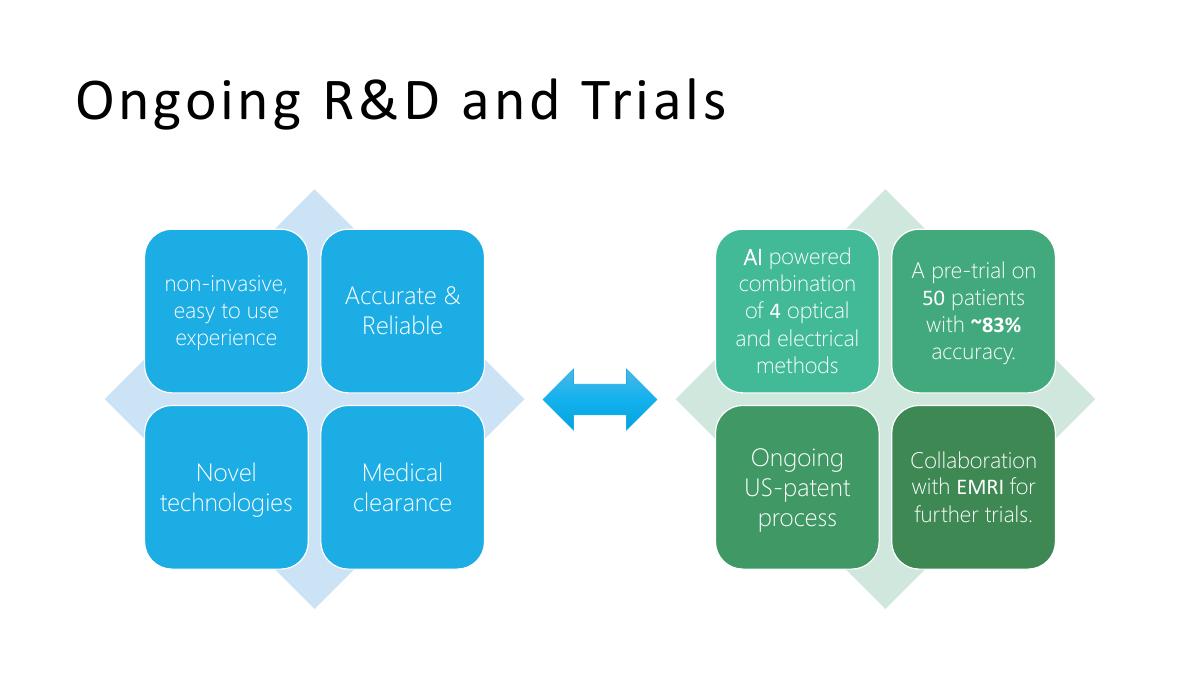
Eight tiles. "Non-invasive, easy to use experience." "Accurate & Reliable." "AI powered combination of 4 optical and electrical methods." "A pre-trial on 50 patients with ~83% accuracy ." "Novel technologies." "Medical clearance." "Ongoing US-patent process." "Collaboration with EMRI for further trials."
This is the most important slide in the deck and it is laid out as a word cloud. Three of those eight tiles are hard, checkable facts and five are adjectives, and they are given identical visual weight.
Start with the fact that matters. Fifty patients, ~83% accuracy. Real data from real people is more than most non-invasive glucose startups ever put on a slide, and the founders deserve credit for stating a number rather than hiding behind "promising early results." But the number is undefined and, taken at face value, it is a problem the deck does not acknowledge.
Accuracy against what? 83% of readings within ±15% of a reference? 83% correlation? 83% of readings in Clarke Error Grid Zone A? These mean radically different things, and the deck picks none of them. · Against which reference, measured how — laboratory venous plasma, or a consumer fingerstick meter that itself carries error? · Which 50 patients? Type 1 or Type 2, what glucose range, fasting or postprandial, what skin tones, what ages? Non-invasive optical methods are notoriously sensitive to exactly these variables, and a result from 50 people in one clinic is where the field's failures have historically begun, not ended. · And the number itself is below the bar. The recognised international standard for blood glucose meter accuracy, ISO 15197, requires roughly 95% of results to fall within tight limits of a laboratory reference. Under any of the plausible definitions, ~83% is not a clearance-grade result. It is a legitimate and encouraging engineering milestone — and the deck presents it as though it settles the question rather than opening it.
The honest framing is far more investable than the confident one: "83% on a 50-patient pre-trial with a consumer-meter reference. To reach the ~95% required for clearance we need N patients across these glucose ranges, this reference protocol, and this much money — which is what this round buys." That sentence turns an accuracy shortfall into a use-of-funds argument. The deck instead sits it next to a tile reading "Accurate & Reliable," which invites a reader to conclude the founders do not know how far 83% is from the standard.
"Medical clearance" is the second unresolved tile. Clearance from whom — Iran's IFDA, the US FDA, a CE mark? Achieved, in progress, or planned? For a medical device, the regulatory pathway is not an item on a feature grid; it is the timeline and the majority of the cost. "Ongoing US-patent process" has the same gap: filed when, provisional or non-provisional, what application number, covering what claim? An investor can check a published application in minutes when given a number, and cannot verify anything from the phrase "ongoing."
The EMRI collaboration is the strongest asset on the slide after the trial data — an endocrinology research institute is precisely the partner that makes larger trials credible — and it appears as the eighth tile of eight, with no description of the relationship, no named investigator and no trial design.
Slide 7 — Our solution
Two product images. "Point of care device (First product)" and "Wearable wristband (Next version)."
Sequencing a benchtop point-of-care unit before a wearable is a sound engineering decision — it relaxes the power, size and motion-artifact constraints that have killed wearable non-invasive glucose projects — and stating it in this order shows the team thinking about feasibility rather than pitching the sexier product first. That is a maturity signal.
The slide never explains why. It also never says who the point-of-care device is for — a clinic, a pharmacy, a home? — or what it costs to build, or what it will sell for. A solution slide in hardware has to establish form factor, user and unit cost; this one establishes form factor alone.
Slide 8 — Roadmap
Five numbered steps with timings: (1) Proof of concept & MVP — Accomplished . (2) Initial trials & validation — Accomplished . (3) PoC device design — in 8 months . (4) Further medical trials, marked "(PoC device Launch)" — in 2 months . (5) Wearable device design, marked "(Wristband Launch)" — in 8 months .
Marking the first two steps as accomplished is good practice: it separates what exists from what is promised, which the rest of the deck does not do consistently. And an 18-month path from prototype to a launched wearable is at least legible.
But the timeline as printed does not work. Step 3 takes eight months and step 4 takes two — so is step 4 sequential (month 10) or concurrent? The row reads left to right as though step 4 lands before step 3 finishes. More significantly, step 4 is "further medical trials" allocated two months , in a device whose current accuracy sits below the clearance standard. Two months is not a clinical trial timeline; it is barely a recruitment window. And nowhere on this roadmap does regulatory submission or approval appear as a step at all , despite "medical clearance" being claimed two slides earlier. A medical device roadmap without a regulatory milestone is a roadmap that has not been costed.
Slide 9 — Market
Three circles. 422m worldwide potential users (source: WHO & IDF). 15m potential users in Iran (source: WHO & IDF). 1.5m , labelled "1% of Iran's market," "For 2022."
Citing WHO and IDF is the right move, and the 422m global figure is consistent with widely published adult diabetes prevalence for the period. The funnel structure — world, country, obtainable share — is the correct shape for a market slide.
Then the arithmetic fails in public. 1% of 15 million is 150,000, not 1.5 million. The third circle is off by a factor of ten from its own label. Either the target is 1.5m users, which is 10% of the national diabetic population inside three years and needs a serious defence, or the target is 150,000 and the deck has overstated its own goal tenfold. Whichever it is, a reader who does the division — and in a medtech round, someone always does — now has to re-check every other number in the file.
Two further gaps. First, the market is measured in people, never in money : 422 million patients is not a market size until it is multiplied by a device price and a replacement or subscription cycle. There is no price anywhere in these 13 slides, so no revenue figure exists in the deck at all. Second, "potential users" is not addressable : the addressable market for a first point-of-care device is not every diabetic in Iran, it is the clinics and pharmacies that would buy one, and that is a number in the thousands with a unit price attached. The word "Potentiel" is also misspelled twice on the same slide.
Slide 10 — Competition
A tree diagram. Under "minimally invasive": Sugar-Beat (Nemura) , Gaurdian (Medtronic) , FreeStyle Libre (Roche) . Under "non-invasive (under development)": Glucowise (since 2016) and Diamontech (since 2018) .
The taxonomy is correct and useful: separating minimally invasive incumbents from the non-invasive field under development is exactly how a specialist thinks about this market, and naming two direct non-invasive competitors with founding years shows the team has looked at the landscape.
The execution undermines it. FreeStyle Libre is Abbott's product, not Roche's — a factual error about the single best-known continuous glucose product on the market, in a deck whose entire premise is that the founders understand this field. That one attribution will be caught by any healthcare investor within seconds of reading the slide, and it recontextualises every other claim in the file. Two of the remaining names are also misspelled: SugarBEAT is Nemaura Medical, not "Nemura," and Medtronic's product is Guardian, not "Gaurdian." DiaMonTech is rendered "Diamontech."
The structural failure is bigger than the typos: AKO does not appear on its own competition slide , and the diagram has no axes. There is no column for accuracy, no column for invasiveness, none for regulatory status, price, or form factor. A competition slide exists to show where you sit and why that position is defensible. This one shows only that other companies exist — and given that Glucowise and DiaMonTech are pursuing the same non-invasive goal with more capital and a longer run-up, the unanswered question is left standing in the middle of the deck: why does this team of three in Tehran solve what they have not?
The four-method combination on slide 6 is the beginning of that answer. It never gets connected to this slide.
Slide 11 — Business model
Four boxes. B2C direct selling. B2B data analysis and data sharing. B2B patent transfer. B2B selling to health-care mobile apps.
Four revenue models for a company that has not finished one device is the classic pre-revenue business model slide, and each box carries an unexamined problem. Direct selling has no price, no channel and no unit cost. Data analysis and sharing is patient health data — its own regulatory and consent regime, in a company with no clinician and no compliance function on the team page. Patent transfer means licensing away the core asset, which contradicts every other slide's premise of building a product company. Selling to health-care mobile apps has no named partner and no pricing.
Nothing here is sized. There is no price point, no cost of goods, no gross margin, no forecast, no revenue figure of any kind anywhere in the 13 slides. For a hardware business, bill of materials versus selling price is the arithmetic that determines whether the company can exist, and it is entirely absent.
Focus would fix most of this. One model — sell the point-of-care device to clinics at a stated price, with a stated build cost — is worth more on a slide than four models with no numbers, because it can be believed.
Slide 12 — Investing
750 million Tomans for 3 years , split across five mountains: Facilities and location 10%, Research 30%, Human resource 50%, Production 5%, Trials/IP/Clearance 5%. The percentages total 100, which is more than many decks manage.
Missing first: there is no equity offered, no valuation, and no instrument. The slide states an amount and a duration and stops. An investor cannot act on this — there is no proposition on the ask slide, only a budget.
Missing second: no currency conversion and no milestone. A figure denominated in Tomans, in a deck written in English with a global competitive set, will be read by people who do not know the exchange rate — and in April 2019 the rate itself was the story. At the open-market rate of roughly 13,000–14,000 Tomans to the dollar, 750 million Tomans was on the order of US$55,000 ; at the official rate then in force it was several times that. The deck never says which, and the gap between the two readings is larger than the raise itself. Nor does it say what the money achieves: which accuracy figure, which trial, which regulatory submission is complete when the three years end.
Now the alarming part. 5% of the budget is allocated to "Trials/IP/Clearance." Whatever the absolute figure, five per cent of a three-year budget is being assigned to the clinical trials, patent prosecution and regulatory clearance of a medical device — the three activities that dominate cost and timeline in this industry, and the exact three the deck has already claimed as in progress. Meanwhile 50% goes to human resource and 30% to research, on a product the roadmap says is already past proof of concept and validation.
That allocation tells a medtech investor something the founders did not intend to say: the team has budgeted like a hardware R&D group, not like a company that intends to get a regulated device to market. It is the single most damaging slide in the deck, and it is damaging precisely because it is honest.
Slide 13 — Contact
Website (ako.technology), a physical address inside the Endocrinology and Metabolism Research Center in Tehran, two mobile numbers, Instagram, LinkedIn and Twitter. Then: "Thanks for attention."
Complete contact detail is a genuine strength — a surprising number of decks omit it — and the address is more than an address: being physically located inside an endocrinology research institute is a credibility asset that belongs on the team slide, not buried in a footer on the last page. Two personal mobile numbers and no company email is the one weak note; for a company selling into clinics, an @ako.technology address reads differently.
What this deck does better than most startup pitch decks
It states real trial data. "50 patients, ~83% accuracy" is a number from actual human measurement. Most pre-seed hardware decks contain no measured result at all, and most non-invasive glucose decks in particular hide behind "promising results in early testing." · It marks what is finished. The roadmap labels proof of concept and initial validation as Accomplished , cleanly separating history from promise. · It sequences the hard product second. Point-of-care device first, wristband later, is the engineering-honest order and quietly signals that the team understands the wearable constraints. · It cites sources on the market slide. WHO and IDF are named, which is rarer at this stage than it should be. · It makes a local argument. One in twenty worldwide versus one in ten in Iran is a specific, defensible reason for this company to exist where it does. · It names competitors, including the direct ones. Listing Glucowise and DiaMonTech — companies chasing the same prize — rather than pretending the category is empty is intellectually honest. · The one-line positioning is excellent. "Monitor glucose without blood drop" is understood by anyone in under two seconds. · The ask adds up and the contact page is complete. Five allocations totalling 100%, and every channel a reader could need.
Where this deck would fail in an investor meeting
83% accuracy is below the standard and the deck does not say so. Blood glucose meters are held to roughly 95% agreement with a laboratory reference under ISO 15197. Presenting 83% beside a tile reading "Accurate & Reliable" suggests either the team does not know the bar or hopes the reader does not. · The accuracy figure is undefined. No reference method, no error-grid zone, no patient demographics, no glucose range, no protocol. · 1% of 15 million is stated as 1.5 million. A tenfold arithmetic error on the market slide, in a deck where every other number is then re-checked. · FreeStyle Libre is attributed to Roche. It is Abbott's. Getting the best-known product in your own category wrong is a domain-credibility failure, not a typo. · Trials, IP and clearance receive 5% of a three-year budget for a regulated medical device, while human resources take 50%. · There is no price, no cost of goods, no margin and no revenue forecast anywhere in the file — and four revenue models with none of them sized. · No equity, valuation or instrument is offered on the ask slide, and the amount is stated only in Tomans. · Regulatory approval is not a step on the roadmap, despite "medical clearance" being claimed as a bullet. · Further medical trials are allocated two months, which no clinical timeline supports. · No clinician, no regulatory lead and no commercial lead on a three-person team building a regulated diagnostic. · AKO is absent from its own competition slide, which has no comparison axes at all. · Spelling errors on load-bearing words — "Diabates" as a slide title, "Potentiel" twice, "Gaurdian," "Nemura."
A medical device deck vs. the software deck template it borrowed
Slide What a software seed deck shows What a medical device investor needs What AKO delivered
Problem A widespread pain Patient burden costed: pricks per day, strips per year, cost of non-compliance Prevalence pictograms and three adjectives
Solution Product screenshots Form factor, user, sensing principle, unit cost Two product images and a sequence
Evidence Usage metrics N, reference method, error grid, glucose range, demographics "50 patients, ~83% accuracy" and nothing else
Regulatory Not applicable Named pathway, class, submission date, cost, predicate A tile reading "Medical clearance"
IP Optional Application numbers, jurisdictions, claim scope, filing dates "Ongoing US-patent process"
Market TAM in dollars Devices x price x replacement cycle, plus reimbursement Patient counts, one off by 10x, no price
Competition Feature grid Accuracy, invasiveness, clearance status, price — with you plotted on it A tree of five names, one misattributed, AKO absent
Team Engineers and founders Engineers plus a clinician, a regulatory lead and prior shipped work Three engineers, degrees only
Ask Amount, valuation, runway Amount, equity, instrument, and the clinical milestone it buys An amount, a duration and a budget split
How you would rebuild this deck
Lead with the measurement. Slide 1 becomes "Monitor glucose without a blood drop — 50 patients measured, 83% agreement with reference, targeting the 95% clearance standard." Naming your own gap is what makes the number believable. · Give the trial its own slide. N, patient types, glucose range, reference method, protocol, a Clarke Error Grid, and what the residual error is caused by. This is the page the round is decided on. · Add a regulatory slide. Which authority, which device class, which pathway, submission date, estimated cost, and the trial design required to get there. Then put those milestones on the roadmap, which currently has none. · Fix the market arithmetic and convert it to money. Either 150,000 users at 1%, or 1.5m at 10% with a defence. Then multiply by a device price and a replacement cycle so a revenue number exists. · Correct and rebuild the competition slide. FreeStyle Libre is Abbott. SugarBEAT is Nemaura. Guardian is Medtronic. Then replace the tree with a table — accuracy, invasiveness, clearance status, price — and plot AKO on it. · Re-cut the budget. A medical device raise that assigns 5% to trials, IP and clearance will not be believed. Cost the clinical and regulatory work first and build the rest of the allocation around it. · Finish the ask. Amount, equity offered, valuation, instrument, currency in both Tomans and dollars, and the single milestone the money delivers: "this round takes us from 83% on 50 patients to clearance-grade accuracy on N patients." · Cut the business model to one line. Point-of-care device sold to clinics at a stated price with a stated build cost. Move data, licensing and app partnerships to a "future revenue" footnote. · Put a clinician on the team slide. The company already sits inside an endocrinology research institute; name the investigator and make the EMRI relationship a slide instead of a tile. · Substantiate the IP. Application number, filing date, jurisdiction and what the claim covers, or remove the word "patent" from the deck. · Proofread. "Diabates" in a headline and "Potentiel" twice on the market slide are two minutes of work in a document asking strangers for three years of funding.
The transferable lesson
AKO's deck contains something most early hardware decks do not: a measured result from real patients. Fifty people and an 83% figure is more evidence than the overwhelming majority of pre-seed teams can show, and in a category littered with companies that promised optical glucose sensing and never published a number, it is genuinely differentiating.
The deck then spends thirteen slides refusing to build anything on it. The number appears once, in a tile, between two adjectives. It is never defined, never compared to the standard it must eventually meet, never turned into a plan, and never priced into the budget — which allocates five per cent to the work of closing the gap. The result is a deck whose strongest fact reads like a decoration.
This is the pattern worth taking away, and it is not specific to medical devices. A hard number is only an asset if the deck is built around it. Standing alone, a measurement invites an expert to ask what it means, and an unanswered question does more damage than a claim never made. Surrounded by its definition, its distance from the required standard, and the funded plan to close that distance, the same number becomes the reason to invest.
Run this on your own deck. Find the single hardest fact in it — the one thing a stranger could verify. Then count how many slides do work on it. If the answer is one, you have not written a pitch; you have written a list that happens to contain evidence.
Frequently asked questions
- What is the AKO Smart Technologies pitch deck?
- It is a 13-slide seed investor deck created on 25 April 2019 in PowerPoint by AKO Smart Technologies, a Tehran-based team of three engineers developing a non-invasive glucose monitoring device that measures blood sugar without a finger prick. The deck covers the team, diabetes prevalence, current monitoring pain points, R&D progress, a product roadmap, market size, competitors, four revenue models and a request for 750 million Tomans over three years.
- What is AKO Smart Technologies building?
- According to the deck, a non-invasive glucose monitor using an AI-powered combination of four optical and electrical sensing methods. Two products are planned: a point-of-care device first, then a wearable wristband. The deck reports a pre-trial on 50 patients with approximately 83% accuracy and a collaboration with the Endocrinology and Metabolism Research Center in Tehran for further trials.
- What is the biggest weakness in the AKO Smart Technologies deck?
- The accuracy figure is stated but never contextualised. Blood glucose meters are typically held to ISO 15197, requiring roughly 95% agreement with a laboratory reference; the deck's ~83% is presented as a success with no reference method, no error-grid zone and no patient demographics. Compounding this, only 5% of the three-year budget is allocated to trials, IP and clearance — the exact work needed to close that gap.
- Which slides should founders copy from this deck?
- Two habits rather than two slides. First, the deck states an actual measured result from real patients instead of hiding behind 'promising early results' — rare and valuable at pre-seed. Second, the roadmap explicitly marks proof of concept and initial validation as 'Accomplished', cleanly separating what already exists from what is being promised.
- What should a medical device pitch deck include that a software deck does not?
- A defined clinical evidence slide (sample size, reference method, error grid, patient demographics and glucose range), a named regulatory pathway with device class, submission date and estimated cost, IP stated as application numbers and jurisdictions rather than 'ongoing', and a budget in which clinical and regulatory work is the largest line rather than an afterthought.
- How should a hardware startup present its funding ask?
- State the amount, the equity offered, the valuation and the instrument, convert the figure into a currency international investors can read, and tie the money to one verifiable milestone. AKO's slide gives 750 million Tomans over three years and a five-way percentage split, but no equity, no valuation and no statement of what accuracy, trial or clearance is complete when the three years end.