Akmazio Thrift presents a 13-slide pitch deck for a mobile platform designed to connect small business owners with vetted financial advisors, CPAs, and lawyers. The company identifies a dual problem: professionals using outdated client-acquisition methods and business owners lacking reliable ways to find high-quality help. Their business model relies on a $300 monthly subscription for professionals, while business owners access the service for free. At the time of the deck's creation, the project was in its infancy, having filed for an LLC in August 2020 and completing a business plan in Marc…
Key takeaways
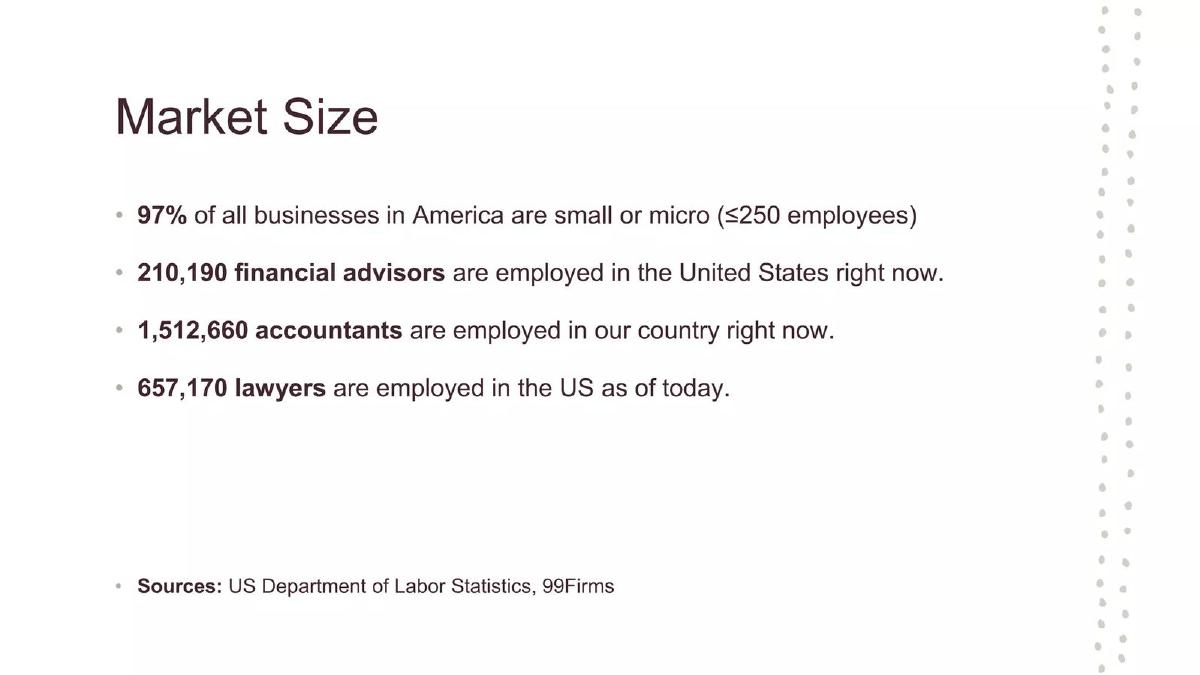
- The platform targets a market of 210,190 financial advisors, 1.5 million accountants, and 657,170 lawyers in the US (Slide 5).
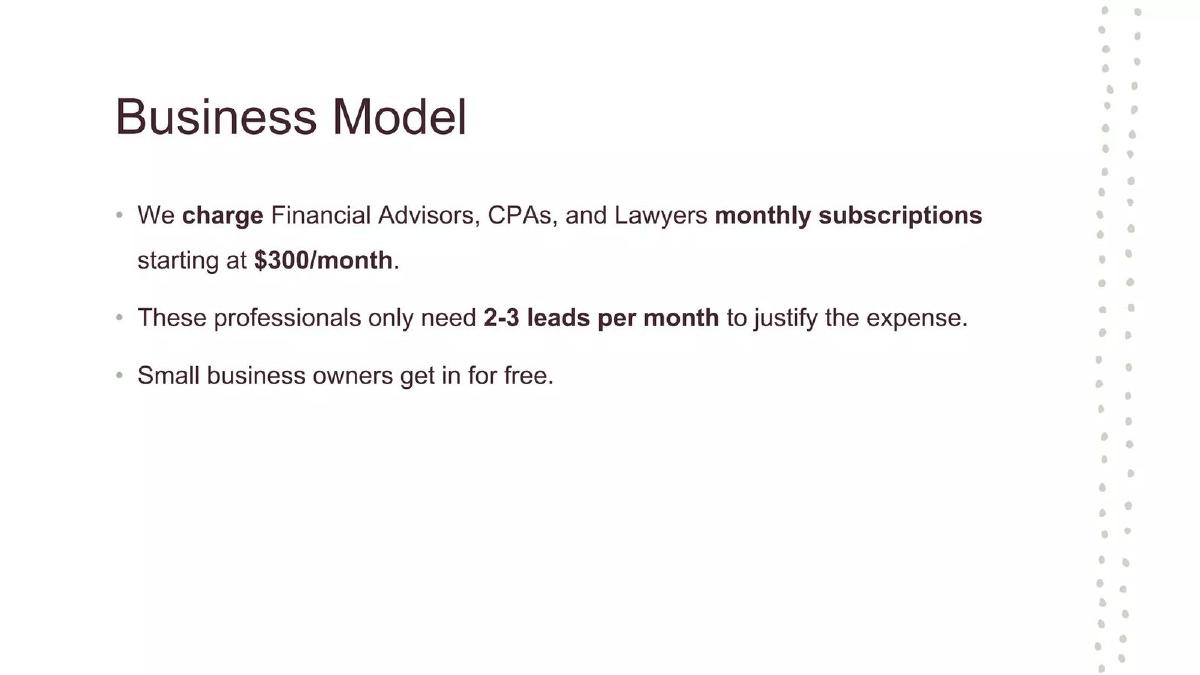
- Professional users are charged a monthly subscription starting at $300, while small business owners join for free (Slide 6).
- The company claims that professionals only need 2-3 leads per month to justify the subscription cost (Slide 6).
- The technical approach relies on 'Deep Learning Algorithms' to facilitate connections between users (Slide 7).
- The go-to-market strategy involves a 12-18 month design and build phase followed by 14 months of national product launching (Slide 9).
- Traction is limited to administrative milestones, such as filing an LLC in August 2020 and completing a marketing plan in February 2021 (Slide 11).
- The fundraising ask is unconventional, requesting $2 million if salaries are paid in advance or $50k if salaries are set aside in payables (Slide 12).
- Financial projections estimate $1 million in profit by year six and $2 million by year seven (Slide 12).
Executive Summary
Akmazio Thrift (referred to as Akmazio in the deck) is a mobile-first networking platform designed to facilitate connections between small business owners and professional service providers. The deck focuses on the inefficiency of current lead-generation tools for high-value professionals like CPAs and lawyers. While the market size is clearly defined using Department of Labor Statistics, the product itself appears to be in the very early conceptual stages, with a long development roadmap and an unusual approach to fundraising structures.
Slide 1: Title Slide
The cover slide features the brand name "Akmazio.io" and the tagline "THE THRIFT APP." The visual theme uses paper airplanes, with one green plane leading a group of white planes. No specific location or founding date is provided on this opening slide.
Slide 2: The Problem
The problem is framed from two perspectives. First, for professionals (Financial Advisors, CPAs, and Lawyers), the deck claims they waste time and money on "dinosaur technologies" to find clients. Second, for Small Business Owners, the deck states there is no reliable way to find high-quality, vetted, and verified professionals. This slide establishes the need for a modernized, trusted marketplace.
Slide 3: The Solution
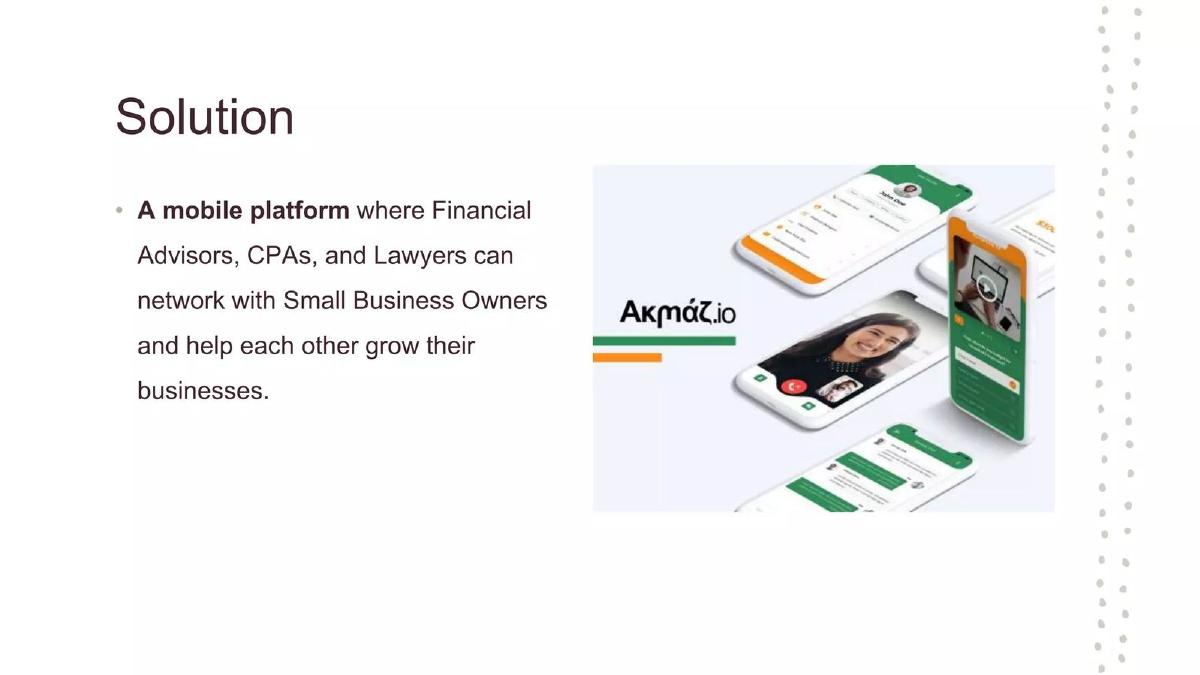
The solution is described as a mobile platform where these two groups can network to help grow their businesses. The slide includes a composite image of mobile app screens showing profile pages, video call interfaces, and the Akmazio logo. The emphasis is on the "mobile platform" nature of the service.
Slide 4: Product Demo
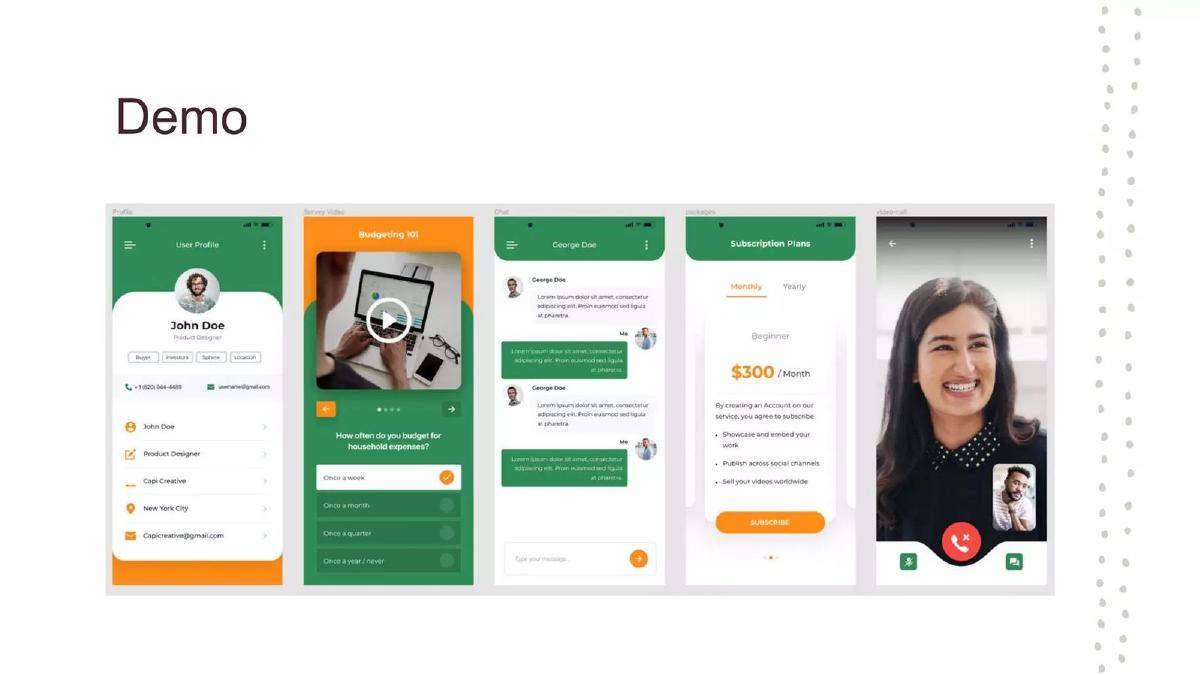
This slide provides a closer look at the UI/UX through five mobile mockups. Key features visible include:
User Profiles: Showing names, titles (e.g., Product Designer), and locations. · Survey/Onboarding: A screen titled "Budgeting 101" asking users how often they budget for household expenses. · Chat Interface: A standard messaging UI between users. · Subscription Plans: A screen showing a "Beginner" plan priced at $300/Month. · Video Calling: A full-screen video chat interface.
Slide 5: Market Size
Akmazio uses specific figures to define their Total Addressable Market (TAM). They cite that 97% of all businesses in America are small or micro (defined as having 250 or fewer employees). They list the following professional counts:
210,190 financial advisors. · 1,512,660 accountants. · 657,170 lawyers.
The slide attributes these figures to the US Department of Labor Statistics and 99Firms.
Slide 6: Business Model
The revenue model is a straightforward subscription service. Professionals are charged monthly fees starting at $300. The deck includes a justification for this price point, stating that professionals only need 2-3 leads per month to see a return on the expense. Small business owners are granted free access to the platform, ensuring a low barrier to entry for the "demand" side of the marketplace.
Slide 7: Underlying Magic
Under the heading "Underlying Magic," the company states they will use "Deep Learning Algorithms" to connect advisors to business owners. The slide is dominated by a stock photo of a neuron or neural network. There is no technical detail provided regarding the architecture of these algorithms or what specific data points they will use for matching.
Slide 8: Competition
The competition slide is a logo cloud featuring major tech and service companies. It includes Google, HomeAdvisor, Angie's List, Upwork, Freelancer, Personal Capital, SmartAsset, LinkedIn, and Facebook. The deck does not provide a competitive matrix or a specific breakdown of how Akmazio differs from these established players.
Slide 9: Go-to-Market
The roadmap is divided into two long-term phases. The first 12 to 18 months are dedicated to "designing, building, and testing" the app. The following 14 months are allocated to "traveling the country launching our product." This suggests a total of 26 to 32 months before the product achieves national scale.
Slide 10: Team
Adam Steinberger: President & CEO. · Ryan Armstrong: Chief Marketing Officer.
The slide includes their photos, email addresses, and phone numbers. However, it lacks professional biographies, past experience, or educational backgrounds for either founder.
Slide 11: Traction/Milestones
Traction is presented as a timeline of administrative and planning achievements:
Aug 2020: Filed for LLC. · Jan 2021: Completed Market Research. · Feb 2021: Completed Marketing Plan. · Mar 2021: Completed Business Plan and started Friends & Family funding.
The slide concludes with the goal of being "fully funded in 3-6 months."
Slide 12: Fundraising Information
This slide contains the most specific financial requests and projections. The founders state they are looking for two types of investments: "stocks and bonds." They present two funding scenarios:
If salaries are paid in advance, they require $2M. · If salaries are set aside in payables, they require $50k.
Regarding projections, they believe they will reach $1M in profit by year six and $2M in profit by year seven, which they note would be the break-even point for a $2M investor.
Slide 13: Thank You
The final slide repeats the contact information for Adam Steinberger, including his email and phone number, under a simple "Thank You" heading.
What Akmazio Thrift Does Well
The deck identifies a very clear and lucrative target demographic. Financial advisors, accountants, and lawyers are high-earning professionals who are often willing to pay significant sums for high-quality leads. By quantifying the number of these professionals using Department of Labor Statistics (Slide 5), the founders demonstrate that even a small percentage of market capture could result in a viable business. The pricing model ($300/month) is also well-aligned with the industry standards for lead generation in the legal and financial sectors.
What is Missing from the Akmazio Thrift Deck
The most significant omission is the lack of founder pedigree or relevant experience. Slide 10 provides names and photos but no context as to why these individuals are the right people to build a complex, algorithm-driven marketplace for regulated professionals. Furthermore, the "Underlying Magic" slide (Slide 7) is purely aspirational; there is no evidence of a proprietary algorithm or a technical co-founder to build it. The competition slide (Slide 8) is also underdeveloped. Listing Google and LinkedIn as competitors without explaining the specific niche Akmazio will occupy makes the task seem insurmountable rather than focused. Finally, the financial projections (Slide 12) are exceptionally conservative for a tech startup, suggesting a seven-year path to break even on a $2M investment, which may not align with the expectations of traditional venture capital.
Founder Takeaways: What to Copy and What to Avoid
Copy the market segmentation: Using government statistics to count the exact number of potential paying customers (Slide 5) is an excellent way to ground a pitch in reality. It shows the investor exactly who the customer is and how many of them exist.
Avoid the 'Salary-First' funding ask: The request on Slide 12 for $2M specifically to pay salaries in advance is a red flag for many investors. Most early-stage investors want to see capital deployed toward product development and customer acquisition, with founder salaries being a secondary necessity rather than the primary reason for the round. Additionally, the distinction between a $2M ask and a $50k ask is too wide, suggesting the founders have not yet determined their actual burn rate or operational requirements. Founders should present a single, well-justified number based on a clear 18-month budget.
Avoid vague technical claims: Claiming to use "Deep Learning" without any technical explanation or a CTO on the team can undermine credibility. If the core value is the connection, focus on the user experience and the vetting process rather than buzzwords that aren't backed by the team's expertise.
Frequently asked questions
- What is the core value proposition of Akmazio?
- Akmazio acts as a specialized networking marketplace. It aims to replace 'dinosaur technologies' used by lawyers, CPAs, and financial advisors to find clients. For small business owners, it provides a vetted and verified pool of professionals, solving the difficulty of finding high-quality financial and legal help.
- How does Akmazio plan to generate revenue?
- The company utilizes a B2B subscription model. Professionals (advisors, accountants, and lawyers) pay a monthly fee starting at $300. The deck argues this is a low-friction sale because just a few leads per month would provide a positive return on investment for those professionals. Small business owners are not charged.
- What is the current stage of the product according to the deck?
- Based on the milestones slide, the company is in the pre-seed or concept stage. As of March 2021, they had completed their business plan and started friends and family funding. The go-to-market slide indicates the app still needs 12 to 18 months of design and building work.
- Who are the competitors identified by Akmazio?
- Slide 8 lists a broad range of competitors including search engines (Google), general labor marketplaces (Upwork, Freelancer), social networks (LinkedIn, Facebook), and specialized lead-gen or finance sites (HomeAdvisor, Angie's List, Personal Capital, SmartAsset). The deck does not detail how it specifically differentiates from these giants.
- What are the specific funding requirements mentioned?
- The funding request is split into two scenarios on Slide 12. They are seeking $2 million to cover operations and salaries if paid in advance. Alternatively, they mention a $50k requirement if salaries are handled through payables accounts. They also mention looking for both 'stocks and bonds' investments.