Alan’s November 2017 investor deck is a study in clarity and operational philosophy. The company targets the €36bn French private health insurance market, which is currently saturated by over 500 legacy players with little differentiation (Slide 16). Alan differentiates itself through a frictionless user experience—claiming a 5-minute online signup for employers (Slide 6)—and a unique internal culture that eschews meetings and Product Managers in favor of GitHub-based knowledge sharing (Slide 36). While the deck uses placeholders for specific ARPU and margin figures (Slide 21), it leans heavi…
Key takeaways
- Alan identifies a massive €36bn market opportunity in French private health insurance where 96% of the population is already covered (Slide 16).
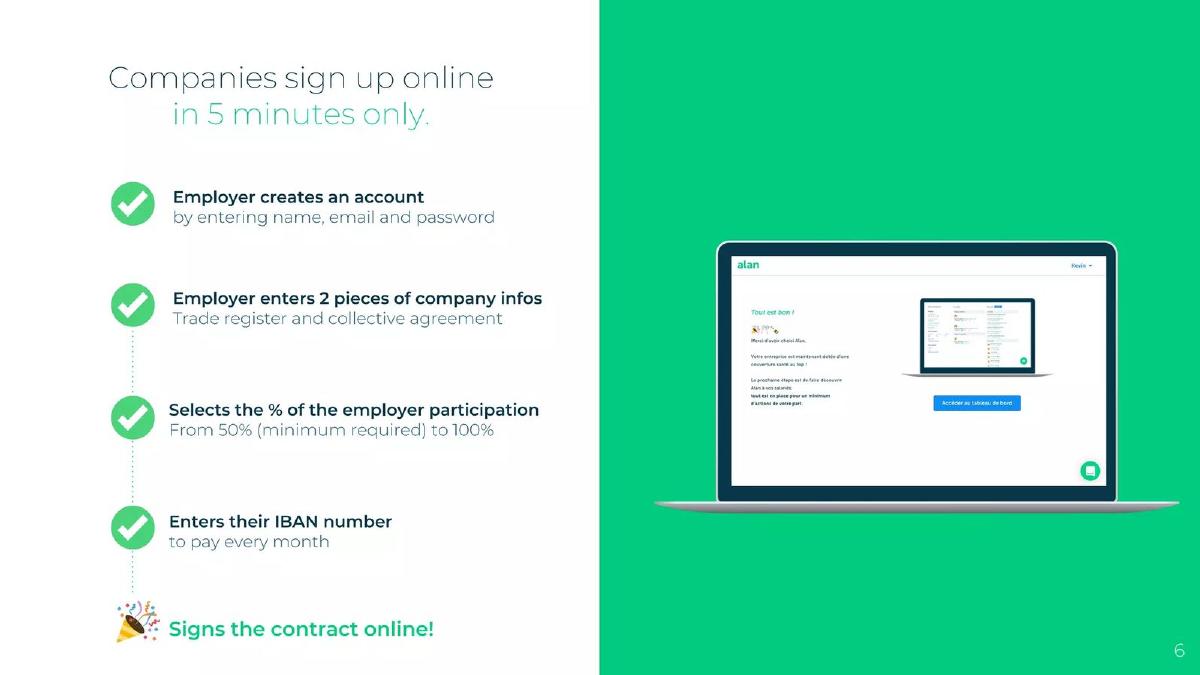
- The product value proposition centers on speed, allowing companies to sign up online in just 5 minutes (Slide 6).
- Reimbursement is simplified through direct connection to the French Healthcare System and a 'Tiers Payant' card to avoid upfront costs (Slide 11).
- The company employs a seasonal growth strategy, targeting the October 31st cancellation deadline for legacy contracts (Slide 26).
- The team slide emphasizes high-tier engineering talent from Facebook, Instagram, and Twitter, alongside 40+ years of insurance expertise (Slide 31).
- Alan operates with a radical internal structure: no Product Managers and almost no meetings, using GitHub for all documentation (Slide 36).
- The unit economics slide (Slide 21) uses '€X' placeholders for ARPU and margin, suggesting this version of the deck was intended for public sharing or early-stage discussions.
- Marketing efforts are split between high-visibility offline campaigns (Paris underground) and digital ads on Facebook and LinkedIn (Slide 26).
Alan Pitch Deck Teardown: Disrupting the French Insurance Hegemony
Alan’s November 2017 investor deck is a masterclass in how to present a complex, highly regulated industry as a solvable software problem. At 42 slides, the full deck is comprehensive, but the core narrative focuses on removing friction from a market that has historically thrived on it. The deck positions Alan not just as an insurance provider, but as a technology company that happens to sell insurance.
Slide 1: Cover and Branding
The cover slide (Slide 1) introduces the brand with its distinctive mascot and the tagline 'L’assurance santé simple' (Simple health insurance). Dated November 2017, this deck represents the company in its early scaling phase, shortly after becoming the first new independent health insurance company in France in over 30 years. The minimalist design sets the tone for the 'simplicity' promise that follows.
Slide 6: The 5-Minute Signup
One of the most compelling slides in the deck is Slide 6, which details the employer signup process. By breaking it down into four simple steps—creating an account, entering company info, selecting participation percentage, and entering an IBAN—Alan claims companies can sign up in '5 minutes only.' This is a direct attack on legacy competitors whose onboarding processes often involve weeks of paperwork and physical signatures. The inclusion of a laptop mockup showing the 'Tout est bon!' (Everything is good!) screen reinforces the digital-first nature of the product.
Slide 11: Simplifying Reimbursements
Slide 11 addresses the biggest pain point for insurance users: getting paid back. Alan presents a three-pronged solution: the 'Magical Alan Card' to avoid upfront payments, a mobile document transfer system (taking pictures of bills), and a direct integration with the French Healthcare System. The emphasis on 'Automatic reimbursement' is a key differentiator in a market where manual claims processing is the norm.
Slide 16: The €36bn Opportunity
The market slide (Slide 16) provides the macro justification for the business. It identifies a €36bn market for private health insurance in France. Crucially, it notes that while 96% of French people are already covered, the market is fragmented with over 500 players and 'very little differentiation.' This slide frames the opportunity not as 'creating a new market,' but as 'capturing an existing, stagnant market' through superior user experience.
Slide 21: Unit Economics and Placeholders
Slide 21 is perhaps the most frustrating for an analyst, as it uses '€X' and 'X%' placeholders for ARPU and Gross Margin. However, it does reveal Alan’s two primary product lines: Health Insurance and 'Prevoyance.' It also notes that for Prevoyance, there is 'No Loss Ratio risk at this stage' because they are distributing a product from CNP. This indicates a strategic use of partnerships to expand their product suite without taking on immediate underwriting risk for all categories.
Slide 26: Seasonal Growth and Marketing
Slide 26 shows a sophisticated understanding of the French regulatory environment. Because legacy contracts must be canceled before October 31st, Alan focuses its growth efforts on a two-month window (September and October). The slide honestly admits that 'First results were not super effective on online' for Facebook and LinkedIn ads, leading to a pivot toward offline Paris underground billboards and a dedicated sales team for companies with 20+ employees. This level of transparency regarding what isn't working is rare in pitch decks.
Slide 31: The Engineering-Heavy Team
The team slide (Slide 31) is a 'flex' of technical talent. Rather than focusing solely on insurance veterans, it highlights senior software engineers from Facebook, Withings, Mixpanel, Blablacar, and Square. The founders are described as 'Serial entrepreneurs,' with the CEO having exited a company called Expliseat. By balancing this tech pedigree with '40+ years of experience in Insurance' (citing AXA and Generali), Alan positions itself as the perfect bridge between Silicon Valley-style execution and European regulatory expertise.
Slide 36: Radical Operational Transparency
Slide 36 is unique. It describes Alan’s internal culture, which includes 'Almost no meeting' and using GitHub for all knowledge management. The claim of having 'No Product Manager' and focusing on 'project-specific leads' suggests a highly autonomous, engineering-led culture. For an investor, this slide argues that Alan is built to scale with significantly lower overhead than a traditional insurance company.
Slide 41: Future Vision
The final slide in this selection (Slide 41) is a placeholder for 'Team evolution: until early 2020.' While the content is blank in this version, the heading suggests that the founders were already planning their headcount and organizational structure three years into the future, reinforcing the 'scalable internal organisation' mentioned earlier in the deck.
What Alan’s Deck Does Well
Clarity of Mission: The deck never loses sight of its core promise: simplicity. Every slide, from the 5-minute signup to the automatic reimbursements, reinforces this. · Market Context: By highlighting the 500+ undifferentiated competitors, Alan makes the case that the market is ripe for a 'tech-first' disruptor. · Operational Philosophy: Slide 36 provides a deep look into how the company actually works. This builds confidence that the team isn't just building a product, but a scalable machine. · Honesty: Admitting that online ads were initially ineffective (Slide 26) builds trust with investors. It shows the team is data-driven and willing to iterate.
What is Missing from the Deck
Hard Financial Data: The use of '€X' on Slide 21 is a significant omission. While likely done for confidentiality in a public-facing version, a real investor would require these numbers to validate the business model. · Competitive Landscape: While Slide 16 mentions 500 players, it doesn't name specific direct competitors or explain how Alan will defend against other well-funded InsurTech startups. · Regulatory Roadmap: As the first new insurer in 30 years, the deck could have benefited from more detail on the barriers to entry they overcame and how they maintain their license.
Lessons for Founders
Sell the 'How' as much as the 'What': Alan’s focus on their internal GitHub-based workflow (Slide 36) tells investors they are building a modern, efficient company, not just a shiny app. · Align Growth with Regulation: Alan’s seasonal strategy (Slide 26) shows they understand the 'rules of the game' in their specific market and are concentrating their capital when it has the highest ROI. · Pedigree Matters in Regulated Spaces: If you are disrupting a 'boring' industry like insurance, show that you have the best tech talent (Slide 31) to make it interesting.
Frequently asked questions
- What is the primary market problem Alan is solving?
- Alan targets the inefficiency and lack of differentiation in the French health insurance market. Slide 16 notes there are over 500 players, yet the top 20 hold 50% market share. By offering a 5-minute digital signup and automated reimbursements, Alan aims to replace 'incomprehensible' legacy mutuals with a simple, paperless experience.
- How does Alan handle the complexity of health insurance reimbursements?
- According to Slide 11, Alan uses three pillars: a 'Magical Alan Card' (Tiers Payant) to eliminate upfront payments, a mobile app for photographing and transferring documents, and a direct connection to the French Healthcare System for automatic processing. This removes the traditional administrative burden from the user.
- What is unique about Alan's internal organizational structure?
- Slide 36 reveals a 'very efficient and transparent' organization. They operate with no Product Managers, focusing instead on project-specific leads. They also claim to have 'almost no meetings,' instead tracking all decisions and knowledge on GitHub, which allows for a highly scalable and asynchronous work environment.
- What does the deck reveal about Alan's customer acquisition strategy?
- Slide 26 highlights a seasonal approach. Because legacy contracts must be canceled by October 31st, Alan concentrates growth efforts in September and October. This includes offline brand awareness via Paris underground billboards and a sales team dedicated to companies with more than 20 employees.
- Does the deck provide specific financial metrics or unit economics?
- No. Slide 21, which covers Health Insurance and 'Prevoyance' (long-term care/disability), uses '€X' for ARPU and 'X%' for gross margins. While it mentions a 50% claims/premium ratio experienced since the start of the year, the lack of hard numbers suggests this specific file was a template or a redacted version for broad distribution.