AlfredCamera (formerly Alfred) utilized a 10-slide deck in 2015 to secure seed funding for its IoT security platform. The deck is notable for its extreme minimalism, relying on large-scale imagery and bold numbers rather than dense bullet points. By highlighting a '1,000,000 smartphones' milestone (Slide 4) and a 'MoM >20%' growth rate (Slide 9), the founders demonstrated significant product-market fit before the formal seed round. The narrative focuses on the utility of 'junk drawer' electronics, turning old phones into security cameras. While it lacks traditional sections like competition,…
Key takeaways
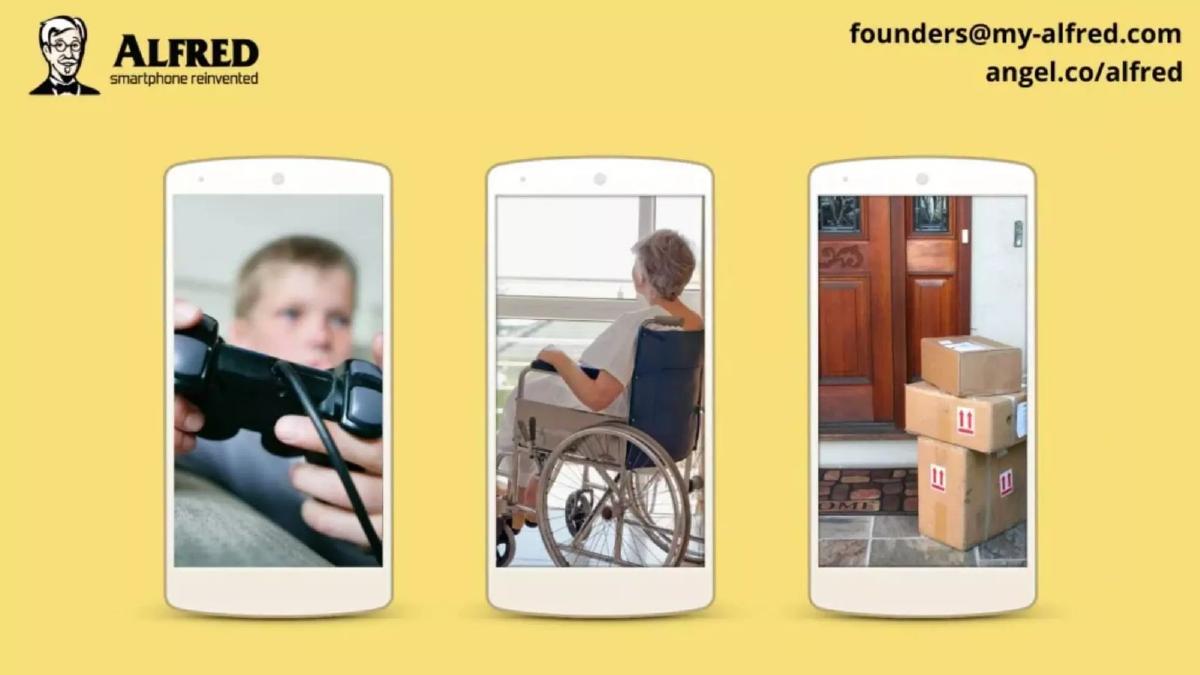
- The deck uses a visual-first approach, with Slide 2 and 3 illustrating use cases like baby monitoring and home security without using a single word of descriptive text.
- Traction is the centerpiece, highlighting that users engage with the app '10 times every day' on Slide 8, suggesting high retention and utility.
- The 'junk drawer' problem is visualized on Slide 7, positioning the product as a solution for electronic waste and a low-cost entry into the smart home market.
- Growth is presented as a hockey-stick curve on Slide 9, reaching 2.4M Live Views by March 2015 with a month-over-month growth rate exceeding 20%.
- The team slide (Slide 10) focuses on high-impact credentials: a $70M exit for Alex Song and a PhD in CS for Alex Chiu.
- The deck completely omits a 'Problem' slide in the traditional sense, choosing instead to show the solution and the scale of the available hardware (Slide 4).
- There is no mention of unit economics, revenue, or a specific fundraising target within the 10 slides provided.
- The branding is consistent throughout, utilizing a distinct yellow background and a 'butler' mascot to reinforce the 'Alfred' name.
The Power of Minimalism in Seed Fundraising
The AlfredCamera (then branded simply as Alfred) pitch deck from 2015 is a fascinating artifact from the peak of the mobile-first era. At just 10 slides, it defies almost every modern 'rule' of pitch deck construction. There are no deep dives into market trends, no competitive matrices, and no financial projections. Instead, the deck functions as a visual storyboard supported by three or four massive, undeniable data points. This teardown explores how a company can raise capital by focusing almost exclusively on traction and the 'repurposing' economy.
Slides 1-3: The Visual Hook
Slide 1 is a standard title slide featuring the 'Alfred' logo—a stylized butler—and contact information. Notably, it includes an AngelList link (angel.co/alfred), which was a primary discovery platform for startups in 2015.
Slide 2 introduces the use cases through three vertical smartphone frames. We see a child playing video games, an elderly person in a wheelchair, and packages delivered to a front door. There is no text explaining these are 'Baby Monitoring,' 'Elderly Care,' or 'Package Security.' The images do the work, establishing the product's versatility in a home environment.
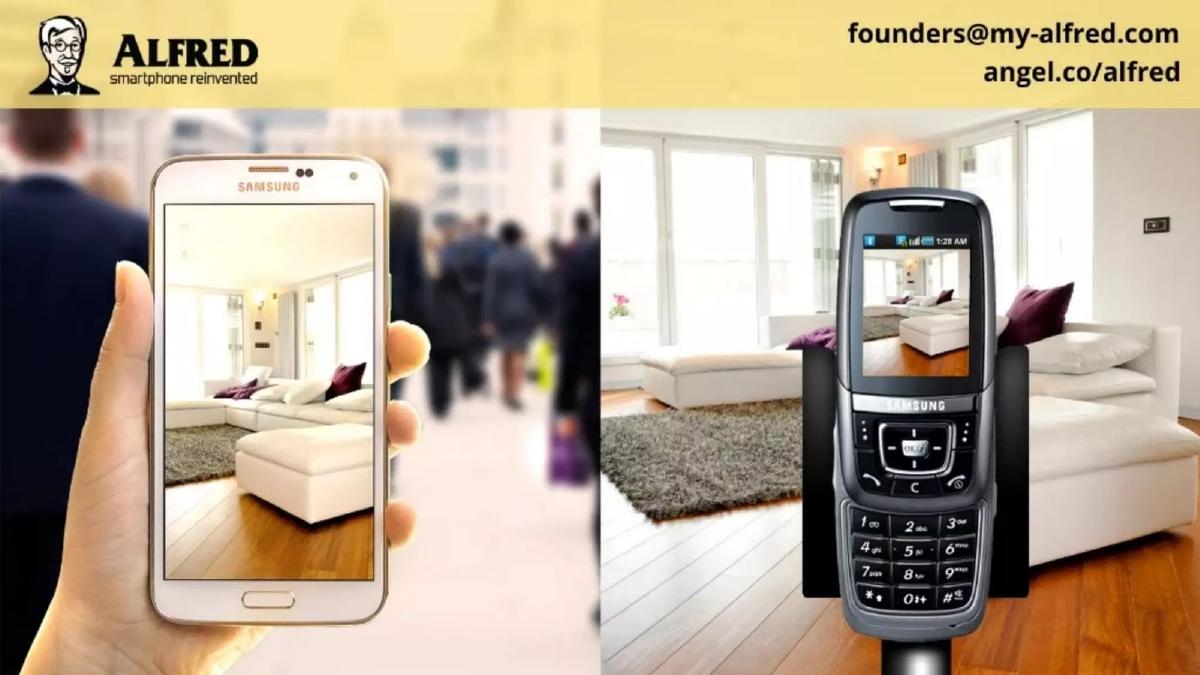
Slide 3 clarifies the product's technical mechanism. It shows a modern Samsung smartphone in a user's hand viewing a living room, while a much older, keypad-based Samsung phone is mounted on a wall acting as the camera. This is the 'aha' moment of the deck: the realization that the software turns old, obsolete hardware into a functional security system. The tagline 'smartphone reinvented' appears under the logo for the first time here.
Slides 4-6: The Scale of the Opportunity
Slide 4 features the number 1,000,000 in a massive font above the word 'smartphones.' Without further context on the slide, this serves as a dual-purpose metric: it likely refers to the number of devices already running the software, while simultaneously hinting at the millions of 'retired' phones available for the service.
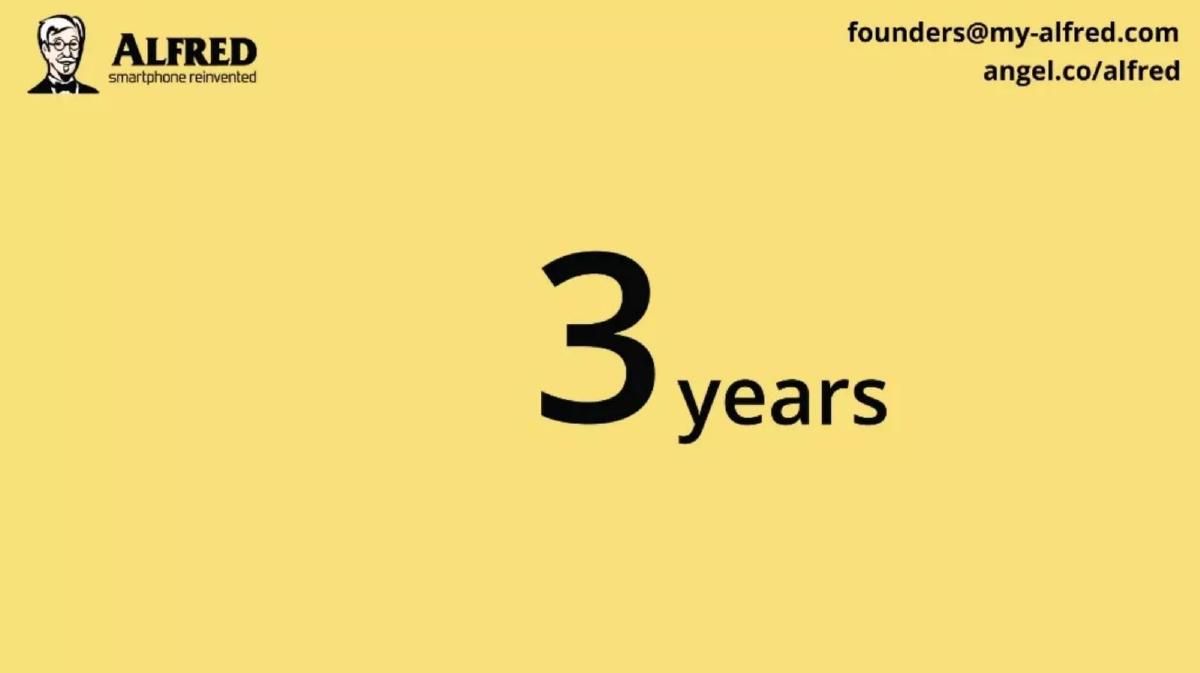
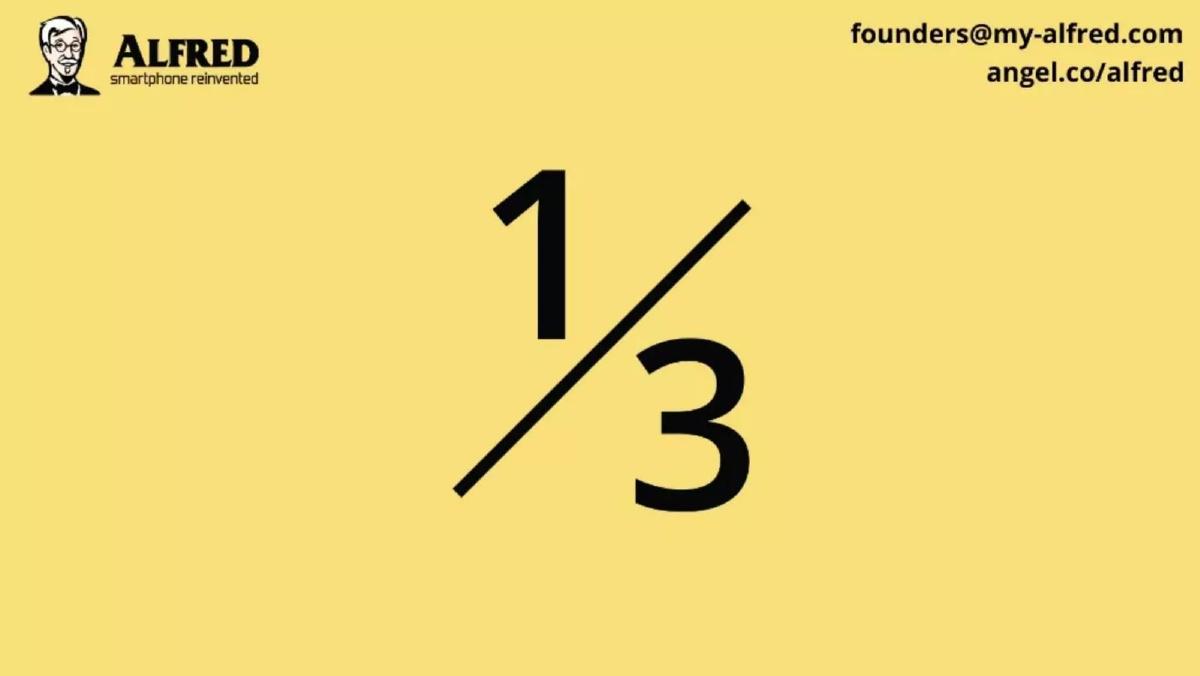
Slide 5 simply says '3 years.' This likely refers to the average replacement cycle of a smartphone, which creates a constant supply of 'new' old hardware for Alfred to utilize. Slide 6 shows the fraction '1/3,' which, when paired with the previous slide, suggests a significant portion of the population has at least one unused device sitting at home.
Slides 7-9: The Junk Drawer and The Growth Curve
Slide 7 is perhaps the most relatable image in the deck: a 'junk drawer' filled with old iPhones, HTC devices, charging cables, and miscellaneous household items. This slide identifies the 'hidden' inventory Alfred taps into. It reframes electronic waste as a dormant security network.
Slide 8 shifts to engagement. It shows a cat on a monitor screen with the text '10 times every day.' This is a critical metric for investors; it proves that the app isn't just downloaded and forgotten, but is a daily utility for its users. High frequency of use is a leading indicator for long-term retention.
Slide 9 provides the 'money shot' for any seed deck: the traction graph. The chart shows a clear hockey-stick trajectory from March 2014 to March 2015. It highlights 2.4M Live Views and a growth rate of MoM >20% . By the time an investor reaches this slide, the 'how it works' and 'why it matters' have been answered visually, and the data now proves that the market is responding.
Slide 10: The Team
The final slide introduces the three core members. Alex Song is highlighted not by his previous titles, but by a '$70M exit.' In the world of seed funding, a founder who has already returned capital to investors is the ultimate de-risking factor. Renee Yeh is credited with 'Global Marketing,' and Alex Chiu is noted for having a 'PhD in CS.' This covers the three pillars of a tech startup: leadership/exit experience, growth/marketing, and deep technical expertise.
What Works in This Deck
The primary strength of this deck is its cognitive ease . An investor can flip through these 10 slides in under 60 seconds and understand exactly what the company does, who is building it, and how fast it is growing. By using a yellow background and high-contrast black text, the deck is visually arresting without being cluttered.
The use of social proof through data is also masterful. Instead of claiming they will grow, they show they are growing at 20% month-over-month. The '10 times every day' metric is particularly effective because it suggests the product has become a habit for its users, which is the holy grail for consumer apps.
What is Missing
This deck is a 'teaser' or a 'presentation' deck, not a 'leave-behind' deck. Because it lacks text, it requires a founder to narrate the slides. Specifically, the following are missing:
Business Model: There is no mention of how Alfred makes money. Is it a subscription? Ad-supported? A freemium model for cloud storage? · The Ask: The deck does not state how much money they are raising or what the milestones for the next 18 months will be. · Competition: It ignores the existence of Dropcam (acquired by Nest/Google) or other low-cost security cameras that were emerging in 2015. · Market Size (TAM): While it hints at the number of smartphones, it doesn't provide a traditional dollar-value market analysis.
What a Founder Should Copy
Founders should emulate the visual storytelling seen in Slides 2, 3, and 7. If your product solves a physical problem or utilizes existing behavior, show it; don't describe it in bullet points. The 'junk drawer' slide is a perfect example of using a single image to represent a massive, untapped resource.
Additionally, the focus on engagement over just downloads is a strategy every consumer founder should adopt. Showing that users return to the app 10 times a day is far more impressive to a sophisticated investor than showing a large number of one-time downloads. Finally, the team slide's brevity is a great lesson: highlight the one thing that makes you an elite founder (like a previous exit or a specific PhD) rather than listing every job you've had since college.
Conclusion
AlfredCamera's 2015 deck succeeded because it had the one thing no investor can ignore: traction . When you are growing at 20% MoM and have millions of live views, you don't need 30 slides of market research to prove there is a demand. This deck is a reminder that if the product-market fit is evident in the data, the deck's job is simply to get out of the way and let the numbers speak.
Frequently asked questions
- How does AlfredCamera address the competition in this deck?
- It doesn't. There is no competition slide in this 10-slide deck. The founders likely relied on the uniqueness of their 'hardware-free' approach—repurposing old smartphones—to differentiate themselves from traditional security companies like Nest or ADT during their verbal pitch.
- What is the primary value proposition presented?
- The value proposition is the transformation of 'junk' into utility. Slide 7 shows a drawer full of old phones, and Slide 3 shows those phones acting as security monitors. It suggests that home security doesn't require new, expensive IoT devices, just an app and an old phone.
- Is there a business model or monetization strategy included?
- No. The deck is entirely focused on user growth and engagement metrics. Slides 8 and 9 highlight '10 times every day' usage and '2.4M Live Views.' This suggests a 'growth first, monetize later' strategy typical of 2015-era consumer mobile startups.
- What makes the team slide effective despite its simplicity?
- Slide 10 uses 'anchor' credentials. By stating Alex Song had a '$70M exit,' the founders immediately signal to investors that they are capable of building and selling a high-value company. The 'PhD in CS' for Alex Chiu provides the technical validation for the product's performance.
- How does the deck handle the 'Market Size' slide?
- Instead of a traditional TAM/SAM/SOM slide with billions of dollars, Slide 4 simply states '1,000,000 smartphones.' In the context of the deck, this represents the immediate install base or a milestone reached, implying the market is as large as the number of unused phones in the world.