Elisity’s 17-slide Series A deck is a highly technical, enterprise-focused presentation that successfully navigated the complex cybersecurity landscape in 2018. Rather than relying on flashy marketing, the deck leans heavily on the founders' 'Cisco-pedigree' and granular architectural diagrams to explain their 'Cognitive Trust' platform. By showcasing specific, large-scale deployments—such as a top-5 global pharma company with 500,000 OT devices—Elisity proved its ability to handle massive scale. The deck identifies a $38.6 billion TAM and provides a clear, per-user/per-device pricing model,…
Key takeaways
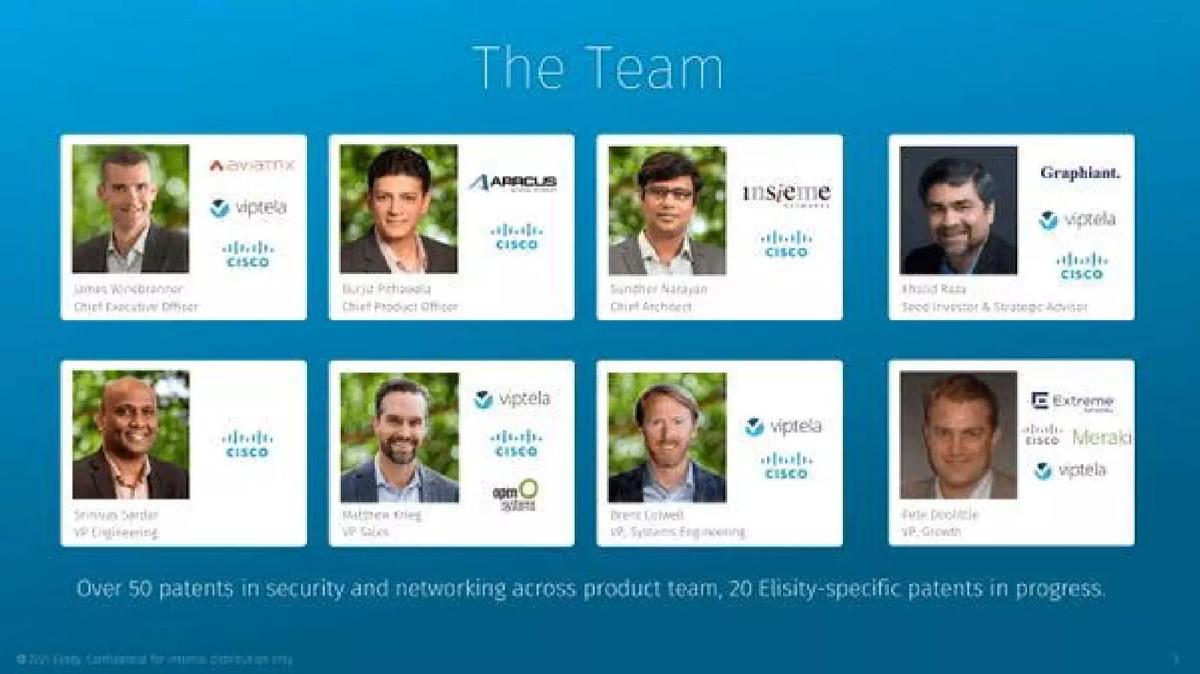
- The team slide (Slide 3) highlights a deep bench of talent from Cisco, Viptela, and Meraki, claiming over 50 patents in security and networking.
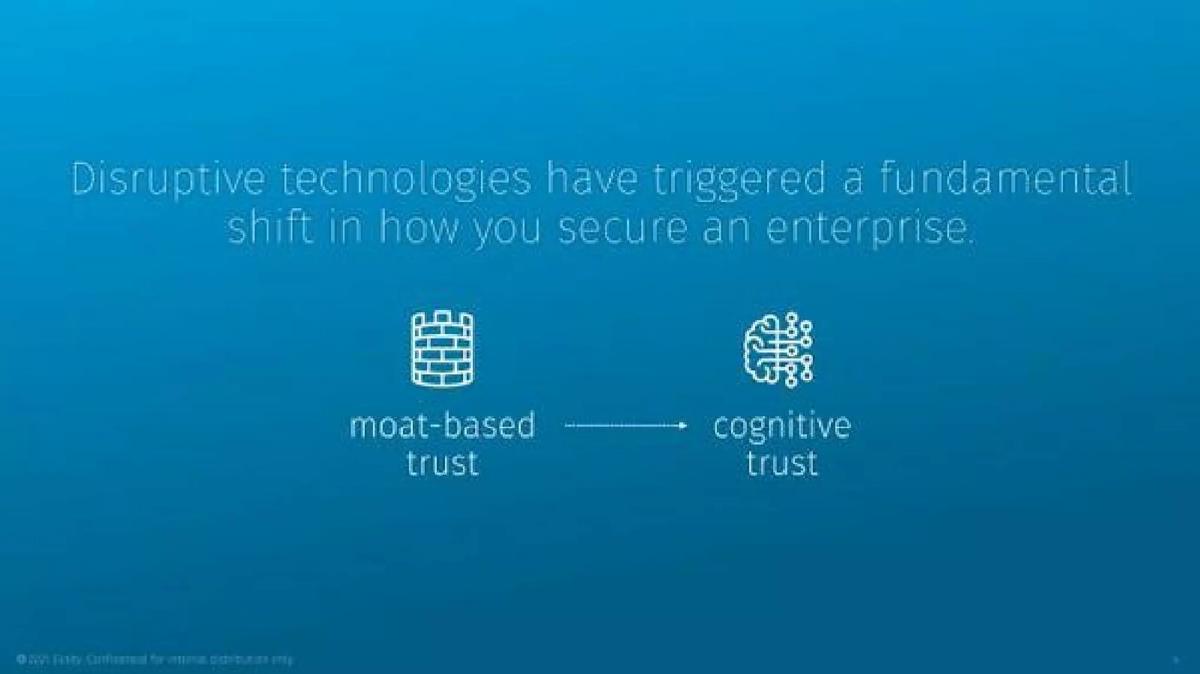
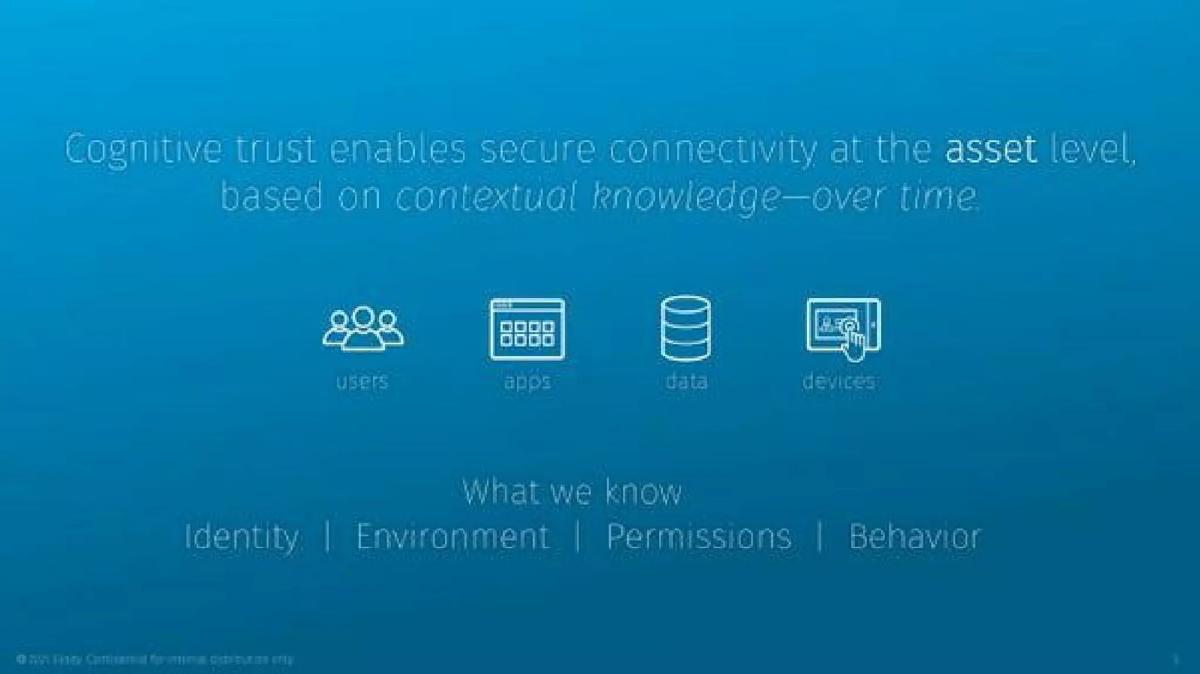
- Elisity defines a clear market shift from 'moat-based trust' to 'cognitive trust' based on identity, environment, permissions, and behavior (Slide 4 and 5).
- The deck provides a detailed architectural breakdown of the 'Cloud Control Center' and 'Data Plane' to satisfy technical due diligence (Slide 7).
- Market sizing is specific, citing a $38.6 billion Zero-Trust TAM and a $9.6 billion SAM for North American OT/ICS and cloud-edge (Slide 10).
- Real-world validation is shown through a pharma case study involving 73 manufacturing facilities and 500,000 OT devices (Slide 11).
- A national financial services firm case study highlights the failure of legacy solutions like Zscaler to address branch least-privilege (Slide 12).
- Pricing is transparently listed as $7/user/month and $5/device/month, with a free tier for up to 20 users (Slide 14).
- The deck omits a specific 'Ask' slide, failing to state the exact dollar amount sought or the intended use of funds within the slides themselves.
Executive Summary: The Technical Fortress
Elisity’s Series A pitch deck is a masterclass in technical storytelling for a sophisticated investor audience. In the crowded cybersecurity market of 2018, Elisity didn't just promise better security; they promised a fundamental architectural shift. By raising $33.5 million, the company demonstrated that a high-pedigree team combined with massive-scale enterprise validation can overcome the need for flashy design. The deck is dense, text-heavy, and unapologetically technical, reflecting a product built for the world's largest and most security-conscious organizations.
Slides 1-3: The Pedigree and Vision
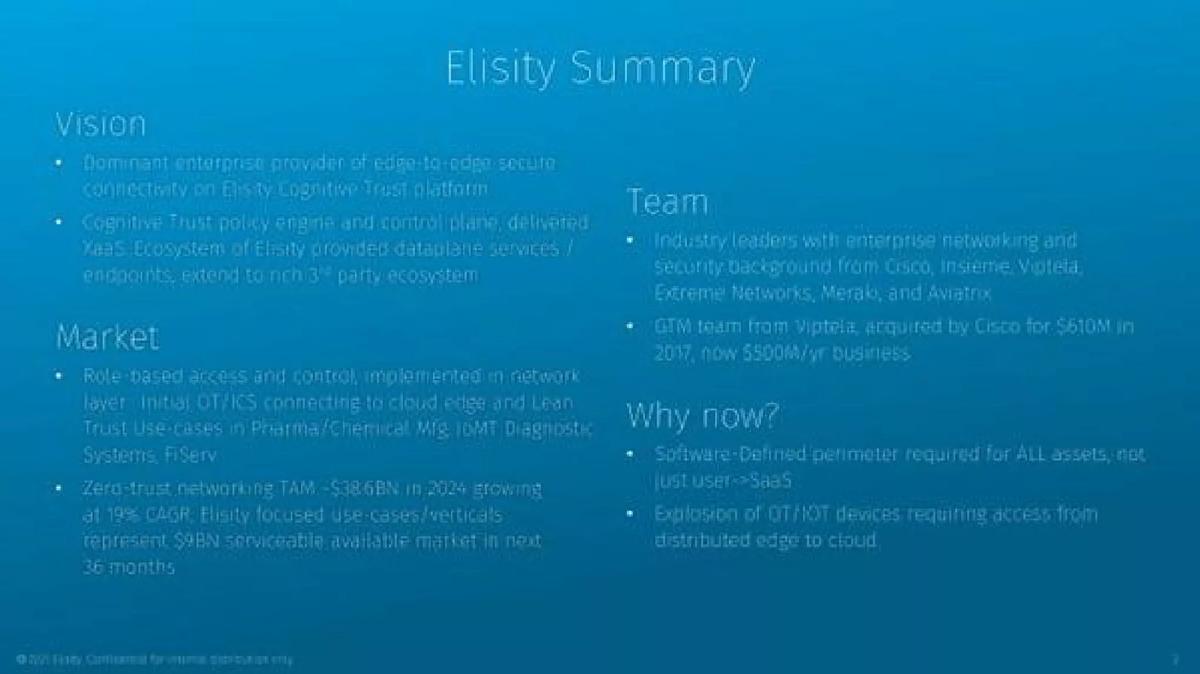
The deck opens with a minimalist title slide (Slide 1) featuring the tagline "Cognitive Trust." This sets the stage for the central theme of the presentation. Slide 2 provides a high-level summary, touching on vision, market, team, and the "Why now?" The vision is stated as becoming the "dominant enterprise provider of edge-to-edge secure connectivity." Notably, the team section on this slide highlights that their GTM team comes from Viptela, which was acquired by Cisco for $610M in 2017 and grew to a $500M/year business.
Slide 3 is the 'power slide' of the deck. It features eight key team members and advisors, each accompanied by logos of industry giants like Cisco, Viptela, Meraki, and Aviatrix. The bottom of the slide notes that the team holds over 50 patents in security and networking, with 20 more in progress specifically for Elisity. For a Series A investor, this level of domain expertise significantly de-risks the execution of a complex technical roadmap.
Slides 4-6: Defining the Paradigm Shift
Slide 4 introduces the core thesis: a shift from "moat-based trust" to "cognitive trust." This is a classic 'Old Way vs. New Way' framing. Slide 5 defines what Cognitive Trust actually means, breaking it down into four pillars: Identity, Environment, Permissions, and Behavior. It emphasizes that security should be applied at the "asset level" rather than the network perimeter.
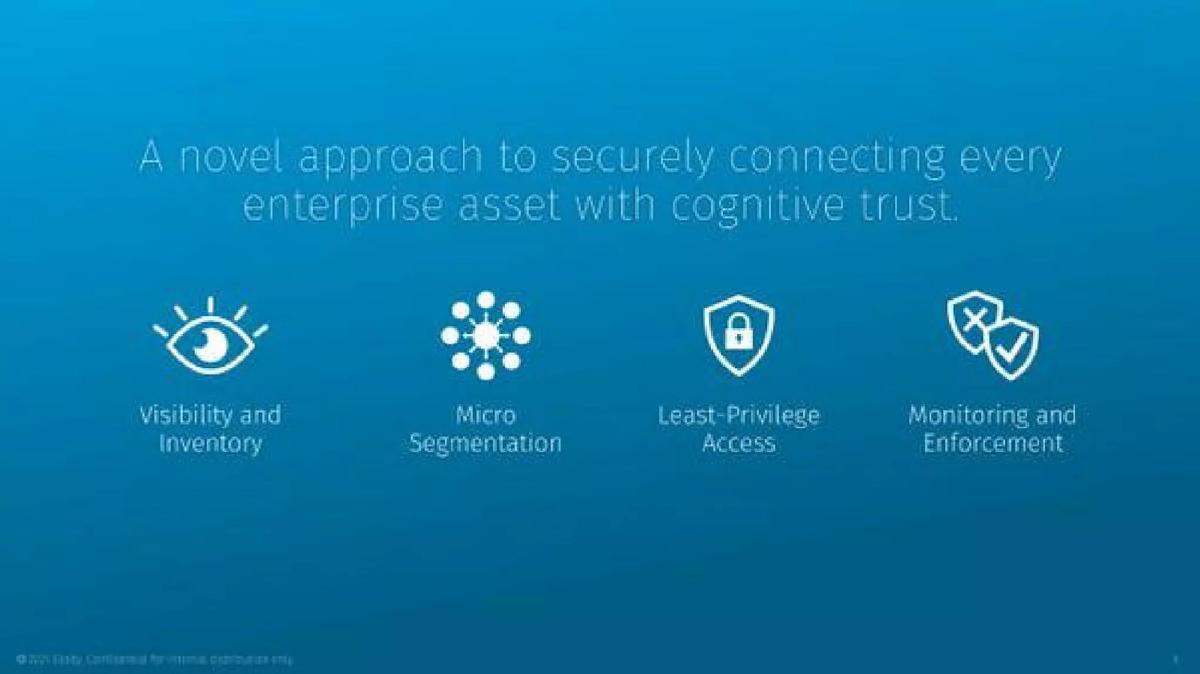
Slide 6 outlines the four functional steps of their approach: Visibility and Inventory, Micro Segmentation, Least-Privilege Access, and Monitoring and Enforcement. This slide serves as a bridge between the high-level philosophy and the actual product functionality, showing how the "Cognitive Trust" concept is operationalized.
Slides 7-9: The Architecture and Logic
Slide 7 is a detailed architectural diagram of the Elisity Cognitive Trust platform. It separates the "Asset-level Control and Policy Plane" from the "Data Plane." It shows integrations with identity providers like Okta and Ping, and visibility tools like Armis and Claroty. This slide is crucial for technical due diligence, as it explains how Elisity sits on top of existing infrastructure without requiring a complete rip-and-replace.
Slide 8, titled "Elisity Basics: Policy and Connectivity," goes deeper into the mechanics. It explains that the "Cloud Control Center" is the management plane and that policy takes precedence over routing. Slide 9 introduces a unique value proposition: "We’ve architected Elisity to be better on Day 100 than Day 1." It claims the system uses AI to map new users to policies and tighten security parameters over time, positioning the product as a living system rather than a static firewall.
Slides 10-13: Market Opportunity and Enterprise Validation
Slide 10 addresses the market size, citing a $38.6 billion TAM for Zero-Trust Network Access by 2024. They narrow this down to a $9.6 billion SAM, focusing on North American OT/ICS and cloud-edge markets. This specificity shows that the founders understand exactly which budgets they are targeting.
Slides 11 and 12 are the strongest evidence of product-market fit. Slide 11 details a deployment for a "top-5 global pharma" company with 500,000 OT devices across 73 facilities. It contrasts a "Legacy Solution" that would cost $200M and take 4 years with the Elisity solution. Slide 12 does the same for a "national financial services firm" with 62,000 employees and 10,000 ATMs, specifically calling out that a Zscaler implementation failed to address their branch least-privilege needs. These are not just pilots; they are massive-scale enterprise use cases.
Slide 13 provides further market validation, stating that 84% of large companies have a budget of $250k+ for Zero Trust networking. It includes a bar chart showing budget allocations across mid-sized, large, and very large companies, proving that the "willingness to pay" is already established in the market.
Slides 14-17: Business Model and Closing
Slide 14 reveals the "General Licensing Model." It is a straightforward SaaS model: a free tier for small teams, $7/user/month for larger workforces, and $5/device/month for IoT/OT assets. This transparency is rare in Series A decks and suggests a high level of confidence in their unit economics.
Slide 15 uses a "Before and After" diagram to show how Elisity replaces a "patchwork of solutions" (including names like Palo Alto Networks, Cisco DNA Center, and Zscaler) with a single platform. This slide visualizes the consolidation play, which is a major selling point for CISOs looking to reduce vendor sprawl.
Slide 16 summarizes "Why Elisity?" by listing five key points: flawless execution on seed milestones, customer momentum, a proven GTM team, enterprise-scale architecture, and a recurring revenue model. Slide 17 closes with the final tagline: "Secure your enterprise without moats."
What Works in this Deck
Unrivaled Team Credibility: The team slide is the strongest part of the deck. By listing specific successful exits (Viptela) and high patent counts, they establish themselves as the definitive experts in the field. Investors aren't just betting on an idea; they are betting on the people who built the modern networking stack at Cisco and Meraki.
Massive-Scale Case Studies: Most startups at the Series A stage show small pilots. Elisity shows a pharma company with 500,000 devices. This immediately answers the question of whether the technology can scale to the needs of the Fortune 500.
Architectural Transparency: The deck doesn't hide behind buzzwords. The diagrams on Slides 7 and 8 provide enough detail for a technical analyst to understand exactly how the software interacts with the network, which is essential for a high-stakes security product.
What is Missing
The Financial Ask: The deck completely omits a slide stating how much money they are raising and what the milestones for the next 18-24 months will be. While the catalogue facts state they raised $33.5M, a founder should always include a slide detailing the use of proceeds (e.g., hiring 20 engineers, expanding sales to EMEA).
Competitive Matrix: While the deck mentions competitors like Zscaler and Palo Alto Networks in the case studies, it lacks a dedicated slide comparing features or performance metrics. A CISO or a VC would want to see a head-to-head comparison on latency, deployment time, or cost.
Unit Economics and Burn: While the pricing is clear, there is no information on the cost of goods sold (COGS) or the current burn rate. For a Series A, investors usually expect to see a glimpse into the company's financial health beyond just the pricing model.
What a Founder Should Copy
The 'Before and After' Consolidation Slide: Slide 15 is a perfect example of how to sell a platform play. By showing the complexity of the current 'patchwork' and the simplicity of the new 'single platform,' you make the purchase decision feel like an operational necessity rather than a luxury.
Specific Budget Data: Slide 13, which shows that 84% of companies have a $250k+ budget for this specific technology, is incredibly persuasive. It proves that the founder isn't just guessing at a TAM; they have researched the actual line items in their customers' budgets.
The 'Day 100' Concept: The idea that a product gets better the longer you use it (Slide 9) is a powerful way to frame AI and machine learning. It moves the conversation away from 'features' and toward 'long-term value' and 'defensibility.'
Frequently asked questions
- What is 'Cognitive Trust' as defined in this deck?
- According to Slide 5, Cognitive Trust is a security model that enables connectivity at the asset level based on contextual knowledge over time. It moves away from traditional perimeter security ('moats') and instead uses four key data points—Identity, Environment, Permissions, and Behavior—to determine if a user, app, or device should have access to specific data.
- How does Elisity justify its $38.6 billion TAM?
- On Slide 10, Elisity cites a forecast that the Zero Trust Networking market will grow from $16 billion to $38.6 billion by 2024. They further refine this to a Serviceable Addressable Market (SAM) of $9.6 billion, which focuses specifically on North American OT/ICS (Operational Technology/Industrial Control Systems) and cloud-edge verticals over a 24-36 month horizon.
- What makes the Elisity team particularly credible for this sector?
- Slide 3 showcases a team with deep roots in the world's most successful networking companies. Key members come from Cisco, Viptela (acquired for $610M), Meraki, and Aviatrix. The slide explicitly mentions that the team holds over 50 patents in security and networking, with an additional 20 Elisity-specific patents in progress, signaling high technical defensibility.
- What is the specific problem Elisity solves for large pharmaceutical companies?
- Slide 11 details a case study where a top-5 pharma company needed to connect 500,000 OT devices and industrial control systems that were previously air-gapped. Legacy solutions required a $200M infrastructure refresh and a 4-year deployment. Elisity’s solution provided security at the asset level without constant rule changes, enabling digitization without expanding the attack surface.
- How does Elisity's pricing model work?
- Slide 14 outlines a 'General Licensing Model' consisting of three tiers. There is a Free Tier for up to 20 users and 10 policies. The paid tiers are priced at $7 per user per month and $5 per device per month. Both paid tiers include 'All Functionality' and 24x7 support, suggesting a simple, scalable SaaS-style revenue model.