EliseAI’s Series D deck is a concise, data-driven presentation that focuses on scale and market penetration rather than technical granularities. By 2024, the company had achieved a $1B+ valuation, underpinned by the fact that they serve 1 out of every 12 apartment units in the U.S. (Slide 3). The deck highlights a dual-industry strategy, showcasing 'HousingAI' and 'HealthAI' as distinct but related verticals. With 2.5x ARR growth since their Series C and 70 million conversations handled to date, the narrative is one of proven execution. The deck omits traditional early-stage elements like a d…
Key takeaways
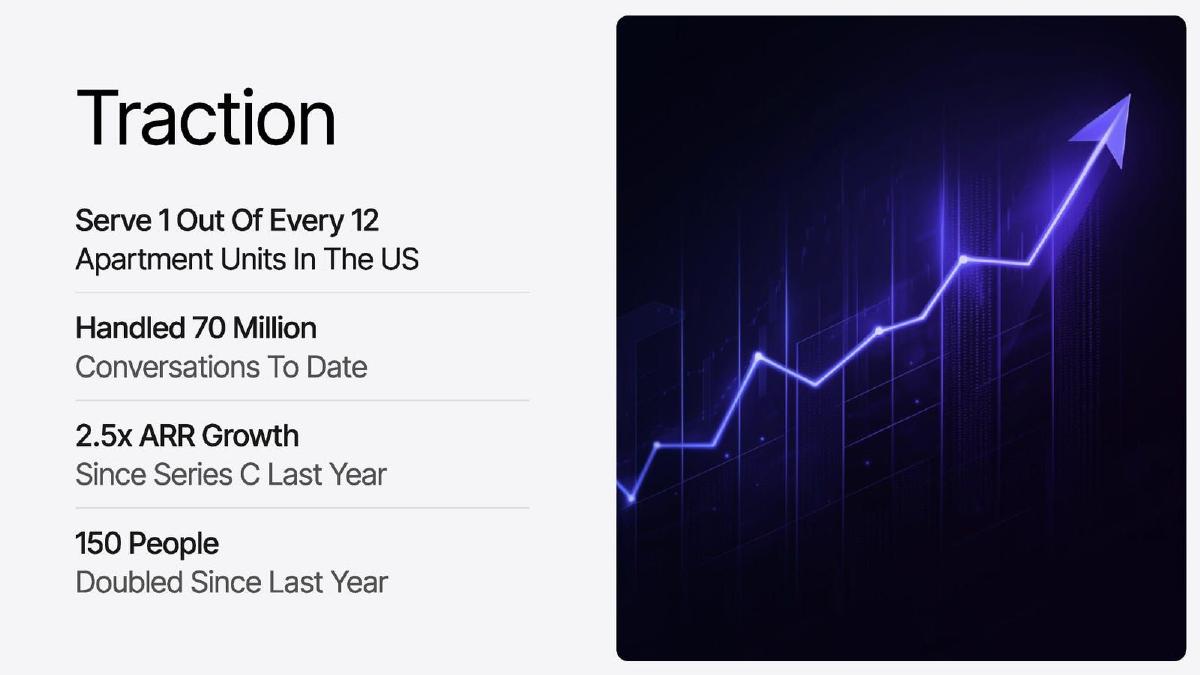
- The company serves 1 out of every 12 apartment units in the U.S., representing significant market share in the housing sector (Slide 3).
- EliseAI achieved 2.5x ARR growth in the single year between their Series C and Series D rounds (Slide 3).
- The platform has handled 70 million conversations to date, demonstrating the scale of their conversational AI (Slide 3).
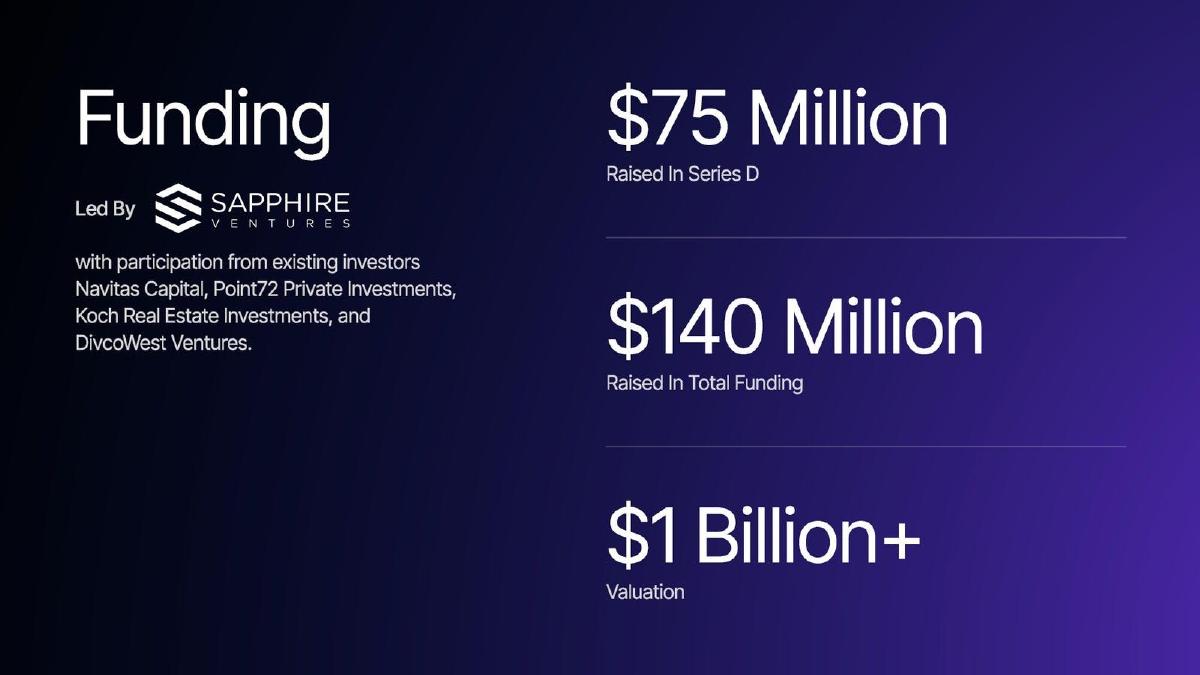
- The Series D round raised $75 million, bringing total funding to $140 million at a $1 billion+ valuation (Slide 4).
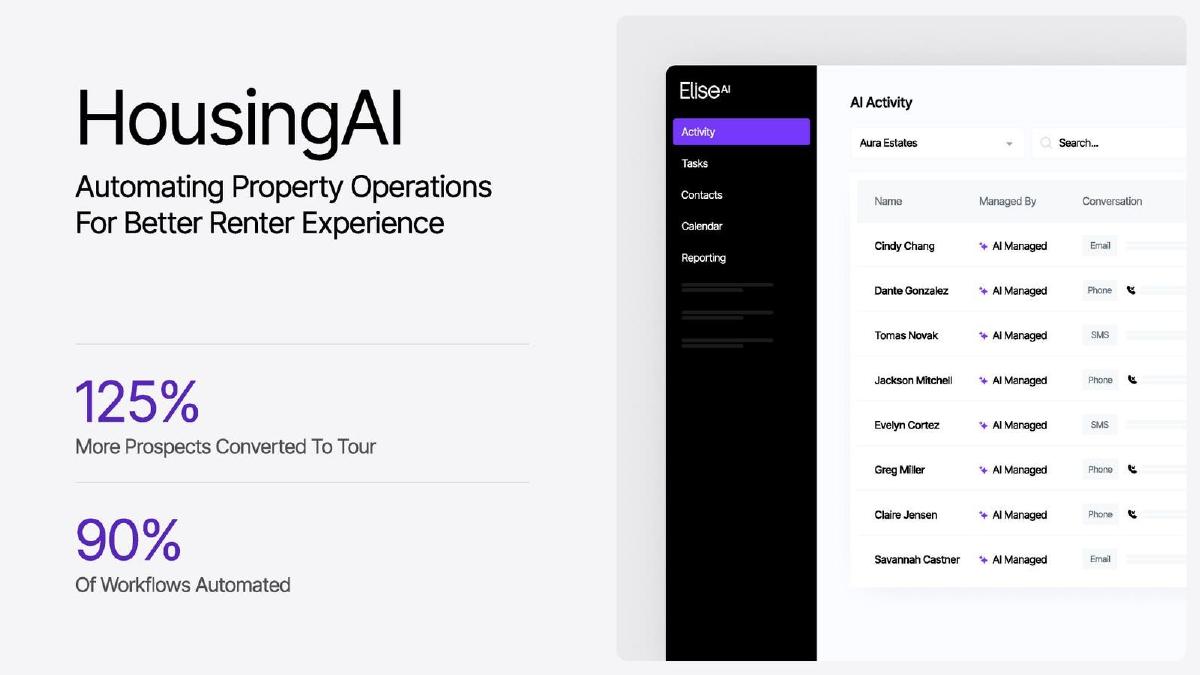
- The 'HousingAI' product claims to convert 125% more prospects to tours and automates 90% of workflows (Slide 5).
- The 'HealthAI' expansion targets a market with over 1 billion annual patient encounters in the U.S. (Slide 2).
- HealthAI claims to provide a 90% decrease in cost per call for healthcare providers (Slide 6).
- The team has doubled in size over the last year to 150 people, led by founders from MIT and the University of Cambridge (Slides 3 and 7).
The Series D Momentum Play
EliseAI’s 7-slide deck is a masterclass in late-stage fundraising efficiency. At the Series D level, investors are looking for proof of scale, market dominance, and the ability to expand into adjacent verticals. EliseAI delivers this by focusing almost entirely on traction and high-level outcomes. The deck does not waste time explaining what AI is; instead, it demonstrates what their specific AI has already accomplished in the real estate market and its potential in healthcare.
Slide 1: Title Slide
The opening slide is minimalist, featuring the company logo and the tagline "Transforming Housing & Healthcare: The AI-Powered Future." The visual design uses a dark theme with a fluid, purple abstract shape, signaling a modern, high-tech brand identity. It immediately establishes the two core industries the company operates in, setting the stage for a multi-vertical narrative.
Slide 2: Mission and Market Context
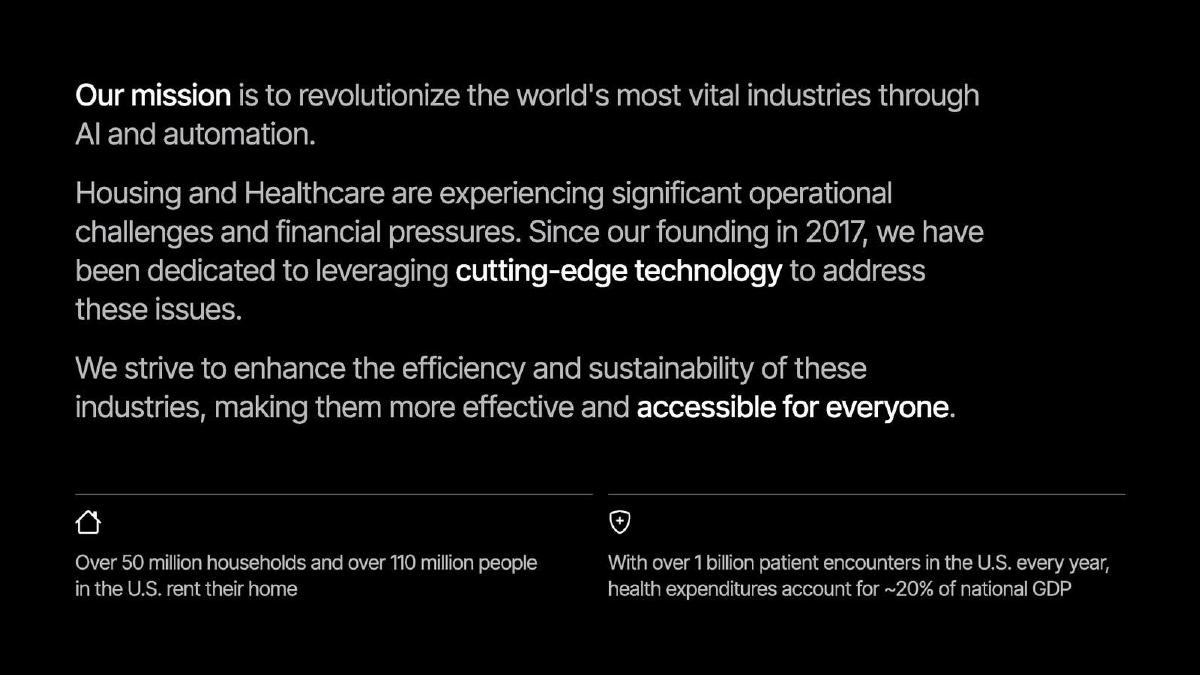
Slide 2 outlines the company's mission: "to revolutionize the world's most vital industries through AI and automation." It notes that the company was founded in 2017. The slide provides two critical market data points to justify their focus. For housing, it notes that over 50 million households and 110 million people in the U.S. rent their homes. For healthcare, it cites over 1 billion annual patient encounters and notes that health expenditures account for roughly 20% of the U.S. GDP. This slide effectively frames the problem as one of "significant operational challenges and financial pressures" in massive, essential sectors.
Slide 3: Traction
This is the most critical slide in the deck. It presents four heavy-hitting metrics that demonstrate EliseAI's market fit and growth velocity. First, they serve "1 Out Of Every 12 Apartment Units In The US," a staggering penetration statistic for a software provider. Second, they have handled "70 Million Conversations To Date," proving the robustness of their NLP models. Third, they report "2.5x ARR Growth Since Series C Last Year," indicating that their revenue growth is accelerating even at scale. Finally, they note their team has reached 150 people, having doubled since the previous year. An upward-trending arrow graphic reinforces the theme of rapid expansion.
Slide 4: Funding and Valuation
Slide 4 details the specifics of the round. The $75 million Series D was led by Sapphire Ventures, with participation from a list of existing investors including Navitas Capital, Point72, Koch Real Estate Investments, and DivcoWest Ventures. The slide explicitly states a "$1 Billion+" valuation and a total funding amount of "$140 Million." By highlighting the quality of the cap table and the unicorn status, EliseAI signals to the market that they are a category leader.
Slide 5: HousingAI Product Impact
This slide focuses on the company's primary vertical. Titled "HousingAI," it describes the product as "Automating Property Operations For Better Renter Experience." The slide includes a screenshot of the software interface, showing an "AI Activity" dashboard where conversations are "AI Managed" across email, phone, and SMS. The key performance indicators (KPIs) are bold: a 125% increase in prospects converted to tours and 90% of workflows automated. This slide connects the technology directly to the bottom-line ROI for property managers.
Slide 6: HealthAI Expansion
Slide 6 introduces the expansion vertical, "HealthAI." The value proposition here is "Automating Administrative Tasks So Providers Can Focus On Care." The visual is a mobile phone mockup showing an AI assistant named "Elise" interacting with a patient to verify insurance coverage. The metrics provided are "24/7 Responses To Patient Inquiries" and a "90% Decrease In Cost Per Call." This slide demonstrates that the core conversational AI technology is portable across industries, significantly increasing the company's Total Addressable Market (TAM).
Slide 7: Team Pedigree
The final slide highlights the founders. Minna Song (CEO) and Tony Stoyanov (CTO) are presented alongside their academic credentials from MIT and the University of Cambridge, respectively. The headline, "Over 150 engineers, researchers & team members led by AI pioneers," emphasizes that the company is a technical powerhouse. For a Series D, showing that the original founders are still at the helm and have the technical depth to lead a large engineering organization is a strong signal of stability and vision.
What Works in This Deck
The primary strength of this deck is its brevity and focus on 'Big Numbers.' By Series D, a company should not need 20 slides to explain its business model. EliseAI focuses on the metrics that matter to growth-stage investors: market share (1 in 12 units), revenue growth (2.5x), and efficiency gains (90% automation). The use of specific, high-impact percentages makes the value proposition undeniable.
The vertical segmentation is also highly effective. By separating HousingAI and HealthAI into two distinct slides with their own KPIs, the company shows it has a repeatable playbook for entering new markets. This reduces the perceived risk of the healthcare expansion, as the real estate metrics provide a proven baseline for the technology's efficacy.
What Is Missing
While the deck is effective for its purpose, it omits several standard elements that would typically be expected in a comprehensive investor presentation. There is no financial roadmap or detailed breakdown of how the $75 million will be deployed. There is also a complete absence of a competitive landscape slide. At a $1B+ valuation, investors usually want to see how a company defends its moat against incumbents and other AI startups.
Additionally, there are no case studies or testimonials . While the 125% conversion metric is impressive, a quote from a major real estate investment trust (REIT) or a healthcare system would have added a layer of social proof. Finally, the deck lacks a unit economics slide (CAC, LTV, Churn), which is often a focal point for Series D investors looking at the sustainability of the growth.
Founder Takeaways
Lead with your strongest metric: If you have 8% market share in a major U.S. industry, put that on the first traction slide. It immediately establishes you as the incumbent to beat. · Use 'The Playbook' narrative: If you are expanding into a new industry, show the results of your first industry side-by-side with the potential of the second. This proves your technology is a platform, not just a single-point solution. · Design for speed: This deck uses high-contrast colors, large fonts, and minimal text. It is designed to be read in under two minutes, which respects the time of high-level partners at venture firms. · Pedigree matters at scale: Highlighting MIT and Cambridge backgrounds, even years after founding, reinforces the idea that the company is built on a foundation of deep technical expertise, which is vital in the crowded AI space. · Own your valuation: By explicitly stating the $1B+ valuation on a slide, the company sets the floor for all future discussions, ensuring they are only talking to investors who can play at that level.
Frequently asked questions
- What is EliseAI's primary value proposition in real estate?
- According to Slide 5, EliseAI's 'HousingAI' focuses on automating property operations to improve the renter experience. The key metrics provided are a 125% increase in prospects converted to tours and the automation of 90% of property management workflows, allowing for more efficient leasing operations.
- How does EliseAI justify its expansion into the healthcare sector?
- Slide 2 establishes the market size, noting over 1 billion patient encounters annually in the U.S. and health expenditures accounting for approximately 20% of national GDP. Slide 6 then positions 'HealthAI' as a tool to automate administrative tasks, offering 24/7 responses and a 90% reduction in cost per call.
- Who are the lead investors in EliseAI's Series D?
- Slide 4 identifies Sapphire Ventures as the lead investor for the $75 million Series D round. Other participating investors mentioned include Navitas Capital, Point72 Private Investments, Koch Real Estate Investments, and DivcoWest Ventures.
- What are the academic backgrounds of the EliseAI founders?
- Slide 7 highlights the technical pedigree of the leadership. CEO and Co-Founder Minna Song is an alumna of the Massachusetts Institute of Technology (MIT) with a degree in Computer Science. CTO and Co-Founder Tony Stoyanov holds a Computer Science degree from the University of Cambridge.
- How much total capital has EliseAI raised to date?
- As stated on Slide 4, the company has raised a total of $140 million in funding. This includes the $75 million Series D round detailed in this deck, which pushed the company's valuation above the $1 billion threshold.