Eliconn’s pitch deck, dated late 2019, outlines a massive $500 million Security Token Offering (STO) to disrupt Supply Chain Finance (SCF). The company proposes a blockchain-as-a-service model to reduce KYC costs by 10% and tap into a $6 billion revenue opportunity in SCF. The strategy is notably broad, encompassing everything from smart contracts for cross-border trade to the development of a 'Smart Blockchain Building' featuring an R&D center and commercial operations. While the deck boasts a high-profile advisor list including government legislators and international bank specialists, it l…
Key takeaways
- The company is seeking a $500 million target through an STO Strategy and Trust Fund (Slide 4).
- Blockchain implementation is projected to reduce KYC process costs by 10% (Slide 3).
- The use of funds allocates 65% of the $500 million raise specifically to SCF Businesses (Slide 4).
- Eliconn positions itself in the high-financing power and high-technology quadrant of its competitive analysis (Slide 6).
- The business model includes physical infrastructure, specifically a 'Smart Blockchain Building' with R&D and commercial zones (Slide 7).
- The roadmap targets a global IPO within just three and a half years of the project's launch (Slide 9).
- The deck relies heavily on a diverse board of advisors from Taiwan, Thailand, Japan, and the U.S. to establish credibility (Slide 8).
- Revenue potential for the SCF sector is cited at $6 billion based on 2018 BSR data (Slide 3).
Executive Summary: The $500M Blockchain Ambition
The Eliconn pitch deck, version 2 dated November 14, 2019, represents a specific era of fintech fundraising where blockchain was viewed as the universal solvent for supply chain inefficiencies. The deck is characterized by an extremely high capital ask—$500 million—and a business model that blends digital finance with physical infrastructure. While the deck provides a clear roadmap and competitive positioning, it leaves significant gaps regarding the core executive team and the specific mechanics of its 'Smart Blockchain Building.'
Slide 1: Title and Branding
The cover slide introduces Eliconn as "the Fintech Project for SCF & Investment." It identifies Jack Huang as the COO. Notably, the bottom of the slide features logos for Foxconn, Finconn, Eliconn, and CDS (Global Delivery Service). The inclusion of the Foxconn logo suggests a corporate relationship or affiliation, though the nature of this link is not explicitly defined on this slide. The presence of a formal legal disclaimer at the footer indicates this was intended for private placement or sophisticated investors.
Slide 2: The Eliconn Solution
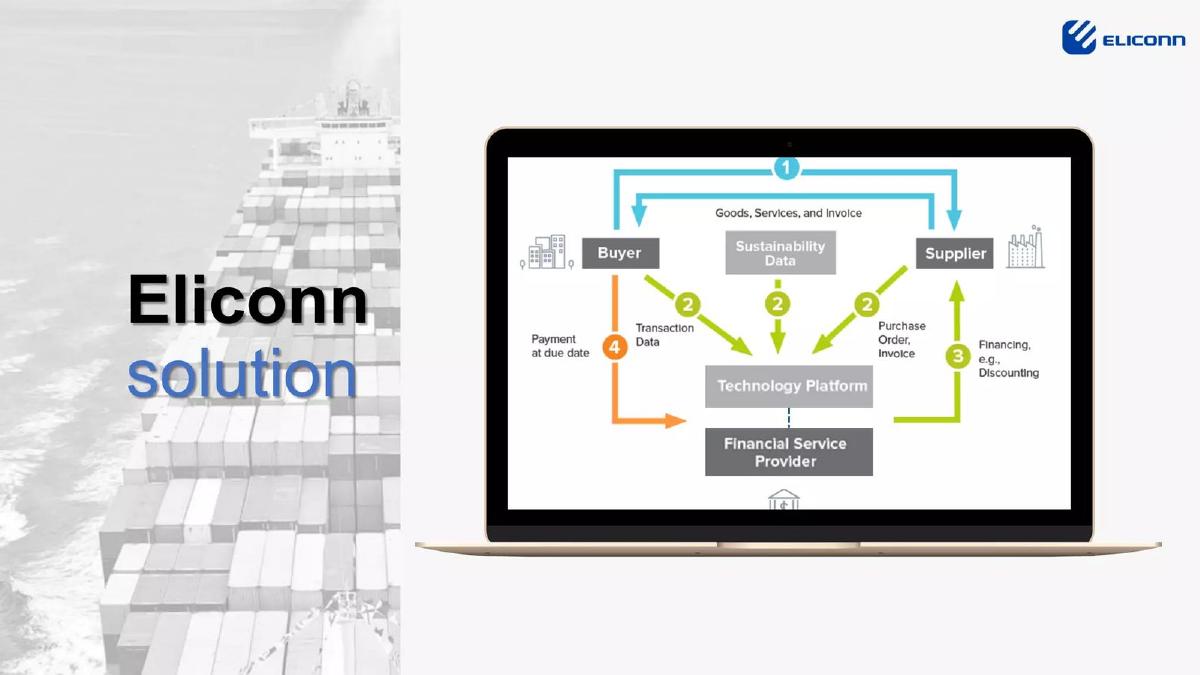
Slide 2 uses a laptop mockup to display a flow chart of the Eliconn ecosystem. The diagram illustrates a four-step process: (1) The exchange of goods, services, and invoices between a Buyer and Supplier; (2) The feeding of transaction data, sustainability data, and purchase orders into a central Technology Platform; (3) The Technology Platform connecting to a Financial Service Provider to offer financing or discounting to the Supplier; and (4) The Buyer making payments at the due date. This slide establishes Eliconn as the technological intermediary between traditional supply chain participants and capital providers.
Slide 3: Blockchain as a Service for SCF
This slide attempts to quantify the value proposition. It lists five qualitative benefits, such as transparency and visibility, but focuses on two major figures: a 10% reduction in KYC process costs and a $6 billion revenue opportunity in Supply Chain Finance (SCF). A detailed process map on the right side of the slide shows how smart contracts and "cash tokens" facilitate order processing, shipment, billing, and final payment. It specifically mentions "Payment e.g. BTC" and "Cash tokens" at the maturity stage, indicating a crypto-native settlement layer.
Slide 4: The $500 Million STO Strategy
Slide 4 is the "Ask" slide, and it is substantial. The target is $500 million for the "Eliconn Trust Fund." The use of funds is heavily weighted toward the actual financing of supply chains (65%) rather than just building software (10% for blockchain development). The slide also introduces a partnership with Polymath (indicated by the "Fuel Network Fuelled by POLY" logo) for the creation and launch of security tokens. The text promises that investors will "share the yield from SCF business periodically," framing the token as a dividend-bearing instrument.
Slide 5: Supply Chain Finance Visuals
This is a transition slide featuring three vertical images: an industrial warehouse, a stack of US hundred-dollar bills, and a digital representation of a blockchain. It serves to reinforce the connection between physical industry, traditional fiat currency, and the new digital ledger technology.
Slide 6: Competitive Analysis
The competitive landscape is mapped on a quadrant with "Financing Power" on the Y-axis and "Technology & Innovation Use" on the X-axis. Eliconn positions itself in the top-right corner, claiming higher financing power and better tech use than "Big Banks," "SCF Providers," and "New Startups." The slide notes that competitors suffer from "time-consuming paper-works" and that their investment channels are "not friendly to the public." Interestingly, the chart shows Eliconn moving from a mid-tier position to a top-tier position, implying a growth trajectory.
Slide 7: Multiple SCF Operations & Physical Infrastructure
This slide expands the scope of the project significantly. It introduces "EliPay" and various sub-sectors including Agri-tech Finance (traceable food), HR Fintech (salary receivables), and traditional SCF (factoring). The right side of the slide depicts a "Smart Blockchain Building." This 11-story structure includes a restaurant, commercial operations, a Big Data Center, and an R&D Center. The text states that "new technology MUST need the existing commercial scenarios to test its model," justifying the move into physical real estate.
Slide 8: Advisors and Partners
Eliconn relies on a heavy-hitting board of advisors to provide credibility for its $500M ask. The list includes Jason Hsu (Taiwan Legislator and Blockchain leader), Stanley Kang (Chairman of the Joint Foreign Chambers of Commerce in Thailand), and Marc Lepage (Asian Development Bank). The diverse geographical background of the advisors (Taiwan, Thailand, Japan, USA) aligns with the cross-border nature of supply chain finance. However, the slide notes "More advisers & partners are inviting...", suggesting the network was still being built at the time of the deck's creation.
Slide 9: The Aggressive Roadmap
The final slide in this selection provides a timeline from January 2019 to July 2022. The milestones are: 01/2019 (Launch), 05/2019 (STO & MVP), 12/2019 (Expand to other SCF businesses), 05/2020 (Scale-up funds), 05/2021 (Operate in most developed regions), and 07/2022 (IPO in global capital markets). The three-year journey from launch to IPO is exceptionally fast for a company managing $500 million in assets and physical real estate.
What Eliconn Does Well
Clear Market Sizing: By citing specific sources for the $6 billion SCF revenue opportunity and the 10% KYC cost reduction (Slide 3), Eliconn grounds its ambitious claims in third-party research.
Strategic Partnerships: The explicit mention of Polymath for the STO infrastructure and the inclusion of high-level government and banking advisors (Slide 8) suggests the founders understood the regulatory and technical hurdles of a security token offering.
Holistic Ecosystem: Unlike many fintech decks that focus solely on software, Eliconn connects the digital (smart contracts) to the physical (warehouses and R&D buildings), acknowledging that supply chain finance requires a presence in the real world (Slide 7).
What is Missing from the Deck
Executive Team: While Jack Huang is listed as COO on the cover, there is no dedicated slide for the founding team. Investors typically want to see the track records of the CEO, CTO, and Head of Risk, especially for a $500 million fund.
Unit Economics: The deck mentions "sharing the yield," but it does not explain the spread. There is no information on the expected interest rates charged to suppliers, the default rate assumptions, or the platform fee structure.
Regulatory Details: Raising $500 million via an STO involves complex international securities laws. The deck mentions a "Trust Fund" but does not specify the jurisdiction (e.g., Cayman, Singapore, Delaware) or the specific exemptions being used (e.g., Reg D, Reg S).
Risk Factors: Supply chain finance is inherently risky, involving credit risk, fraud risk, and cross-border legal risk. The deck paints a very optimistic picture without addressing how the blockchain technology specifically mitigates the risk of "double invoicing" or supplier insolvency.
Founder Takeaways: Lessons from Eliconn
1. Align the Ask with the Business Model: Eliconn is asking for $500 million because they are effectively starting a bank/fund, not just a software company. If your startup requires heavy capital for lending or liquidity, your "Ask" slide must reflect that 65% or more of the funds will go toward the balance sheet, not just "burn" for salaries (Slide 4).
2. Use Advisors to Bridge the Credibility Gap: If you are a new player in a highly regulated space like Fintech, your advisor slide is your most important asset. Eliconn’s inclusion of a sitting legislator and an ADB specialist (Slide 8) is a masterclass in using external authority to validate a high-risk project.
3. Visualize the Data Flow: Complex fintech products are hard to explain. The laptop mockup on Slide 2 and the process flow on Slide 3 are excellent examples of how to turn abstract blockchain concepts into a concrete workflow that a non-technical investor can understand.
4. Be Wary of Over-Aggressive Roadmaps: While a 2022 IPO (Slide 9) sounds exciting, it can also be a red flag for sophisticated investors who know that building a global financial institution usually takes a decade, not three years. Ensure your milestones are ambitious but grounded in the reality of regulatory timelines.
Frequently asked questions
- What is the primary financial instrument Eliconn is using to raise capital?
- Eliconn is utilizing a Security Token Offering (STO) strategy. According to Slide 4, the target for this STO and the associated Eliconn Trust Fund is $500 million. Investors are told they will hold security tokens and share in the yields generated from the Supply Chain Finance (SCF) business, with profits and dividends distributed periodically to token holders.
- How does Eliconn plan to use the $500 million raise?
- The capital allocation is broken down on Slide 4: 65% ($325M) is dedicated to SCF Businesses, 20% ($100M) to Projects & Investment, 10% ($50M) to Blockchain Development, and 5% ($25M) to Operation & Foundation. This suggests the company acts more as a capital-intensive finance vehicle than a pure software startup.
- What specific problems does Eliconn claim to solve with blockchain?
- Slide 3 identifies five key benefits: speed and increased control, increased competition, transparency/auditability, validation/authentication, and improved capital flow. Quantitatively, the deck claims blockchain can reduce costs from the KYC (Know Your Customer) process by 10%, citing research from Hofmann E., Strewe U.M., and Bosia N. (2018).
- What is the 'Smart Blockchain Building' mentioned in the deck?
- Slide 7 introduces a physical component to the business model. Eliconn proposes a multi-story building that serves as a 'Smart Blockchain Building & industrial alliance.' The floors are zoned for specific uses: 1F-2F for restaurants, 3F for commercial operations, 6F-7F for a Big Data Center, and 8F-11F for an R&D Center.
- Does the deck provide a clear exit strategy for investors?
- Yes, Slide 9 outlines a very specific and aggressive timeline. After launching in January 2019 and scaling the funds through 2020 and 2021, the company targets an 'IPO in global capital markets' by July 2022. This represents a 42-month window from inception to public listing.