eino’s pitch deck is a concise, 10-slide presentation that identifies a high-value niche: the inefficiency of global telecom infrastructure spending. By targeting the $350 billion annual spend on network upgrades, eino positions its AI-driven forecasting tool as a way to eliminate the 20% waste caused by 'guesswork.' The deck excels at quantifying the problem, citing a $65 billion annual loss in network upgrades. While it provides strong social proof through Proof of Concept (PoC) logos like Telus and Telstra, it lacks critical financial details, such as a specific funding ask, revenue model,…
Key takeaways
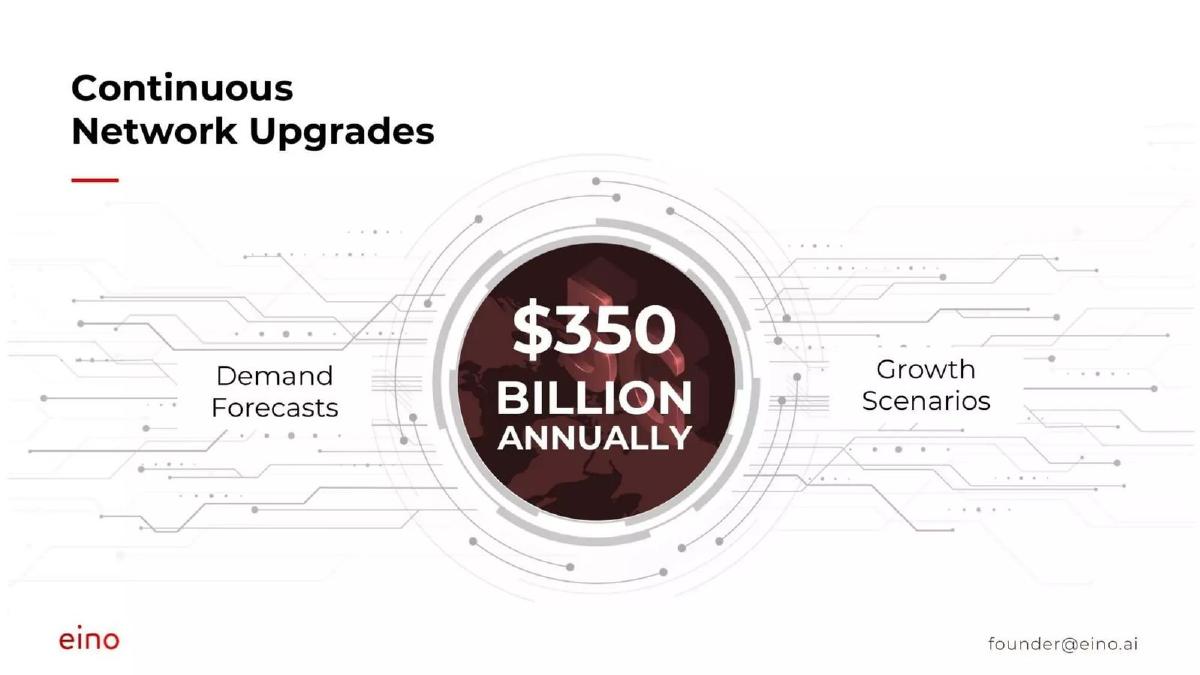
- The deck identifies a massive market opportunity with $350 billion spent annually on network upgrades (Slide 3).
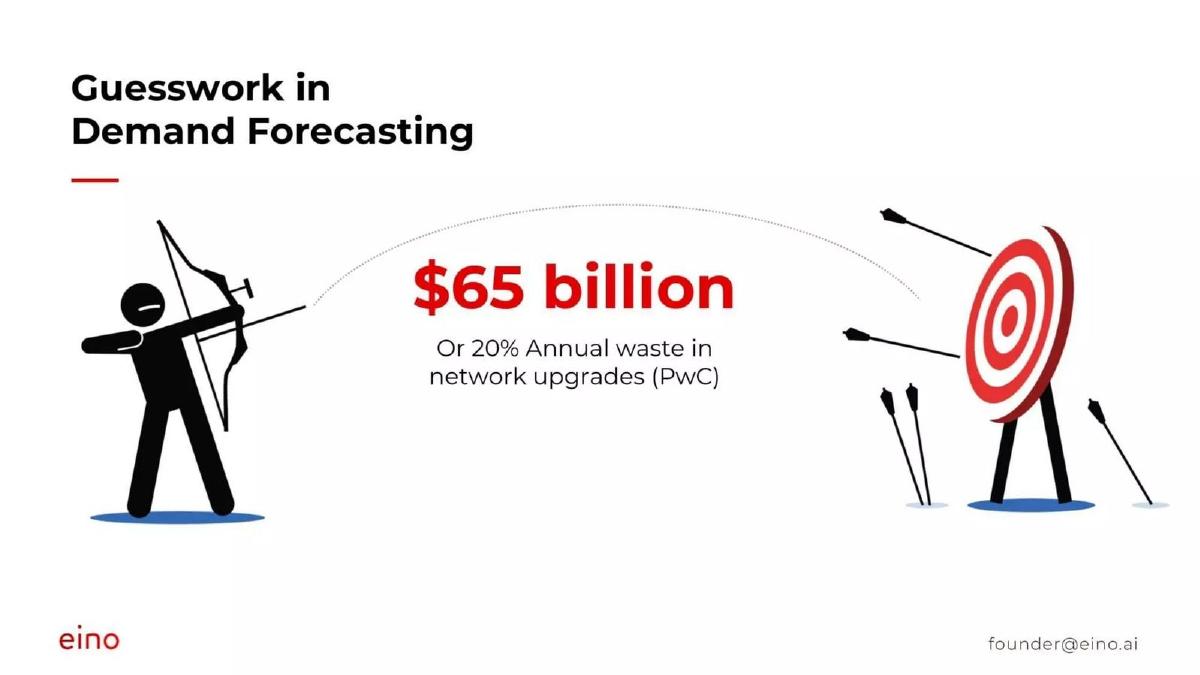
- eino quantifies the problem effectively, citing a PwC figure of $65 billion (20%) in annual waste due to poor forecasting (Slide 4).
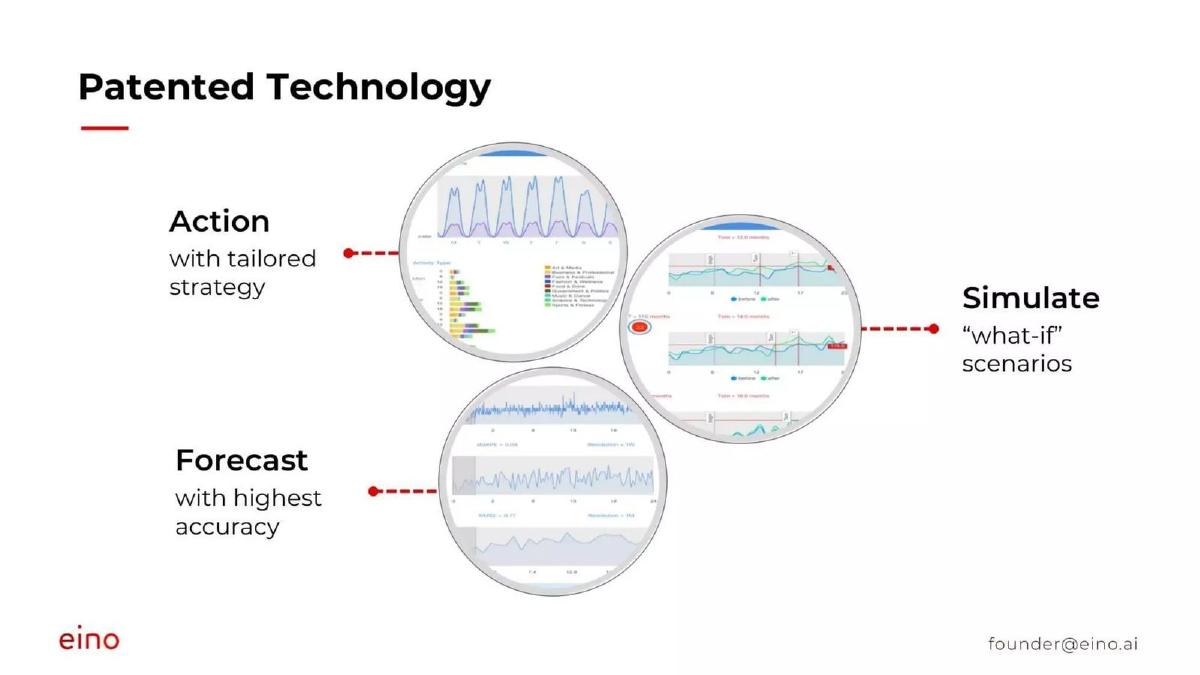
- The company claims to have 'Patented Technology' that enables 'what-if' scenario simulations and high-accuracy forecasting (Slide 5).
- Traction is demonstrated through Proofs of Concept with major global operators: Telus, NOS, and Telstra (Slide 7).
- The sales pipeline is stated to include 20 potential customers (Slide 7).
- The deck suggests a horizontal expansion strategy into E-Commerce, Ride-hailing, and Electric Utilities (Slide 8).
- The team includes advisors from major industry players like BT, Nokia, and Ericsson (Slide 9).
- The deck omits a specific fundraising 'Ask' and does not detail the business model or unit economics.
The Pitch Deck Overview
eino’s 10-slide deck is a masterclass in 'Problem-Solution' framing for a B2B enterprise audience. It focuses heavily on the telecommunications sector, specifically the transition to 5G, which was a massive capital expenditure (CapEx) cycle starting around 2017. The deck uses a clean, professional aesthetic with a consistent red-and-white color palette and high-quality iconography.
The Macro Trend and Market Size (Slides 1-3)
Slide 1: Title Slide The deck opens with a clear value proposition: 'The first-of-its-kind prediction platform that Forecasts Demand and Optimizes Resources.' The background image of a connected city with 5G icons immediately anchors the company in the smart city and telecom infrastructure space.
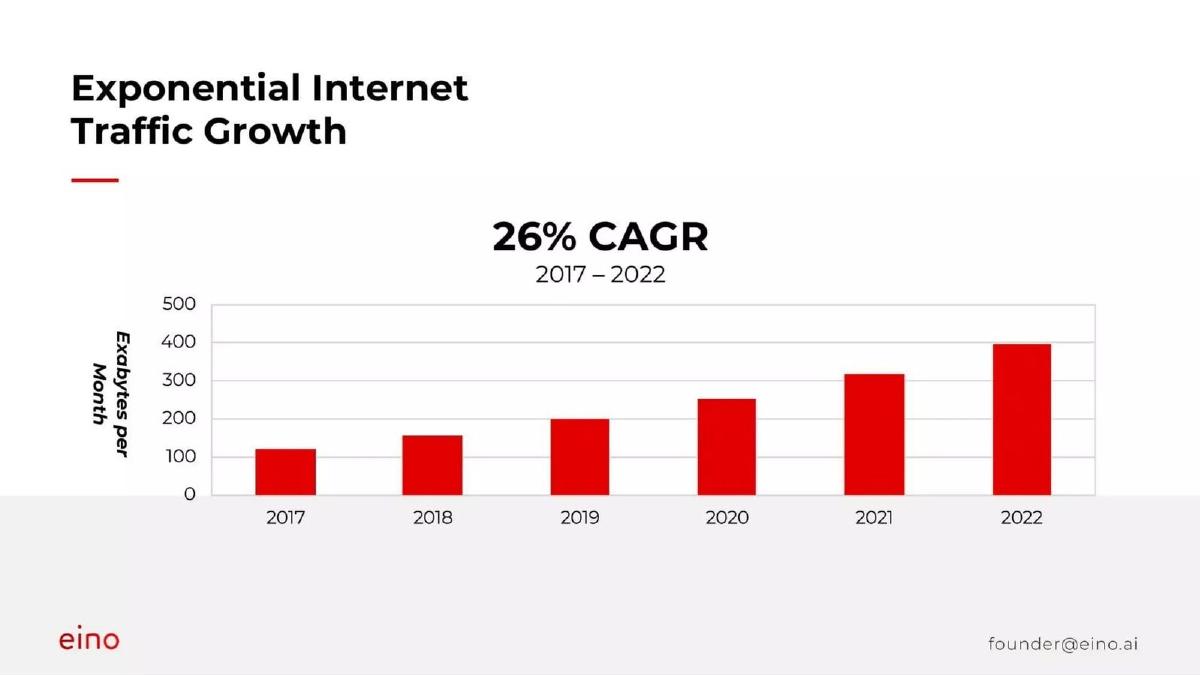
Slide 2: Exponential Internet Traffic Growth This slide establishes the 'Why Now.' It shows a bar chart of internet traffic growing from roughly 120 Exabytes per month in 2017 to 400 Exabytes in 2022. The 26% CAGR (Compound Annual Growth Rate) justifies why current manual planning methods are no longer sufficient to keep up with demand.
Slide 3: Continuous Network Upgrades eino identifies the Total Addressable Market (TAM) by highlighting the $350 billion spent annually on network upgrades. By placing 'Demand Forecasts' and 'Growth Scenarios' on either side of this figure, they position their software as the essential steering mechanism for this massive capital flow.
The Problem and The Solution (Slides 4-6)
Slide 4: Guesswork in Demand Forecasting This is the 'villain' slide. Using a simple archer graphic, eino illustrates that current methods are missing the mark. They cite a PwC figure: $65 billion, or 20% annual waste in network upgrades. This is a powerful slide because it translates a technical problem (forecasting) into a specific, massive dollar amount that any CFO would want to recover.
Slide 5: Patented Technology The solution is presented as a three-step process: Action (tailored strategy), Simulate ('what-if' scenarios), and Forecast (highest accuracy). The slide includes small UI screenshots, which, while difficult to read in detail, serve to prove that a functional product exists. The mention of 'Patented Technology' provides a defensive moat in the eyes of investors.
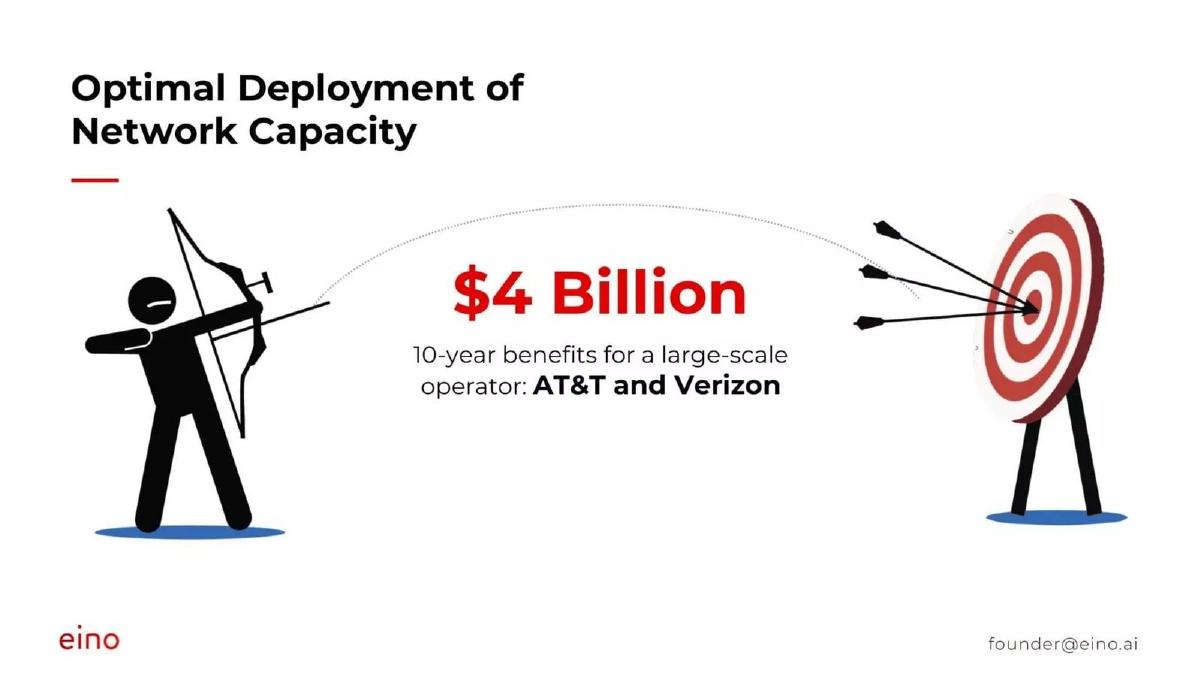
Slide 6: Optimal Deployment of Network Capacity This slide serves as a 'Value Realization' proof point. It claims a $4 billion 10-year benefit for large-scale operators like AT&T and Verizon. By naming specific industry giants, eino makes the potential impact feel tangible, even if those companies aren't yet customers.
Traction and Future Growth (Slides 7-8)
Slide 7: Traction The 'Traction' slide is strong on logos but light on revenue. It lists Proofs of Concept (PoCs) with Telus, NOS, and Telstra. For an early-stage company in the telecom space, getting PoCs with tier-1 operators is a significant hurdle. They also mention '20 customers in our sales pipeline,' indicating a healthy top-of-funnel for their sales team.
Slide 8: Horizontal Market Opportunity eino signals that they aren't just a 'telecom tool.' They highlight use cases in E-Commerce (supply chain planning), Ride-hailing/Autonomous Vehicles (fleet size adjustment), and Electric Utilities (capital planning). This slide is intended to show investors that the company has a path to becoming a multi-billion dollar platform beyond its initial niche.
Team and Social Proof (Slides 9-10)
Slide 9: Core Team and Advisors The team slide is split between the core operators and a heavy-hitting advisory board. The advisors bring logos from BT, Nokia, Ericsson, and McGill University. In the infrastructure world, who you know is often as important as what you build; these advisors suggest eino has the necessary 'ins' to close enterprise deals.
Slide 10: Prediction-as-a-Service The final slide reiterates the 'Prediction-as-a-Service' category. It also includes a 'wall of fame' for their institutional support: Cornell Tech, Rough Draft VC, 500 Startups, PowerBridge NY, and the National Science Foundation (NSF). This provides a final layer of credibility, showing that the company has been vetted by both academic and venture institutions.
What Works in this Deck
The $65 Billion Waste Metric: Quantifying the cost of the problem is the most effective way to sell to enterprise customers and investors. It moves the conversation from 'this is a cool AI tool' to 'this is a way to save $65 billion.' · Industry Credibility: The advisory board and the PoC logos (Telus, Telstra) are vital. Telecom is a notoriously difficult industry for startups to break into; these logos prove eino has managed to navigate the procurement and security hurdles of major telcos. · Clear Category Design: Calling themselves 'Prediction-as-a-Service' helps investors bucket the company into a scalable SaaS model rather than a consulting or services business.
What is Missing
The Ask: There is no slide detailing how much money is being raised, the valuation, or what the milestones for the next 18 months look like. This is a significant omission for a fundraising deck. · Business Model: While they call it 'As-a-Service,' they don't explain the pricing. Is it per node, per city, or a percentage of the CapEx saved? Investors need to know how the $65 billion waste translates into revenue for eino. · Competition: The deck assumes eino is the 'first-of-its-kind.' In reality, legacy network planning tools and other AI startups exist. A slide addressing why eino’s 'Patented Technology' is superior to existing solutions would strengthen the case. · Financial Projections: There is no mention of current ARR (Annual Recurring Revenue) or future growth targets.
What a Founder Should Copy
The 'Why Now' Slide: Slide 2 (Internet Traffic Growth) is a perfect example of using an undeniable macro trend to create urgency. · The Problem Quantification: If you can find a reputable third-party source (like PwC) to put a dollar value on the problem you are solving, do it. It is much more convincing than making your own estimates. · Visual Simplicity: The deck avoids 'wall of text' slides. It uses icons and large numbers to tell a story that can be understood in a 30-second flip-through.
Frequently asked questions
- What problem is eino specifically solving?
- eino addresses the 'guesswork' in demand forecasting for telecommunications companies. According to the deck, network operators spend $350 billion annually on upgrades, but 20% of that ($65 billion) is wasted due to inefficient planning and inaccurate predictions of where capacity is actually needed.
- How does eino's technology work?
- The deck describes the solution as 'Prediction-as-a-Service' powered by patented AI technology. It ingests historical and contextual data to provide three core functions: high-accuracy forecasting, 'what-if' scenario simulations, and tailored strategy actions for resource optimization.
- What traction has the company achieved?
- At the time of the deck, eino had secured Proof of Concept (PoC) projects with three major global operators: Telus, NOS, and Telstra. Additionally, they reported a sales pipeline of 20 customers and support from institutions like Cornell Tech, 500 Startups, and the National Science Foundation (NSF).
- Who are the key people behind eino?
- The team is led by Founder and CEO Payman Samadi, supported by Data Scientist Vladimir Eremin and Information Architect Carolyn Quirk. Crucially, they have a heavy-hitting advisory board with experience from BT, Nokia, and Ericsson, which provides significant industry credibility.
- What is missing from the eino pitch deck?
- The deck is missing several standard venture components: it does not state a specific funding amount being raised, it lacks a business model (pricing) slide, it provides no financial projections, and it does not include a competitive landscape analysis or a product roadmap.