VibeBuddy is an early-stage concept for an AI-powered productivity app designed specifically for students. The deck identifies a clear pain point: the disconnect between academic productivity tools and the mental health of the user. By integrating mood tracking—via manual check-ins or facial recognition—with task management and curated media (Spotify/YouTube), VibeBuddy aims to optimize study habits based on energy levels. While the deck provides a solid high-level overview of the product vision, market size ($400B+ EdTech), and a three-pronged business model (Freemium, Premium, and B2B), it…
Key takeaways
- The product aims to bridge the gap between wellness apps and academic productivity tools (Slide 4).
- Mood detection is proposed through both self-reporting and AI-driven facial analysis (Slide 6).
- The primary target market is high school and college students, representing a TAM of 250M+ global students (Slide 7).
- The deck cites the EdTech market at $400B+ and the Mental Wellness industry at $4.5T (Slide 7).
- Direct competitors are identified as Headspace, Endel, and aptihealth (Slide 8).
- The business model relies on a freemium tier, premium subscriptions for advanced analytics, and B2B licensing for schools (Slide 9).
- The leadership team consists of five members, including a CEO, CTO, CFO, CMO, and COO (Slide 10).
- The deck omits any mention of current traction, user metrics, or a specific financial ask.
VibeBuddy: The Ideation Deck Analysis
The VibeBuddy pitch deck, sourced from a SlideShare listing titled "EDP Pitch Deck Startup idea Business idea," is a textbook example of a conceptual stage presentation. It focuses heavily on the 'Why' and the 'What,' establishing a clear narrative for a product that addresses student burnout through AI. However, as an analyst, it is important to note that this deck functions more as a product proposal than a comprehensive business plan, as it lacks the financial and operational data typically required by venture capital firms.
Slide 1: Title Slide
The opening slide is minimalist, featuring the words "PITCH DECK" in a large, blue sans-serif font. The graphics include line-art illustrations of users interacting with digital content, newsletters, and cameras. Notably, the company name "VibeBuddy" does not appear on the cover slide; it is only introduced in the subsequent sections. This is a missed branding opportunity, as the cover should immediately establish the identity of the startup.
Slide 2: Table of Contents
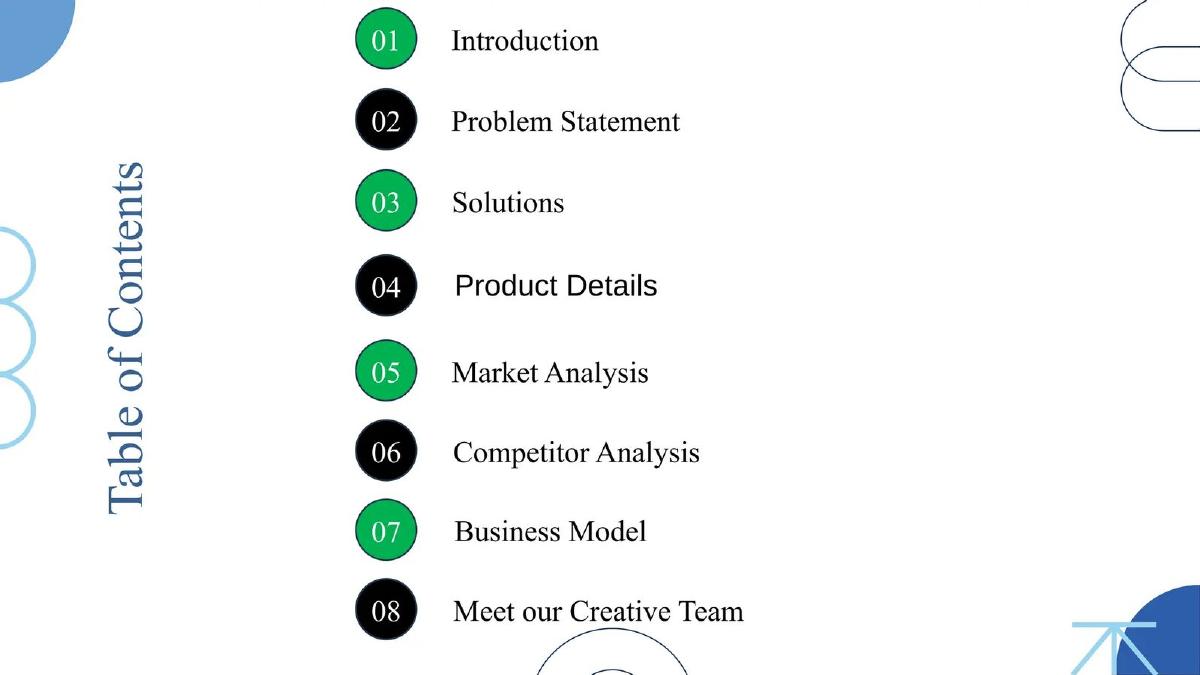
The deck follows a standard eight-point structure: Introduction, Problem Statement, Solutions, Product Details, Market Analysis, Competitor Analysis, Business Model, and Team. This logical flow is helpful for viewers, though the inclusion of a Table of Contents in a short 10-slide deck is often considered unnecessary real estate that could be used for a high-impact 'hook' or vision statement.
Slide 3: Introduction
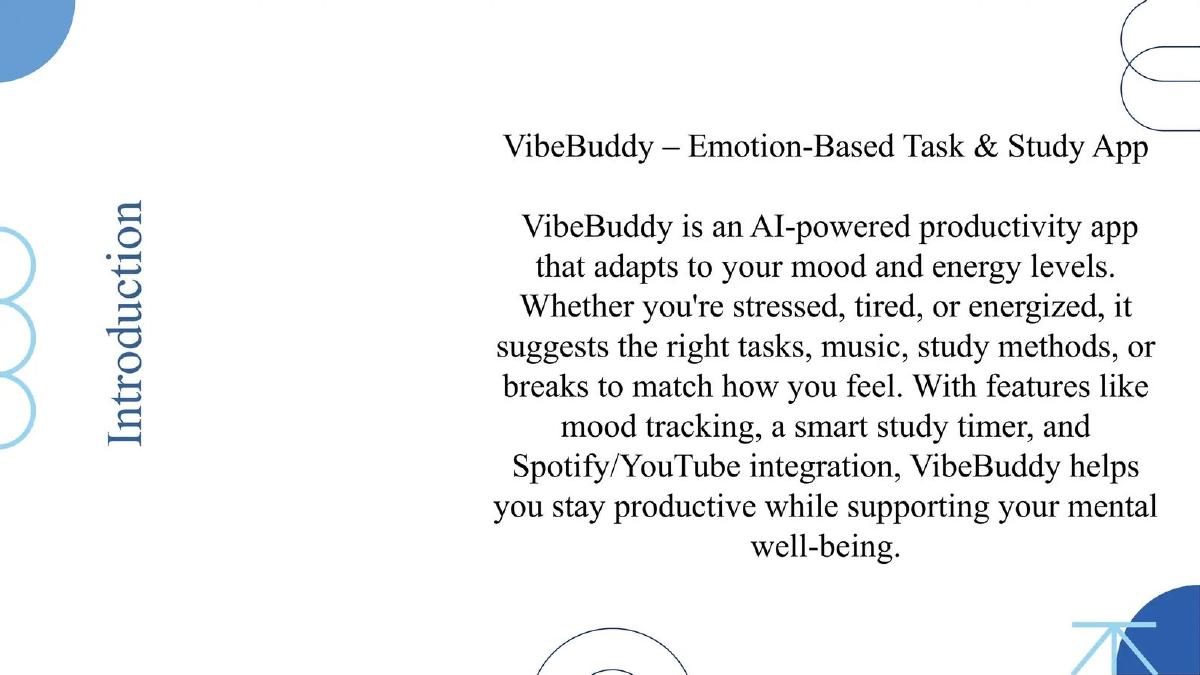
Slide 3 introduces VibeBuddy – Emotion-Based Task & Study App . The slide defines the product as an "AI-powered productivity app that adapts to your mood and energy levels." It lists key features such as mood tracking, a smart study timer, and integrations with Spotify and YouTube. The stated goal is to help users stay productive while supporting mental well-being. The language is clear and avoids excessive jargon, focusing on the user experience.
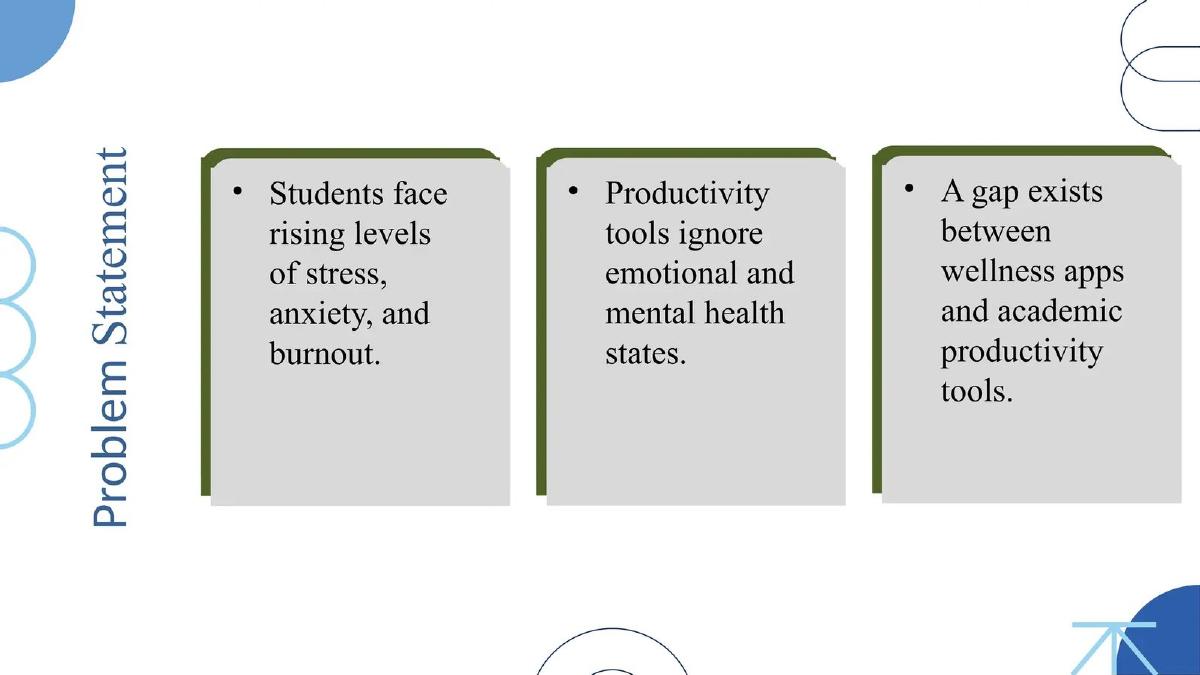
Slide 4: Problem Statement
Students face rising levels of stress, anxiety, and burnout. · Productivity tools ignore emotional and mental health states. · A gap exists between wellness apps and academic productivity tools.
This slide effectively identifies a niche. Most productivity tools (like Notion or Todoist) are emotion-agnostic, while wellness apps (like Calm) are not designed for task execution. VibeBuddy positions itself in the center of this Venn diagram.
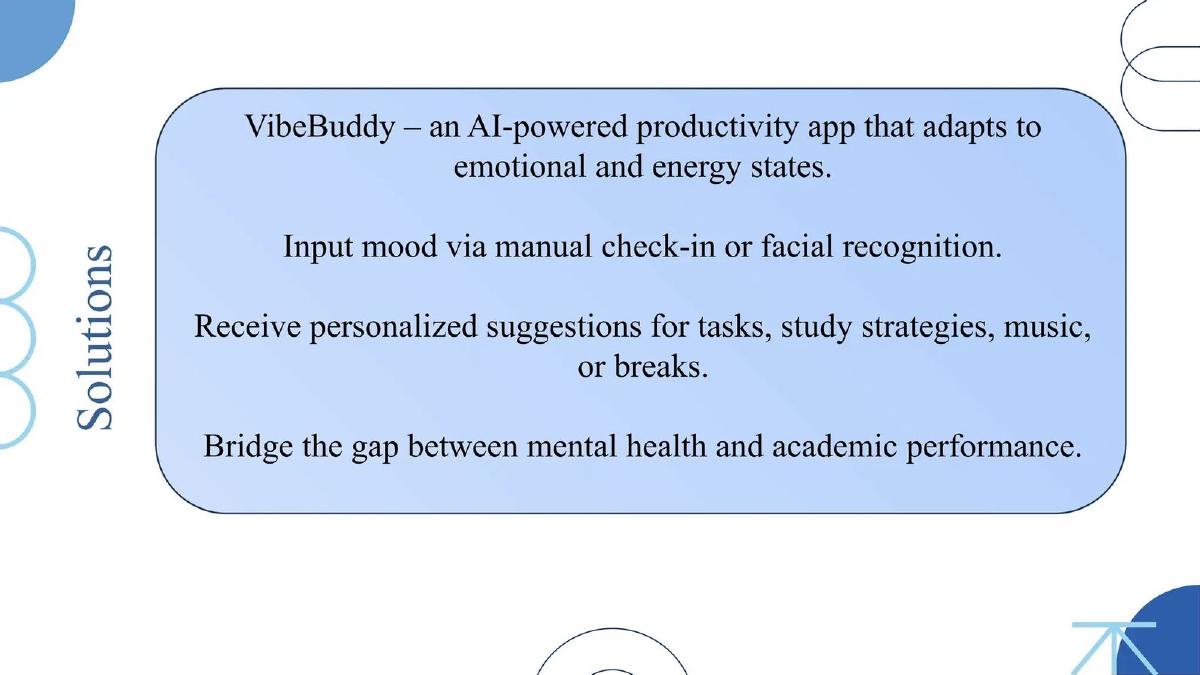
Slide 5: Solutions
The solution slide mirrors the problem slide, stating that VibeBuddy will bridge the gap between mental health and academic performance. It highlights the use of facial recognition or manual check-ins to input mood. The promised outcome is "personalized suggestions for tasks, study strategies, music, or breaks." This slide transitions the deck from the theoretical problem to the functional solution.
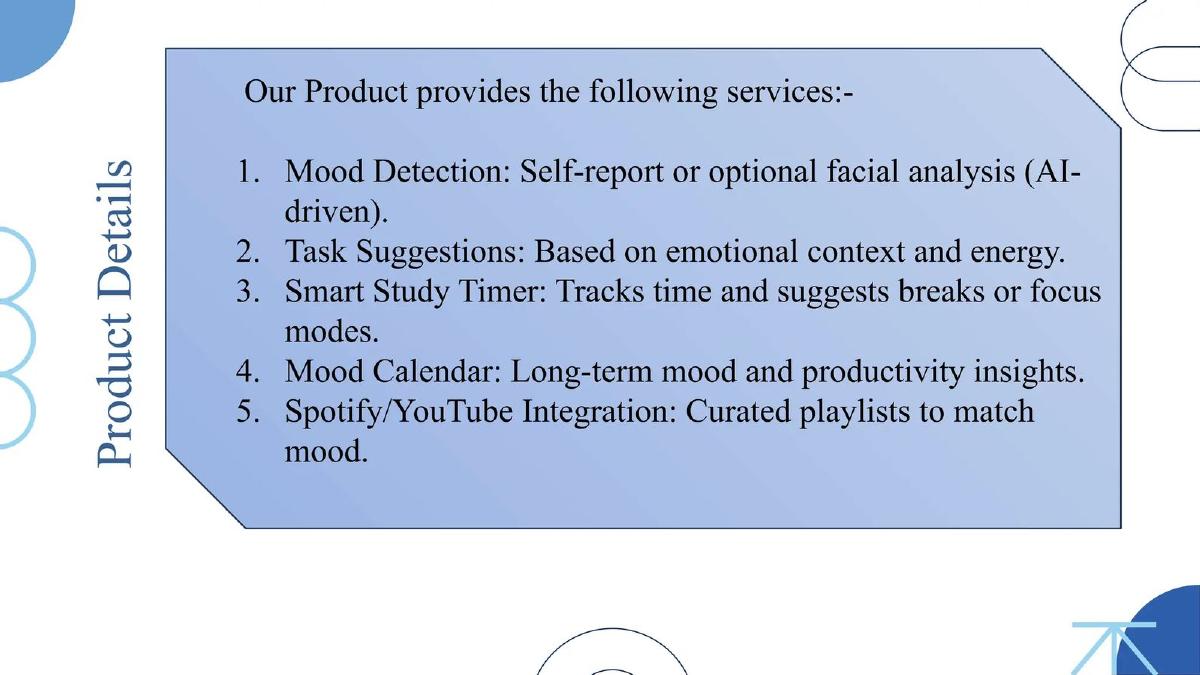
Slide 6: Product Details
This slide provides a more granular look at the service offerings. It lists five specific features: 1. Mood Detection: Self-report or AI-driven facial analysis. 2. Task Suggestions: Based on emotional context and energy. 3. Smart Study Timer: Tracks time and suggests focus modes. 4. Mood Calendar: Provides long-term insights into productivity trends. 5. Spotify/YouTube Integration: Curated playlists to match the user's mood.This is the most technical slide in the deck, though it still lacks screenshots or mockups of the actual user interface (UI), which would significantly strengthen the presentation.
Slide 7: Market Analysis
VibeBuddy identifies a massive potential market. The slide lists:
Primary Target: High school and college students. · Total Addressable Market (TAM): 250M+ global students. · Intersecting Markets: EdTech ($400B+) and Mental Wellness ($4.5T global industry).
While the numbers are impressive, they represent the entire global industry rather than the Serviceable Obtainable Market (SOM). Investors generally prefer to see a more realistic calculation of how much of this market the startup can actually capture in its first few years.
Slide 8: Competitor Analysis
The deck acknowledges three main competitors: Headspace , Endel , and aptihealth . The positioning statement claims that VibeBuddy differentiates itself by being more "interactive and engaging" and by integrating psychological techniques into everyday task management. The deck does not provide a competitive matrix (a common feature in pitch decks), which would have allowed for a direct feature-by-feature comparison.
Slide 9: Business Model
The revenue strategy is presented as a three-stage progression:
Freemium Tier: Core features are free to attract a large user base. · Premium Subscription: Paid access to advanced analytics and deeper personalization. · B2B Partnerships: Licensing the software to schools, counseling centers, and wellness brands.
This is a standard and viable model for SaaS (Software as a Service), though the slide lacks specific pricing points or projected conversion rates.
Slide 10: The Team
Aanchal Jain: Chief Executive Officer · Vaishnavi Verma: Chief Technical Officer · Vidit Agarwal: Chief Financial Officer · Dev Sharma: Chief Marketing Officer · Devanshu Sharma: Chief Operating Officer
The slide includes photos for each member but omits their professional backgrounds, previous exits, or educational credentials. In a seed-stage deck, the team's pedigree is often the most important factor for investors, so the lack of bios is a significant omission.
What Works and What is Missing
What Works: The deck is visually clean and follows a logical narrative. The problem-solution fit is well-articulated, and the identification of the gap between productivity and wellness is a compelling angle. The inclusion of a B2B revenue stream shows that the founders are thinking about scalability beyond individual consumer subscriptions.
What is Missing: The deck is missing several critical components required for a successful fundraise:
The Ask: There is no mention of how much capital is being raised or how it will be allocated. · Traction: There are no metrics regarding current users, waitlist signups, or pilot programs. · Financials: There are no projections for revenue, expenses, or growth over the next 3-5 years. · Product Mockups: Without visual representations of the app, the product remains purely theoretical. · Technical Validation: Using facial recognition for mood detection is a complex technical hurdle; the deck does not explain how the team intends to build or validate this AI.
Founder Takeaways
For founders looking to build a similar deck, the primary lesson here is clarity of vision . VibeBuddy does an excellent job of explaining exactly what the product does in simple terms. However, founders should ensure they include Team Bios that highlight why they are the right people to solve the problem. Additionally, always include a Call to Action or an "Ask" slide at the end. An investor should never finish a deck wondering what the startup needs from them. Finally, if you are pitching an app, visuals are mandatory . Even high-fidelity wireframes are better than text-only descriptions of features.
Frequently asked questions
- What is the core value proposition of VibeBuddy?
- VibeBuddy's core value proposition is 'emotion-based' productivity. Unlike standard task managers, it attempts to synchronize a student's workload with their current mental state. By detecting if a user is stressed or energized, the app suggests specific study methods, music, or breaks to prevent burnout and maximize efficiency.
- How does the app handle mood detection?
- According to slide 6, the app utilizes two methods for mood detection. The first is a manual self-report check-in where users input their feelings. The second is an optional AI-driven facial analysis, which presumably uses the device's camera to interpret emotional cues and energy levels.
- What is the revenue strategy for this startup?
- The strategy is a hybrid model outlined on slide 9. It starts with a Freemium tier to drive user acquisition. Revenue is generated through Premium subscriptions offering 'deeper personalization' and B2B partnerships, where the software is licensed to schools, counseling centers, and wellness brands.
- Who are the primary competitors mentioned in the deck?
- Slide 8 identifies three main competitors: Headspace (meditation/mindfulness), Endel (AI-powered soundscapes), and aptihealth (digital mental health platform). VibeBuddy differentiates itself by specifically targeting the intersection of these wellness features with academic task management.
- What critical information is missing from this pitch?
- The deck is missing several 'hard' data points required for a professional fundraise. There is no slide regarding the 'Ask' (how much money they need), no financial roadmap or burn rate, no mention of existing user traction, and no technical roadmap for the AI development.