Edgify's 13-slide deck is a highly targeted sales-style pitch that addresses a specific, high-friction problem in retail: the identification of non-barcoded items at checkout. The deck stands out by contrasting traditional cloud-based AI training with its proprietary 'Edge Training Loop,' which allows devices to learn locally. While the deck lacks traditional financial projections, a team slide, and a specific 'Ask,' it compensates with a strong technical value proposition, claiming 99.98% accuracy and a 75% reduction in checkout time. The narrative is built around efficiency, privacy, and co…
Key takeaways
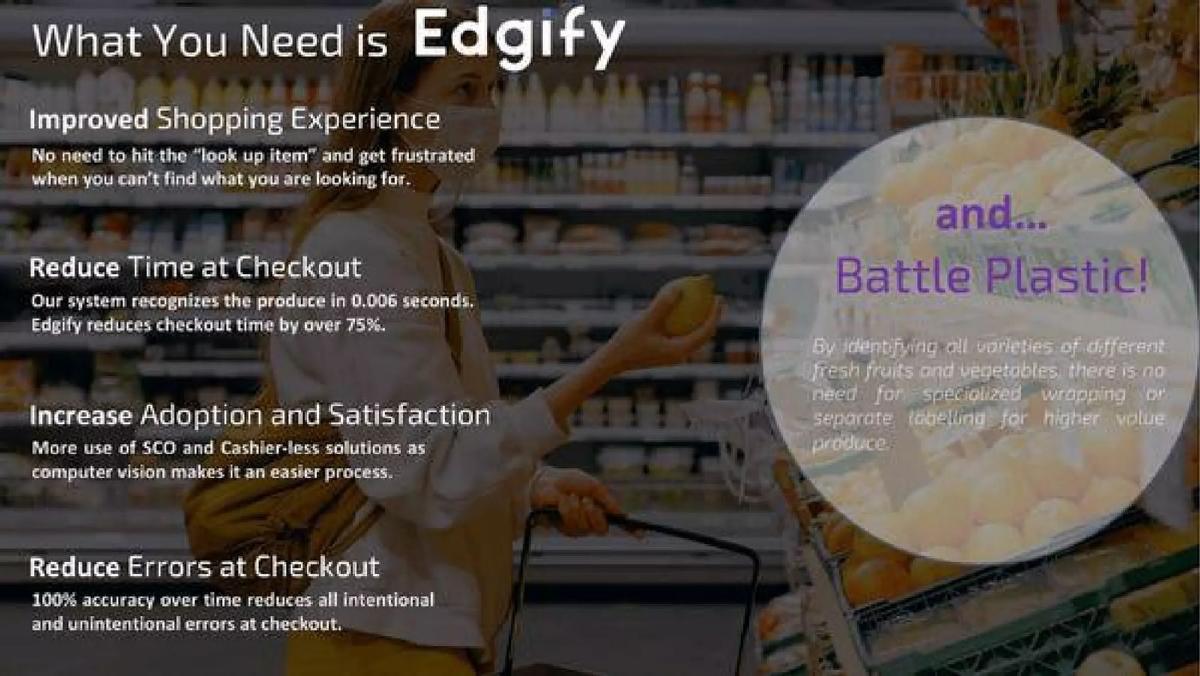
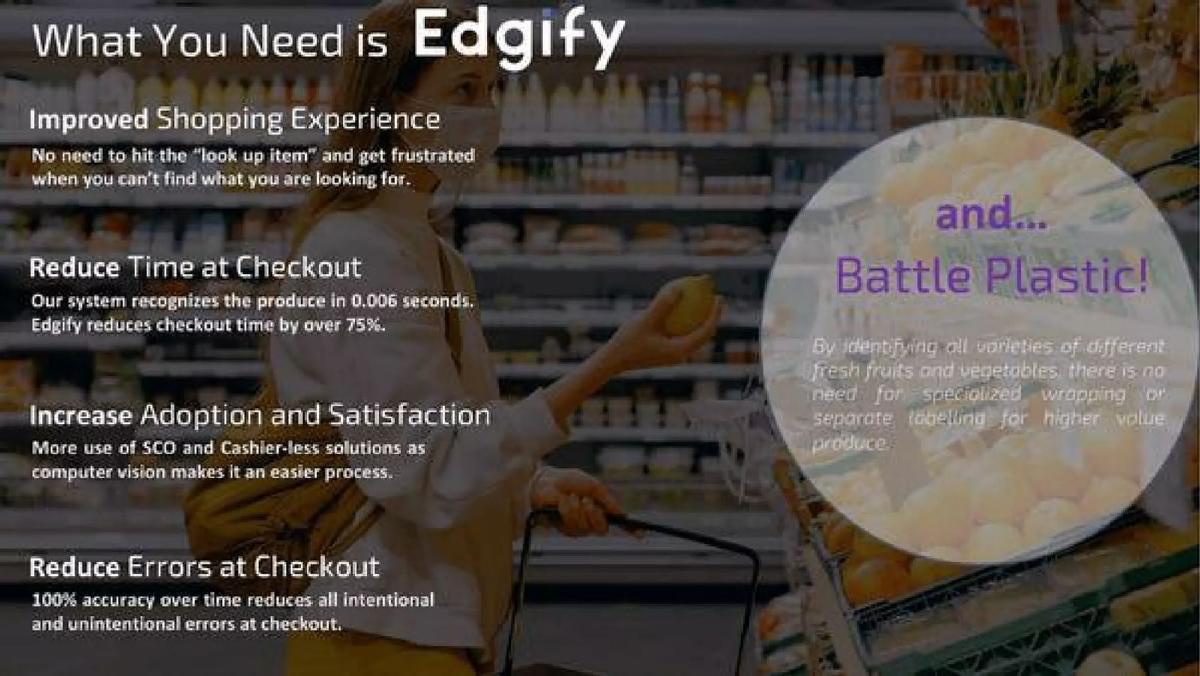
- The deck claims a 75% reduction in checkout time by recognizing produce in just 0.006 seconds (Slide 1).
- Edgify positions its technology as a way to 'Battle Plastic' by eliminating the need for specialized wrapping or labels on high-value produce (Slide 1).
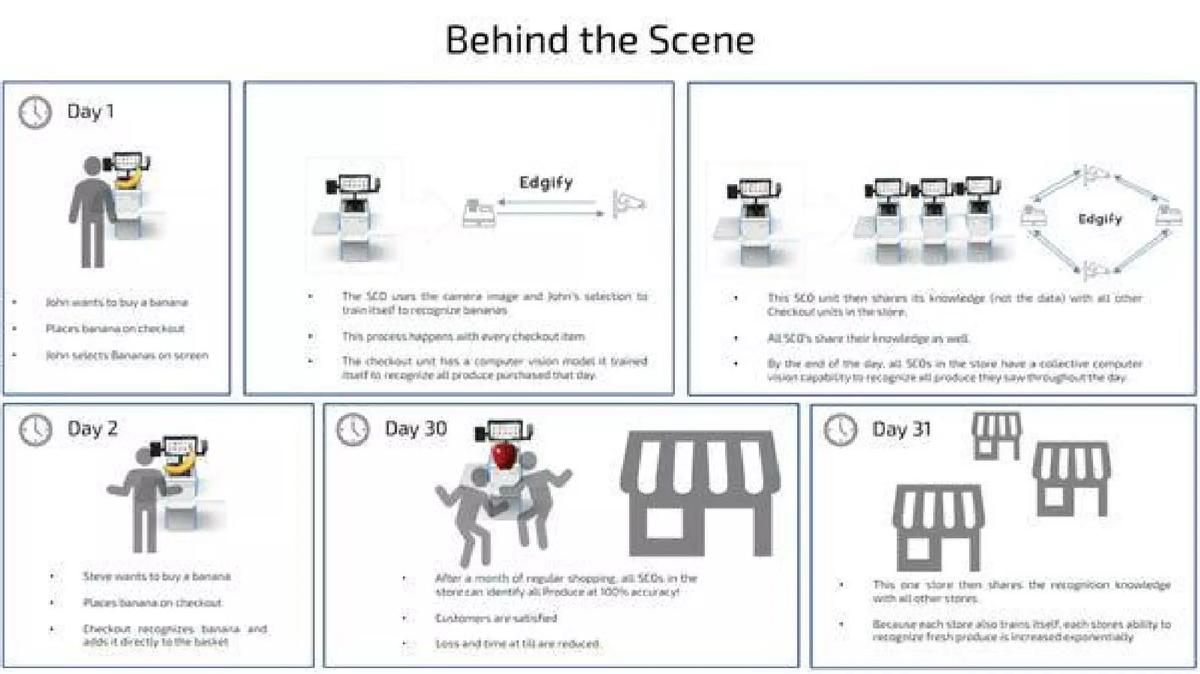
- A 'Behind the Scene' walkthrough explains how a single store's knowledge is shared across all checkout units and eventually all stores (Slide 3).
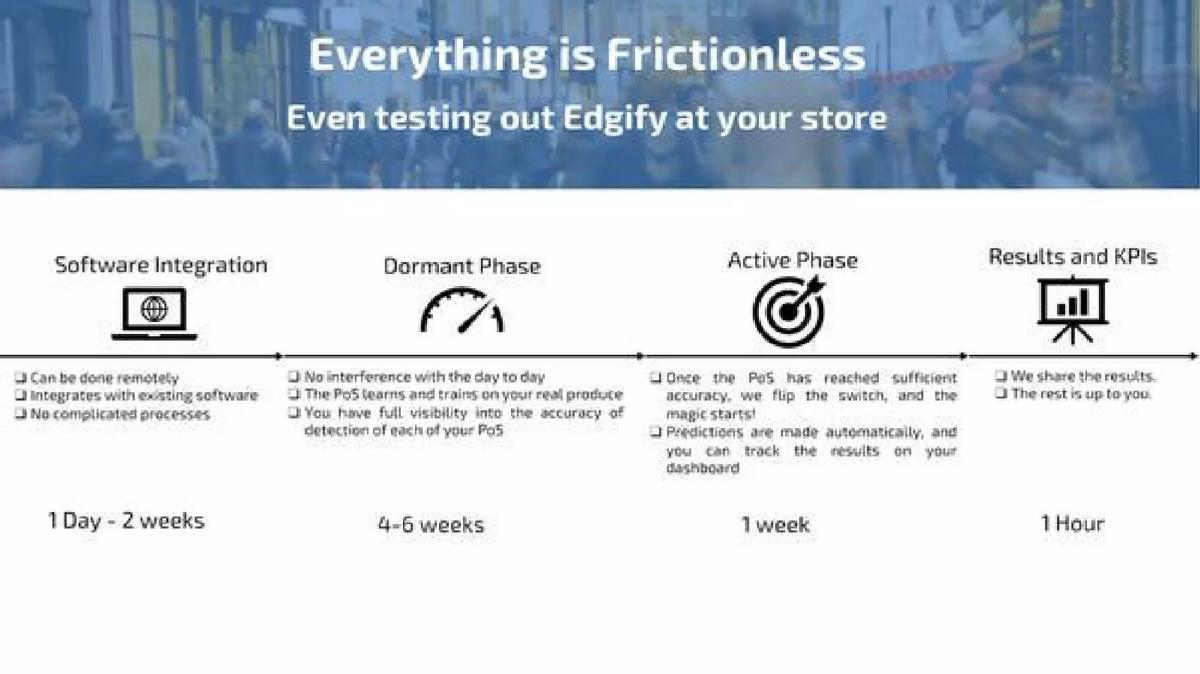
- The implementation timeline is clearly defined, ranging from a 1-day software integration to a 4-6 week 'Dormant Phase' for local training (Slide 4).
- The deck directly challenges cloud giants like Amazon, Azure, and Google by highlighting the inefficiencies of transferring millions of data points to the cloud (Slide 7).
- Technical superiority is asserted through a 99.98% accuracy rate compared to a stated 65% market standard for product detection at PoS (Slide 8).
- The core IP consists of the 'Edgify Edge Training Loop' and the 'Edgify Collaborative Controller' (Slide 9).
- The deck identifies three primary hardware use cases: Lane PoS, Self Checkout (SCO), and PC Scales (Slide 13).
The Value Proposition: Speed and Sustainability
Slide 1: What You Need is Edgify
The opening slide immediately establishes the core benefits of the technology. It lists four primary value drivers: Improved Shopping Experience, Reduce Time at Checkout, Increase Adoption and Satisfaction, and Reduce Errors at Checkout. A specific metric is provided: the system recognizes produce in 0.006 seconds, which leads to a claimed reduction in checkout time by over 75%. Interestingly, the slide also includes a 'Battle Plastic!' callout, arguing that by identifying produce varieties accurately, retailers no longer need specialized wrapping or labels for high-value items.
Slide 2: How will life look like with Edgify?
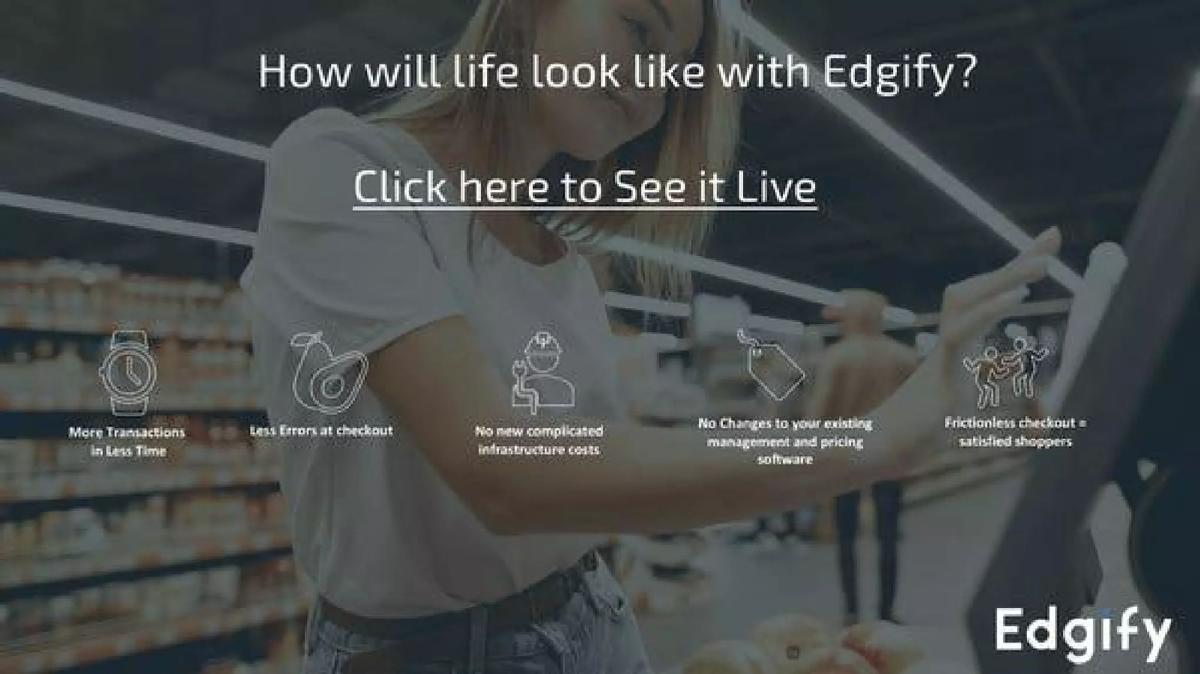
This slide serves as a high-level summary of the user and business benefits. It uses icons to represent five key points: More Transactions in Less Time, Less Errors at checkout, No new complicated infrastructure costs, No Changes to your existing management and pricing software, and Frictionless checkout leading to satisfied shoppers. It also includes a 'Click here to See it Live' call-to-action, suggesting this deck was used in a digital format where a demo video was accessible.
The Technical Workflow
Slide 3: Behind the Scene
This slide uses a storyboard format to explain the machine learning process. It follows 'John' on Day 1 as he buys a banana. The Self Checkout (SCO) unit uses the camera image and John's manual selection to train itself. By the end of the day, the SCO shares its 'knowledge' (not the data) with other units. By Day 2, when 'Steve' buys a banana, the system recognizes it automatically. By Day 30, the store can identify all produce at 100% accuracy, and by Day 31, this knowledge is shared with all other stores in the chain.
Slide 4: Everything is Frictionless
This slide outlines the deployment timeline for a retail partner. It breaks the process into four stages: Software Integration (1 Day - 2 weeks), Dormant Phase (4-6 weeks) where the PoS trains on real produce without interference, Active Phase (1 week) where the system is 'switched on,' and Results/KPIs (1 hour). This is a crucial slide for B2B sales, as it addresses the 'how long will this take' question that plagues enterprise software sales.
The Core Technology and Differentiation
Slide 5: #startyourtransformation
A transition slide featuring the company name and a hashtag. It serves as a visual break before diving into the more technical appendix sections of the deck.
Slide 6: Appendix
A simple title slide indicating that the following slides provide deeper technical or comparative detail.
Slide 7: It's a New Way of Thinking About AI
This is the 'Competitive Landscape' slide, but it focuses on architecture rather than specific companies. It contrasts the 'Old Way' (sending millions of data points to Amazon, Azure, or Google Cloud) with the 'Edgify Way' (local training on the device). The slide argues that cloud-based models don't account for store-specific lighting and require expensive retraining every time a new product is introduced. Edgify, by contrast, trains continuously on the actual machine, maintaining 99.9% accuracy without data looping.
Slide 8: Edgify Changes Everything
This slide is a direct 'Before and After' comparison. It lists seven categories: Accuracy, Time at Till, Loss/Shrinkage, Environmental, AI Costs, Data Privacy, and COVID-19. Notable claims include moving from a 65% market standard accuracy to 99.98%, and reducing AI costs by eliminating the need for server rooms and AI expertise. The inclusion of COVID-19 (transaction rates and minimal touch) suggests this deck was updated or created during the pandemic era, despite the 2015 founding date.
Slide 9: Our Unique IP
Edgify defines its intellectual property through two components: The Edgify Edge Training Loop (software that turns edge devices into training machines with minimal processing power) and The Edgify Collaborative Controller (which combines models from various devices into one optimized model). This slide is essential for justifying a Seed round valuation based on proprietary technology rather than just a first-mover advantage.
Slide 10: Our Groundbreaking Framework
This slide reinforces the 'Distributed yet collaborative training' message. It positions Edgify as the 'only true alternative to centralised learning' and claims the potential to 'change the balance of power in the battle for the cloud.' It uses a diagram to show how different edge units (represented by icons for food, cars, and retail) can interact with a central collaborative hub.
Market Application
Slide 11: Summary of Benefits
A reiteration of the primary value propositions: Increase Turnover, Reduce Time at Till, Reduce Loss at Till, Reduce Friction in Store, and Reduce Use of Plastic. It uses a lifestyle background image to ground the technology in a real-world retail environment.
Slide 12: Accuracy Metrics
This slide provides specific accuracy claims for different product categories: Fruit & Vegetables, Bakery products, and Fresh Produce. It explicitly states 'Accuracy in recognizing produce = 100%' and 'Accuracy in Identifying different varieties of a produce = 100%.' These are bold claims that would likely face heavy scrutiny during technical due diligence.
Slide 13: 3 Main Use Cases
The final slide identifies the hardware targets for the software: Lane PoS (Cashier-operated), Self Checkout (SCO), and PC Scales (used in Fruit & Veg or Dairy sections). The closing statement emphasizes that the software is easily deployed on existing hardware with no new infrastructure required.
What Works
Specific Metrics: The deck is unafraid to use hard numbers. Claiming a recognition speed of 0.006 seconds and a 75% reduction in checkout time gives investors a concrete 'reason to believe' in the efficiency gains. Architectural Contrast: By positioning themselves against the 'Cloud Giants' (Amazon, Azure, Google), they frame their technology as a paradigm shift rather than just an incremental improvement. This is a classic 'David vs. Goliath' narrative that appeals to venture capitalists looking for disruptive technology. Clear Implementation Path: Slide 4 is excellent. It demystifies the integration process for a complex AI product, showing that the 'Dormant Phase' allows for training without disrupting the retailer's daily operations.
What is Missing
The Team: There is no slide introducing the founders or the technical team. For a Seed round, especially one involving deep tech like edge AI, the pedigree of the engineering team is usually a primary factor in the investment decision. Market Size: The deck assumes the investor already understands that retail checkout is a massive market. There is no mention of the Total Addressable Market (TAM) or the specific segment they are targeting first. Business Model: It is unclear how Edgify makes money. Is it a per-transaction fee, a monthly SaaS subscription per device, or a licensing model? The Ask: The deck ends without a call to action for investors. There is no mention of the amount being raised, the valuation, or the milestones the company intends to reach with the new capital. Competition: While they compare themselves to cloud providers, they do not mention other computer vision startups working in the retail space (e.g., Grabango or Standard AI).
What a Founder Should Copy
The 'Behind the Scene' Storyboard: Slide 3 is a masterclass in explaining complex distributed machine learning to a non-technical audience. Using 'John' and 'Steve' to illustrate how a machine learns and then shares that knowledge makes the 'Edge Training Loop' intuitive. The 'From/To' Comparison: Slide 8 effectively summarizes the entire business case in one table. It covers everything from operational efficiency (Time at Till) to social responsibility (Environmental/Plastic) and technical concerns (Data Privacy). Hardware Agnosticism: By showing the software running on existing Lane PoS, SCO, and PC Scales (Slide 13), Edgify removes a major objection: the cost of new hardware. Founders should always emphasize when their solution can leverage a customer's existing capital expenditures.
Frequently asked questions
- What is the primary problem Edgify solves?
- Edgify addresses the friction associated with non-barcoded items at retail checkouts, such as fruits, vegetables, and bakery products. Traditionally, these require manual lookups by cashiers or customers, which is slow and prone to error. Edgify uses computer vision to identify these items in 0.006 seconds, aiming to reduce checkout time by 75% and eliminate the need for plastic packaging used for labeling.
- How does Edgify's AI differ from standard cloud-based AI?
- Unlike traditional AI that requires sending millions of data points to the cloud (like AWS or Azure) for training, Edgify trains models locally on the edge device. This 'Edge Training Loop' accounts for specific store lighting and angles. Once a device learns, it shares the 'knowledge' (not the raw data) with other devices in a collaborative framework, reducing network costs and improving privacy.
- What are the claimed performance metrics?
- The deck makes bold claims regarding accuracy and speed. It states a 99.98% accuracy rate using the Edgify framework, compared to a 65% market standard. It also claims 100% accuracy in recognizing produce varieties over time and a recognition speed of 0.006 seconds. These metrics are central to their value proposition of reducing 'shrinkage' (loss) and increasing transaction rates.
- What is missing from the Edgify pitch deck?
- This deck is notably missing several standard venture capital slides. There is no 'Team' slide showcasing the founders' expertise, no 'Market Size' (TAM/SAM/SOM) analysis, no 'Financials' or unit economics, and no 'Competition' slide other than a high-level comparison to cloud providers. Most importantly, there is no 'Ask' slide detailing how much capital is being raised or how it will be spent.
- How does the implementation process work for a retailer?
- The deck outlines a four-step process: Software Integration (1 day to 2 weeks), a Dormant Phase where the PoS learns from real produce (4-6 weeks), an Active Phase where the system goes live (1 week), and finally, the delivery of Results and KPIs (1 hour). This suggests a low-friction deployment that uses existing hardware without requiring new infrastructure.