Edfa3fly’s pitch deck is an exercise in minimalist efficiency, using just nine slides to tell a compelling story of regional market dominance. The deck bypasses traditional text-heavy slides in favor of clear data visualizations, most notably a revenue chart showing a 108% yearly CAGR and a jump from $0.9M in 2011 to projected revenues of $71.3M by 2017. By identifying four specific 'problems worth solving'—including low credit card penetration and unpredictable customs—the company positions itself as a critical infrastructure layer for cross-border e-commerce in the Middle East and Africa. D…
Key takeaways
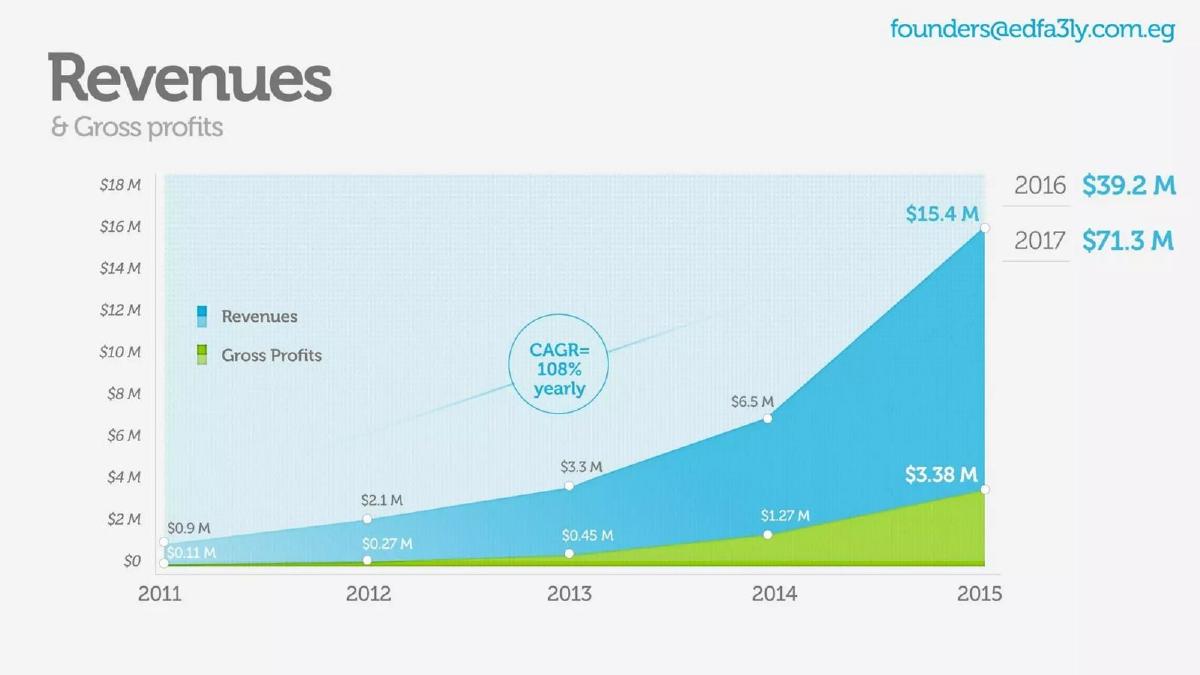
- The deck highlights a consistent 108% yearly CAGR for revenue between 2011 and 2015 on slide 2.
- Revenue projections show a steep climb from $15.4M in 2015 to a forecasted $71.3M in 2017 on slide 2.
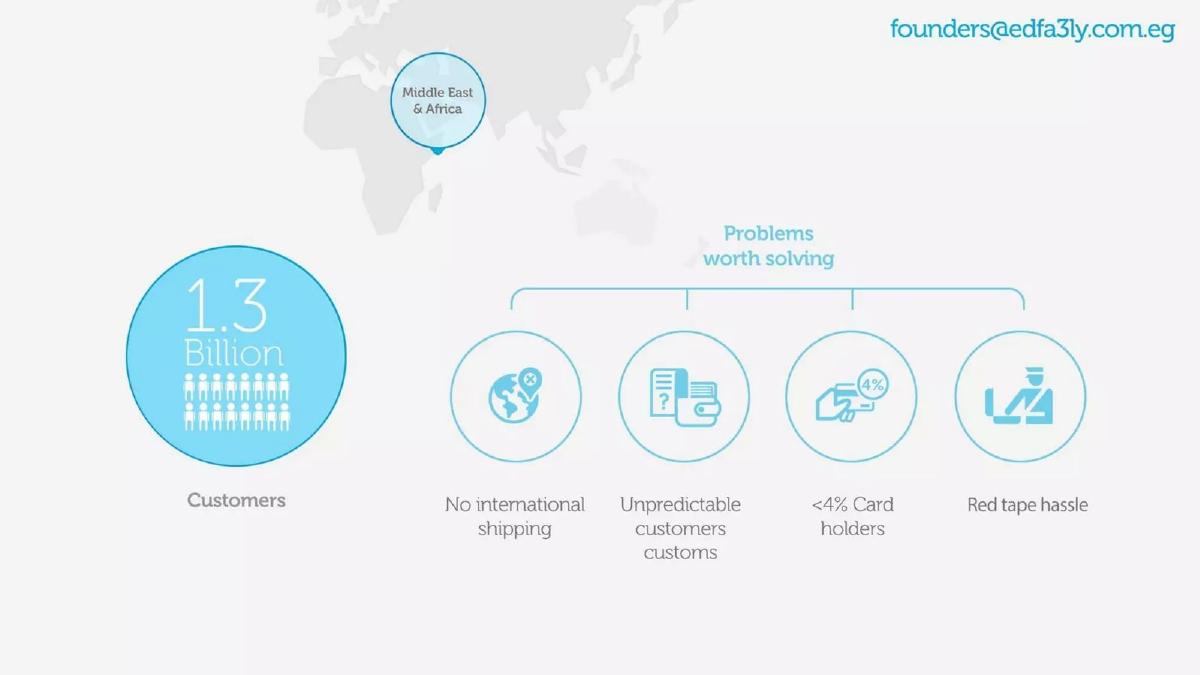
- Market size is defined by a target of 1.3 billion customers across the Middle East and Africa on slide 4.
- The company identifies a critical regional barrier: less than 4% cardholders in their target market on slide 4.
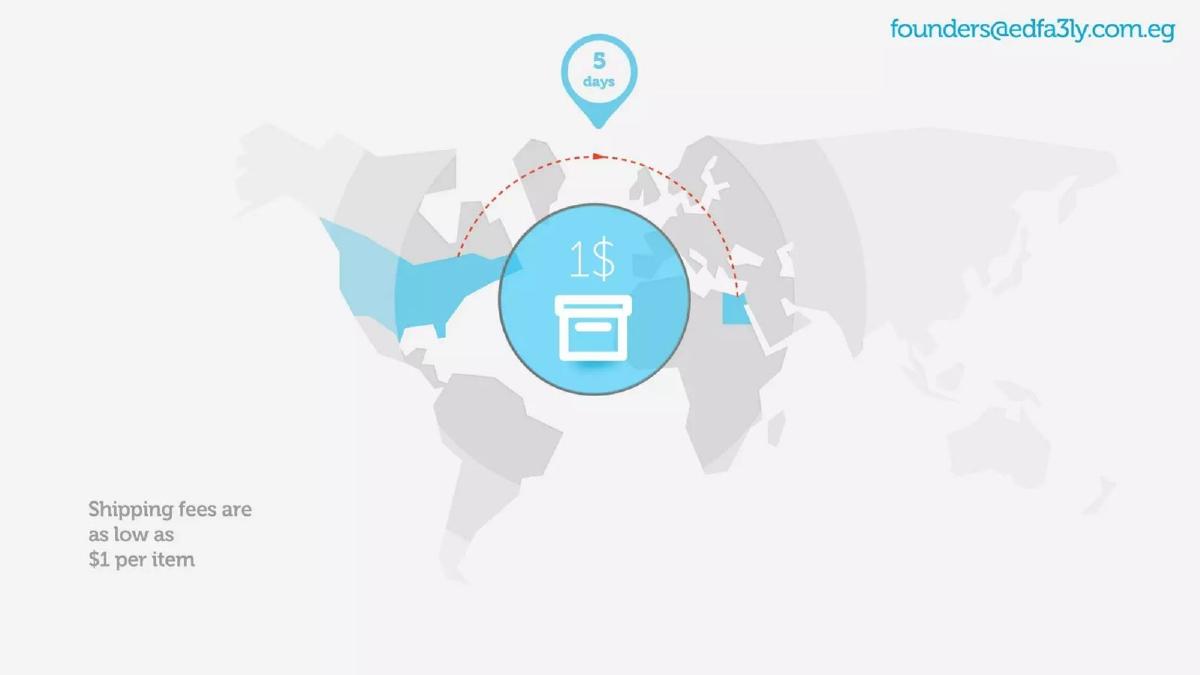
- Logistical efficiency is a core value proposition, claiming shipping fees as low as $1 per item on slide 6.
- Historical efficiency is demonstrated by turning a $150,000 seed fund into 33,000 customers and $15 million in delivered products on slide 7.
- The deck completely omits a team slide, leaving investor backgrounds and founder expertise to be discussed elsewhere.
- There is no explicit 'Ask' slide detailing the amount of capital sought or the planned use of funds.
Introduction: The Lean Traction Deck
Edfa3fly’s 2011 seed deck is a fascinating artifact from the early days of the Middle Eastern e-commerce boom. With only nine slides, it is shorter than the average 12-15 slide deck recommended by most venture capital firms today. However, what it lacks in length, it makes up for in raw data. The deck was used to raise $1.8 million, a significant seed round for the era and region. It succeeds by focusing almost exclusively on two things: the massive friction of cross-border shopping in Africa and the Middle East, and Edfa3fly’s proven ability to overcome that friction profitably.
Slide 1: Title and Positioning
The cover slide is minimalist, featuring the Edfa3fly logo—a stylized 'e' that doubles as a shopping cart. The tagline, "Bridge for Middle Eastern & African consumers to shop the world," immediately establishes the company's value proposition. It doesn't describe itself as a store, but as a "bridge," which is a crucial distinction for a logistics and personal shopper service. The contact email for the founders is clearly visible in the top right corner, a small but important detail for accessibility.
Slide 2: The Traction Powerhouse
Slide 2 is arguably the most important slide in the entire deck. It breaks away from the traditional deck flow (which usually puts traction near the end) to lead with Revenues & Gross profits . The chart shows a CAGR of 108% yearly . The revenue figures are impressive: starting at $0.9 M in 2011 and climbing to $15.4 M in 2015 . The slide also includes forward-looking projections, estimating $39.2 M for 2016 and $71.3 M for 2017 . By showing gross profits (green) alongside revenue (blue), the founders demonstrate that their growth isn't just top-line vanity; they are building a sustainable business. The gross profit for 2015 is listed at $3.38 M .
Slide 3: The User Journey
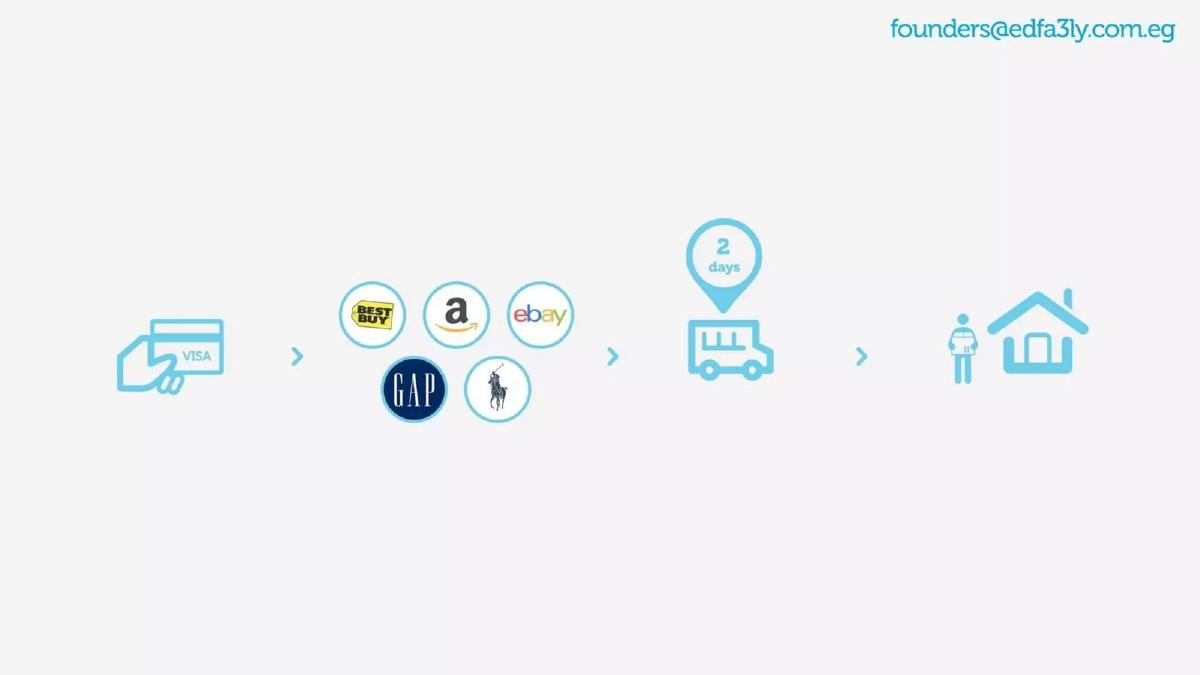
This slide uses simple icons to explain the operational flow. It shows a credit card leading to a cluster of US retail logos ( Best Buy, Amazon, eBay, GAP, Ralph Lauren ), followed by a delivery truck with a "2 days" callout, and finally a courier at a doorstep. This visualizes the "Personal Shopper" model described in the catalogue listing, where Edfa3fly handles the complexity of buying from US-only retailers and moving those goods across borders.
Slide 4: Market Size and Regional Friction
Slide 4 defines the 1.3 Billion Customers in the Middle East & Africa. Rather than just giving a large number, it breaks down the "Problems worth solving" into four distinct buckets: No international shipping , Unpredictable customers customs , <4% Card holders , and Red tape hassle . This slide is critical because it justifies why a local player is needed; global giants like Amazon were not solving these specific regional hurdles in 2011.
Slide 5: Solving the Payment Gap
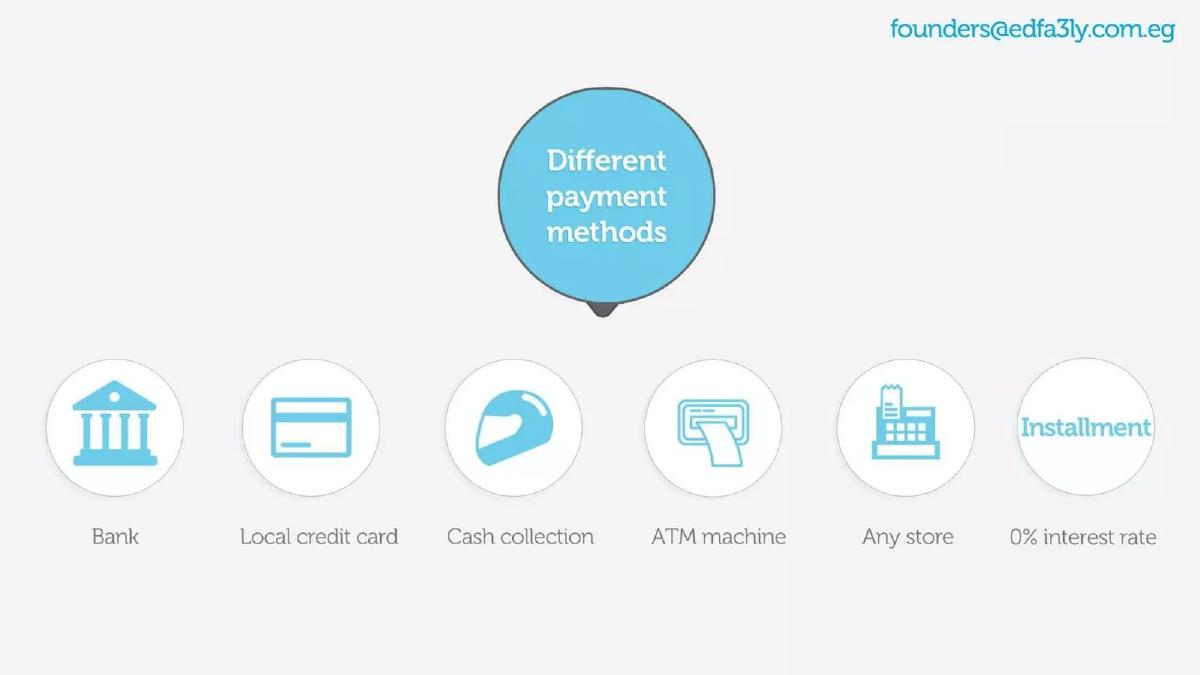
Building on the "<4% Card holders" problem, Slide 5 details the Different payment methods Edfa3fly supports. This is a classic "moat" slide. By accepting Bank transfers, Local credit cards, Cash collection, ATM machines, Any store payments , and 0% interest installments , Edfa3fly makes itself accessible to the 96% of the population that traditional US e-commerce sites cannot reach. The "Cash collection" icon (a motorcycle helmet) hints at a sophisticated local logistics network.
Slide 6: Logistics and Pricing
This slide focuses on the shipping advantage. It features a world map with a red dotted line connecting the US to the Middle East with a "5 days" transit time. The central callout is "$1" per item, supported by text stating "Shipping fees are as low as $1 per item." In the world of international shipping, where costs often exceed the value of the goods, this price point is a major competitive advantage.
Slide 7: Capital Efficiency
Slide 7 is a "proof of concept" slide. It shows that with a $150,000 Seed fund , the company acquired 33,000 Customers and delivered $15 Million in products. This 100x return on capital (in terms of GMV) is a powerful signal to investors that the team knows how to stretch a dollar and that the market demand is organic and aggressive.
Slide 8: The Expansion Roadmap
The penultimate slide shows the transition from a single-market focus (Egypt) to a regional one. The text states, "Now we are expanding in East Africa, North Africa and the Gulf Cooperation Council countries." It displays flags for Kuwait, Kenya, Tunisia, Saudi Arabia, Uganda, Algeria, Morocco, and Tanzania . This demonstrates that the model is not just a local quirk but a scalable solution for emerging markets globally.
Slide 9: Closing
The final slide returns to the logo and the founder's email. It is a standard, clean exit to the presentation.
What Works in This Deck
The primary strength of the Edfa3fly deck is its unwavering focus on traction . By putting the revenue chart on Slide 2, the founders immediately silence any doubts about product-market fit. The use of specific regional pain points—like the 4% credit card penetration—shows a deep understanding of their local environment that a Silicon Valley competitor might lack. Furthermore, the capital efficiency shown on Slide 7 (turning $150k into $15M GMV) is a dream metric for seed investors, as it suggests that additional capital will act as high-octane fuel for an already moving engine.
What is Missing
The most significant omission is the Team Slide . There are no names, no photos, and no professional backgrounds mentioned. In a seed round, investors are primarily betting on the people, so excluding this is a high-risk move that likely required the founders to have strong existing relationships or a very impressive verbal pitch. Also missing is a Competitive Landscape slide. While they mention the problems with US stores, they don't address other regional logistics players or freight forwarders. Finally, there is no Ask Slide . The deck doesn't state how much they are raising or what they will do with the money, which is a standard requirement for a fundraising deck.
What a Founder Should Copy
Founders should emulate Edfa3fly’s visual clarity . There are almost no blocks of text in this deck; every slide uses icons and large-font numbers to convey a single, powerful idea. The "Problems worth solving" framework on Slide 4 is also a perfect way to frame a market opportunity—it doesn't just say the market is big; it says the market is broken, and here is exactly how. Lastly, if you have traction that looks like Slide 2, lead with it . Don't bury your best evidence on page 10; use it to set the tone for the rest of the presentation.
Final Thoughts
Edfa3fly’s deck is a "traction-first" presentation. It assumes that the numbers are so good they speak for themselves. While the lack of a team slide and a clear ask makes it incomplete by modern standards, the $1.8M result proves that for a high-growth company in a difficult market, a clear demonstration of scale and efficiency can outweigh traditional deck structure.
Frequently asked questions
- What is the primary business model of Edfa3fly according to the deck?
- Edfa3fly acts as a personal shopper and logistics bridge for consumers in the Middle East and Africa. As shown on slides 3 and 6, they allow customers to purchase from US stores like Amazon, eBay, and Best Buy, handling the payment, international shipping, and last-mile delivery to the customer's doorstep, often for fees as low as $1 per item.
- How does the company address the lack of credit cards in their target region?
- Slide 5 outlines a comprehensive multi-channel payment strategy to solve the '<4% card holders' problem. They accept payments via traditional banks, local credit cards, cash collection (represented by a courier helmet icon), ATM machines, physical retail stores, and even offer 0% interest installments.
- What kind of growth did Edfa3fly demonstrate to investors?
- The company demonstrated exceptional historical growth. Slide 2 shows revenue growing from $0.9M in 2011 to $15.4M in 2015. More impressively, slide 7 notes that their initial $150,000 seed fund resulted in 33,000 customers and $15 million worth of delivered products, indicating high capital efficiency.
- What are the biggest risks or omissions in this pitch deck?
- The most glaring omission is the lack of a team slide. In seed-stage investing, the founders' ability to execute is paramount, yet this deck provides no names or bios. Additionally, the deck lacks a competitive analysis and a clear 'ask,' meaning it functions more as a traction report than a complete investment proposal.
- What is the expansion strategy mentioned in the deck?
- Slide 8 details a shift from a primary focus on Egypt to a broader regional footprint. The company targets expansion into East Africa, North Africa, and the Gulf Cooperation Council (GCC) countries, showing a map with flags for nations like Kuwait, Saudi Arabia, Kenya, and Morocco.