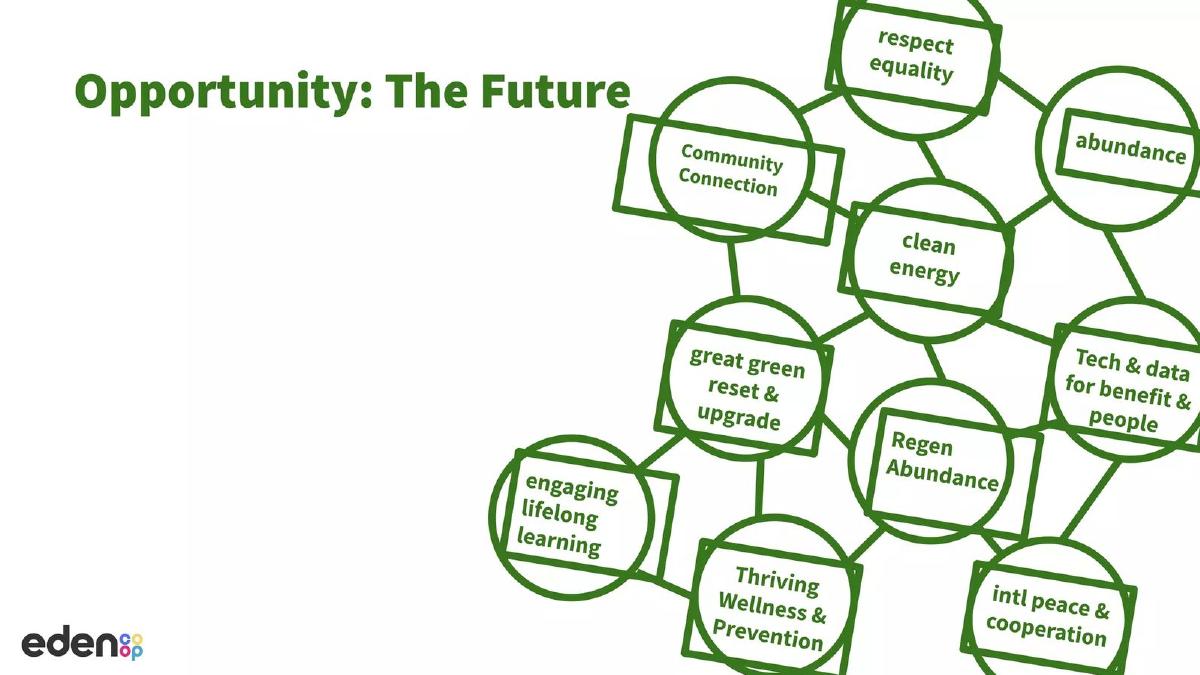
Eden Co-op is a non-profit, cooperative venture seeking to address a 'Complex Cluster' of global problems—ranging from climate change to systemic inequality—by focusing on youth empowerment. The deck outlines a solution based on 'facilitated circles' that provide affordable coaching and community connection, leveraging technology and media to scale. With a stated goal of actualizing 3 billion young people by 2035, the organization positions itself as a holacratic entity that has already completed a six-month pilot with a core team of eight people. The presentation concludes with a bold 'Big P…
Key takeaways
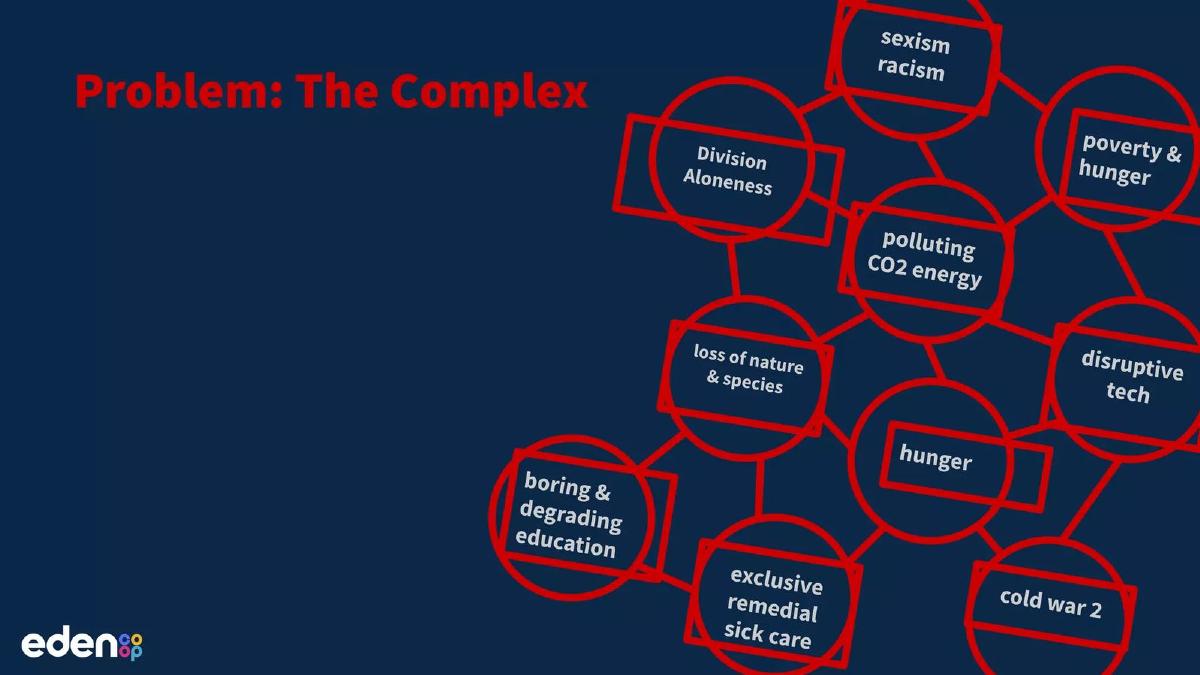
- The deck identifies a 'Complex Cluster' of problems including CO2 energy, sexism, racism, and 'boring & degrading education' (Slide 2).
- The primary goal is the 'actualization' of 3 billion young people to ensure the 'world works' by 2035 (Slide 5).
- The product offering consists of 'facilitated circles' designed to make coaching and community connection affordable (Slide 6).
- Eden Co-op operates as a non-profit, entrepreneurial, cooperative, and holacratic structure (Slide 7).
- The organization reports having a core team of 8 people who have worked for 6 months on business planning and a circle pilot (Slide 7).
- The deck lacks traditional financial projections, unit economics, or a specific investment 'ask' for private investors.
- The #QEden campaign proposes a $10 trillion funding model based on central bank currency printing (Slide 8).
Slide-by-Slide Analysis
Slide 1: Title Slide
The deck opens with a minimalist title slide featuring the eden co-op logo. The branding uses a multi-colored 'co-op' suffix (blue, yellow, pink, and light blue), suggesting a focus on diversity and community. There is no tagline or mission statement on this slide, leaving the initial impression to the brand name alone.
Slide 2: Problem: The Complex
This slide uses a network diagram to visualize a 'Complex Cluster' of global issues. The red circles and connecting lines highlight interconnected problems including sexism, racism, poverty & hunger, polluting CO2 energy, loss of nature & species, disruptive tech, boring & degrading education, exclusive remedial sick care, and cold war 2 . By framing the problem as a 'complex,' the company signals that it is not looking to solve a single vertical issue but rather a systemic failure of current global structures.
Slide 3: What’s missing?
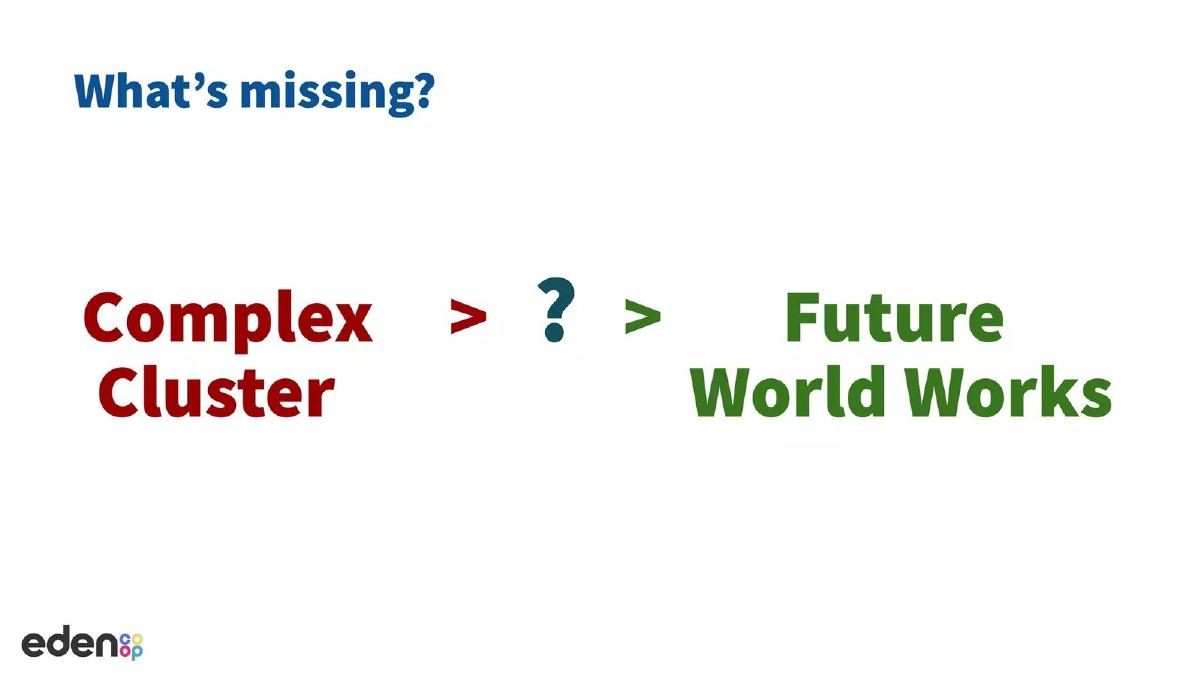
Slide 3 functions as a transition, posing a question about the bridge between the Complex Cluster and a state where Future World Works . It uses a simple flow diagram with a question mark in the center. This is a classic narrative device to introduce the 'hero' (the solution) in the following slides.
Slide 4: Opportunity
The opportunity is defined in two words: next generation . By placing this in large, bold red text on a white background, the deck identifies youth as the primary lever for global change. It suggests that the solution to the 'Complex Cluster' lies in the potential of young people rather than in fixing existing institutions directly.
Slide 5: Solution
The solution slide provides a high-level goal: 'The more & sooner that 3B young people are actualized, the more the world works by 2035.' This sets a massive target—3 billion people—and a specific timeline (2035). The use of the word 'actualized' suggests a psychological or developmental approach to social change, moving beyond simple education or employment metrics.
Slide 6: eden: connection. coaching. community.
This slide defines the operational pillars of the organization. It states that 'Facilitated circles make coaching affordable & personal,' and that 'Technology & media can make learning affordable, personal & engaging.' This is the first mention of the actual mechanism of the business: a combination of small-group facilitated coaching (circles) and a tech/media platform to scale the reach.
Slide 7: eden now
Slide 7 provides the current status of the project. It lists a 'core team & clear vision' consisting of 8 people who have worked for 6 months . Their activities include business planning, identity, and a 'circle pilot & program development.' It also defines the organizational structure as 'non profit, entrepreneurial, cooperative, holacratic.' This slide is crucial as it moves the deck from abstract theory to tangible organizational progress.
Slide 8: big picture: #QEden campaign
The final slide in this set presents a macro-economic argument. It compares the proposed funding for Eden Co-op to COVID-19 stimulus packages, stating that central banks could print '$10 trillion over the next 5 years' to fund these facilitated circles. The slide concludes with the statement: 'There is no better investment in the world than the activation of the next generation.' This moves the 'ask' away from traditional venture capital and toward a global policy or sovereign-level funding model.
What Eden Co-op Does Well
The deck is exceptionally strong at narrative framing . By grouping disparate global issues into a 'Complex Cluster,' it creates a sense of urgency and scale that justifies a massive solution. The visual simplicity—using large text and limited colors—ensures that the core message is never lost in data or jargon.
Furthermore, the definition of the 'lever' is clear. Many social impact decks struggle to explain exactly how they will change the world; Eden Co-op explicitly states that 'actualizing' 3 billion young people is the specific mechanism for global stability. This clarity of purpose is a hallmark of a strong visionary pitch.
The inclusion of the 'eden now' slide (Slide 7) is also a positive. It grounds the high-level philosophy in reality by mentioning a core team of eight and a pilot program. Without this slide, the deck would risk being perceived as purely academic or theoretical.
What is Missing from the Deck
The most glaring omission is unit economics and a revenue model . While the deck mentions making coaching 'affordable,' it does not explain how the organization sustains itself. Even as a non-profit or cooperative, there must be a flow of capital to pay the '8 people' and the facilitators of the circles. The reliance on a $10 trillion central bank stimulus (#QEden) is a political statement rather than a business plan.
There is also no competitor analysis . The coaching and 'community' space is crowded with both for-profit startups (like BetterUp) and established non-profits. The deck does not explain why 'facilitated circles' are superior to existing educational or mentorship models.
Finally, the deck lacks a specific investment ask for the audience it is presumably addressing. Unless this deck is intended solely for central bankers, a private investor or donor would not know how much capital is needed to reach the next milestone or what that milestone actually is (e.g., 'raising $500k to expand the pilot to 1,000 users').
What a Founder Should Copy
Founders should emulate the boldness of the 'Big Picture' . Many decks are too timid, focusing on incremental improvements. Eden Co-op’s willingness to link their success to the resolution of 'Cold War 2' and 'CO2 energy' issues shows a level of ambition that can be very attractive to certain types of impact investors.
The structural transparency on Slide 7 is also worth copying. Clearly stating that the organization is 'holacratic' and a 'cooperative' sets expectations for how the company will be managed. For founders building 'Zebras' (sustainable, community-focused companies) rather than 'Unicorns,' being upfront about a non-traditional corporate structure is essential for finding the right partners.
Lastly, the problem visualization on Slide 2 is a great example of how to show interconnectedness. If your startup operates in a complex ecosystem, using a network map instead of a simple bulleted list can help investors understand the 'ripple effect' of your solution.
Frequently asked questions
- What is the core product of Eden Co-op?
- According to slide 6, the core product is 'facilitated circles.' These are designed to provide affordable and personal coaching, rebuilding connections and community. The deck also mentions that technology and media will be used to make this learning process engaging and scalable for a global audience.
- What is the legal and organizational structure of the company?
- Slide 7 specifies that Eden Co-op is a non-profit, entrepreneurial cooperative. It utilizes a 'holacratic' management style, which typically refers to a system of decentralized management and organizational governance where authority and decision-making are distributed throughout self-organizing teams.
- How does the company plan to fund its $10 trillion vision?
- Slide 8 introduces the #QEden campaign. It argues that since central banks printed $10 trillion in six months for COVID relief, they should print an equivalent amount over the next five years to fund facilitated circles and resources for youth actualization globally.
- What progress has the team made so far?
- Slide 7 notes that the 'eden now' status includes a core team of 8 people. They have spent 6 months on business planning, identity formation, program development, and a 'circle pilot,' indicating that the concept has moved past the pure ideation phase into early testing.
- Who is the target demographic for this solution?
- The deck focuses exclusively on the 'next generation.' Slide 5 explicitly states the goal is to actualize '3B young people.' The problem slide (Slide 2) also highlights 'boring & degrading education' as a key systemic issue they aim to rectify.