The Adaface pitch deck from 2019 is a brief, 10-slide presentation for an HRTech company. It opens with a title slide, followed by a '2018 HRTech recap' slide detailing recent acquisitions and investments in the talent assessment and recruitment space, establishing market relevance. A LinkedIn logo slide and a 'trick questions' slide serve as a problem introduction, leading into a screenshot of the product, which appears to be an AI-driven coding assessment chat interface. The deck then presents early traction points, including '6 figure contracts with 2 government organisations' and '50 stud…
Key takeaways
- The deck is extremely concise, comprising only 10 slides, including title slides (Slide 1, Slide 10).
- It establishes market context early with a '2018 HRTech recap' slide, citing acquisitions and investments in the sector (Slide 2).
- The problem is introduced implicitly through a LinkedIn logo (Slide 3) and a 'trick questions' slide (Slide 4), suggesting issues with traditional technical assessments.
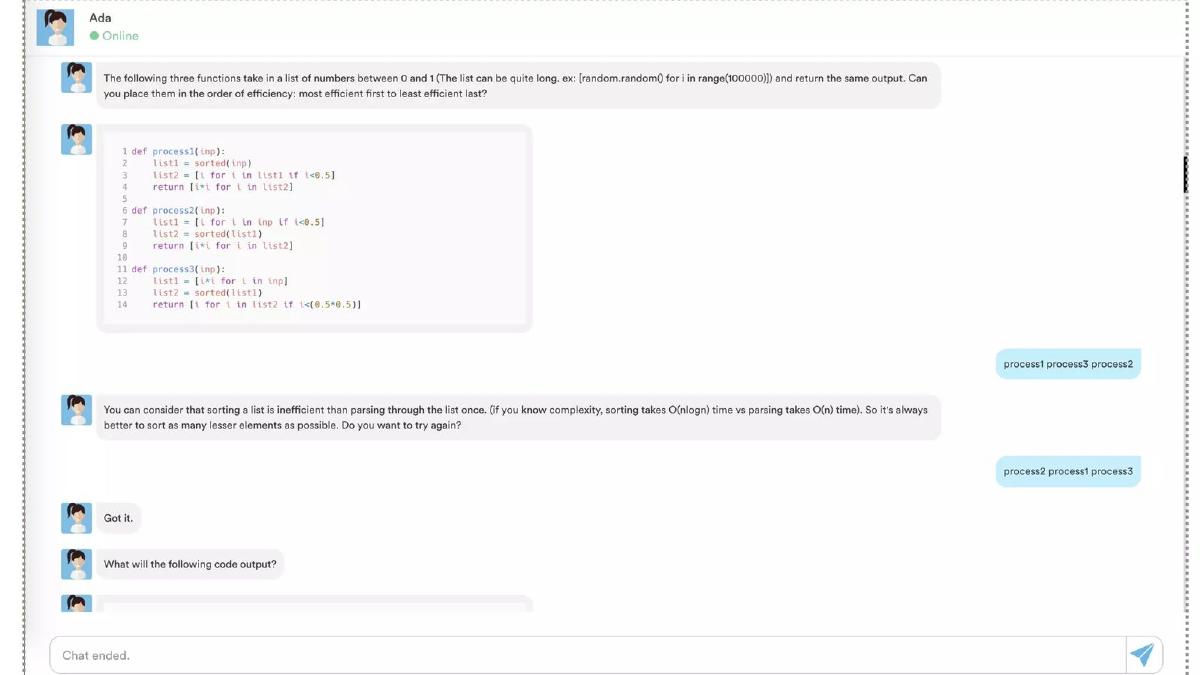
- A product screenshot demonstrates an interactive, chat-based coding assessment tool (Slide 5).
- Early traction is highlighted with '6 figure contracts with 2 government organisations' (Slide 7) and '50 students from tier 1 college in paid beta' (Slide 8).
- The team slide features two founders and showcases affiliations with IIT Alumni, Caltech, Goldman Sachs, FusionCharts, Headout, and Vahan (Slide 9).
- A dedicated slide for 'customers' states 'removed for confidentiality reasons' (Slide 6), indicating existing client relationships without disclosing names.
- The deck omits common fundraising elements such as a detailed problem/solution, market size, business model, competitive landscape, financial projections, or an explicit ask.
Adaface Pitch Deck Teardown: A Sparse, Early-Stage HRTech Overview
This teardown provides a detailed, slide-by-slide analysis of the Adaface pitch deck from 2019. The deck, sourced from SlideShare with the title 'Adaface Pitch Deck 2019', consists of 10 slides. It offers a concise look into an early-stage HRTech company, focusing on market trends, product demonstration, and initial traction. The analysis adheres strictly to the content presented on each slide, noting both what is included and what is conspicuously absent, which is often as informative as the content itself for a fundraising document.
The overall impression of the deck is one of brevity and an early-stage focus. It attempts to quickly establish market relevance and demonstrate product functionality without delving into deeper business metrics or strategic plans. This approach can be effective for initial conversations but typically requires more substance for advanced fundraising rounds.
Slide 1: Title Slide
The deck opens with a simple title slide featuring the company logo: 'Adaface'. The logo consists of a blue, pixelated square graphic to the left of the company name, which is rendered in a sans-serif typeface. This slide serves solely as an introduction to the company name.
Slide 2: 2018 HRTech recap
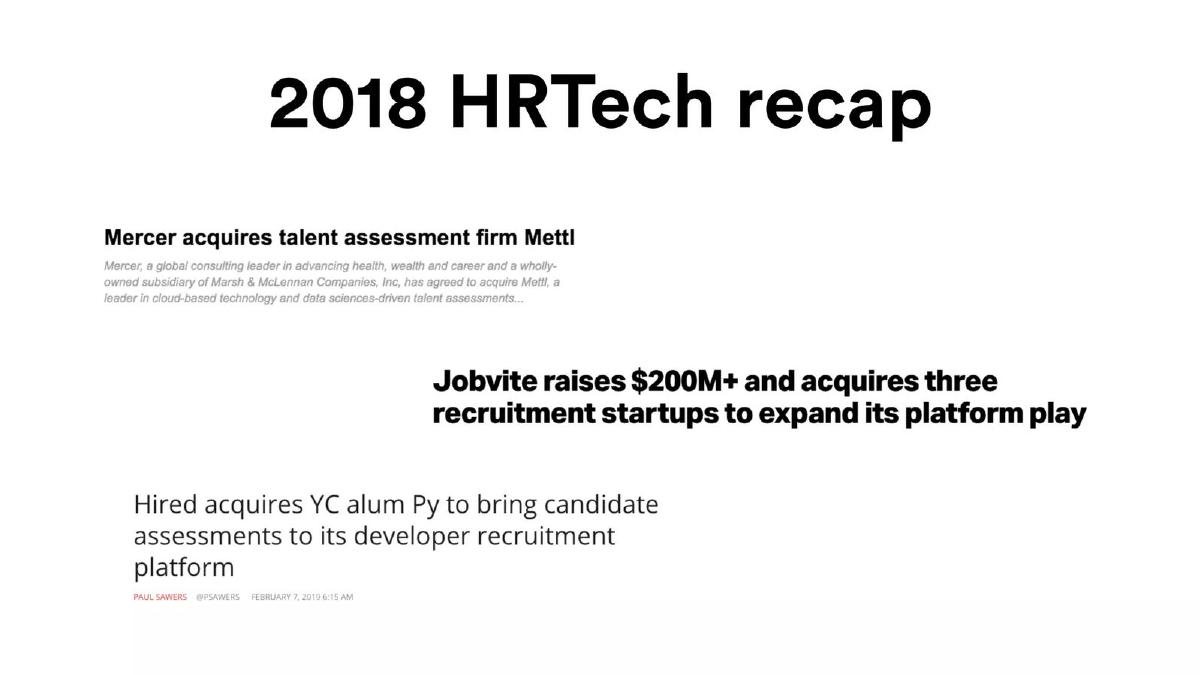
This slide provides context by highlighting significant activities in the HRTech sector during 2018. It lists three distinct news items:
'Mercer acquires talent assessment firm Mettl' : A paragraph below this headline states, 'Mercer, a global consulting leader in advancing health, wealth and career and a wholly-owned subsidiary of Marsh & McLennan Companies, Inc, has agreed to acquire Mettl, a leader in cloud-based technology and data sciences-driven talent assessments...' · 'Jobvite raises $200M+ and acquires three recruitment startups to expand its platform play' · 'Hired acquires YC alum Py to bring candidate assessments to its developer recruitment platform' : This item includes a small attribution 'PAUL SAWERS @PSAWERS FEBRUARY 7, 2019 6:15 AM'.
The purpose of this slide is to demonstrate that the HRTech market, specifically in talent assessment and recruitment, is active with significant M&A and investment, suggesting a fertile ground for Adaface's offering.
Slide 3: LinkedIn Logo
This slide displays only the LinkedIn logo. Its placement directly after the HRTech market recap suggests an implicit connection to professional networking, recruitment, and talent sourcing, which are core functions often associated with LinkedIn. It likely serves to hint at the problem space or a key platform relevant to Adaface's business without explicitly stating it.
Slide 4: trick questions
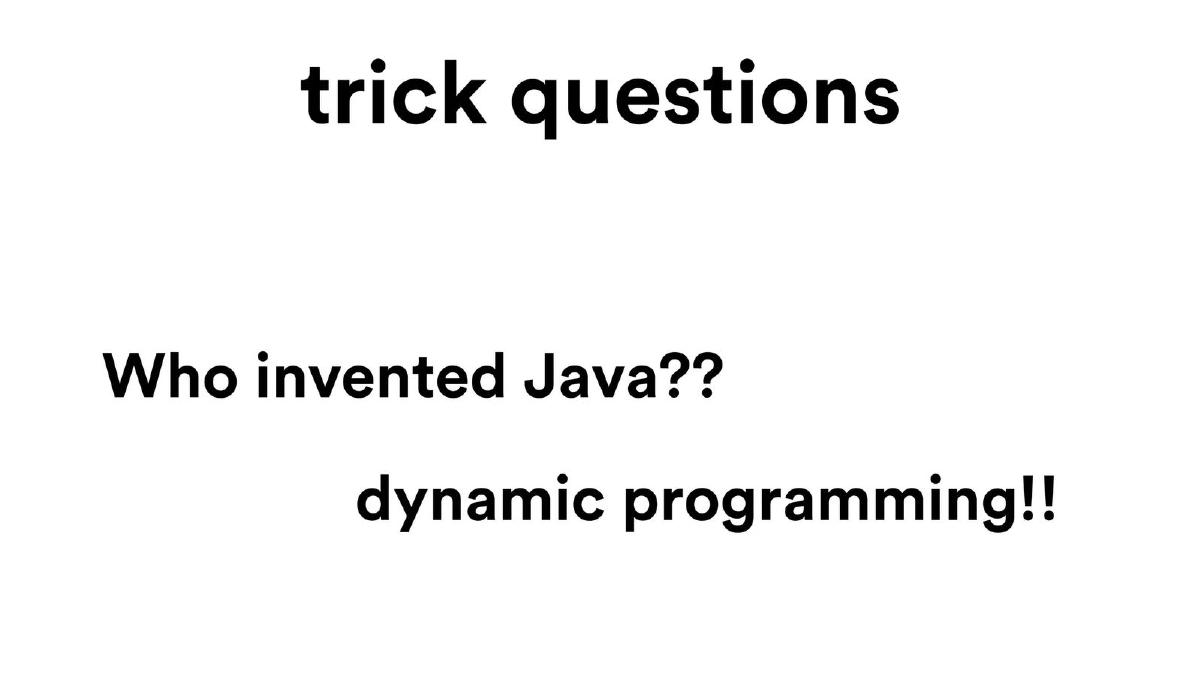
This slide presents two lines of text: 'Who invented Java??' and 'dynamic programming!!'. The title 'trick questions' indicates that these are not meant to be straightforward inquiries. The content implies a critique of superficial or irrelevant technical interview questions, suggesting that traditional assessment methods might be flawed or misleading. This slide acts as an indirect problem statement, highlighting the inadequacy of common technical screening practices.
Slide 5: Product Screenshot
This slide features a detailed screenshot of what appears to be Adaface's product interface. The interface is chat-based, with a character named 'Ada' (labeled 'Online') interacting with a user. The conversation flow shows:
'Ada' poses a question about the efficiency of three Python functions, asking the user to order them. · A code block displays the three Python functions ( process1 , process2 , process3 ). · The user responds with 'process1 process3 process2'. · 'Ada' provides feedback, explaining the time complexity of sorting versus parsing and asking if the user wants to try again. · The user replies 'Got it.'. · 'Ada' then asks 'What will the following code output?'.
This slide effectively demonstrates the core functionality of Adaface: an interactive, AI-powered platform for assessing coding skills through practical questions and immediate, educational feedback. It visually conveys the product's user experience and its focus on deeper technical understanding rather than 'trick questions'.
Slide 6: customers
This slide is dedicated to customer information but explicitly states: 'removed for confidentiality reasons'. This indicates that Adaface has existing customers but has chosen not to disclose their names in this public version of the deck. While it confirms the existence of clients, the lack of specific names or logos means an investor cannot independently verify or assess the caliber of these relationships from this slide alone.
Slide 7: 6 figure contracts with 2 government organisations
This slide presents a key piece of traction: '6 figure contracts with 2 government organisations'. This statement provides a concrete, albeit high-level, indicator of revenue and market validation. Securing government contracts, especially at a '6 figure' value, suggests a level of credibility and product maturity. However, the exact figures, duration, or nature of these contracts are not specified.
Slide 8: Adaface Campus Club
This slide highlights another aspect of early traction or market engagement: 'Adaface Campus Club' with '50 students from tier 1 college in paid beta'. This indicates an initiative to engage with students, potentially as future talent or as a testing ground for the platform. The 'paid beta' aspect suggests early monetization and validation from an educational institution or student body, further diversifying their customer base beyond government organizations.
Slide 9: Team Slide
This slide features a photograph of two individuals, presumably the founders, smiling and standing side-by-side. To the right of their image, a vertical stack of logos is displayed:
IIT ALUMNI · Caltech · Goldman Sachs · FusionCharts · headout · vahan
These logos represent educational backgrounds and professional experiences, signaling strong academic credentials and prior work experience at reputable organizations or successful startups. While the names and specific roles of the founders are not explicitly stated, the logos serve to establish credibility and expertise within the team.
Slide 10: Closing Slide
The deck concludes with a repeat of the title slide, showing only the 'Adaface' logo. This serves as a simple closing, reinforcing the company's brand.
What Works Well
Despite its brevity, the Adaface pitch deck effectively communicates a few critical points. The '2018 HRTech recap' (Slide 2) is a strong opening, immediately establishing a vibrant and active market for talent assessment, which helps investors understand the industry context without requiring extensive prior knowledge. This shows market awareness and positions Adaface within a growing trend of M&A and investment. The implicit problem statement, conveyed through the LinkedIn logo (Slide 3) and 'trick questions' (Slide 4), is clever, hinting at the inefficiencies of traditional technical hiring without explicitly stating a lengthy problem narrative. This approach can pique an investor's curiosity and lead to a more engaging discussion.
The product screenshot (Slide 5) is arguably the strongest element of the deck. It clearly demonstrates the core functionality of Adaface's platform: an interactive, chat-based coding assessment tool that provides immediate feedback. This visual representation is far more impactful than a textual description, allowing investors to quickly grasp the user experience and the value proposition. It showcases a modern, engaging approach to technical evaluation, directly addressing the 'trick questions' problem implied earlier. The inclusion of early traction points, such as '6 figure contracts with 2 government organisations' (Slide 7) and '50 students from tier 1 college in paid beta' (Slide 8), provides tangible evidence of market acceptance and early revenue, which is crucial for early-stage companies. These specific, albeit broad, metrics offer concrete proof that the product is gaining adoption and generating income. Finally, the team slide (Slide 9), while lacking names, uses logos of prestigious institutions and companies (IIT Alumni, Caltech, Goldman Sachs) to effectively convey the founders' strong backgrounds and relevant experience, building credibility through association.
What is Missing
The Adaface pitch deck, while concise, omits several critical components typically expected in a fundraising deck, especially for later-stage rounds, but even for seed. The most significant omission is a clear and detailed problem statement and solution. While 'trick questions' (Slide 4) hints at a problem, it doesn't articulate the full scope of challenges faced by companies in technical hiring, nor does it explicitly detail how Adaface's solution comprehensively addresses these issues beyond the demonstrated chat interface. There is no mention of the specific technology or AI capabilities powering the platform, which would be vital for a tech-focused company.
Furthermore, the deck completely lacks information on the total addressable market (TAM), serviceable available market (SAM), or serviceable obtainable market (SOM). Without these figures, investors cannot assess the potential scale and growth opportunities for Adaface. A business model slide is also absent; while '6 figure contracts' (Slide 7) implies a B2B or B2G sales model, the pricing structure, subscription details, or revenue streams are not explained. The competitive landscape is another major gap. There's no mention of direct or indirect competitors, how Adaface differentiates itself, or its unique selling propositions in a potentially crowded HRTech space. This makes it difficult for investors to understand Adaface's strategic positioning and competitive advantage.
Financial projections, including revenue forecasts, burn rate, and runway, are entirely missing. This is a fundamental requirement for any fundraising deck, as investors need to understand the company's financial health and future trajectory. Unit economics, customer acquisition cost (CAC), and customer lifetime value (LTV) are also not discussed, which are crucial metrics for SaaS businesses. Finally, and perhaps most importantly for a fundraising deck, there is no explicit 'ask' slide. Investors are left without clear guidance on how much capital Adaface is seeking, what it will be used for, or what milestones the funding will achieve. This omission means the deck fails to provide a clear call to action for potential investors.
What a Founder Should Copy
Founders can learn several valuable lessons from the Adaface deck's strengths, particularly in its approach to market context and product demonstration. The strategy of starting with a '2018 HRTech recap' (Slide 2) is excellent for quickly establishing market relevance and investor interest. By showing recent M&A and funding activity in their sector, founders can immediately signal that they are operating in a dynamic and attractive market. This sets a positive tone and provides a macro-level justification for their venture.
The use of an implicit problem statement, as seen with the LinkedIn logo (Slide 3) and 'trick questions' (Slide 4), is a creative way to introduce a pain point without being overly verbose. While it needs to be followed up with a more explicit problem/solution, this method can be effective for initial engagement. It encourages investors to think about the problem themselves before the solution is presented, making them more receptive. Most importantly, the detailed product screenshot (Slide 5) is a masterclass in demonstrating value. Founders should strive to include clear, intuitive visual representations of their product in action. Showing, rather than just telling, how the product works and the user experience it offers can significantly enhance an investor's understanding and excitement. For tech companies, a live demo or a detailed screenshot with annotations can be incredibly powerful.
Finally, the inclusion of early, quantifiable traction points, such as '6 figure contracts with 2 government organisations' (Slide 7) and '50 students from tier 1 college in paid beta' (Slide 8), is crucial. Even in early stages, any concrete evidence of customer adoption, revenue, or successful pilots provides validation. Founders should always aim to include specific numbers and types of customers or users to demonstrate momentum. The use of logos on the team slide (Slide 9) to convey credibility, even without explicit names, is also a good tactic for early-stage decks where brevity is key, assuming the logos are genuinely impressive and relevant to the company's mission.
Frequently asked questions
- What year was this Adaface pitch deck created?
- The SlideShare title for this deck is 'Adaface Pitch Deck 2019', indicating it was created in 2019. This information is derived from the source listing rather than a slide within the deck itself.
- What is the core product or service presented in the deck?
- The core product appears to be an AI-driven or chat-based technical assessment platform. Slide 5 shows a screenshot of an interactive chat interface where 'Ada' asks coding-related questions and provides feedback, suggesting a tool for evaluating developer skills.
- Does the deck include information about the company's financial performance or projections?
- No, the deck does not include any slides detailing financial performance, revenue figures, or future projections. It only mentions '6 figure contracts' on Slide 7 as a form of early traction, but no specific monetary values or growth rates are provided.
- Who are the founders of Adaface, according to the deck?
- Slide 9 features a photograph of two individuals, presumably the founders. Their names are not explicitly stated on the slide, but their affiliations with IIT Alumni, Caltech, and companies like Goldman Sachs, FusionCharts, Headout, and Vahan are displayed.
- What key information is missing from this pitch deck that investors typically look for?
- Several key pieces of information are missing, including a clear problem statement, detailed solution, market size analysis, business model, competitive landscape, go-to-market strategy, financial projections, and a specific 'ask' or funding request. The deck focuses heavily on market context, product demonstration, and early traction.