Acin’s 14-slide Series A deck is a highly professional, enterprise-focused presentation that successfully argues for the electronification of operational risk. The company’s core value proposition lies in its 'Acin Code'—a standardized taxonomy that allows Tier 1 banks to benchmark their internal controls against the industry. The deck is notable for its heavy reliance on social proof, showcasing logos like J.P. Morgan, Credit Suisse, and UBS as early adopters. While the deck lacks a traditional team slide or a specific financial 'ask' slide, it compensates with rigorous problem-definition an…
Key takeaways
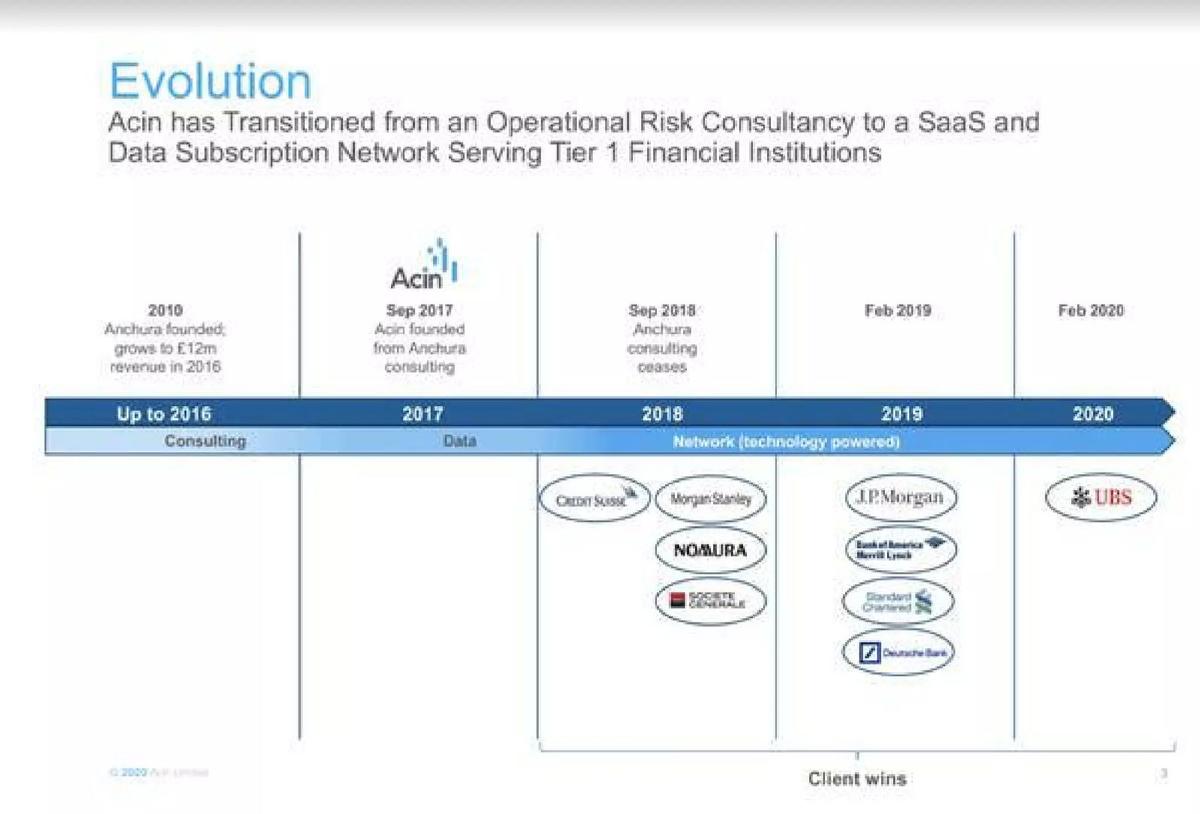
- The company successfully transitioned from a consultancy (Anchura) with £12m revenue in 2016 to a SaaS network (Slide 3).
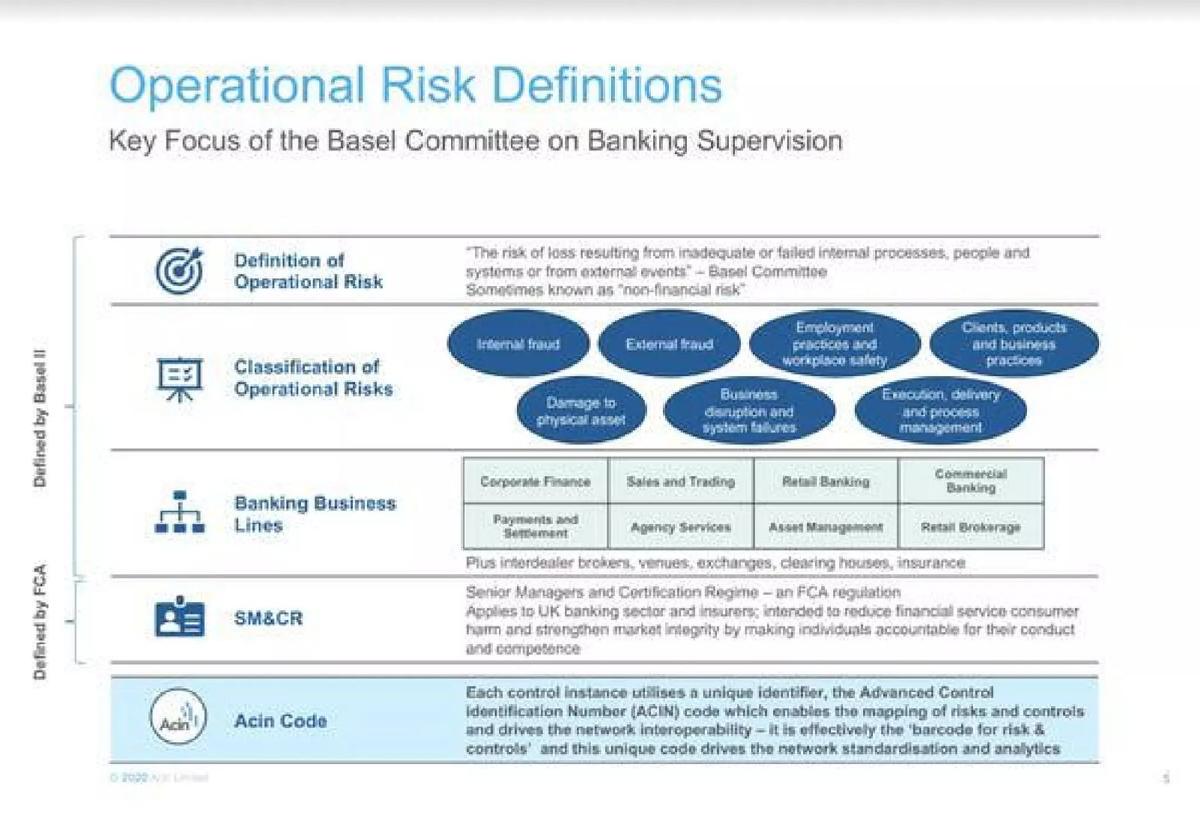
- Acin uses a proprietary 'Acin Code' to standardize risk data across the industry, creating a 'barcode for risk' (Slide 4).
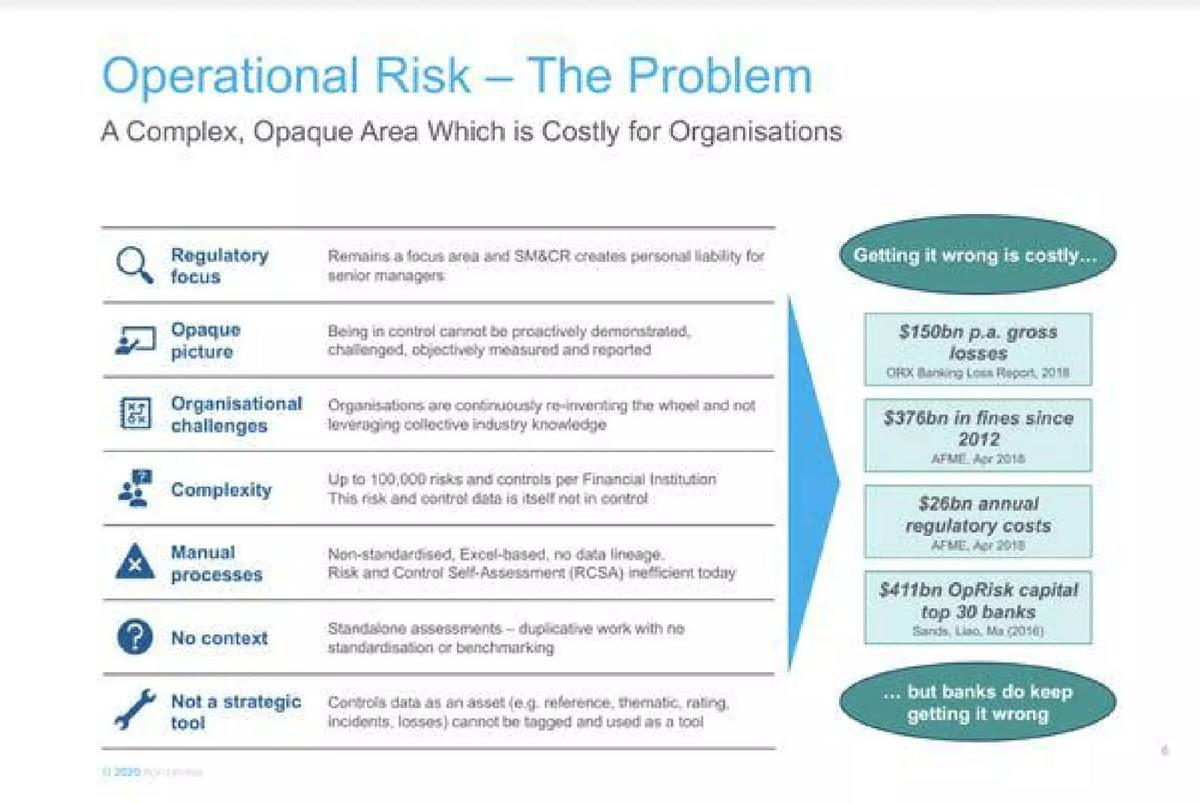
- The problem is quantified with massive figures: $150bn in annual gross losses and $376bn in fines since 2012 (Slide 5).
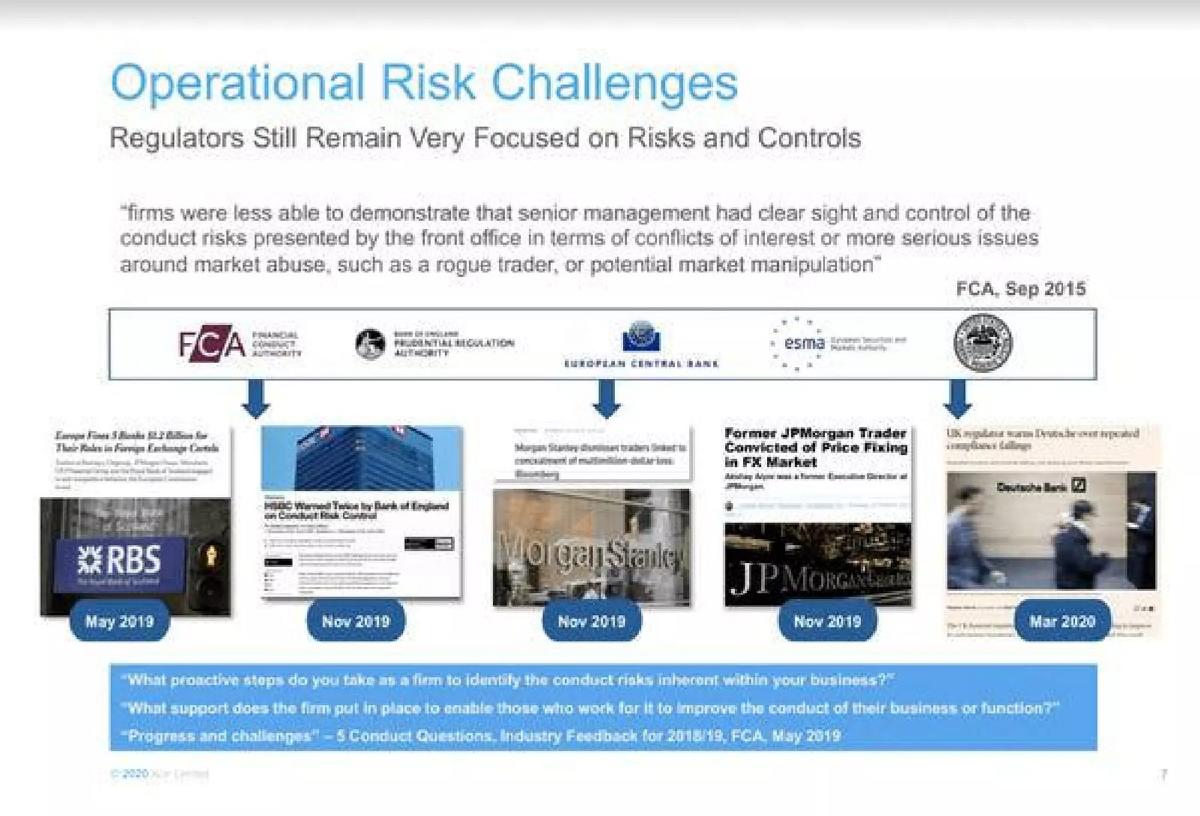
- The deck leverages significant regulatory pressure, citing the FCA and Basel Committee to create urgency (Slide 6).
- Social proof is a primary driver, featuring logos from J.P. Morgan, Morgan Stanley, and UBS as 'Client wins' (Slide 3).
- Product efficacy is demonstrated through case studies showing that Bank 2 had 55% of its controls missing compared to the Acin standard (Slide 10).
- The network effect is visualized through a growth chart showing 'Unique Control Identifiers' jumping from 1,200 in 2018 to 35,000 in 2020 (Slide 14).
- The deck omits a dedicated team slide, financial projections, and a specific funding ask.
The Enterprise Fintech Blueprint
Acin’s pitch deck is a sophisticated example of how to pitch to institutional investors in the RegTech and FinTech space. Unlike consumer-facing startups that focus on user growth and virality, Acin focuses on systemic risk, regulatory pressure, and industry-wide standardization . The deck is designed to look and feel like the reports produced by the very banks they sell to—professional, data-dense, and authoritative.
Slides 1-2: The Vision and Purpose
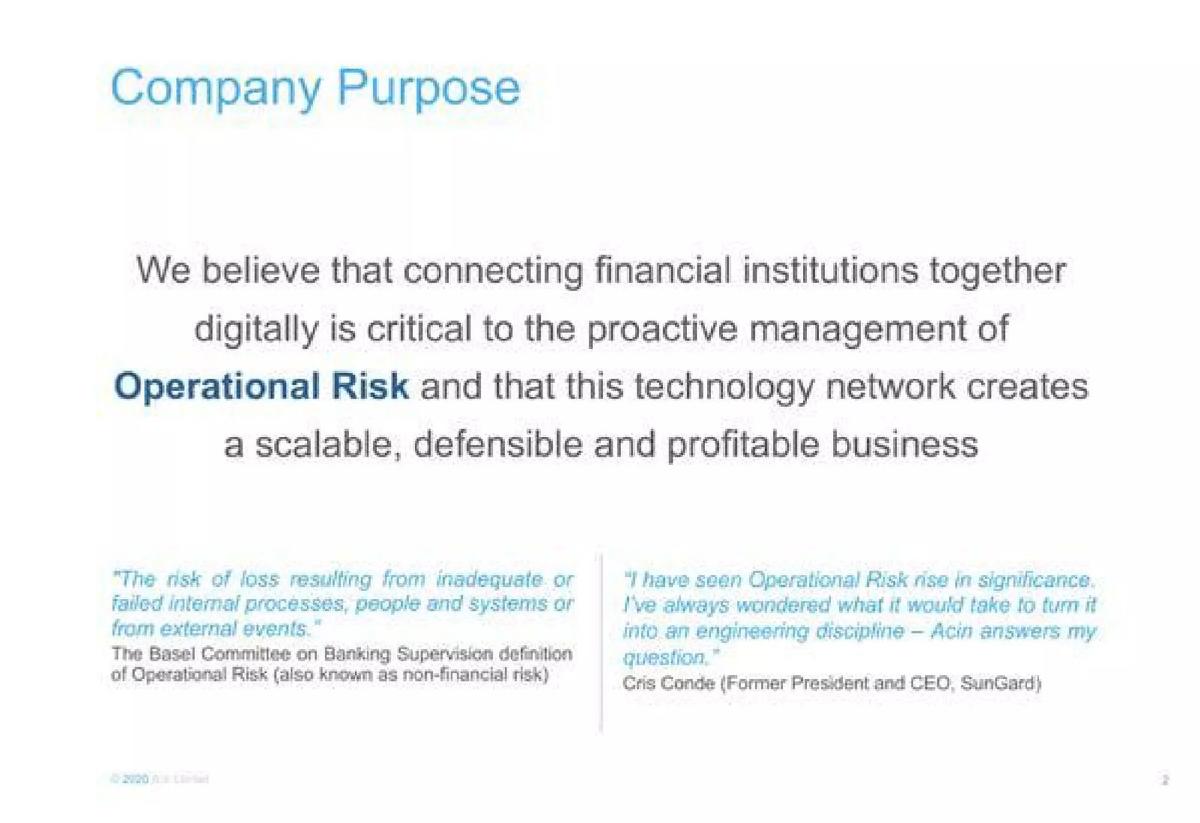
The deck opens with a clean title slide (Slide 1) dated April 2020, followed immediately by the 'Company Purpose' (Slide 2). Acin defines its mission as connecting financial institutions digitally to manage Operational Risk . They include a heavy-hitting quote from Cris Conde, former CEO of SunGard, who describes Acin as turning operational risk into an 'engineering discipline.' This sets the stage: this is not just a software tool; it is a new industry standard.
Slide 3: The Evolution of a SaaS Network
Slide 3 is perhaps the most important slide for establishing credibility. It shows the company's transition from Anchura (a consultancy founded in 2010 that grew to £12m revenue) to Acin (a SaaS and Data Subscription Network). This 'consulting-to-product' story is a favorite for investors because it proves the founders have deep domain expertise and a pre-existing relationship with their target customers. The timeline shows a rapid succession of Tier 1 client wins from 2018 to 2020, including J.P. Morgan, Deutsche Bank, and UBS .
Slides 4-6: Defining the Problem and the Opportunity
Acin spends three slides defining the 'Operational Risk' landscape. Slide 4 uses the Basel Committee’s definitions to categorize risks like internal fraud, external fraud, and business disruption. Slide 5 quantifies the pain: $150bn in annual gross losses and $376bn in fines since 2012 . They characterize the current state of the industry as 'manual processes' that are 'Excel-based' with 'no data lineage.' Slide 6 adds regulatory urgency, showing headlines of fines and conduct issues at RBS, HSBC, and Morgan Stanley, framed by a quote from the FCA.
Slides 7-9: The Solution and Platform
Slide 7 introduces 'The Acin Terminal,' highlighting features like Risk Intelligence, Benchmarks & Analytics, and Data Architecture . Slide 8 dives into the 'Platform' and the 'Data-First Build Strategy.' It mentions a modern tech stack including React, Docker, Scala, and Python , and specifically highlights their 'bespoke Natural Language Processing engine.' This slide reassures investors that the underlying technology is scalable and modern. Slide 9 summarizes the benefits to clients, emphasizing the 'network effect' where risk identification ensures 'no unknown unknowns that are known to peers/industry.'
Slide 10: Proving the Value with Case Studies
Slide 10 provides empirical evidence of the product's value. It shows anonymized data from three banks. For example, Bank 2 was found to have 55% of its controls missing compared to the Acin standard, with 134 metrics missing. This slide moves the pitch from theoretical benefits to concrete ROI: the software finds exactly where a bank is vulnerable to a multi-billion dollar fine.
Slides 11-14: The Network Effect and Data Growth
Slide 11 reiterates the solution as a 'Technology Solution to Identify, Manage, Benchmark and Analyse.' Slide 12 focuses on 'Risk Intelligence' reports, specifically mentioning 'Colocation/WFH (Covid-19)' as a specific risk scenario—showing the platform's relevance to current events at the time. Slide 14 concludes with a 'hockey stick' graph of Unique Control Identifiers , which grew from 1,200 in October 2018 to 35,000 in January 2020 . This graph visualizes the growing 'moat' of the business: as more banks join, the data becomes more comprehensive and the benchmarking more valuable.
What Works in the Acin Deck
Unassailable Social Proof: Listing nearly a dozen of the world's largest banks as customers is the ultimate 'de-risking' mechanism for a Series A investor. It proves that the product can pass the grueling procurement and security audits of Tier 1 financial institutions.
Standardization as a Moat: By creating the 'Acin Code,' the company isn't just selling software; they are attempting to own the 'language' of risk. If the industry adopts their taxonomy, they become an entrenched utility that is very difficult to displace.
Clarity of the 'Why Now': By citing specific FCA regulations (SM&CR) and the Basel Committee, Acin makes it clear that the 'status quo' of using Excel is no longer legally or operationally viable for bank executives.
What is Missing from the Acin Deck
The Team Slide: It is highly unusual for a Series A deck to omit a team slide. While the 'Evolution' slide hints at their consulting background, investors typically want to see the specific bios of the leadership team and their technical/regulatory pedigree.
Financials and Unit Economics: There is no mention of Annual Recurring Revenue (ARR), churn rates, or Customer Acquisition Cost (CAC). While the client logos are impressive, the deck doesn't explain the pricing model or the typical contract value (ACV).
The Ask: The deck ends abruptly without a 'The Ask' slide. There is no information on the size of the round, the valuation target, or how the capital will be deployed (e.g., sales expansion, R&D, geographic growth).
What a Founder Should Copy
The 'Evolution' Slide: If you are pivoting from a service business to a product business, use Slide 3 as your template. It shows how your past expertise fuels your current product and uses revenue from the 'old' business to validate the 'new' one.
The Problem Quantification: Don't just say the problem is 'big.' Use Slide 5's approach: find the specific industry reports (like the ORX Banking Loss Report) and cite the exact dollar amounts of losses and fines. It makes the 'cost of inaction' for the customer feel massive.
The Benchmarking Visual: Slide 14's 'Maturing vs. Optimised' quadrant is a great way to show how your product helps a customer move from 'inconsistent' to 'simplified and complete' relative to their peers. It taps into the competitive nature of enterprise clients.
Frequently asked questions
- What is the core product Acin is selling?
- Acin sells 'The Acin Terminal,' a SaaS platform that allows financial institutions to manage, benchmark, and analyze non-financial risks. Its secret sauce is the 'Acin Code,' a standardized data taxonomy that enables banks to compare their internal risk controls against an anonymized industry peer group, effectively creating a network effect for regulatory compliance.
- How does Acin demonstrate market traction?
- Traction is shown through an 'Evolution' timeline on Slide 3, which lists Tier 1 client wins including Credit Suisse, Morgan Stanley, Nomura, Societe Generale, J.P. Morgan, Bank of America Merrill Lynch, Standard Chartered, Deutsche Bank, and UBS. This list of global systemically important banks (G-SIBs) serves as ultimate validation for a Series A fintech.
- What is the 'problem' Acin is solving according to the deck?
- The deck identifies operational risk as a 'complex, opaque area' where banks currently use manual, Excel-based processes. It highlights that banks have up to 100,000 risks and controls that are not standardized, leading to $150bn in annual losses and $26bn in annual regulatory costs. Acin aims to turn these 'standalone assessments' into a strategic, networked tool.
- Why is the 'Acin Code' important for their business model?
- The Acin Code acts as a 'barcode for risk and controls.' By assigning a unique identifier to every control instance, Acin enables 'network interoperability.' This means different banks can speak the same data language, allowing Acin to provide cross-industry analytics and benchmarking that would be impossible if every bank used its own proprietary naming conventions.
- What is missing from this pitch deck?
- The deck is notably missing a Team slide, which is unusual for a Series A. It also lacks a 'The Ask' slide detailing how much they are raising and how the funds will be used. Furthermore, there are no detailed financial projections or unit economics (CAC/LTV) included in this specific version of the presentation.