Acquco’s 9-slide Series A deck is a high-velocity presentation designed for a specific moment in the e-commerce aggregator craze of 2020. By the time this deck was presented, the company had already raised over $165 million (Slide 2) and achieved $100 million in revenue (Slide 4). The narrative bypasses the typical 'problem' slides to focus on execution: how their proprietary technology and Amazon-native experience allow them to close deals in under 30 days and achieve 205% organic EBITDA growth. It is a deck built on the strength of existing momentum and a team that includes a former Amazon…
Key takeaways
- The company achieved $100 million in revenue and positive cash flow within its first year of operation, as stated on Slide 4.
- Acquco claims a deal closure speed of under 30 days through automated operational due diligence, according to Slide 3.
- The founding team has significant pedigree, including a CEO who was a former Amazon Product Manager and a CSO who transacted over $40 billion in M&A volume (Slide 2).
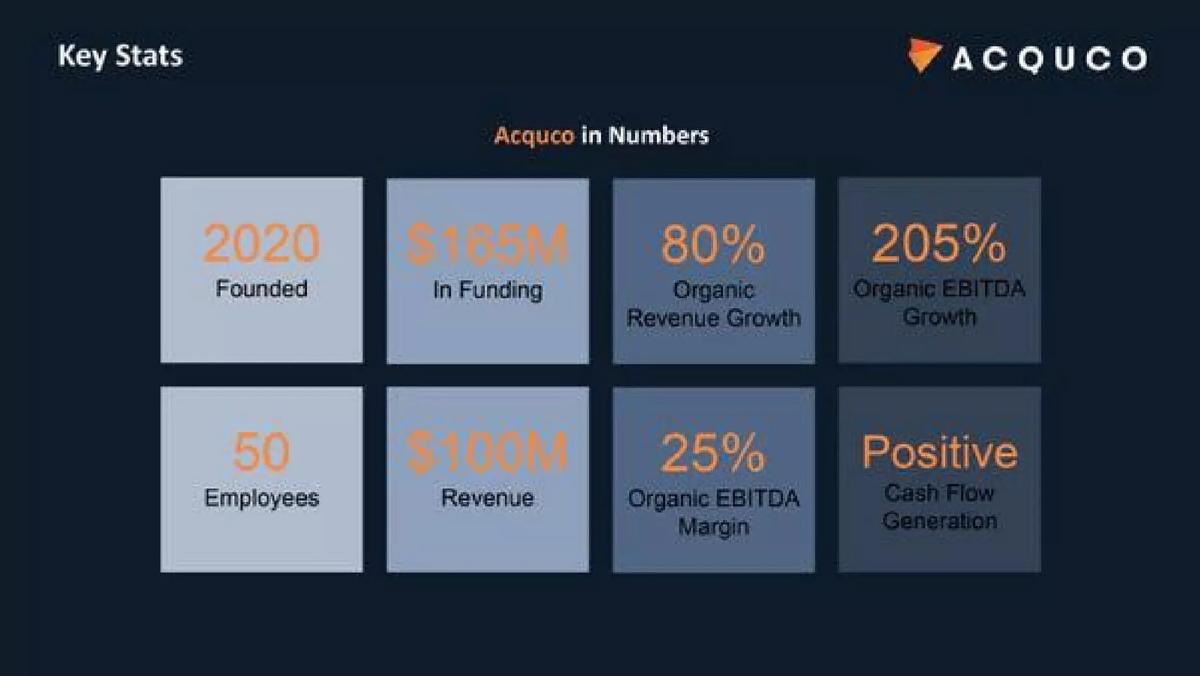
- Organic EBITDA growth is reported at 205% with a 25% organic EBITDA margin, cited on Slide 4.
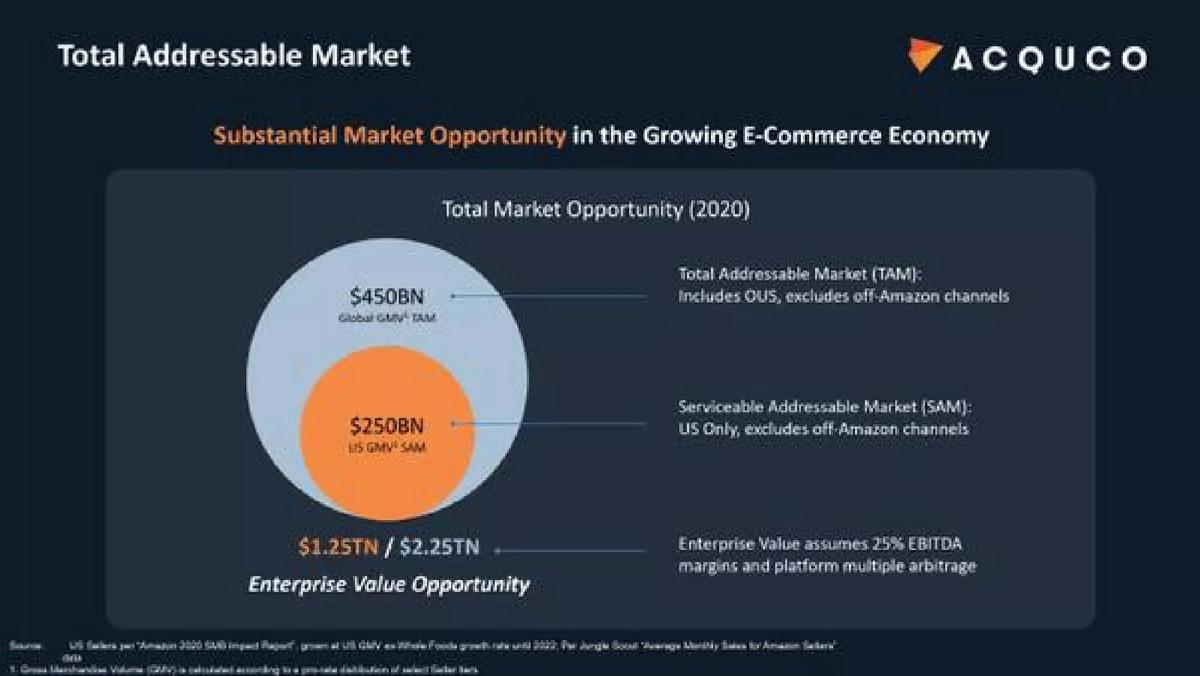
- The deck identifies a $250 billion Serviceable Addressable Market (SAM) specifically for US Amazon GMV, as shown on Slide 6.
- Proprietary technology is a core pillar, utilizing machine learning for lead scoring and automated brand management (Slide 8).
- Growth playbooks include specific supply chain optimizations, such as improving in-stock rates to 99.9%, according to Slide 7.
- The deck omits a traditional 'Ask' slide or a specific breakdown of how the new Series A funds will be allocated.
The Aggregator Land Grab: Acquco's 9-Slide Series A
In 2020, the Amazon aggregator space was one of the most crowded and well-funded sectors in the startup ecosystem. Acquco entered this fray not with a vision of what could be, but with a report of what already was. Their 9-slide deck is a lean, metric-heavy document that focuses on three things: team pedigree, operational speed, and existing profitability. By the time this deck was circulating, Acquco had already raised $165 million and was generating $100 million in revenue. This is not a deck designed to convince investors that the market exists; it is a deck designed to prove that Acquco is the most efficient machine for capturing that market.
Slides 1-2: The Executive Summary and Mission
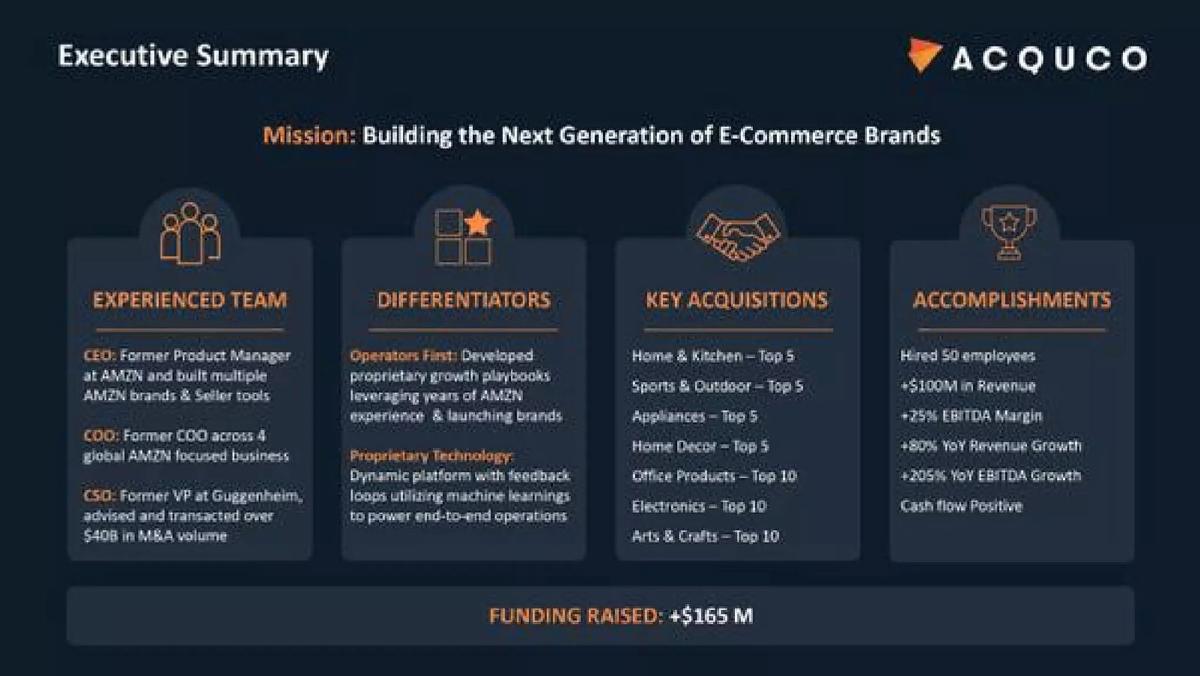
The deck opens with a standard title slide, but Slide 2 immediately dives into an Executive Summary that functions as a 'greatest hits' reel. It establishes the mission: "Building the Next Generation of E-Commerce Brands." The slide is divided into four pillars: Experienced Team, Differentiators, Key Acquisitions, and Accomplishments. Under 'Experienced Team,' they highlight a CEO who was a former Product Manager at Amazon and a CSO with $40 billion in M&A volume. The 'Accomplishments' column is particularly aggressive for a Series A deck, citing $100M in Revenue , 25% EBITDA Margin , and the fact that they are Cash Flow Positive . The footer of this slide notes they have already raised +$165 M , setting a high bar for the rest of the presentation.
Slide 3: The Operational Process
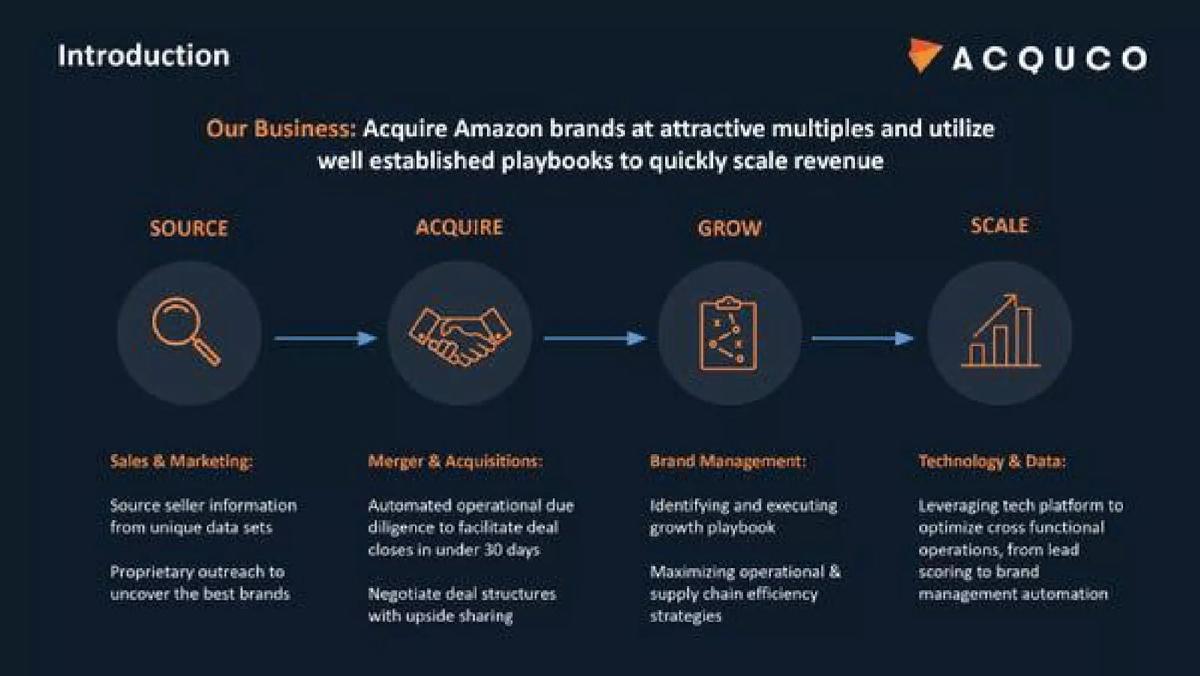
Slide 3, titled Introduction , outlines the four-stage business process: Source, Acquire, Grow, and Scale. The most notable claim here is under the 'Acquire' phase, where they mention "deal closes in under 30 days" facilitated by automated operational due diligence. This addresses a major pain point in the aggregator space—the speed of capital deployment. By promising a 30-day window and 'upside sharing' deal structures, they position themselves as the preferred buyer for Amazon sellers. The 'Scale' phase emphasizes leveraging a tech platform for lead scoring and brand management automation, moving the business away from a pure private equity model toward a tech-enabled platform.
Slide 4: The Hard Metrics
Slide 4, Key Stats , is a grid of eight numbers that would be the envy of most Series C companies. It reiterates the 2020 founding date and the 50-employee headcount. The core of the slide is the growth data: 80% Organic Revenue Growth and 205% Organic EBITDA Growth . By specifying 'Organic' growth, Acquco is signaling to investors that their success isn't just coming from buying new revenue, but from actually improving the brands they have already acquired. The 25% Organic EBITDA Margin is a critical figure, as it proves the underlying unit economics of their acquired brands are healthy and sustainable.
Slides 5-6: Market Opportunity and TAM
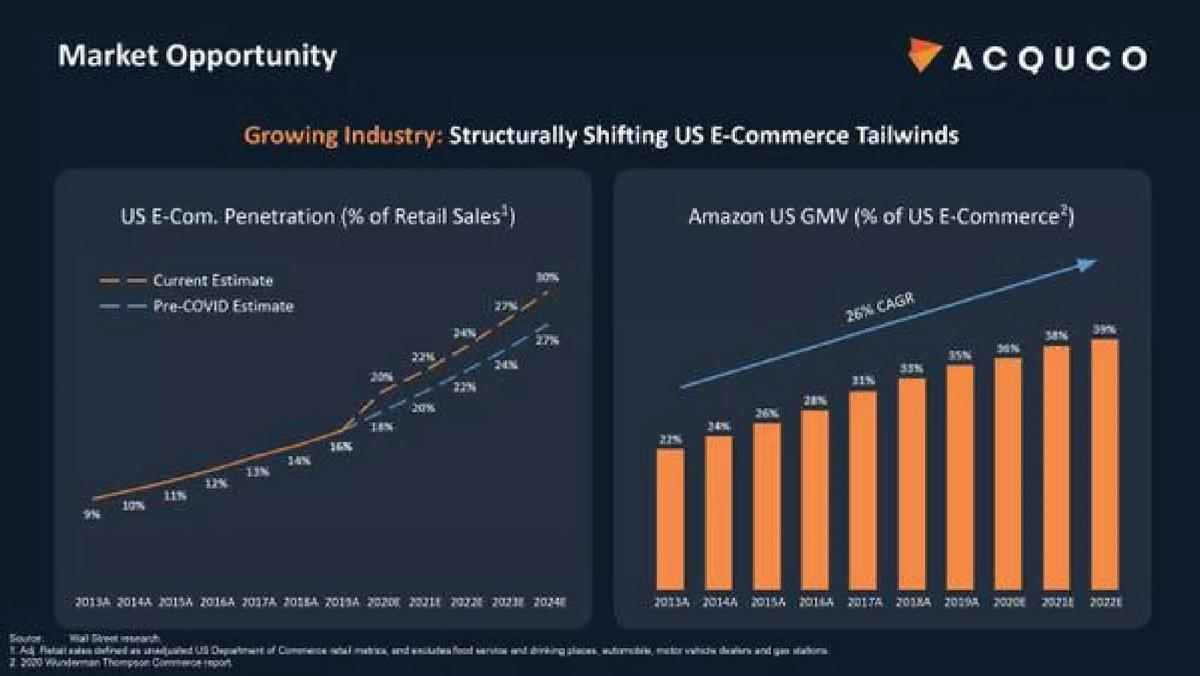
Slide 5 focuses on Market Opportunity , specifically the tailwinds provided by the COVID-19 pandemic. It shows a chart where US E-commerce penetration was estimated to hit 24% by 2024 pre-COVID, but is now projected to hit 30% . A second chart shows Amazon's US GMV growing at a 26% CAGR , reaching 39% of all US e-commerce by 2022. Slide 6 translates this into a Total Addressable Market (TAM) . They define the Global GMV TAM at $450BN and the US GMV SAM (Serviceable Addressable Market) at $250BN . Interestingly, they include an 'Enterprise Value Opportunity' calculation of $1.25TN / $2.25TN , which assumes 25% EBITDA margins and platform multiple arbitrage. This is a bold attempt to quantify the total wealth creation possible in the aggregator category.
Slides 7-8: The Secret Sauce - Playbooks and Tech
Slide 7 details the Growth Playbooks . This is the 'how' behind their 80% organic growth. They list six specific areas of intervention: Marketing (SEO/SEM), New Product launches, Content & Reviews (A+ content), Omnichannel (brick & mortar), Supply Chain (99.9% in-stock rates), and Geographical Expansion. This slide is crucial because it moves the narrative from 'we buy brands' to 'we operate brands better than the original owners.' Slide 8 reinforces this with Proprietary Technology . It shows a three-layer stack: a data science platform at the heart, fed by 3rd party APIs and continuous data scraping, powering Growth, M&A, and Brand operations. This slide is intended to justify a tech-company multiple rather than a retail-company multiple.
Slide 9: The Team
The final slide, Experience Management Team , provides headshots and deep bios for the five key leaders. The pedigree is high-tier: Amazon, Guggenheim, WeWork, Walmart, and Microsoft. CEO Raunak Nirmal’s bio is particularly strong, noting he originated a project at Amazon with +$1B annual revenue impact . This slide serves to reassure investors that the complex task of managing dozens of disparate supply chains and brands is being handled by people who have done it at the largest scale possible.
What works in this deck
The primary strength of the Acquco deck is its unapologetic focus on profitability and scale . Most Series A decks are selling a dream; Acquco is selling a proven, cash-flow-positive engine. The inclusion of 'Organic' growth metrics (Slide 4) is a sophisticated touch that separates them from aggregators who merely grow by acquisition without improving the underlying assets. The deck is also visually clean and uses a consistent dark-mode aesthetic that feels modern and professional. The 30-day closing promise (Slide 3) is a brilliant piece of competitive positioning that speaks directly to the supply side of their marketplace (the sellers).
What is missing from this deck
The most glaring omission is a Competitor Analysis . In 2020, Thrasio and Perch were already massive players in this space, and the deck makes no mention of how Acquco wins against other well-funded aggregators. There is also no Use of Funds/Ask slide. While the catalogue facts state they raised $160 million, the deck itself doesn't specify what they are looking for or how they will spend the next tranche of capital. Furthermore, there is very little detail on the specific brands they have acquired. While they list categories like 'Home & Kitchen' and 'Sports & Outdoor' on Slide 2, the lack of case studies or specific brand names makes the 'Growth Playbooks' feel slightly theoretical despite the strong aggregate numbers.
What a founder should copy
Founders should emulate the Executive Summary (Slide 2) . It is one of the most efficient summaries in any deck we have analyzed, packing team, differentiation, traction, and funding history into a single, readable view. If an investor only looks at one slide, they get the entire story. Additionally, the Growth Playbook (Slide 7) is a great way to visualize operational complexity. Instead of just saying "we grow brands," they broke it down into six distinct, actionable levers. Finally, the use of specific, high-impact numbers in team bios (like the $1B revenue impact on Slide 9) is much more effective than vague titles or lists of responsibilities. It provides a concrete sense of the scale the team is capable of handling.
Focus on 'Organic' vs 'Acquired' growth to prove operational value-add. · Quantify team impact with specific dollar amounts in bios. · Front-load the Executive Summary to capture interest immediately. · Use a process diagram (Slide 3) to show how you handle high-volume operations.
Frequently asked questions
- What is Acquco's core business model according to the deck?
- Acquco operates as an e-commerce aggregator. According to Slide 3, their model follows a four-step process: Source, Acquire, Grow, and Scale. They focus on acquiring Amazon brands at 'attractive multiples' and then applying proprietary growth playbooks to scale revenue. Their differentiation lies in their 'Operators First' approach, leveraging the founders' direct experience working at Amazon to optimize listings and supply chains.
- How does Acquco use technology to differentiate itself from other aggregators?
- Slide 8 details their 'Acquco Data Science Platform,' which serves as the central hub for Growth, M&A, and Brand operations. The technology uses machine learning and real-time analytics to create feedback loops for operating efficiencies. Specifically, Slide 3 mentions that this tech enables automated due diligence, allowing them to close acquisitions in less than 30 days, a significant speed advantage in a competitive M&A market.
- What specific growth levers does the company pull after an acquisition?
- Slide 7 outlines six 'Growth Playbooks.' These include Marketing (SEO/SEM to lower ACoS), Content & Reviews (new packaging and A+ content), Supply Chain (utilizing China networks to lower COGS), New Product launches, Omnichannel expansion into brick-and-mortar, and Geographical Expansion into new international markets. They specifically aim for a 99.9% in-stock rate to maintain Amazon ranking.
- What are the key financial metrics highlighted in the Series A deck?
- The company presents very strong early-stage financials on Slide 4. They report $100 million in revenue, an 80% organic revenue growth rate, and a 25% organic EBITDA margin. Most notably, they claim to be 'Cash Flow Positive' and have achieved 205% organic EBITDA growth. These figures suggest a highly efficient operation that was already scaling profitably before the Series A round.
- Who are the key members of the leadership team?
- The team is led by CEO Raunak Nirmal, a former Amazon PM who launched multiple multimillion-dollar brands. Slide 9 also highlights COO Wiley Zhang (former COO of 4 Amazon-focused businesses), CSO Jerel Ho (formerly of Guggenheim and WeWork), Director of Brand Mgmt Christine Cui (formerly of Walmart and Jet.com), and VP of Data Paul Li (a 15-year veteran from Microsoft).