AceUp’s pitch deck is a masterclass in establishing credibility through association. By showcasing a client list that includes GE Healthcare, BCG, and Fidelity, the company bypasses the need for complex technical explanations, instead focusing on the 'who' and the 'how' of their coaching network. The deck identifies a massive $95B corporate training market and addresses the 'Skill Gap' with a structured five-phase framework. While it lacks a traditional team slide, financial projections, or a specific funding ask, it excels at demonstrating product-market fit through high-impact user data, su…
Key takeaways
- The deck identifies a $95B market for corporate training in the US as of 2017 (Slide 3).
- AceUp claims a network of over 500 coaches, with 80% holding advanced degrees (PhD, MSc, or MBA) (Slide 9).
- Traction is demonstrated through a logo wall featuring major enterprises like Sanofi, BCG, and Wyndham Hotel Group (Slide 8).
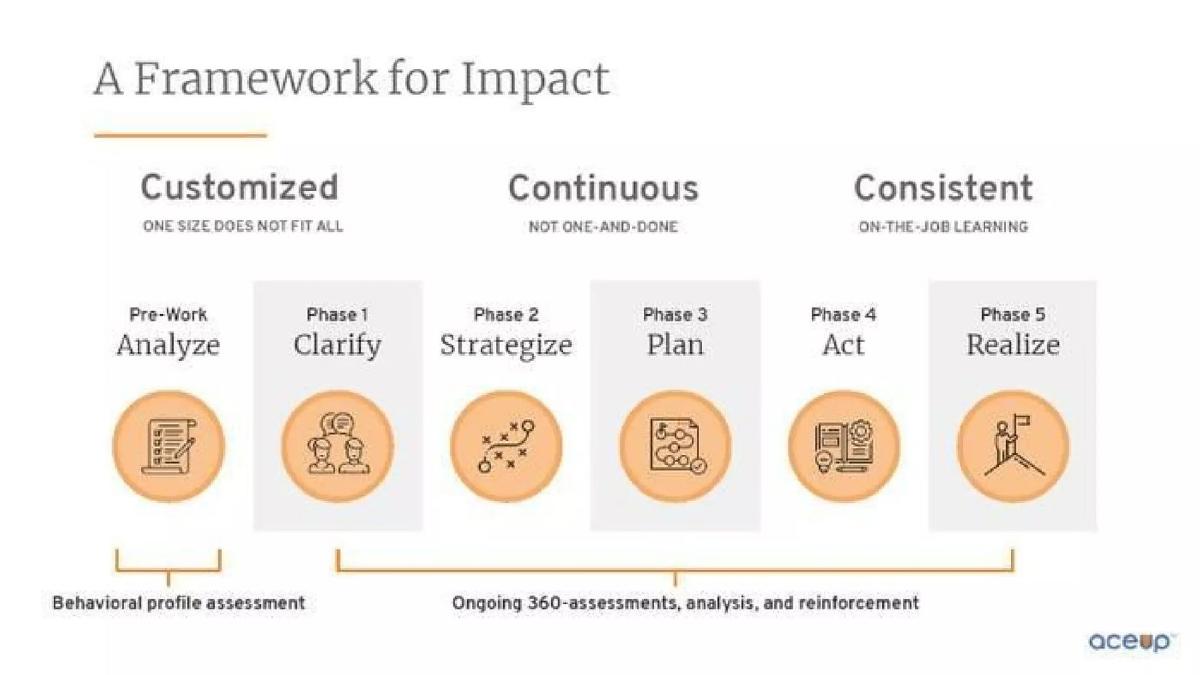
- The product uses a six-step 'Framework for Impact' ranging from Pre-Work/Analyze to Phase 5/Realize (Slide 6).
- User impact data shows 98% of users feel more confident and 92% see significant leadership improvement after 3 months (Slide 7).
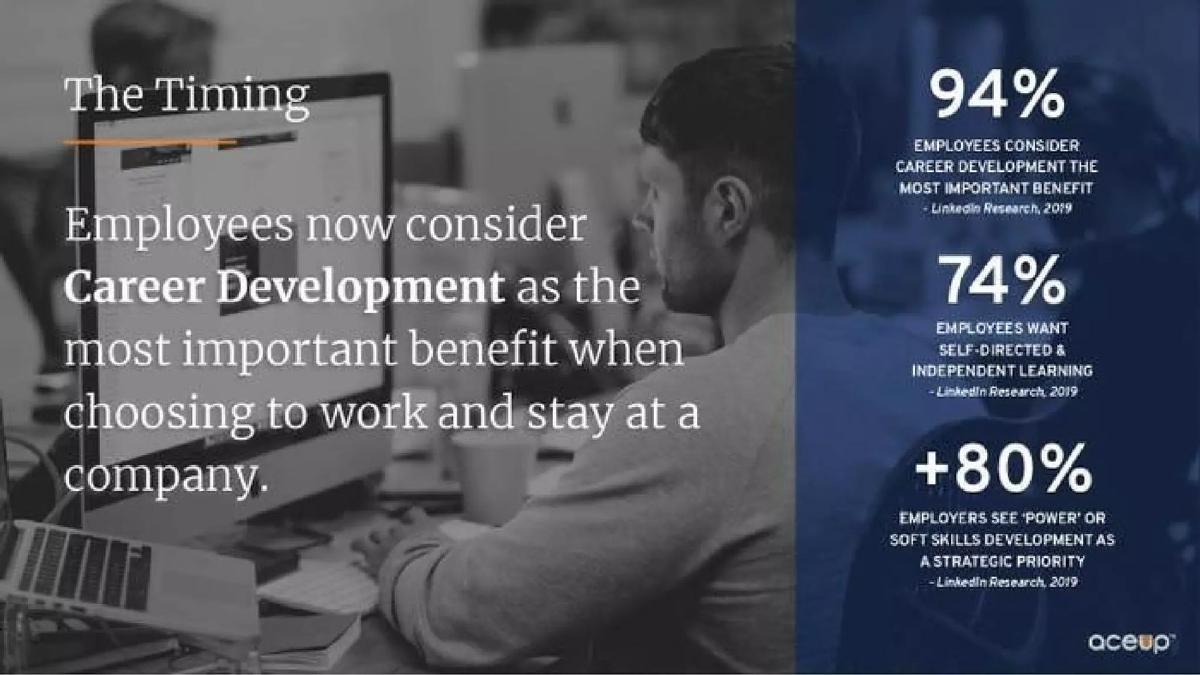
- The deck highlights a shift in employee priorities, citing that 94% of employees consider career development a top benefit (Slide 4).
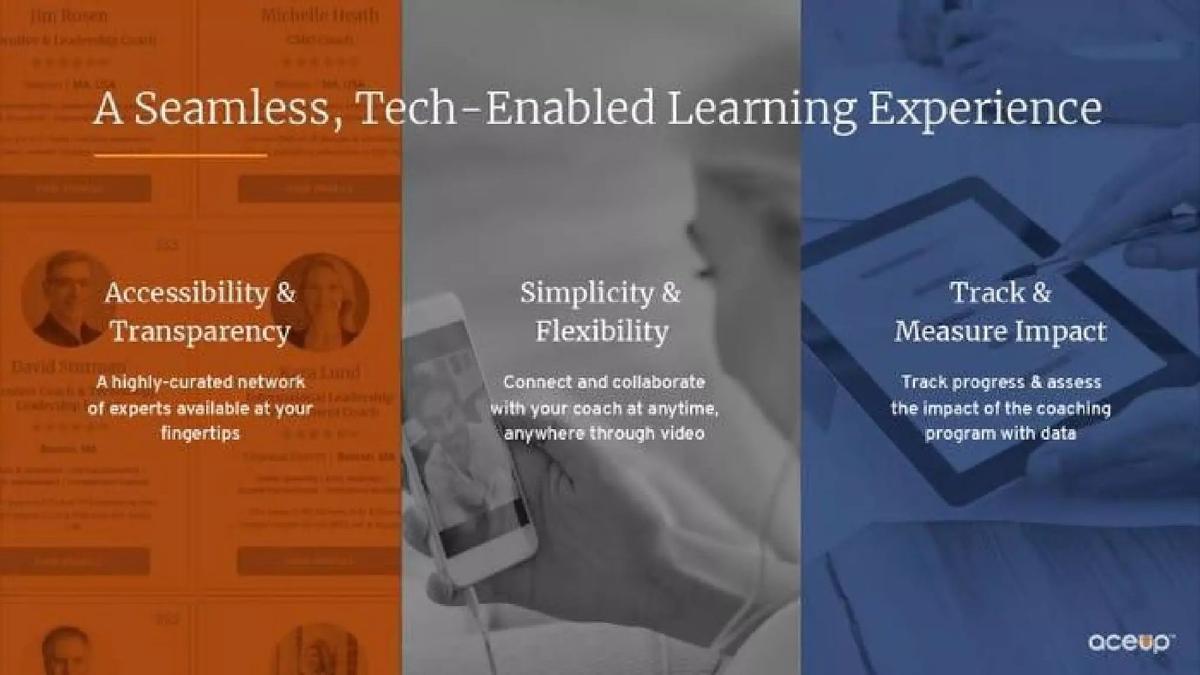
- The platform emphasizes a 'tech-enabled' experience including video collaboration and data-driven impact tracking (Slide 5).
- The deck completely omits a management team slide, financial ask, and competitive landscape analysis.
Executive Summary: The Credibility-First Approach
The AceUp pitch deck is a concise, 10-slide presentation that prioritizes social proof and market timing over technical specifications or financial modeling. By positioning executive coaching as a scalable B2B SaaS solution rather than a boutique service, AceUp targets the enterprise HR budget. The deck leans heavily on the Techstars association (Slide 1) and a robust list of Fortune 500 clients to establish immediate trust.
Slide 1: Title and Branding
The cover slide introduces the tagline 'Because everyone deserves a coach.' It features the Techstars logo in the bottom right corner, which serves as an immediate institutional endorsement. The copyright date is listed as 2019, providing a clear temporal context for the market data that follows.
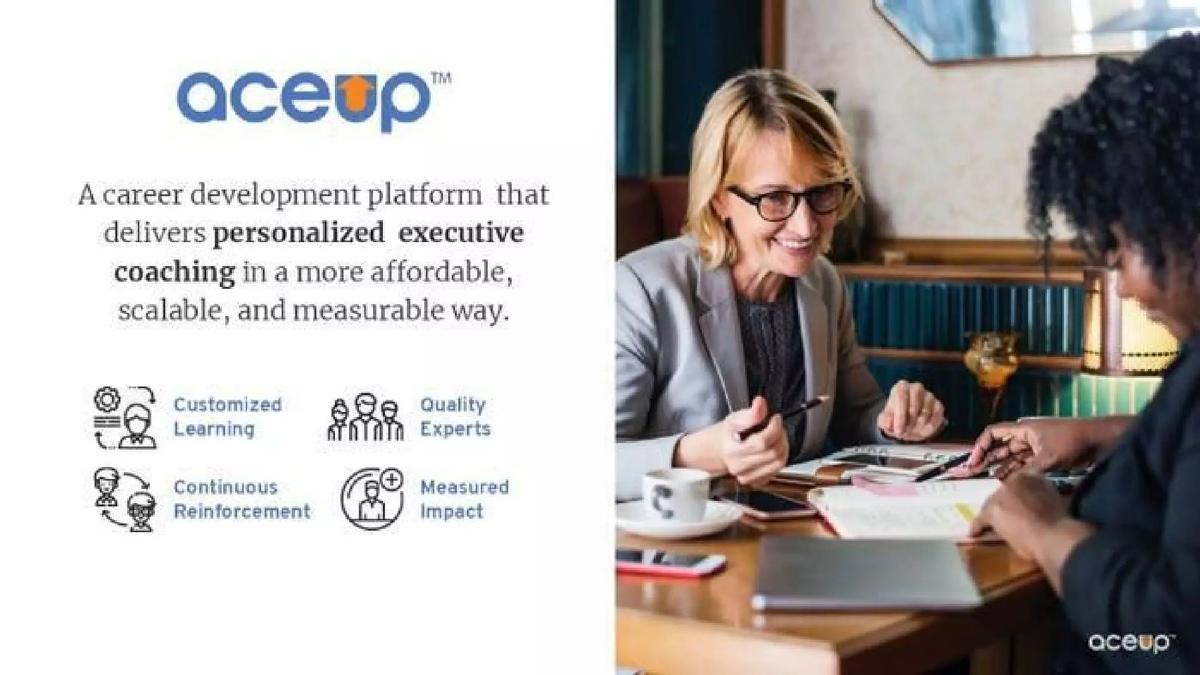
Slide 2: The Value Proposition
AceUp defines itself as a 'career development platform' that delivers 'personalized executive coaching in a more affordable, scalable, and measurable way.' This slide sets the four pillars of their service: Customized Learning, Quality Experts, Continuous Reinforcement, and Measured Impact. The use of a professional, high-quality stock image of a coaching session reinforces the human element of the tech-enabled service.
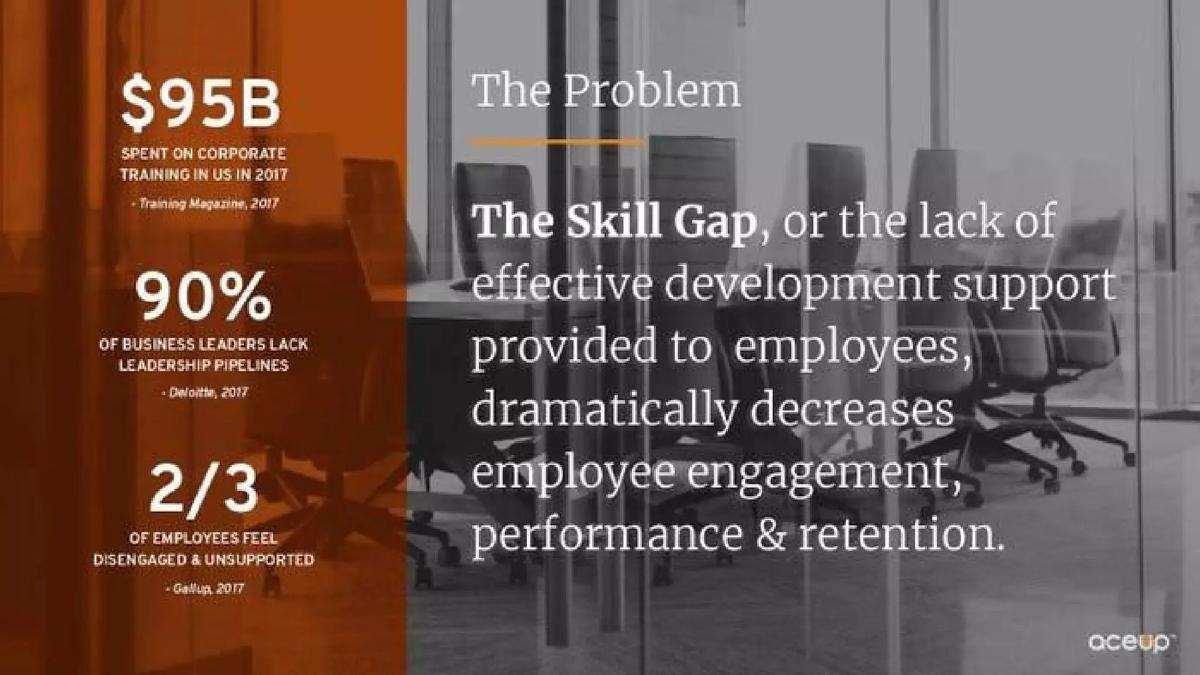
Slide 3: The Problem and Market Size
This slide utilizes a 'dark mode' aesthetic to highlight three critical statistics: a $95B spend on US corporate training in 2017, a 90% lack of leadership pipelines among business leaders, and 2/3 of employees feeling disengaged. By framing the 'Skill Gap' as a direct threat to employee engagement, performance, and retention, AceUp justifies the need for a systemic solution rather than sporadic training workshops.
Slide 4: The Timing (Why Now?)
The deck argues that employee expectations have shifted. Citing 2019 LinkedIn Research, it notes that 94% of employees view career development as the most important benefit. Crucially, it highlights that 74% of employees want 'self-directed & independent learning,' which aligns perfectly with a marketplace model where employees can choose their own coaches. The slide also notes that 80% of employers now see soft skills as a strategic priority.
Slide 5: The Solution - Tech-Enabled Experience
This slide breaks down the user experience into three categories: Accessibility & Transparency (a curated network), Simplicity & Flexibility (video collaboration), and Track & Measure Impact (data-driven assessment). It provides a glimpse of the mobile interface, suggesting a 'coaching in your pocket' accessibility that differentiates it from traditional, scheduled in-person executive coaching.
Slide 6: A Framework for Impact
To move away from the perception of coaching as 'vague advice,' AceUp introduces a structured six-step process. This includes a 'Pre-Work' phase for behavioral profile assessment, followed by five phases: Clarify, Strategize, Plan, Act, and Realize. The slide emphasizes that the process is 'Customized,' 'Continuous,' and 'Consistent,' specifically noting that it is 'not one-and-done.'
Slide 7: Data-Backed Proof
Traction is quantified through user sentiment. After three months, 98% of users report higher confidence. The slide includes a high-profile testimonial from Sampath T. Kandala, Director of Product Management at GE Healthcare. This is a strategic choice; using a leader from a massive, traditional conglomerate like GE proves the platform can handle complex enterprise environments.
Slide 8: Client Logo Wall
This is perhaps the strongest slide in the deck. It features a diverse array of logos, including BCG, Fidelity, Sanofi, Wyndham Hotel Group, and Rapid7. The breadth of industries—from consulting and finance to biotech and hospitality—suggests a highly horizontal product with a broad Total Addressable Market (TAM).
Slide 9: The Coach Network
AceUp addresses the supply side of their marketplace here. They claim a network of over 500 coaches. The quality metrics are impressive: 80% have advanced degrees and 90% have Fortune 500 managerial experience. By listing logos like Google, IBM, and Harvard Business School, they transfer the prestige of these institutions to their own brand.
Slide 10: The Pairing Process
The final slide shows the 'Coach Pairing' interface. It displays five coach profiles, categorized by their specific expertise (e.g., 'Serial CTOs,' 'Productivity Expert'). This slide reinforces the 'self-directed' nature of the platform mentioned earlier in the deck, showing how an employee can find the 'Right Expert at the Right Time.'
What Works in This Deck
Institutional Credibility: The deck is incredibly effective at borrowing authority. Between the Techstars logo, the Fortune 500 client list, and the pedigree of the coach network, a potential investor is led to believe that the 'hard part' of enterprise sales and supply-side vetting has already been solved.
Clear Market Alignment: The 'Timing' slide (Slide 4) does an excellent job of connecting macro trends (the shift in employee benefits) to the specific product offering. It makes the case that AceUp is not just a 'nice to have' but a necessary tool for retention in a competitive labor market.
Structured Methodology: By presenting a 'Framework for Impact' (Slide 6), AceUp demystifies the coaching process. This is vital for B2B sales, as HR departments need to justify the spend with a repeatable, measurable process rather than just 'better conversations.'
What is Missing
The Management Team: There is no slide introducing the founders or the core team. In early-stage fundraising, the 'who' is often as important as the 'what.' The omission of the team’s background is a significant gap.
The Financial Ask: The deck ends abruptly without a call to action or a funding request. There is no mention of how much capital is being raised, the valuation, or the intended use of funds.
Competitive Landscape: The coaching and L&D (Learning and Development) space is crowded with players like BetterUp and Torch. This deck makes no attempt to position AceUp against these competitors or explain their unique moat beyond 'quality experts.'
Unit Economics: While the deck mentions 'affordability' and 'scalability,' it provides no data on customer acquisition costs (CAC), lifetime value (LTV), or the take-rate from the coach marketplace.
Founder's Playbook: What to Copy
The 'Impact' Slide: Founders should emulate Slide 7. Instead of just saying 'users love us,' AceUp provides three specific, high-percentage metrics paired with a testimonial from a recognizable brand. This is the gold standard for proving product-market fit.
Visual Consistency: The deck uses a consistent color palette of navy blue and orange, with clean typography. It looks like a professional enterprise product, which is essential when selling to HR leaders at companies like Fidelity or BCG.
Supply-Side Pedigree: If you are building a marketplace, you must prove the quality of your supply. Slide 9 does this perfectly by using logos of the companies where their coaches previously worked. This is a shortcut to building trust that every marketplace founder should utilize.
Frequently asked questions
- What is the primary problem AceUp is solving?
- According to Slide 3, AceUp addresses 'The Skill Gap,' which they define as a lack of effective development support for employees. They cite that 90% of business leaders lack leadership pipelines and 2/3 of employees feel disengaged. The deck argues that this gap leads to decreased performance and retention, creating a massive opportunity in the $95B corporate training market.
- How does AceUp differentiate its coaching network?
- AceUp focuses on the pedigree of its coaches. Slide 9 states they have over 500 coaches, 80% of whom hold a PhD, MSc, or MBA. Furthermore, 90% have managerial experience at Fortune 500 companies. The deck also lists former employers of their coaches, including Google, IBM, and Deloitte, to signal high-tier professional expertise.
- What metrics does the deck use to prove product effectiveness?
- Slide 7 provides specific 'Impact' data based on three months of usage. Key figures include 98% of users feeling more confident, 92% seeing improvement in leadership and communication skills, and 90% reporting that coaching positively affected their feelings toward their employer. These metrics are paired with a testimonial from a Director at GE Healthcare.
- What is missing from the AceUp pitch deck?
- This deck is notably missing several standard venture capital slides. There is no 'Team' slide introducing the founders, no 'Competition' slide to explain their moat, and no 'Financials' or 'Ask' slide detailing how much capital they are raising or how it will be spent. It functions more as a high-level capabilities deck than a full investment memorandum.
- How does the platform actually work for the employee?
- Slide 10 illustrates a 'Coach Pairing' process where employees can select experts based on specific roles like 'Serial CTOs' or 'Productivity Experts.' Slide 6 details the methodology: a five-phase framework (Clarify, Strategize, Plan, Act, Realize) supported by behavioral profile assessments and ongoing 360-degree feedback.