Ada Health’s 11-slide Series B pitch deck, dated May 2021, is a masterclass in establishing clinical authority. Rather than leading with revenue or market size, the company focuses on its nine years of R&D and a user base of over 10 million people. The deck leans heavily on third-party validation, citing studies that place its diagnostic accuracy at 71%—significantly higher than the 38% competitor average. While the deck excels at proving product-market fit and clinical safety, it is notably silent on business model specifics, revenue figures, and the specific 'ask' for the round. It function…
Key takeaways
- The company claims over 10 million users and 20 million assessments completed as of May 2021 (Slide 3).
- Ada asserts a diagnostic accuracy of 71%, which it compares to a competitor average of 38% (Slide 3).
- The platform covers 99% of conditions, the highest among its competitive set (Slide 7).
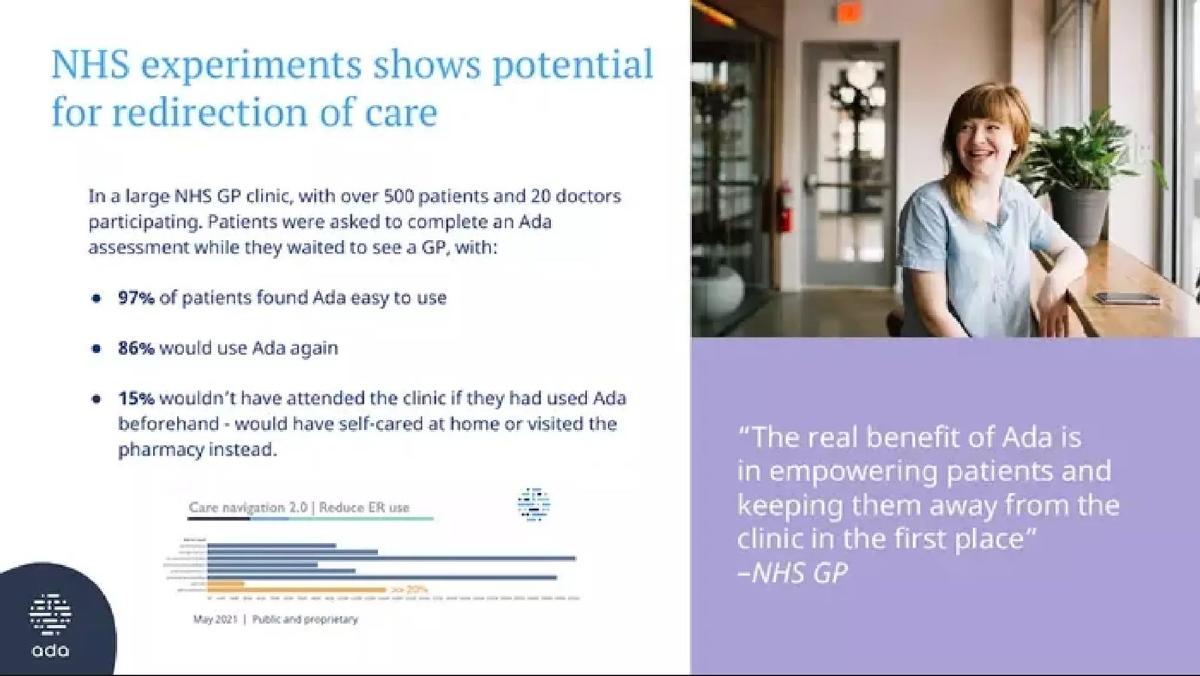
- A case study with the NHS suggests 15% of patients would have avoided a clinic visit if they had used Ada first (Slide 6).
- The team is highly experienced, with the four featured executives totaling over 85 years of combined experience (Slide 10).
- The deck lists major global partners including Pfizer, Samsung, Takeda, and Sutter Health (Slide 8).
- User engagement is high, with a 4.7/5.0 rating across 270,000+ in-app reviews (Slide 9).
- The deck contains no financial projections, revenue data, or specific funding requirements (Slides 1-11).
Introduction and Brand Identity
Slides 1-2: The Vision
The deck opens with a minimalist title slide (Slide 1) dated May 2021, establishing a clean, professional aesthetic consistent with a medical technology firm. Slide 2 defines the company's purpose: "To improve human health by transforming knowledge into better outcomes." This sets a high-level tone, focusing on the result of the technology rather than the technology itself.
The Executive Summary
Slide 3: Ada at a Glance
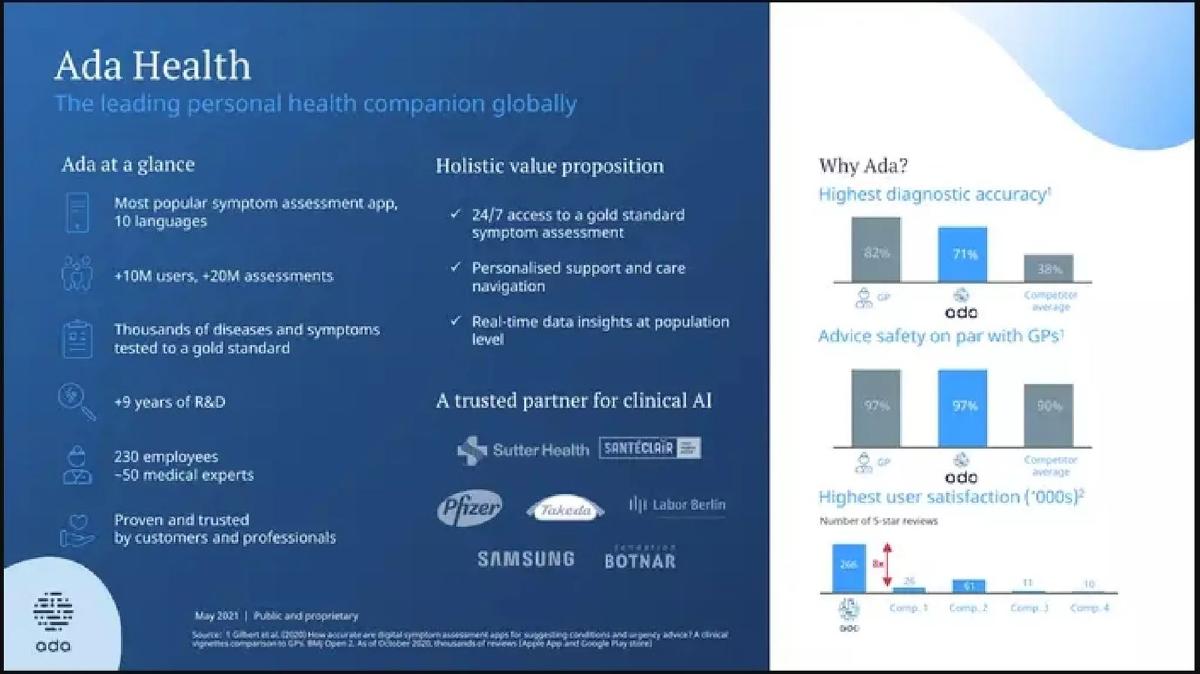
Slide 3 is the most data-dense slide in the deck, serving as a comprehensive executive summary. It breaks down the company into four quadrants: traction, value proposition, clinical AI partnerships, and competitive benchmarking. Key figures include +10M users , +20M assessments , and +9 years of R&D . The company also notes it employs 230 people, including ~50 medical experts. This slide introduces the core competitive claim: a 71% diagnostic accuracy compared to a 38% competitor average, and 97% advice safety , which it claims is on par with GPs.
Product and Differentiation
Slide 4: The User Journey
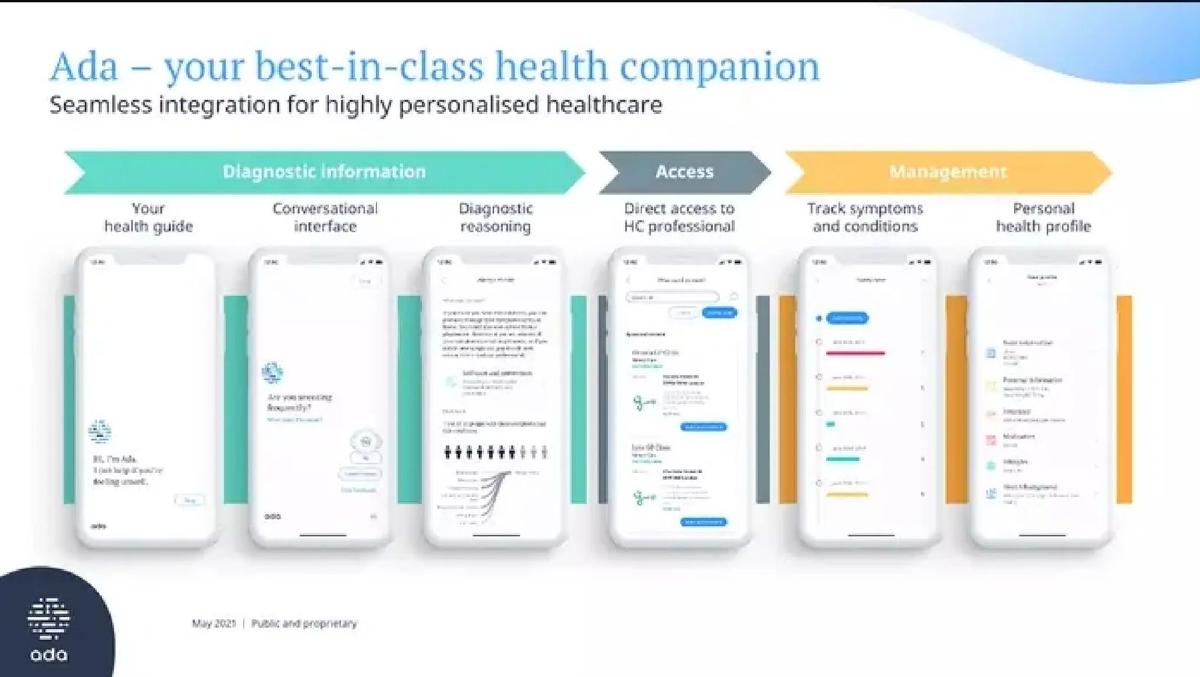
Slide 4 visualizes the product experience through a six-step mobile interface sequence. It categorizes the journey into three phases: Diagnostic Information (Health guide, conversational interface, diagnostic reasoning), Access (Direct access to HC professional), and Management (Symptom tracking and personal health profile). This illustrates that Ada is not just a chatbot, but a full-cycle health management platform.
Slide 5: The Moat
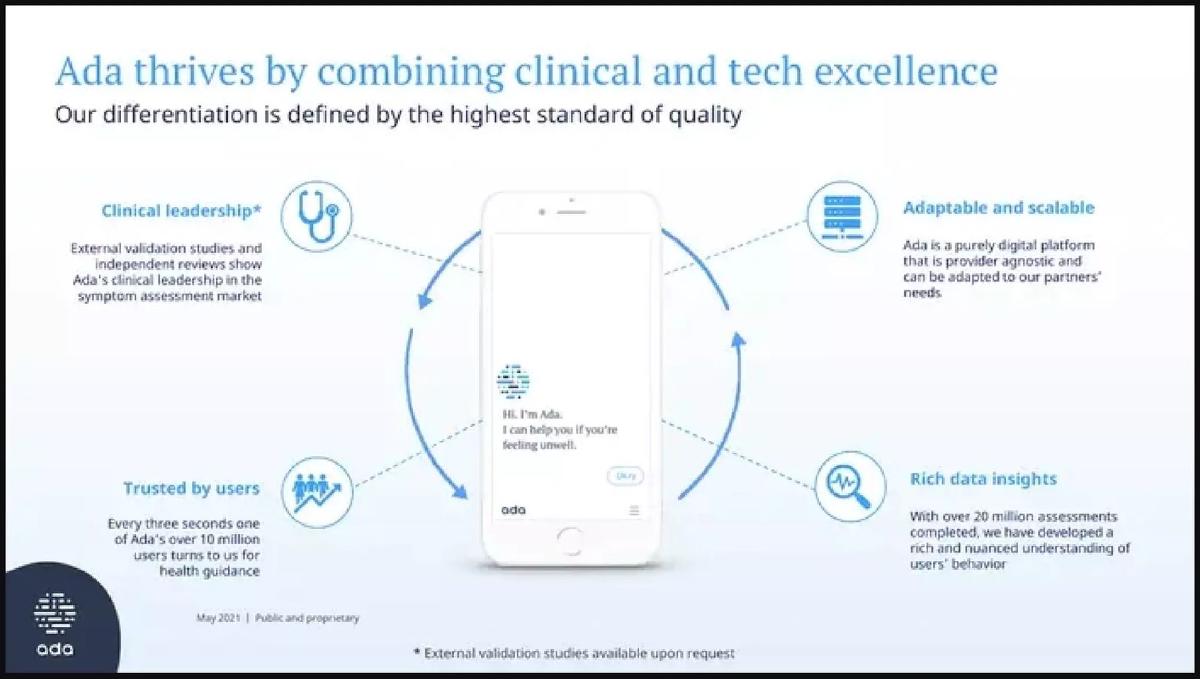
Slide 5 focuses on the pillars of Ada's differentiation. It highlights Clinical leadership (validated by external studies), User trust (one user every three seconds), Scalability (provider-agnostic digital platform), and Rich data insights derived from the 20 million completed assessments. This slide aims to convince investors that the company has a defensible lead built on data and clinical rigor.
Clinical Validation and Competition
Slide 6: The NHS Case Study
To prove real-world utility, Slide 6 presents data from a large NHS GP clinic involving 500 patients and 20 doctors. The results are compelling: 97% found the app easy to use, and 15% of patients would have opted for self-care or a pharmacy instead of visiting the clinic if they had used Ada first. This directly addresses the "redirection of care" value proposition for overstrained health systems.
Slide 7: Competitive Benchmarking
Slide 7 doubles down on the clinical data introduced in Slide 3. It uses three bar charts to show Ada leading in condition coverage (99%) , accuracy (71%) , and advice safety (97%) . By placing itself next to a sea of unnamed "Competition" bars, Ada positions itself as the only viable medical-grade solution in a crowded market of lower-quality apps.
Partnerships and Social Proof
Slide 8: The Partner Ecosystem
Slide 8 is a logo wall featuring "Medical & Digital Health Champions." The inclusion of Sutter Health, Takeda, Pfizer, Samsung, and Labor Berlin suggests that Ada has successfully navigated the complex procurement cycles of global enterprises. This serves as a proxy for a business model slide, implying revenue through B2B licensing and integration.
Slide 9: User and Expert Endorsements
Slide 9 provides qualitative proof to match the quantitative data. It features four consumer testimonials—including one claiming the app "saved my life"—and endorsements from a US telemedicine company's clinical team and GP feedback. The slide reinforces the 4.7/5.0 rating from 270,000+ ratings , emphasizing that the product is beloved by the end-user, not just the enterprise buyer.
Team and Conclusion
Slide 10: The Management Team
The team slide features four leaders: Daniel Nathrath (CEO, +20 years experience), Dr. Martin Hirsch (CSO, +25 years), Dr. Claire Novorol (CMO, +15 years), and Urban Liebel (CTO, +25 years). The logos beneath their names (BCG, NHS, KIT) and their advanced degrees (PhD, MD) underscore the "founder-led" and "expert-driven" nature of the business. The combined experience exceeds 85 years, which is significant for a Series B stage company.
Slide 11: Closing
The deck ends abruptly with a "Thank you" slide. There is no summary of the investment opportunity or contact information on this final page.
What Works
Clinical Credibility: The deck repeatedly cites third-party validation and comparative studies. In healthcare, safety and accuracy are the primary hurdles, and Ada addresses them head-on. · Traction at Scale: 10 million users and 20 million assessments are massive numbers that prove the product is not a pilot or a prototype. · B2B Validation: The partner slide (Slide 8) shows that the world's largest healthcare and tech companies trust Ada's engine. · Visual Clarity: The deck uses a consistent, high-end design that feels "medical" yet modern.
What is Missing
The Ask: There is no mention of how much money is being raised, the valuation, or the use of proceeds. · Financials: There are zero mentions of revenue, ARR, burn rate, or even the basic business model (SaaS vs. per-assessment vs. licensing). · Market Size: The deck assumes the investor already knows the digital health market is huge. It lacks a TAM/SAM/SOM slide. · Roadmap: There is no "Future" slide. Investors want to know what the next 18-24 months look like, but this deck focuses entirely on what has already been achieved.
What a Founder Should Copy
The "At a Glance" Slide: Slide 3 is an excellent template for an executive summary. It combines traction, value prop, and social proof in one view. · Benchmarking: If you have data showing you are 2x better than the competition (as seen on Slide 7), use bar charts to make that gap visual and undeniable. · Case Studies: The NHS slide (Slide 6) is a perfect example of how to use a single pilot to prove a massive economic benefit (reducing clinic visits). · Expertise-First Team Slide: Highlighting the specific years of experience and professional designations (MD, PhD) is crucial for deep-tech or healthcare startups.
Frequently asked questions
- What is Ada Health's primary value proposition?
- Ada Health positions itself as a 'gold standard' symptom assessment tool that bridges the gap between personal health management and professional care. According to slide 3, its value proposition centers on 24/7 access to medical-grade assessments, personalized care navigation, and providing population-level data insights to health systems and partners.
- How does Ada Health compare to its competitors clinically?
- The deck places clinical superiority at the forefront. Slide 7 shows that Ada achieves 71% accuracy for top-three condition suggestions, which is double the 38% average of its competitors. Additionally, slide 7 claims 99% condition coverage and 97% advice safety, which the company states is on par with human doctors.
- Who are Ada Health's key partners?
- Ada demonstrates significant B2B traction by listing several 'Digital Health Champions' as partners. Slide 8 highlights logos from diverse sectors, including pharmaceutical giants like Pfizer and Takeda, technology leaders like Samsung, and healthcare providers such as Sutter Health and the NHS.
- What evidence of user traction does the deck provide?
- The deck provides substantial social proof. Slide 3 notes 10 million users and 20 million assessments. Slide 5 adds that one user turns to Ada for guidance every three seconds. Slide 9 showcases a 4.7-star rating from over 270,000 reviews, alongside testimonials from both patients and medical experts.
- What is missing from this pitch deck?
- This is a high-level 'vision and traction' deck. It lacks a 'Problem' slide (assuming the problem is understood), a 'Market Size' (TAM/SAM/SOM) slide, a detailed 'Business Model' explanation, and any 'Financials.' Most importantly, there is no 'The Ask' slide detailing how much capital is being raised or how it will be spent.