AdKiosks, led by founder J. Peter Meng, pitched a solution to the friction of traditional digital advertising by embedding full e-commerce functionality directly within ad units. The deck, presented at The ROUNDTABLE, argues that traditional ads are limited to one product and force users to leave their current site, whereas AdKiosks allow for unlimited products and in-ad transactions. The company sought $500,000 in angel funding at a $4 million post-money valuation, while simultaneously planning a $1 million Token Generation Event (TGE). The roadmap is heavily influenced by 2017 trends, speci…
Key takeaways
- The core value proposition is 'AdCommerce,' which allows users to search, sort, and buy products without leaving the host website (Slide 7).
- The company sought $500,000 in angel funding for 12.5% equity, implying a $4 million post-money valuation (Slide 13).
- A significant portion of the future strategy relied on a 'Token Generation Event' (TGE) planned for Fall 2017 to raise an additional $1 million (Slide 13).
- The product roadmap spans from May 2017 to April 2019, moving from basic ad units to blockchain marketplaces and AI-intelligent kiosks (Slide 9).
- AdKiosks positions itself as a complement to giants like Amazon, Google, and Facebook rather than a direct competitor (Slide 11).
- The team includes notable advisors, such as Ewin Barnett, the founder of CarFax (Slide 15).
- Budget allocation is heavily weighted toward development and design (26%) and executive administration (22%) (Slide 13).
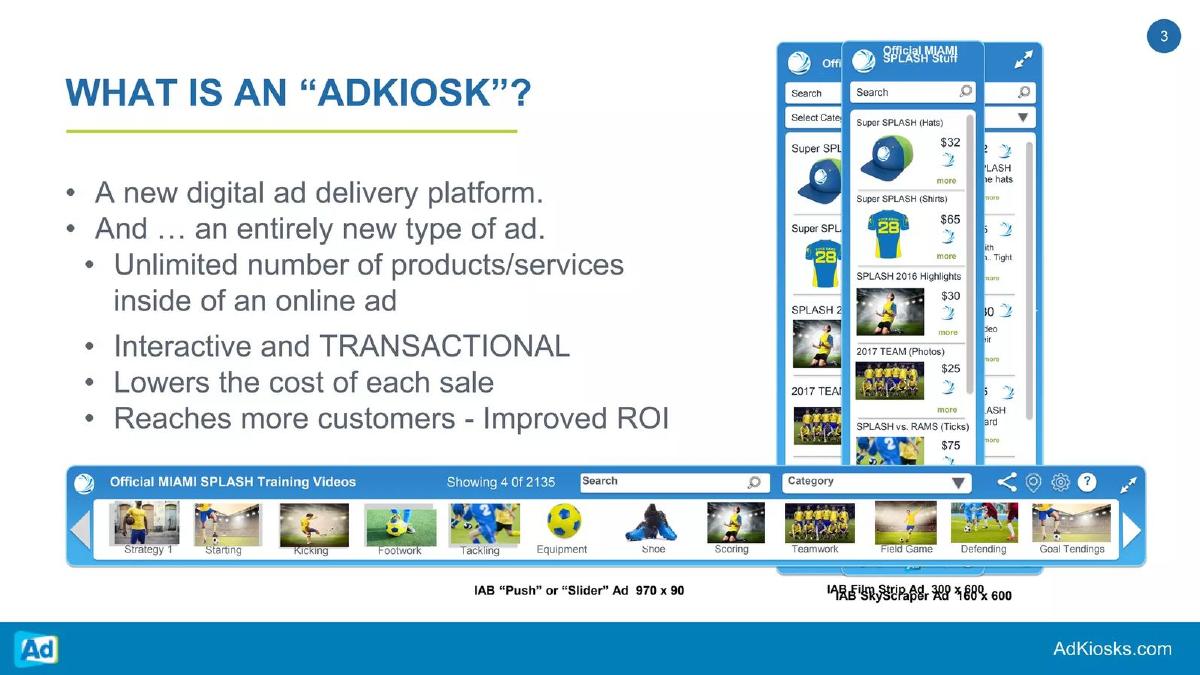
- The technical solution supports various IAB standard sizes, including 'Push' or 'Slider' 970x90 and Skyscraper 160x600 (Slide 3).
Executive Summary: The Transition to Transactional Media
The AdKiosks pitch deck, presented at The ROUNDTABLE, represents a specific moment in the evolution of adtech where the industry attempted to bridge the gap between display advertising and e-commerce. By branding their technology as "AdCommerce," the company proposed a future where the banner ad is no longer a billboard, but a fully functional storefront. The deck is characterized by a strong focus on the user experience—specifically reducing friction—and a heavy reliance on then-emerging technologies like blockchain and AI to secure and personalize the experience.
Slide 1: Title and Positioning
The cover slide introduces the brand "AdKiosks" with the tagline "Revolutionizing Display Advertising." It also introduces the trademarked term "Powering AdCommerce." The slide identifies J. Peter Meng as the Founder & CEO and includes a 2017 copyright for ADFREEQ, LLC. The visual design is clean, using a corporate blue and green palette that suggests a professional, B2B focus.
Slide 3: Defining the AdKiosk
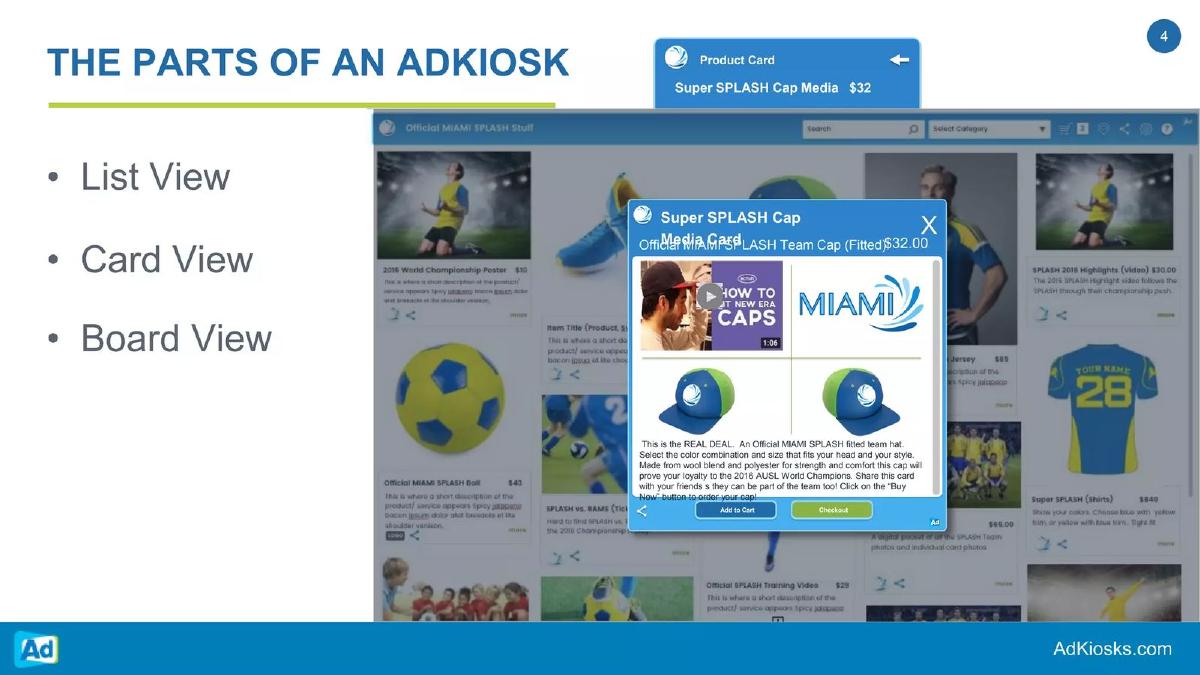
This slide answers the fundamental question: "What is an AdKiosk?" It defines the product as a new digital ad delivery platform and a new type of ad. Key features listed include an "unlimited number of products/services inside of an online ad," and the fact that the units are "interactive and TRANSACTIONAL." The slide claims this lowers the cost of each sale and improves ROI. Visual examples show various IAB (Interactive Advertising Bureau) formats, such as a 970x90 "Push" or "Slider" ad and a 300x600 "Film Strip" ad, populated with sports merchandise like hats and shirts.
Slide 5: The Current State of Online Advertising
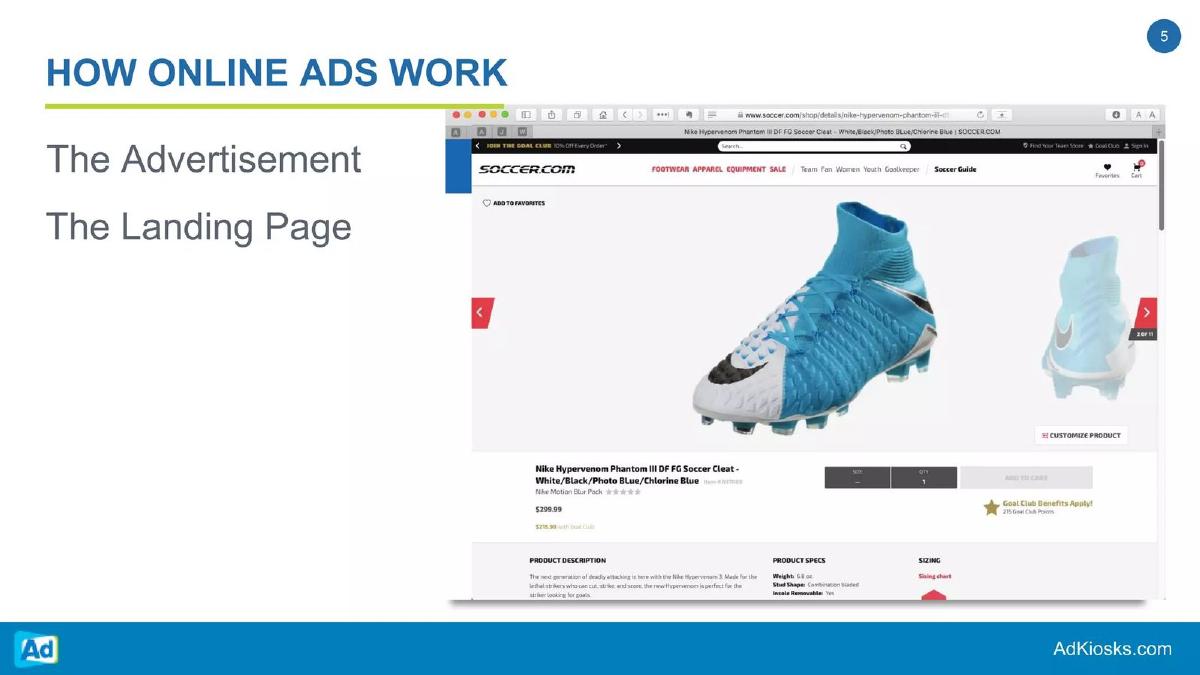
To establish the problem, Slide 5 illustrates "How Online Ads Work" today. It shows a two-step process: The Advertisement and The Landing Page. The visual is a screenshot of a soccer equipment website. This slide serves as the "before" state, highlighting the necessity of a click-through to a separate destination to view product details or make a purchase.
Slide 7: Problem & Solution Comparison
Slide 7 provides a direct side-by-side comparison between "Traditional Ads" and "AdKiosks Ads." Traditional ads are critiqued for having "Only One Product Per Ad," being "Static 'Linked' Ads," and requiring the "Visitor Must Leave Site." In contrast, AdKiosks offers "Unlimited Products Per Ad," "Interactive Ads" (Search, Sort, Preview, Buy, Share), and ensures the "Visitor Stays On Site." This is the strongest articulation of the company's value proposition in the deck.
Slide 9: The Two-Year Product Roadmap
The roadmap covers the period from May 2017 through April 2019. It is divided into five phases:
Phase I-A/B: AdKiosks Ver 2.0 and Integrated AdNetworks. · Phase II: AK Blockchain Marketplace. · Phase III: Blockchain Secured AK Cards. · Phase IV: Deep Personalization. · Phase V: AI Enhanced Intelligent AdKiosks.
The inclusion of AdCommerce.io at the bottom of the slide reinforces the shift toward a blockchain-based ecosystem as the company matures.
Slide 11: The "Complementition" Strategy
Slide 11 addresses the competitive landscape by framing AdKiosks as a partner rather than a threat. It identifies four categories: Website Store Fronts, Pop-ups and Banners Ads, Aggregated Retail (Amazon, eBay), and Aggregated Ads (Facebook, Google). The deck argues that AdKiosks "enhances," "extends," or "replaces" specific elements of these services to provide a more efficient shopping experience within the ad unit itself.
Slide 13: Funds Required and Use of Funds
This slide contains the specific financial ask. AdKiosks sought $500,000 in Angel Funding in exchange for 12.5% Equity , which sets the post-money valuation at $4 million. Additionally, the slide mentions a planned $1 million Token Generation Event (TGE) for the fall of 2017. The use of funds is broken down via a pie chart:
Dev & Design: 26% · Exec & Admin: 22% · Sales: 20% · Marketing: 15% · Overhead: 7% · Prof. Svcs: 5% · T & E: 5%
The slide notes that the prioritized uses are Sales, Marketing, and Coding.
Slide 15: The Management and Advisory Team
The team slide presents a large group of 11 individuals. The core management includes J. Peter Meng (CEO), Guerry Semones (CTO), and Jeff Marlow (COO). There are two developers (Austin and David Bieber) and two business development leads. The "LLC Managers & Advisory Team" includes Dr. Michael Nichols, Greg Wolff, and Jeremy Drzal. Notably, Ewin Barnett is listed as an advisor and identified as the "Founder - CarFax," providing significant institutional credibility to the venture.
Slide 17: Multi-Device Visualization
The final slide in this selection shows the AdKiosks technology functioning across mobile, laptop, and desktop screens. It displays a variety of products—from dance shoes to sports apparel—integrated into different web environments, including a Facebook page. This serves to demonstrate the cross-platform compatibility of the "AdCommerce" vision. The slide concludes with contact information: ADKIOSKS.COM and INFO@ADKIOSKS.COM.
What Works in This Deck
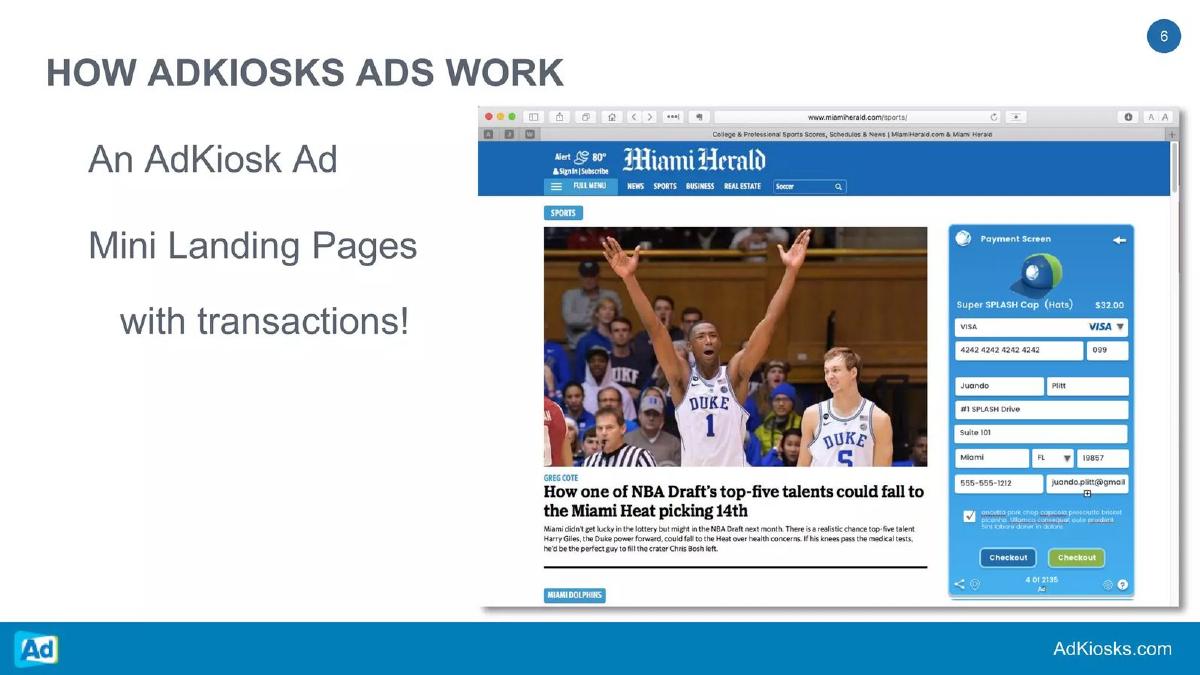
The deck excels at identifying a specific point of friction in the digital marketing funnel: the click-away. By focusing on the "Visitor Stays On Site" benefit (Slide 7), AdKiosks appeals to publishers who are often loath to send their hard-earned traffic to external sites. The visual demonstrations of the product (Slide 3 and Slide 17) are effective because they show exactly how the UI handles multiple product categories and search functions within a small footprint.
Furthermore, the team slide (Slide 15) leverages high-profile advisors well. Mentioning the founder of CarFax provides a "halo effect" that can help a pre-revenue or early-stage startup gain trust with angel investors. The financial ask is also very specific, providing a clear valuation and equity stake, which facilitates faster decision-making for potential investors.
What Is Missing
The most glaring omission in this deck is traction data . There are no metrics regarding click-through rates (CTR), conversion rates, or pilot program results. While the deck claims to "improve ROI," it offers no case studies or data points to prove that a user is actually more likely to buy a product inside a banner than on a dedicated landing page.
Additionally, the unit economics are absent. It is unclear how the revenue is split between AdKiosks, the publisher, and the advertiser. Without a clear explanation of the take-rate or SaaS fee structure, the $4 million valuation is difficult to justify purely on the vision of the technology. The deck also leans heavily on the 2017 blockchain hype cycle (Slide 9 and 13), which, in retrospect, may have distracted from the core utility of the adtech product.
Founder's Playbook: Lessons to Copy
Founders should look at Slide 7 as a masterclass in comparative positioning . Instead of a complex feature list, it uses simple icons and three clear points of differentiation to explain why the new product is better than the status quo. This "Old Way vs. New Way" framing is highly effective for disruptive technologies.
Another takeaway is the "Complementition" approach (Slide 11). Early-stage startups often make the mistake of claiming they will "kill" Google or Amazon. AdKiosks wisely positions itself as a tool that makes those platforms more effective. This reduces the perceived risk for investors who might otherwise fear the startup will be crushed by incumbents. Finally, the use of a detailed pie chart for fund allocation (Slide 13) shows a level of operational planning that gives investors confidence that the capital will be managed responsibly.
Frequently asked questions
- What is the primary problem AdKiosks aims to solve?
- AdKiosks targets the inefficiency of traditional digital ads, which typically feature only one product and require the user to click away to a landing page to complete a purchase. According to Slide 7, this friction leads to lower ROI. Their solution allows for 'unlimited products' and 'transactional' capabilities within the ad unit itself, keeping the visitor on the original site.
- How does the company plan to use the requested $500,000?
- As detailed on Slide 13, the funds are split across several departments: Dev & Design (26%), Exec & Admin (22%), Sales (20%), Marketing (15%), Overhead (7%), Professional Services (5%), and Travel & Entertainment (5%). The slide explicitly prioritizes Sales, Marketing, and Coding as the primary drivers for the use of funds.
- What role does blockchain play in the AdKiosks business model?
- Blockchain is central to their mid-term roadmap. Slide 9 outlines Phase II and III, which involve creating an 'AK Blockchain Marketplace' and 'Blockchain Secured AK Cards.' The company also intended to launch a Token Generation Event (TGE) in late 2017 to raise $1 million, suggesting they viewed crypto-assets as a primary funding and security mechanism.
- Who are the key members of the AdKiosks team?
- The leadership consists of J. Peter Meng (Founder & CEO), Guerry Semones (CTO), and Jeff Marlow (COO). The advisory board is a point of emphasis, featuring Ewin Barnett (Founder of CarFax) and Jeremy Drzal as a Payments/Blockchain Advisor. The team also includes dedicated developers and business development leads for sports and retail sectors (Slide 15).
- How does AdKiosks view its competition?
- Rather than claiming to disrupt major platforms, Slide 11 uses the term 'Complementition.' It suggests that AdKiosks can enhance current banner ads, extend the reach of retail aggregators like Amazon and eBay, and allow platforms like Facebook and Google to display thousands of products in a single ad unit.