Advanced Medical Isotope Corp. (OTC: ADMD) utilizes a 2017 investor presentation to pitch RadioGel, a brachytherapy device combining a liquid-to-solid hydrogel with Yttrium-90 phosphate particles. The company’s core strategy is a 'regulatory bridge': launching first in the veterinary market to generate revenue by January 2018, followed by international licensing for skin cancer. The deck highlights a significant total addressable market, claiming that treating just 10% of eligible pet cancers at $5,000 per therapy could yield $40M in annual revenue. While the technical and intellectual proper…
Key takeaways
- The company identifies as a late-stage developer of brachytherapy devices for both medical and veterinary applications (Slide 3).
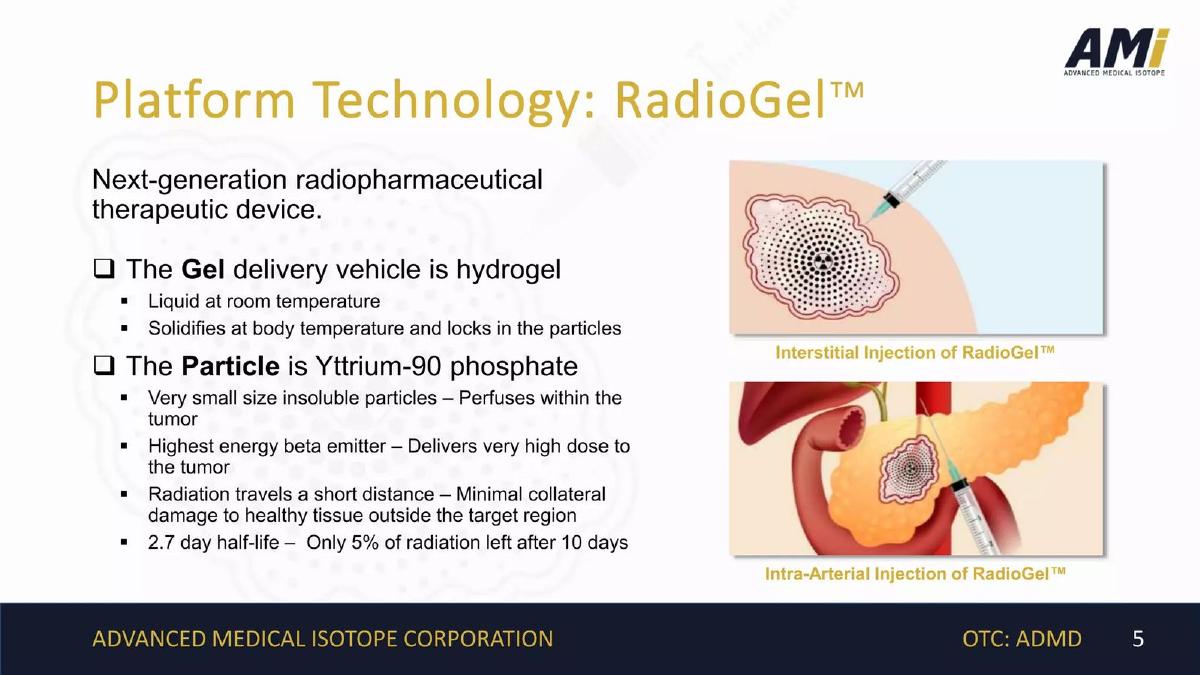
- RadioGel technology uses Yttrium-90 phosphate, a high-energy beta emitter with a 2.7-day half-life, delivered via a temperature-sensitive hydrogel (Slide 5).
- The veterinary market strategy targets 78 million dogs and 86 million cats in the U.S., where cancer is a leading cause of death (Slide 9).
- AMI projects $1.5 billion in annual revenue from skin cancer by capturing 10% of the 3.3 million people affected in the U.S. (Slide 11).
- The growth strategy follows a tiered indication path: starting with skin cancer, moving to lymph nodes, and eventually liver/pancreas (Slide 13).
- Intellectual property is anchored by eight patents sublicensed from Battelle and trademark protection in 17 countries (Slide 15).
- The company utilizes a heavy-weight Medical and Scientific Advisory Board featuring MDs, DVMs, and PhDs to validate the technology (Slide 17).
- A primary corporate goal stated in the highlights is to uplist from the OTC (ADMD) to a senior exchange like NASDAQ or NYSE MKT (Slide 19).
Executive Summary and Strategy
Slide 1: Title Slide
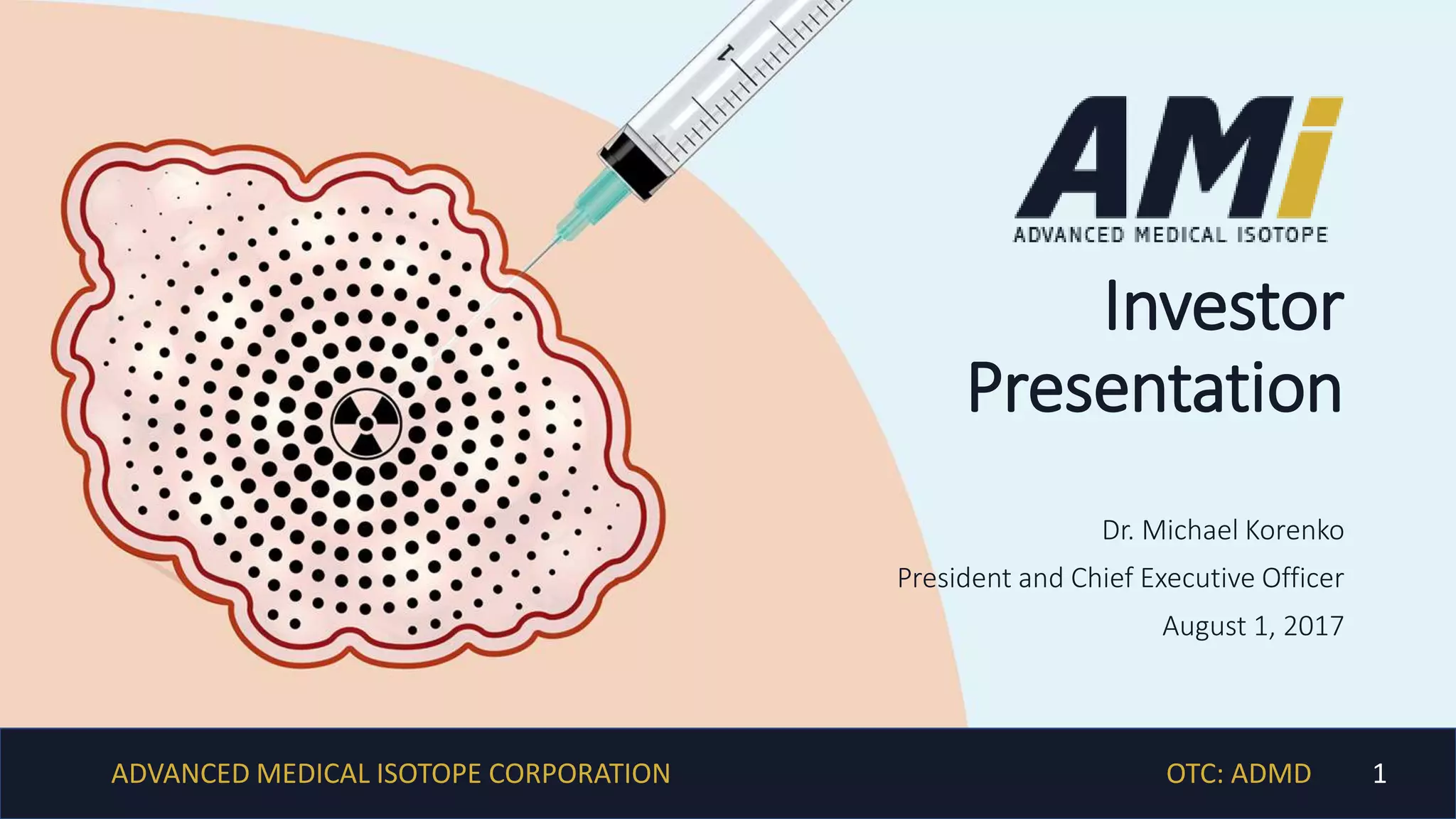
The presentation is titled "Advanced Medical Isotope Corp. Investor Presentation." It is presented by Dr. Michael Korenko, President and Chief Executive Officer, dated August 1, 2017. The slide includes a graphic of a syringe injecting a localized radioactive source into a tumor mass. Notably, the footer indicates the company is publicly traded on the OTC under the ticker ADMD.
Slide 3: Overview
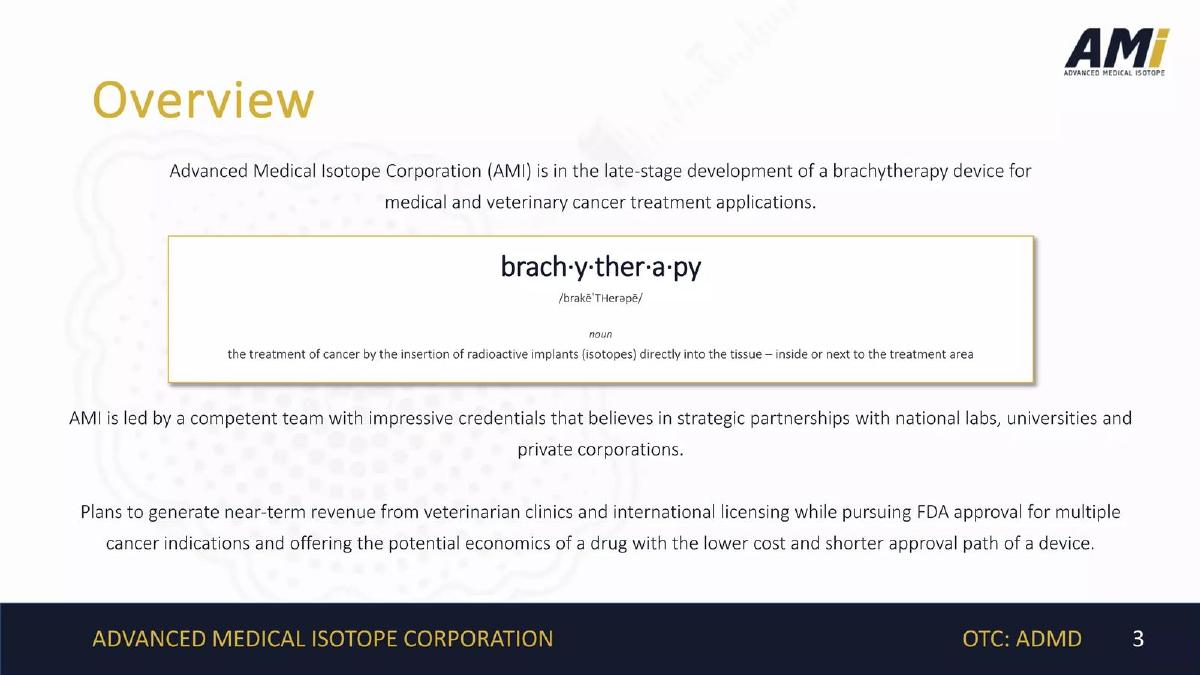
This slide defines the company's core business: the late-stage development of a brachytherapy device for medical and veterinary cancer applications. It provides a dictionary definition of brachytherapy as the treatment of cancer by inserting radioactive implants directly into tissue. The slide outlines a three-pillar strategy: leadership through a competent team, strategic partnerships with national labs and universities, and a dual-track revenue plan. This plan involves near-term revenue from veterinary clinics and international licensing while pursuing FDA approval for human indications.
Technology and Product Mechanics
Slide 5: Platform Technology: RadioGel
AMI describes RadioGel as a "next-generation radiopharmaceutical therapeutic device." The technology is split into two components: the Gel and the Particle. The Gel is a hydrogel that remains liquid at room temperature but solidifies at body temperature to lock particles in place. The Particle is Yttrium-90 phosphate, described as a high-energy beta emitter with a 2.7-day half-life. The slide emphasizes that the radiation travels a short distance, which minimizes collateral damage to healthy tissue. Two diagrams show the application: Interstitial Injection (directly into the tumor) and Intra-Arterial Injection.
Market Opportunity: Veterinary and Human
Slide 7: Initial Market: Veterinary Applications
This slide uses a simple three-step icon process to explain the go-to-market strategy for the veterinary sector. The steps are: 1. Obtain approval to test, 2. Demonstrate therapies at leading research universities, and 3. Begin sales to private clinics. This represents the company's "path of least resistance" to commercialization.
Slide 9: Veterinary Market – Significant Opportunity
AMI quantifies the pet market, noting 78 million dogs and 86 million cats in the U.S. They state that cancer is the leading cause of death for 50% of dogs over age 10. The financial projection suggests that treating 10% of these cancers at a $5,000 therapy price point would generate $40M in annual revenue. The slide sets a target date for revenue to begin by January 2018.
Slide 11: Basal Cell and Squamous Cell Skin Cancers Market Projections
Shifting to human health, the slide focuses on skin cancer, noting it represents one out of every three new cancers. With 5.4 million cases annually in the U.S. affecting 3.3 million people, the company projects a $1.5 billion annual revenue opportunity. This calculation is based on a 10% market share and a $5,000 price per therapy. They anticipate international licensing revenue for this indication to begin in early 2018.
Slide 13: Medical Sector – Growth Strategy
This slide presents a roadmap for human medical indications. The "quantum growth steps" are visualized as three overlapping arrows. The first target is Skin Cancer, followed by Lymph Nodes, and finally Liver/Pancreas. This suggests a strategy of moving from external/accessible tumors to internal, more complex organ systems as the technology matures and regulatory approvals progress.
Defensibility and Leadership
Slide 15: Intellectual Property Protection
AMI lists its defensive assets, including the retention of an IP attorney and a sublicensing agreement with Battelle that grants rights to eight patents. They mention trademark protection in 17 countries and proprietary IP covering production procedures, test data, and advanced product development (specifically resorption time and imaging). This slide is intended to reassure investors of the company's freedom to operate and competitive moat.
Slide 17: Medical & Scientific Advisory Boards
The company showcases its advisory depth with photos and titles of three key chairs: Dr. Barry D. Pressman (Medical), Dr. Alan E. Waltar (Scientific), and Dr. Alice Villalobos (Veterinary). Three additional members are listed: Dr. Albert S. DeNittis, Dr. Darrell Fisher, and Dr. Howard Sandler. The credentials (MD, DVM, PhD, FACR, FASTRO) are emphasized to provide clinical and scientific credibility to the RadioGel platform.
Slide 19: Highlights
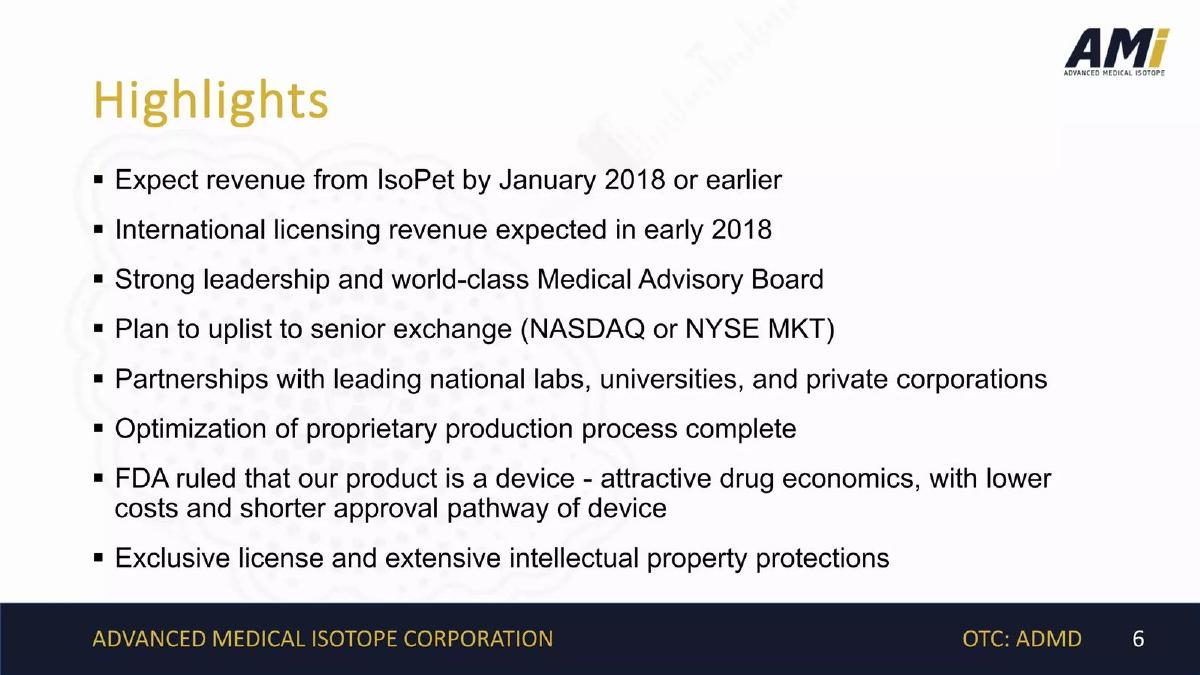
The final slide summarizes the investment thesis: revenue expectations for January 2018 (IsoPet and international licensing), strong leadership, and a plan to uplist to a senior exchange like NASDAQ or NYSE MKT. It reiterates the "drug economics with device approval path" advantage and the strength of their exclusive licenses and IP protection.
What Works in This Deck
Clear Regulatory Strategy: The decision to lead with the veterinary market is a smart strategic move for a small medical device company. It provides a faster route to revenue and real-world data while the human clinical trials proceed. The deck clearly communicates this "regulatory bridge" to investors.
Technical Simplicity: Slide 5 does an excellent job of explaining a complex radiopharmaceutical product. By breaking it down into "The Gel" and "The Particle," the company makes the mechanism of action accessible to non-scientific investors without losing the technical specifics (e.g., Yttrium-90, 2.7-day half-life).
Credibility via Association: Mentioning Battelle for patents and listing a highly credentialed advisory board helps mitigate the perceived risk of a small OTC-traded company. The inclusion of a specific Veterinary Medicine Advisory Board chair validates their commitment to the pet health market.
What Is Missing from This Deck
Financial Performance and Burn Rate: As an OTC-traded company (ADMD), investors need to see the current balance sheet, historical revenue (if any), and the projected runway. The deck provides market projections but omits the company's actual financial health or the cost of achieving the stated milestones.
The Ask: There is no slide detailing how much capital the company is seeking or how those funds will be allocated. While this may be a general corporate update, a fundraising deck must specify the terms of the round or the intended use of proceeds.
Competitive Landscape: The deck operates in a vacuum, assuming RadioGel is the only solution. It fails to mention existing brachytherapy competitors, traditional radiation therapy, or emerging immunotherapy treatments that might compete for the same patient populations in both the human and veterinary sectors.
Clinical Data: While the deck mentions "all test data" is proprietary, it does not show any. Even preliminary animal study results or case studies from the "leading research universities" mentioned on Slide 7 would significantly strengthen the pitch by providing proof of efficacy.
What a Founder Should Copy
The "Indication Expansion" Roadmap: Slide 13 is a textbook example of how to show a long-term growth strategy. Starting with a simpler, lower-risk indication (Skin Cancer) and moving toward higher-value, more complex ones (Liver/Pancreas) shows a logical progression that manages both clinical and financial risk.
Market Sizing Logic: The company uses a very transparent "10% x Market Size x Price" formula for its revenue projections. While the 10% figure is arbitrary, the math is easy for an investor to follow and adjust based on their own risk assessment.
Visualizing the Mechanism: The use of simple medical illustrations to show how the product is actually administered (Slide 5) is vital for medical device pitches. It helps the investor visualize the clinical workflow and the ease of use for the practitioner.
Conclusion
The Advanced Medical Isotope Corp. deck is a focused, technically sound presentation that leans heavily on the strategic advantage of the veterinary market. It successfully positions RadioGel as a versatile platform with a clear path to near-term revenue. However, for a sophisticated investor, the lack of competitive analysis, clinical data summaries, and specific financial requirements leaves significant questions unanswered. It functions well as a high-level overview of the technology and strategy but requires a detailed supplemental data room to close a professional investment round.
Frequently asked questions
- What is the primary product being pitched?
- The product is RadioGel, a brachytherapy device. It consists of a hydrogel that is liquid at room temperature but solidifies at body temperature, locking Yttrium-90 phosphate particles directly into a tumor. This allows for high-dose radiation with minimal collateral damage to healthy tissue due to the short travel distance of the radiation and the 2.7-day half-life of the isotope.
- How does the company plan to generate revenue quickly?
- AMI plans to bypass the lengthy human clinical trial timeline by first entering the veterinary market. Slide 9 indicates they expected revenue to begin by January 2018 from private veterinary clinics. They also planned to generate international licensing revenue from skin cancer applications in early 2018, leveraging the lower cost and shorter approval path of a medical device compared to a drug.
- What is the status of their intellectual property?
- According to Slide 15, AMI has secured rights to eight patents through a sublicensing agreement with Battelle. They also claim proprietary intellectual property regarding production procedures, test data, and advanced product development (resorption time and imaging). Their trademark protection extends to 17 countries, providing a global defensive moat for the brand.
- Who is leading the scientific validation of the technology?
- The company relies on a multi-disciplinary advisory board. This includes Dr. Barry D. Pressman (Chairman of the Medical Advisory Board), Dr. Alan E. Waltar (Chairman of the Scientific Advisory Board), and Dr. Alice Villalobos (Chair of the Veterinary Medicine Advisory Board). The board also includes specialists in radiation oncology and nuclear physics to cover the technical breadth of the product.
- What are the projected market sizes for their target indications?
- For the veterinary market, they estimate a $40M annual revenue opportunity based on a 10% penetration rate. For the human skin cancer market, they cite 5.4 million cases per year in the U.S. and project a $1.5 billion annual revenue stream if they capture 10% of the market at a $5,000 price point per therapy.