Slamby’s 2015 pitch deck is a study in extreme minimalism, utilizing just nine slides to convey a complex technical solution. The company positions itself as a 'Real Time Automated Smart Classifier' targeting four specific verticals: Price Comparison, Classifieds, Customer Service, and Enterprise Email. Despite the sparse visual design, the deck communicates significant traction, claiming profitability and 11 enterprise customers across three countries within 2.5 years of operation. The team is a standout feature, boasting two PhDs and deep experience in ERP development and natural language s…
Key takeaways
- The company identifies as a 'Real Time Automated Smart Classifier' on slide 2.
- Slamby claims to be profitable after 2.5 years of operation as stated on slide 4.
- The startup has secured 11 enterprise customers across 3 different countries according to slide 4.
- In the Price Comparison vertical, the company claims all major providers in their home market are customers (slide 4).
- The team includes two PhDs and a CTO with a decade of ERP development experience for clients like Heineken (slide 5).
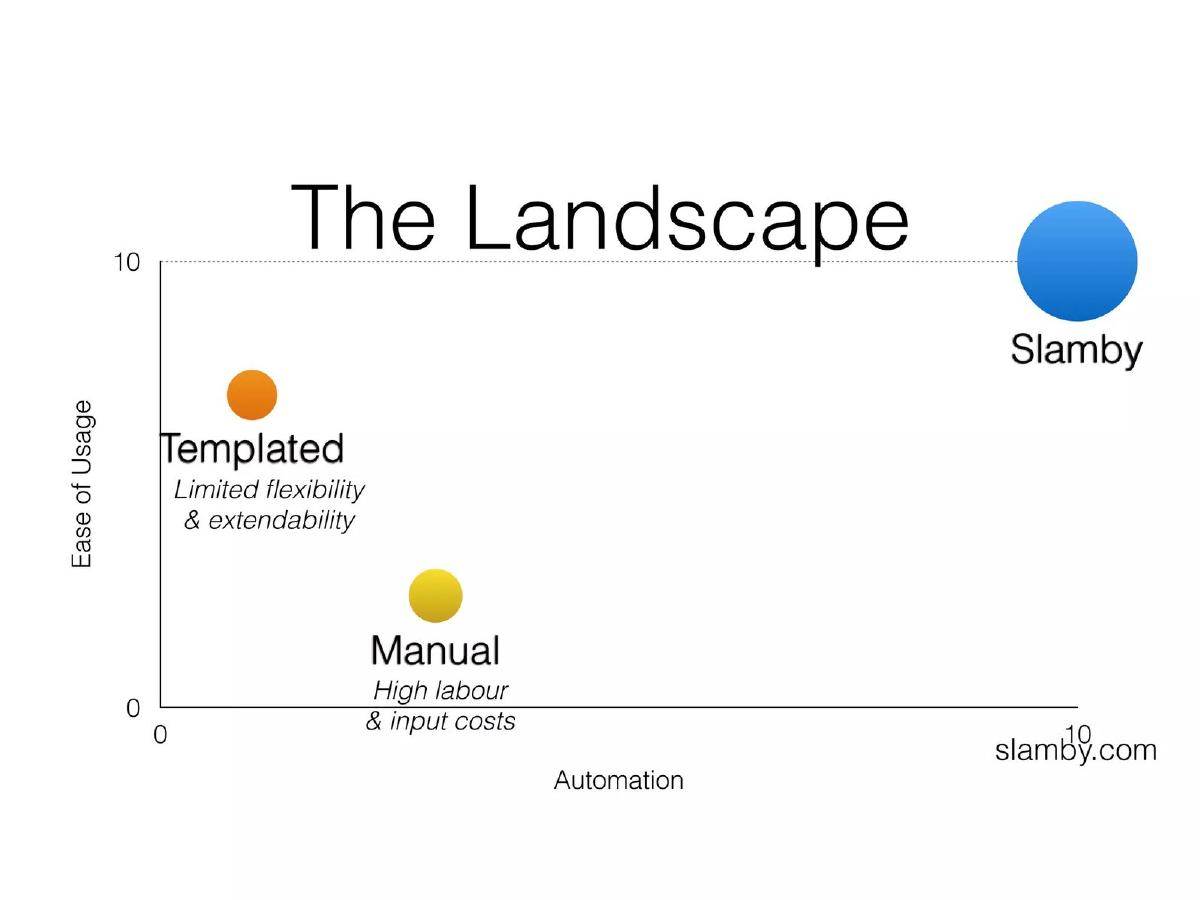
- Slamby positions itself at the top right of the competitive landscape, claiming maximum automation and ease of usage (slide 6).
- The business model is a standard SaaS monthly fee, emphasizing language independence and self-learning capabilities (slide 7).
- The funding ask is $500,000 to fuel a 12-month runway for development and sales in the UK and US (slide 8).
Introduction
The Slamby pitch deck, presented at the Startup AddVenture Budapest 2015 tour, is a minimalist presentation that leans heavily on the 'less is more' philosophy. Comprising only nine slides, the deck avoids the common pitfall of over-explaining technical jargon, instead focusing on the company's proven traction and the high-level utility of its data classification engine. In an era where AI and machine learning pitches are often cluttered with complex diagrams, Slamby’s approach is remarkably clean, using white space and simple typography to guide the viewer through their value proposition.
Slide 1: Title Slide
The opening slide serves as a branding marker for the event rather than the company itself. It features the logos for 'Startup AddVenture Budapest' and 'TechCrunch Pitch Slap Startup Competition.' This sets the context of the deck as a competitive pitch designed for a live audience where the speaker would likely be providing the majority of the narrative. No company information is present here.
Slide 2: The Hook
Slide 2 introduces the company name, Slamby , and its core identity: "Real Time Automated Smart Classifier." The inclusion of the URL (slamby.com) in the bottom right corner—a recurring element throughout the deck—ensures brand persistence. This slide is a textbook example of a clear, concise 'what we do' statement. It doesn't explain how it works yet, but it tells the investor exactly what category the business occupies.
Slide 3: Market Verticals
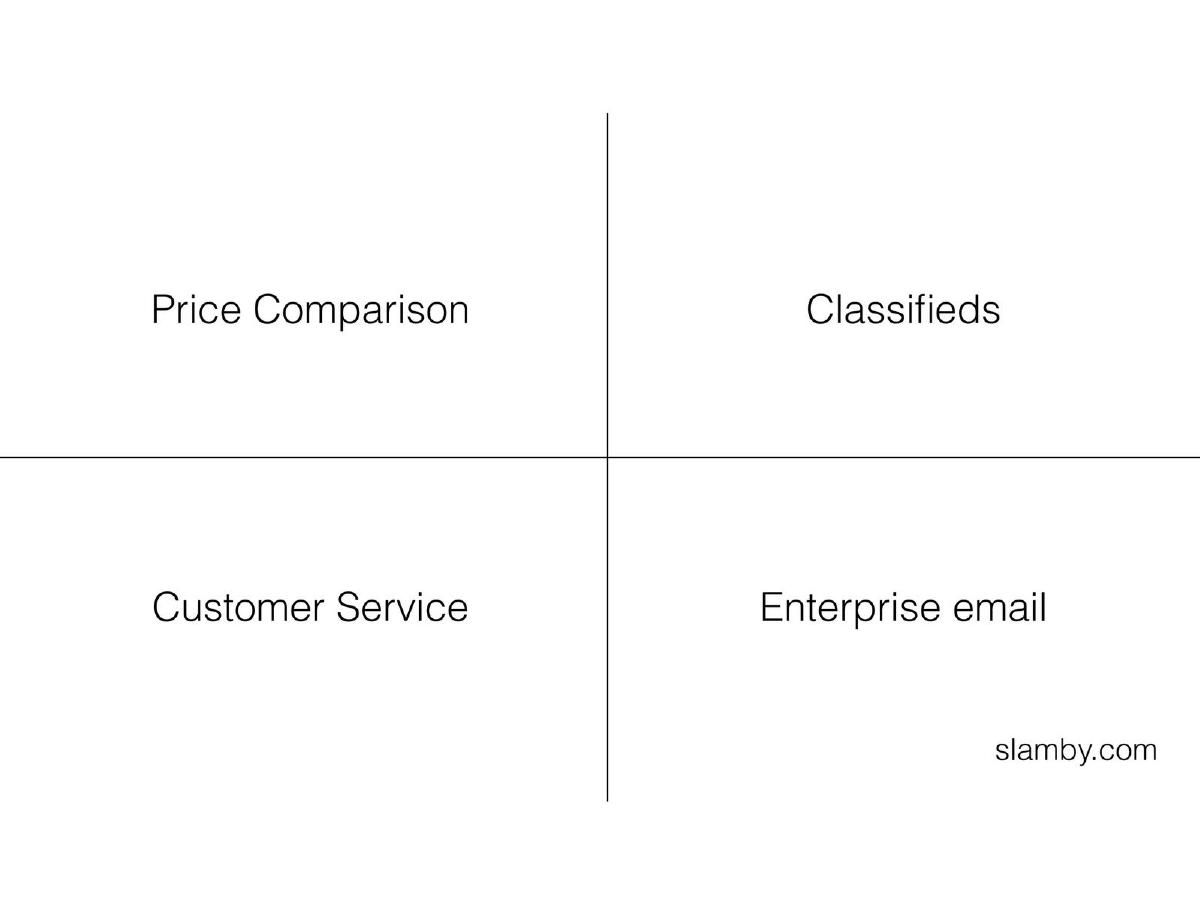
This slide uses a simple four-quadrant layout to identify the primary markets Slamby serves. These are listed as Price Comparison, Classifieds, Customer Service, and Enterprise email. By choosing these four, Slamby signals that their technology is versatile but focused on high-volume data environments where manual classification is either too slow or too expensive. There is no data on market size (TAM/SAM/SOM) on this slide, which is a notable omission for a fundraising deck.
Slide 4: Traction and Achievements
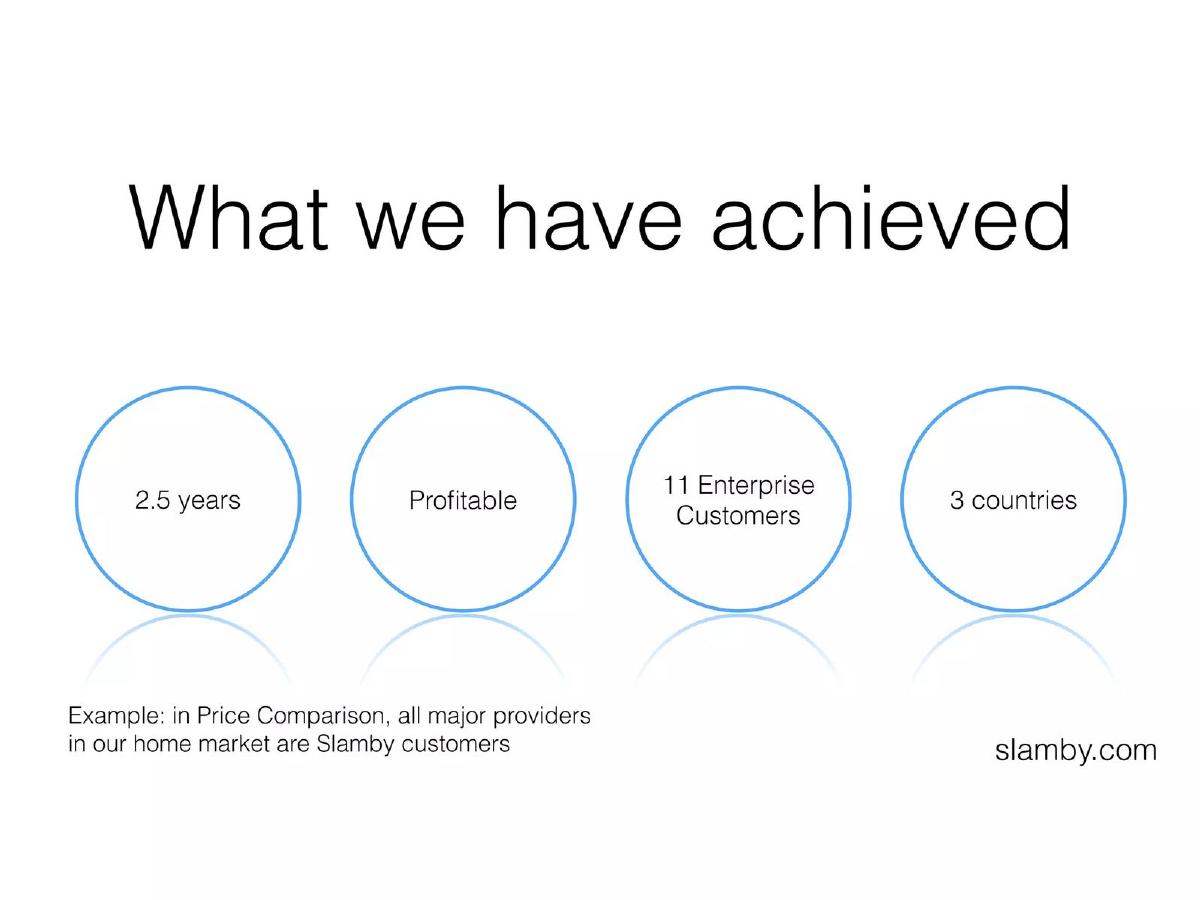
This is arguably the strongest slide in the deck. Under the heading "What we have achieved," Slamby lists four key metrics: 2.5 years in operation, Profitable status, 11 Enterprise Customers , and presence in 3 countries . A footnote adds significant weight to these numbers, claiming that in the Price Comparison sector, "all major providers in our home market are Slamby customers." For a startup at this stage, being profitable while dominating a local niche is a massive de-risking signal for investors.
Slide 5: The Team
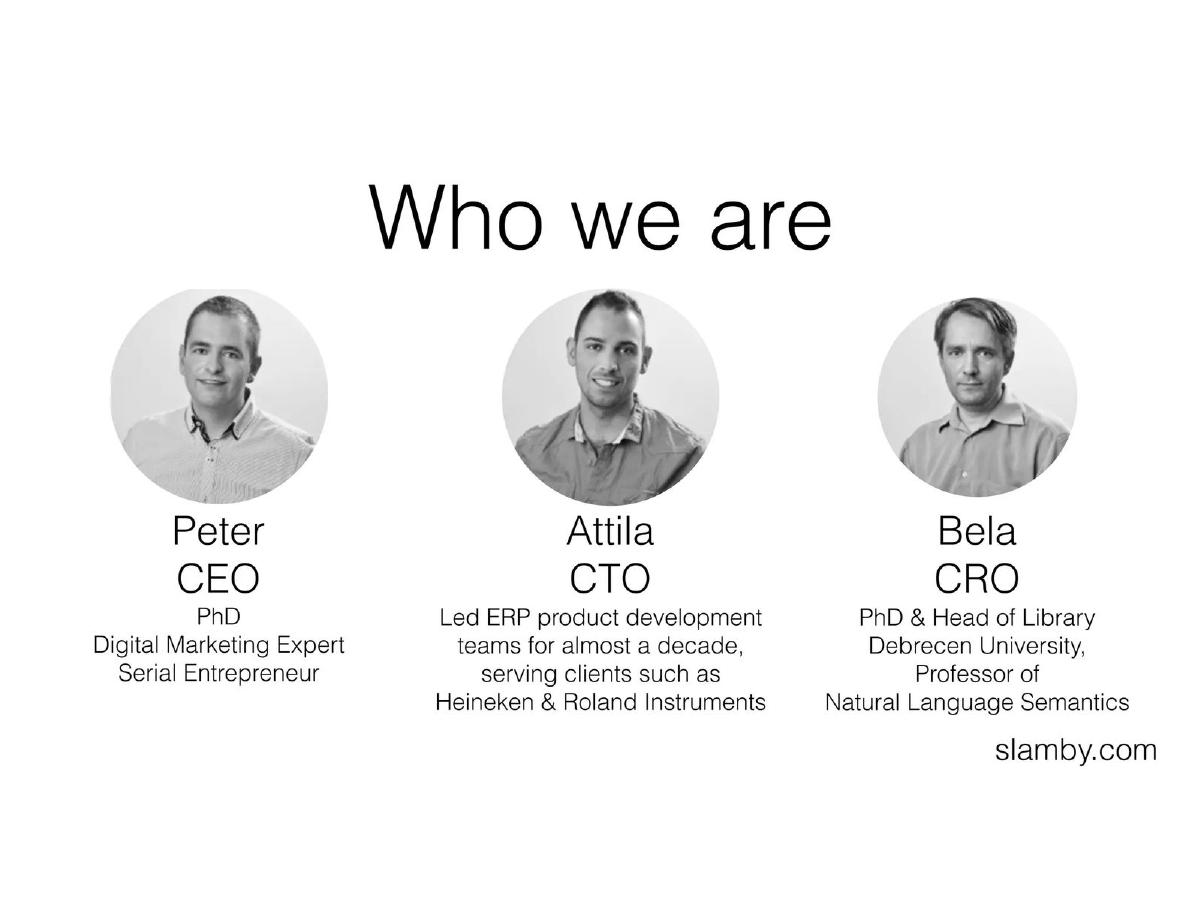
The 'Who we are' slide highlights a team with deep technical and academic roots. Peter (CEO) is described as a PhD and serial entrepreneur. Attila (CTO) brings enterprise-grade experience, having led ERP development for "almost a decade" for clients including Heineken and Roland Instruments. Bela (CRO) adds academic prestige as a PhD, Professor of Natural Language Semantics, and Head of Library at Debrecen University. The team composition suggests that the 'Smart Classifier' is built on legitimate linguistic science rather than basic keyword matching.
Slide 6: Competitive Landscape
Slide 6 features a standard 2x2 matrix, though the axes are "Ease of Usage" and "Automation." Slamby places itself in the top-right corner (10/10 on both scales). It contrasts itself against "Templated" solutions (which have limited flexibility) and "Manual" processes (which have high labor and input costs). While visually clear, the slide lacks specific competitor names, which can sometimes make investors skeptical of the 'Landscape' being too generalized.
Slide 7: The Solution and Model
This slide attempts to explain the product flow using a simple graphic: raw binary data enters the "Slamby Classifier" and emerges as organized streams. It lists three primary advantages: Language Independent, Self Learning, and Unrivalled Accuracy. Below this, the business model is confirmed as SAAS with a Monthly Fee. This slide bridges the gap between the 'what' and the 'how,' though it remains very high-level.
Slide 8: The Ask and Next Steps
The penultimate slide outlines the roadmap. The company is seeking $500,000 to fund 12 months of Development & Sales. The geographic targets are the UK & US , and the strategic goal is to enter 3 additional target markets. The layout mirrors the four-quadrant market slide from earlier, suggesting that the expansion will build directly upon their existing vertical successes.
Slide 9: Contact Information
The deck concludes with a simple contact slide featuring the CEO's email address and a 'Thank You' note. It maintains the minimalist aesthetic of the rest of the presentation.
What Works Well
The Slamby deck excels at clarity and brevity. In a pitch competition setting, where judges see dozens of decks, Slamby’s refusal to clutter slides with text makes the key points—profitability, enterprise customers, and PhD-led team—stand out. The claim of dominating a home market (Price Comparison) is a powerful proof of concept that justifies the ask for international expansion funds. Furthermore, the team slide is exceptionally strong; having a Professor of Natural Language Semantics as a Chief Research Officer (or similar role, though titled CRO here) provides immediate technical credibility to an AI-adjacent product.
What Is Missing
The most glaring omission is financial detail. While the deck mentions profitability, it provides no revenue figures, growth rates, or margins. An investor would want to know if 'profitable' means $10k a month or $100k a month. Additionally, there is no mention of the total addressable market (TAM). While they list four verticals, they don't quantify the dollar value of the problem they are solving in those spaces. Finally, the competitive landscape is purely conceptual; it doesn't name a single rival company, which prevents investors from understanding where Slamby sits relative to established players like IBM Watson or smaller specialized startups.
Founder Takeaways
Founders should look to Slamby as an example of how to leverage academic credentials without making a deck feel like a thesis. The bios are short and impact-oriented. Another takeaway is the use of 'Anchor Traction' —the specific claim that they own the major players in one specific niche (Price Comparison) gives the rest of their claims much more weight. If you have a 'home court' advantage, highlight it as a blueprint for your global expansion. Lastly, the minimalist design is a brave choice that works well for live pitches, though a 'leave-behind' version of this deck would likely require more detailed appendices to satisfy a deep-dive due diligence process.
Frequently asked questions
- What exactly does Slamby's technology do?
- According to slide 2 and slide 7, Slamby is a 'Real Time Automated Smart Classifier.' The technology uses a self-learning engine to take unstructured data and organize it into specific categories. The deck highlights that the solution is 'Language Independent' and offers 'Unrivalled Accuracy,' making it applicable for sorting large volumes of text-based data in real-time without manual intervention.
- Which industries is Slamby targeting?
- Slamby specifically targets four markets: Price Comparison, Classifieds, Customer Service, and Enterprise Email, as listed on slides 3 and 7. These are all sectors characterized by high volumes of incoming data that require rapid, accurate categorization—such as matching products across different retailers or routing customer support tickets to the correct department.
- What is the current stage and traction of the company?
- At the time of this 2015 pitch, Slamby was 2.5 years old and already profitable. Slide 4 notes they had 11 enterprise customers across three countries. Most notably, they claimed a dominant position in their home market's price comparison sector, stating that 'all major providers' were already using their software.
- Who are the founders and what is their background?
- The leadership team consists of Peter (CEO), a PhD and serial entrepreneur; Attila (CTO), who led ERP development for nearly a decade for brands like Heineken and Roland Instruments; and Bela (CRO), a PhD, Professor of Natural Language Semantics, and Head of Library at Debrecen University. This combination suggests a strong mix of commercial experience and deep academic expertise in linguistics.
- What are the company's plans for the requested $500,000 investment?
- As detailed on slide 8, the $500,000 investment is intended to cover a 12-month period. The primary goals are to expand sales and development efforts into the UK and US markets and to penetrate three additional target markets beyond their initial four core verticals.