Hang’s 10-slide deck is a concise example of how to pitch complex technology (Web3/NFTs) through the lens of traditional business pain points. By identifying an 80% increase in customer acquisition costs (CAC) as the primary antagonist, Hang positions its platform not as a crypto experiment, but as a necessary tool for improving Lifetime Value (LTV). The deck relies heavily on high-level conceptual flywheels and product mockups rather than dense financial data or team bios. While it lacks a formal 'Ask' slide or a team overview, the narrative successfully bridges the gap between Web3 interope…
Key takeaways
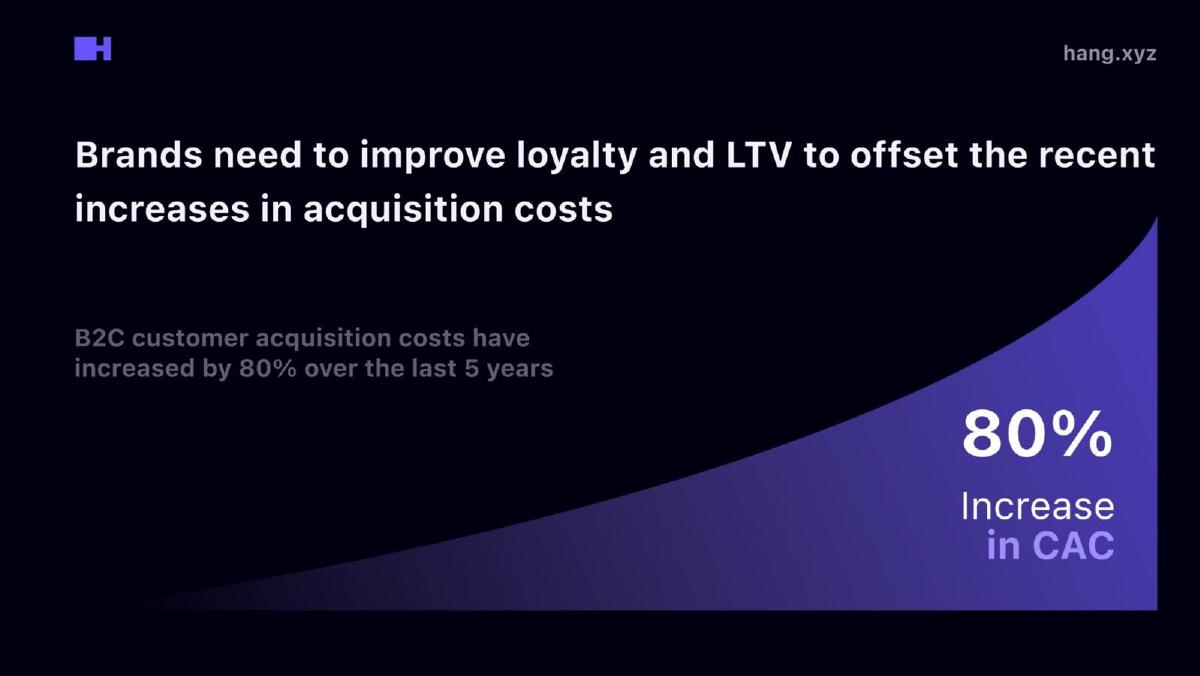
- The deck identifies a specific market macro-trend: B2C customer acquisition costs have increased by 80% over the last 5 years (Slide 3).
- Hang positions its solution as 'enterprise-grade,' a key differentiator in the often fragmented Web3 space (Slide 2).
- The product is marketed as 'no coding required,' lowering the barrier to entry for traditional retail brands (Slide 6).
- The value proposition of NFTs is focused on resale value and appreciation as users 'level up,' creating a new incentive model (Slide 5).
- A conceptual flywheel slide illustrates how more brands lead to more integrations, creating a platform moat (Slide 8).
- The deck highlights 'consumer-friendly on-ramps,' allowing users to pay with credit cards or create wallets via email (Slide 7).
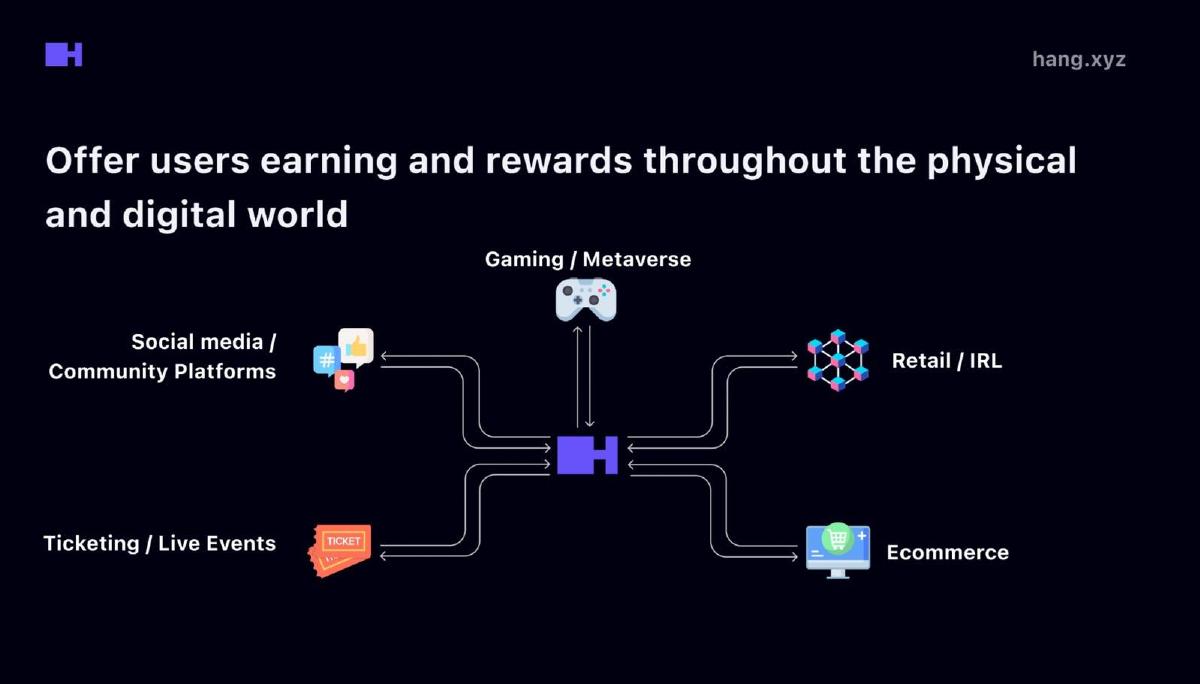
- The platform aims for cross-channel utility, connecting social media, gaming, retail, and e-commerce (Slide 9).
- There is a notable absence of a team slide, financial projections, or a specific funding ask within these 10 slides.
The Narrative: From Crypto Hype to Enterprise Utility
Hang’s pitch deck is a study in restraint. In an era where Web3 companies often get bogged down in technical jargon about consensus mechanisms or gas fees, Hang focuses entirely on the business outcome: Lifetime Value (LTV). The deck is structured to move a traditional enterprise executive from a state of pain (high acquisition costs) to a state of possibility (interoperable, appreciating loyalty assets).
Reported by Business Insider as a $16M Series A, this deck serves as the bridge between the 2021 NFT craze and the 2024 reality of enterprise software. It treats the blockchain not as the product, but as the plumbing for a superior version of Starbucks Rewards or Sephora Beauty Insider.
Slides 1-2: The Vision Statement
The deck opens with a clean, purple-branded title slide. Slide 2 immediately defines the company's category: "Hang is building the first enterprise-grade platform for creating Web3-powered brand membership programs." The use of the term "enterprise-grade" is a deliberate signal to VCs that this is not a consumer dApp or a niche collectible project, but a scalable B2B SaaS play.
Slide 3: The Macro Problem
Slide 3 provides the "Why Now?" factor. It claims that "B2C customer acquisition costs have increased by 80% over the last 5 years." By leading with a hard metric about CAC, Hang anchors the conversation in traditional marketing economics. This makes the subsequent pitch for NFTs feel like a logical solution to a math problem rather than a speculative technology bet.
Slide 4: The Competitive Gap
Slide 4 uses a simple grid to compare "Existing loyalty programs," "Retention marketing," and "Community building." The slide argues that none of these existing solutions are simultaneously brand accretive, easy to build, and incentivizing. It sets the stage for Hang to claim the center of this Venn diagram, though it notably lacks specific competitor names, opting for broad category labels instead.
Slide 5: The Web3 Value Proposition
This is the core "Solution" slide. Hang breaks down the benefits of Web3 into three pillars: Incentive Structure, Interoperability, and Identity & Community. The most compelling argument here is the resale value: "NFTs have a better incentive model... since they can be resold. As users take actions to level up their NFT and unlock perks, it appreciates." This introduces the concept of a "liquid" loyalty program, which is a significant departure from traditional points-based systems.
Slides 6-7: Product and Ease of Use
Slide 6 and 7 focus on the user interface and the "no-code" nature of the platform. Slide 6 shows a dashboard with rewards like "50% Off Order Total" and "Free Sweatshirt," alongside "Enterprise-grade reporting and analytics." Slide 7 introduces "Fuego Friends" as a case study or mock-up, emphasizing that users can pay with credit cards. This is a critical point for enterprise adoption; if a brand's customers need to understand seed phrases to join a loyalty program, the program will fail. Hang removes that friction.
Slide 8: The Flywheel and Moat
Slide 8 attempts to explain the long-term defensibility of the business. It describes a flywheel where "New brands add modules and integrations over time," leading to the "Largest collection of integrations," which in turn makes the platform the "Easiest onboarding and most comprehensive offering." This is a classic network effects argument, suggesting that as Hang grows, it becomes harder for a competitor to catch up because of the sheer volume of third-party connections (POS systems, e-commerce platforms, etc.).
Slide 9: The Ecosystem Map
Slide 9 visualizes the "Hang" logo at the center of a web connecting Social Media, Gaming/Metaverse, Retail/IRL, Ticketing, and E-commerce. This slide illustrates the "Interoperability" mentioned earlier. The promise is that a loyalty NFT earned in a retail store could potentially unlock a skin in a game or a special channel on a community platform. It paints a picture of a unified digital identity across the internet.
Slide 10: The Contact Slide
The deck ends abruptly with a contact email for "matt@hang.xyz." There is no summary of the team's background, no mention of the $16M round size, and no roadmap of what will be built next. This suggests that this deck may have been a teaser or part of a larger presentation where the founders' pedigree was already known to the investors.
What Hang Does Well
Problem-First Approach: By starting with CAC and LTV (Slide 3), they speak the language of the brands they want to sign and the investors they want to pitch. · Friction Reduction: Emphasizing credit card payments and email-based wallets (Slide 7) addresses the biggest hurdle in Web3 adoption. · Visual Clarity: The deck is not cluttered. Each slide has one clear message, usually delivered in a single headline. · Category Leadership: They repeatedly use the word "first" and "enterprise-grade" to position themselves as the professional choice in a crowded, often amateurish market.
What is Missing from the Deck
The Team: There is zero information about who is building Hang. In a Series A, the "Why you?" is usually as important as the "Why now?" · Traction Metrics: While they show a mock-up of "Fuego Friends," there are no slides showing actual growth, number of active brands, or user engagement rates. · The Ask: The deck does not state how much money is being raised or how it will be spent. While we know from publisher facts it was $16M, a standard deck usually includes a slide on milestones and capital allocation. · Unit Economics: There is no mention of the business model. Is it a SaaS fee? A percentage of secondary sales? A per-mint fee? This is a significant omission for a Series A teardown.
Founder Takeaways
Anchor in Reality: If you are pitching a frontier technology (AI, Web3, Biotech), find a boring, traditional business metric (like CAC) to justify why your tech is necessary. · Show, Don't Just Tell: The product mock-ups in Slides 6 and 7 do more to explain the platform than a paragraph of text ever could. · Build a Moat Slide: Even if it's conceptual, showing investors how your business becomes more defensible over time (Slide 8) is crucial for justifying a high valuation. · Keep it Concise: 10 slides is plenty to get a meeting. You don't need a 40-page deck to raise $16M if your narrative is tight and your market timing is right.
Frequently asked questions
- What is the primary problem Hang solves according to the deck?
- Hang targets the rising cost of customer acquisition. Slide 3 states that B2C CAC has increased by 80% over the last five years, making traditional loyalty programs insufficient. Hang proposes that Web3-powered programs can better offset these costs by increasing customer Lifetime Value (LTV) through better incentives and interoperability.
- How does Hang differentiate itself from traditional loyalty programs?
- According to Slide 5, Hang uses NFTs to provide a 'better incentive model' because the digital assets can be resold. As users unlock perks and level up their membership, the NFT appreciates in value. This is contrasted with traditional programs that lack brand accretion and are difficult to build (Slide 4).
- Is the platform technical to implement for brands?
- No. Slide 6 explicitly states 'no coding required' for building and managing programs. It features a drag-and-drop interface for rewards and 'no-code contracts' for launching projects (Slide 7), positioning it as a SaaS-like experience for non-technical marketing teams.
- How does Hang handle the 'crypto barrier' for average consumers?
- Slide 7 addresses this by highlighting 'consumer-friendly on-ramps.' Users can create a digital wallet using just their email address and can pay for memberships using standard credit cards rather than requiring them to hold cryptocurrency first.
- What is missing from the Hang pitch deck?
- The 10-slide deck is missing several standard components: a team slide detailing founder expertise, a competition slide naming specific rivals, a financial slide showing current revenue or burn, and a slide detailing the specific $16M ask and use of funds.