The Pill Club's pre-seed deck from 2016 is a high-impact example of how to pitch a regulated B2C service. With only 10 slides, the founders successfully communicated a complex logistics and healthcare play by focusing on three core pillars: the physical frustration of retail pharmacies, exceptional retention metrics, and a team with deep institutional pedigree. The deck reports a $30K MRR and a 10% weekly growth rate, which are significant figures for a pre-seed round. While the deck lacks a formal 'Ask' slide detailing the specific use of funds, it compensates with strong social proof from Y…
Key takeaways
- The company achieved a $30K MRR and 10% weekly patient growth prior to their pre-seed raise, as shown on slide 7.
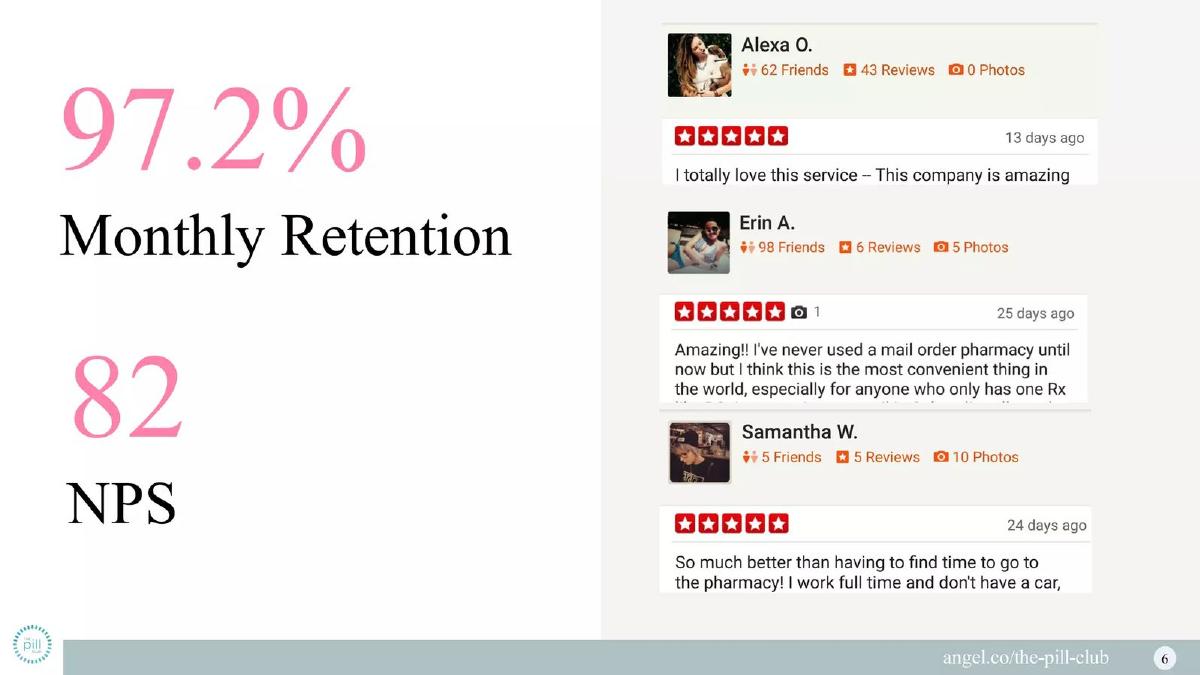
- Retention is the deck's strongest metric, boasting a 97.2% monthly retention rate and an 82 NPS on slide 6.
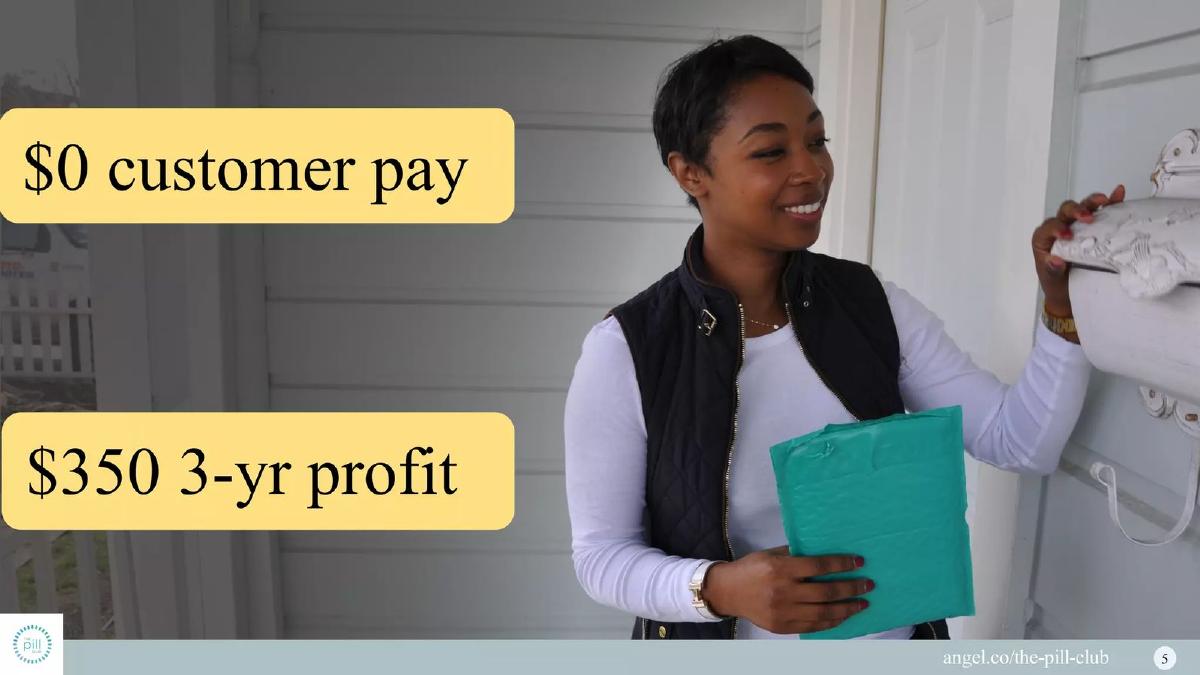
- The business model relies on a $0 cost to the customer while generating a $350 profit over a 3-year period per patient, according to slide 5.
- The founders established a significant barrier to entry by completing a 1.5-year pharmacy build-out and licensing process before scaling, as noted on slide 8.
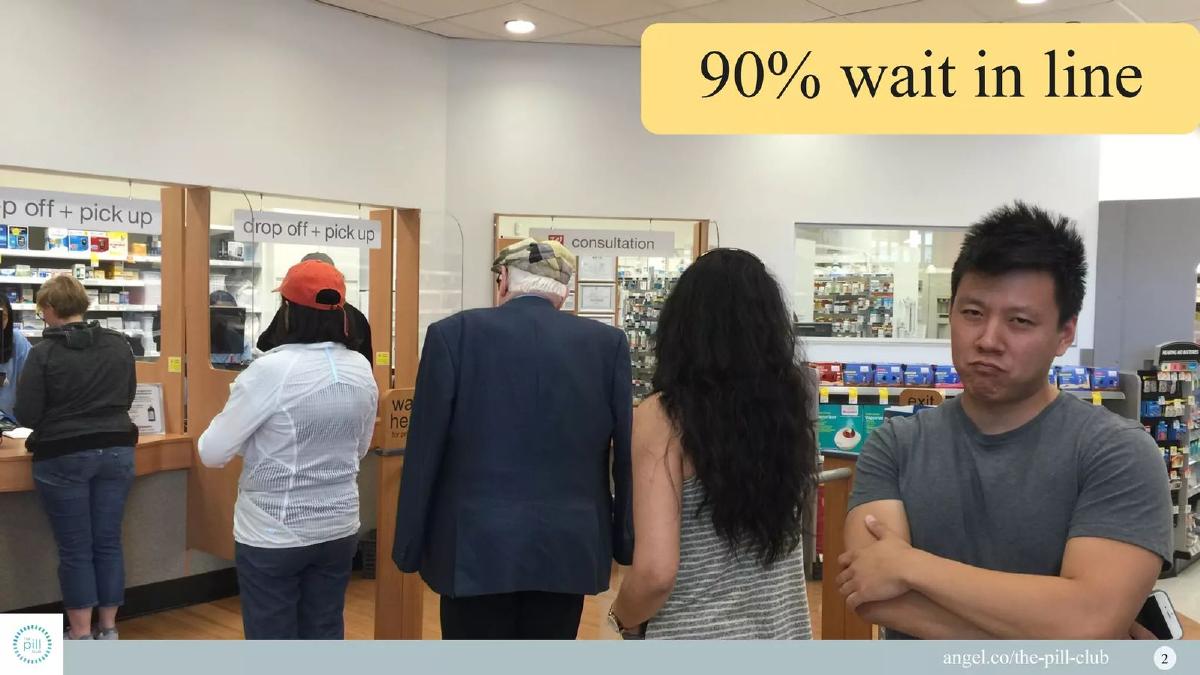
- The problem is framed visually rather than through data, using a photo of a pharmacy line to represent the '90% wait in line' frustration on slide 2.
- The team slide (slide 9) highlights a mix of medical, legal, and engineering backgrounds from Stanford, Duke, and Google.
- The deck omits a specific 'Ask' slide, failing to mention the $125K target or how the capital would be allocated.
- Social proof is integrated via actual Yelp screenshots, providing qualitative validation to match the quantitative data on slide 6.
The Pill Club: A Case Study in Traction-First Pitching
The Pill Club’s 2016 pre-seed deck is a lean, 10-slide presentation that successfully raised $125,000. At a time when direct-to-consumer (DTC) healthcare was beginning to surge, The Pill Club differentiated itself by focusing on a very specific, high-retention niche: birth control. The deck is notable for its lack of fluff; it avoids long-winded market size projections and instead focuses on the immediate reality of their business: people hate waiting in line, and once they switch to The Pill Club, they don't leave.
Slide 1: Title and Branding
The deck opens with a simple title slide featuring the company logo—a circular motif of pills—overlaid on a lifestyle image of a woman using a smartphone. This immediately establishes the target demographic and the mobile-first nature of the service. There is no tagline or mission statement here, just the brand identity.
Slide 2: The Emotional Problem
Slide 2 is a masterclass in visual storytelling. It features a photo of a crowded pharmacy counter with a frustrated-looking man in the foreground. The text is minimal: "90% wait in line." By focusing on the physical inconvenience of the current pharmacy experience, the founders tap into a universal frustration. This slide validates the market need not through abstract data, but through a relatable daily struggle.
Slide 3: The Simple Solution
The solution is presented on slide 3 with equal simplicity: "We mail birth control to women monthly." It adds a crucial differentiator: "From the first birth control only pharmacy." This tells investors that they aren't just a middleman; they are a licensed, specialized healthcare provider. The image of a smiling woman receiving her package reinforces the positive outcome of the service.
Slide 4: Product Features and UX
Slide 4 focuses on the ease of use. It highlights a "2 min signup" and "SMS communication." By showing a laptop screen with the website, they emphasize the digital-native experience. The phrase "EASIEST MAIL ORDER PHARMACY" serves as their primary value proposition, positioning convenience as their main product.
Slide 5: The Business Model and Unit Economics
This is one of the most important slides in the deck. Slide 5 explicitly states "$0 customer pay" and "$350 3-yr profit." This clarifies that the revenue comes from insurance or third-party payers rather than the user's pocket, which is a massive growth lever. The 3-year profit figure gives investors a clear sense of the Lifetime Value (LTV) of a single customer, which is essential for calculating the scalability of marketing spend.
Slide 6: Retention and Social Proof
Slide 6 provides the quantitative and qualitative proof that the model works. It lists a "97.2% Monthly Retention" and an "82 NPS" (Net Promoter Score). An NPS of 82 is exceptionally high for any industry, let alone healthcare. To humanize these numbers, the slide includes screenshots of Yelp reviews from users like Alexa O. and Samantha W., who praise the convenience of the service. This combination of hard data and customer testimonials is highly persuasive.
Slide 7: Traction and Growth
Slide 7 uses a bar chart to show patient growth from May 1st to July 24th. The chart shows a steady climb from approximately 250 patients to over 800. The key metrics highlighted are "10% weekly growth" and "$30K MRR" (Monthly Recurring Revenue). For a pre-seed round, $30,000 in monthly revenue is a very strong signal of product-market fit.
Slide 8: The Competitive Moat
Slide 8 addresses the "Why now?" and "Why you?" questions. It notes a "1.5 YEAR Pharmacy build out and licensing" period. This informs investors that the company has already cleared significant regulatory hurdles that a new competitor would have to face. It also contrasts their focus with retail pharmacies (who want foot traffic) and traditional mail-order pharmacies (who focus on patients with 5+ medications), carving out a clear, uncontested niche.
Slide 9: The Team
The team slide (Slide 9) is heavy on pedigree. It features six team members with impressive backgrounds:
Nick Chang (CEO): Stanford JD, Duke MD, and former CEO at Ganogen, Inc. · Linda Panofsky (COO): PharmD and former CEO of Green Earth Pharmacy. · Chentai Kao (Engineering): Stanford CS and former Lead Engineer at LinkedIn. · Heidi Sigua (Marketing): Experience at Poshmark and Tribe Dynamics. · Yenling Yang (Social Media): Brown BA and experience in Family Planning at JHS Hospital. · Manbir Sodhia (Growth): Marketing experience at Google.
This mix of high-level medical, legal, and tech experience suggests the team is uniquely qualified to navigate the complexities of a regulated pharmacy business.
Slide 10: The Closing and Backers
The final slide returns to the cover image but adds the URL and a list of backers: "Backed by StartX and 500 Startups." It also includes the call to action: "Currently raising!" and the tagline "The Wait is Over!" which ties back to the problem of waiting in line introduced on slide 2.
What The Pill Club Deck Does Well
The Pill Club deck excels at metric-driven storytelling . By the time an investor reaches the end of the 10 slides, they have seen a $30K MRR, a 97.2% retention rate, and a 10% weekly growth rate. These are not projections; they are historical facts. The deck also does an excellent job of simplifying a complex business. Pharmacy licensing and insurance billing are incredibly complicated, but the deck presents the business as a simple, high-growth subscription service.
Another strength is the competitive positioning . By explicitly stating that traditional mail-order pharmacies ignore patients with only one prescription (like birth control), The Pill Club identifies a massive gap in the market that they are uniquely positioned to fill.
What is Missing from The Pill Club Deck
The most glaring omission is a detailed 'Ask' slide . While slide 10 mentions they are "Currently raising," it does not specify the amount, the valuation, or the intended use of funds. According to the catalogue facts, they raised $125K, but a founder using this deck as a template should be more explicit about their capital requirements.
Additionally, there is no Market Size (TAM/SAM/SOM) slide . While the traction numbers imply a large market, investors usually want to see a calculation of the total addressable market to understand the potential for a billion-dollar outcome. The deck also lacks a Financial Projections slide , leaving investors to guess how the $350 3-year profit per patient scales into a long-term P&L statement.
Founder's Guide: What to Copy
Founders should emulate The Pill Club's use of social proof . Including actual screenshots of reviews (Slide 6) is far more effective than simply saying "customers love us." It provides a window into the user's voice and validates the NPS score.
The unit economics slide (Slide 5) is another element to copy. If you have a business where the customer pays $0 but you still make a profit, that is a powerful hook that needs to be front and center. Finally, the visual problem statement (Slide 2) is a great way to build immediate empathy with the investor. Instead of boring them with a list of bullet points about pharmacy inefficiencies, show them a picture of the problem in action.
Final Verdict: This deck is a perfect example of how early traction can overcome a lack of formal structure. It is short, punchy, and focuses entirely on the metrics that matter most to a pre-seed investor: growth, retention, and the team's ability to execute in a regulated space.
Frequently asked questions
- How did The Pill Club demonstrate market demand without a large marketing budget?
- The Pill Club focused on high-velocity growth and retention metrics. Slide 7 shows a consistent upward trajectory in patient count from May to July, reaching over 800 patients. By highlighting a 10% weekly growth rate and a 97.2% retention rate, they proved that their organic or low-cost acquisition was resulting in extremely 'sticky' customers, which is more valuable to investors than raw user numbers alone.
- What was the primary competitive advantage mentioned in the deck?
- The primary advantage was their specialized infrastructure. Slide 8 explains that they spent 1.5 years on pharmacy build-out and licensing. This is a significant 'moat' because retail pharmacies are distracted by foot traffic and traditional mail-order pharmacies focus on patients with 5+ medications. The Pill Club positioned itself as the first pharmacy exclusively for birth control, creating a specialized niche.
- How does the deck handle the 'Problem' slide differently than most startups?
- Instead of using charts or statistics about healthcare accessibility, slide 2 uses a relatable, high-resolution photo of a crowded pharmacy with the text '90% wait in line.' This targets the emotional frustration of the consumer. It simplifies the problem into a single, universal pain point: the inconvenience of the status quo, which makes the '2-minute signup' solution on slide 4 much more compelling.
- What are the unit economics of The Pill Club according to the slides?
- Slide 5 outlines a very attractive unit economic profile for a B2C startup. They claim a '$0 customer pay' model, likely leveraging insurance reimbursements, which removes the barrier to entry for the user. Despite the free front-end, they project a '$350 3-yr profit' per patient. This 36-month LTV (Lifetime Value) calculation suggests a highly sustainable and profitable subscription-style business model.
- Who were the early backers mentioned in the deck?
- Slide 10 notes that the company was backed by StartX (Stanford's accelerator) and 500 Startups. This institutional validation, combined with a team featuring degrees from Stanford and Duke (Slide 9), helped build the necessary credibility for a pre-seed company operating in the highly regulated healthcare and logistics space.