Theo Ai’s 8-slide deck is a lean, high-impact example of a 'Vertical AI' play. By focusing on a specific, high-stakes niche—litigation finance—the company demonstrated immediate ROI, citing a case study where a client grew from $51K to $102K ARR in just four weeks (Slide 6). The deck avoids the common pitfall of being 'too broad' early on, instead showing a clear progression from a specialized tool to a platform for a $350B Big Law market (Slide 5). While the deck is light on competitive analysis and detailed unit economics, the strength of the founding team—which includes former Google, Appl…
Key takeaways
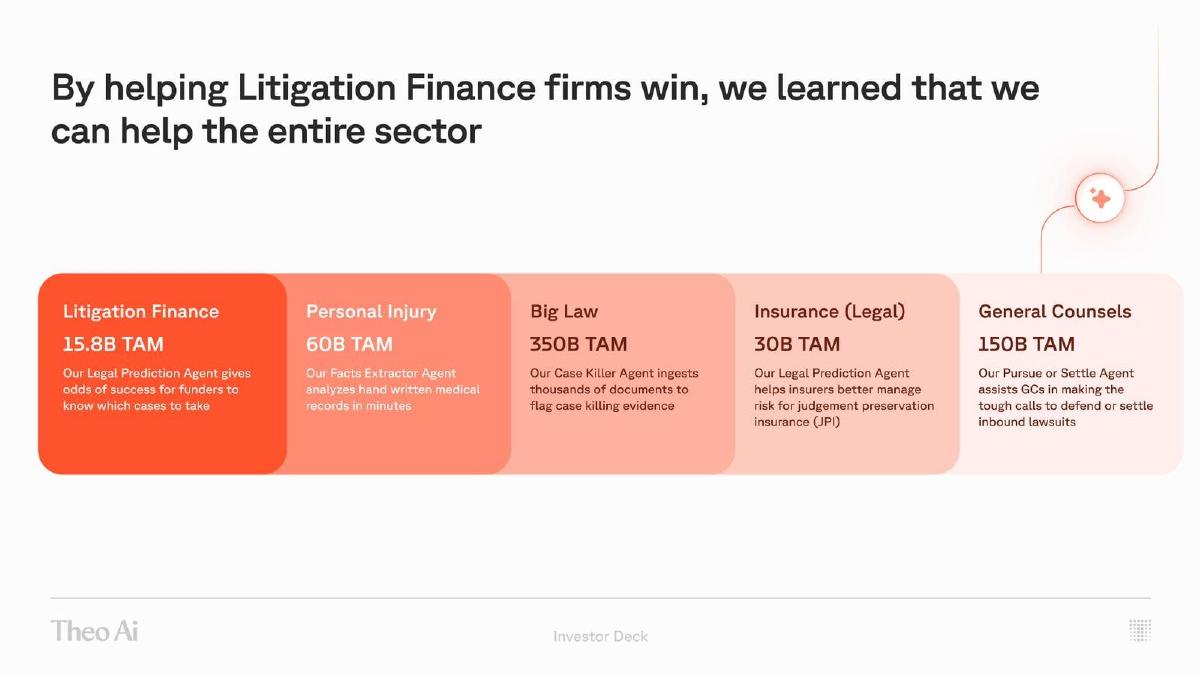
- The deck identifies a massive $350B TAM in Big Law but focuses its initial proof point on the $15.8B Litigation Finance niche (Slide 5).
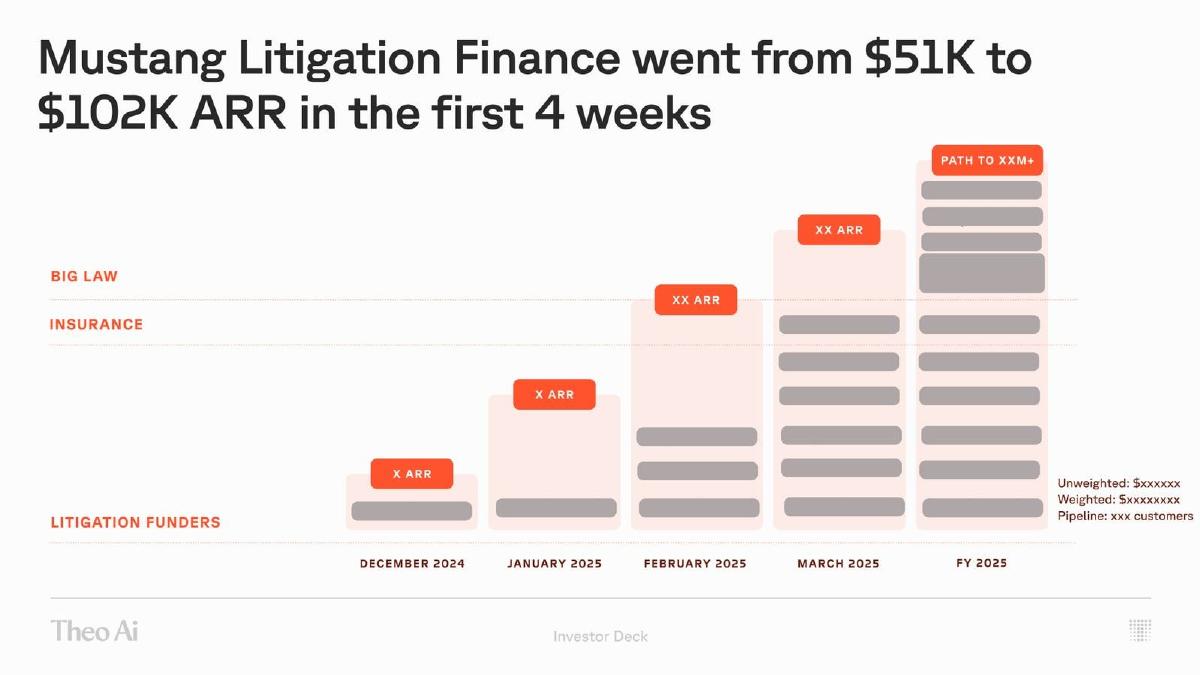
- A specific customer success story shows Mustang Litigation Finance doubling ARR from $51K to $102K in four weeks (Slide 6).
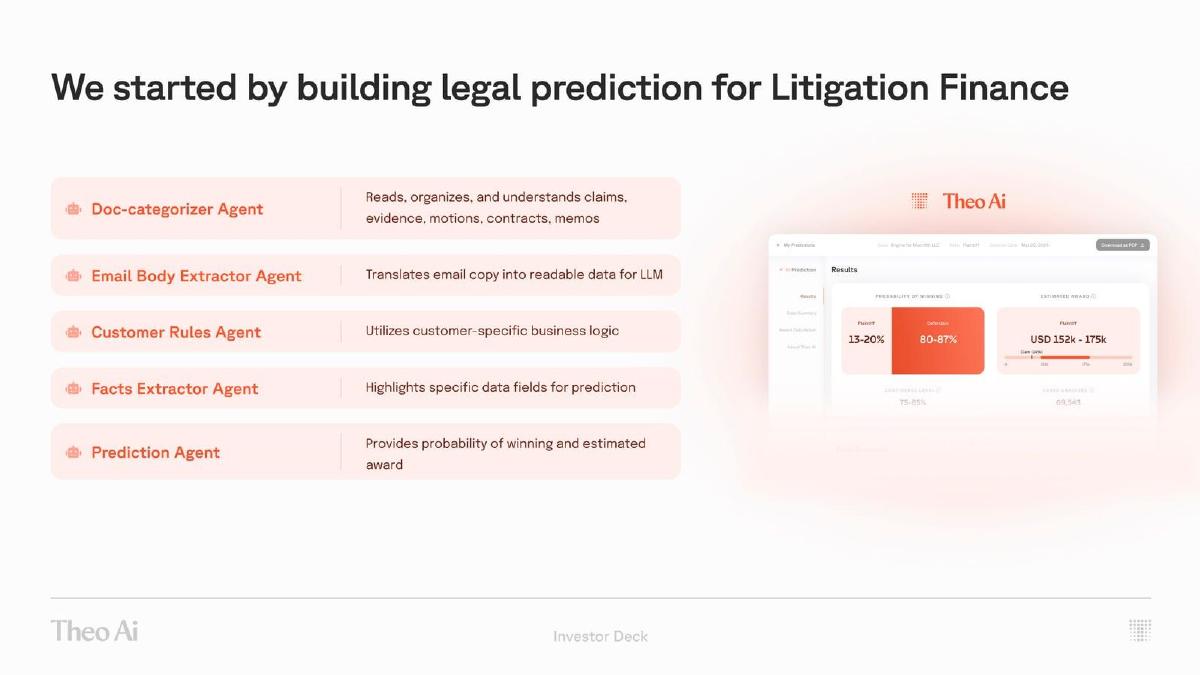
- The product is broken down into five specialized 'Agents,' including a Doc-categorizer and a Prediction Agent (Slide 4).
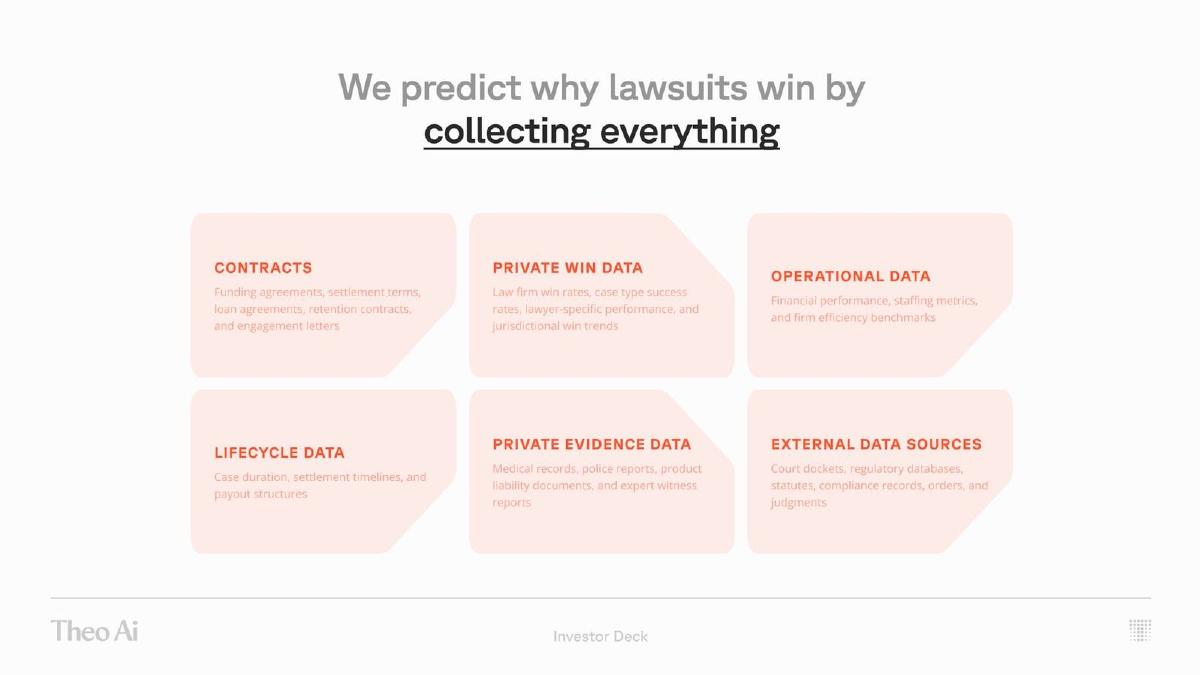
- Data moats are emphasized through the collection of private win data, private evidence, and operational benchmarks (Slide 3).
- The team slide features heavy hitters, including a CTO who sold a company for over $100M to Accenture and a former Head M&A Attorney at Apple (Slide 8).
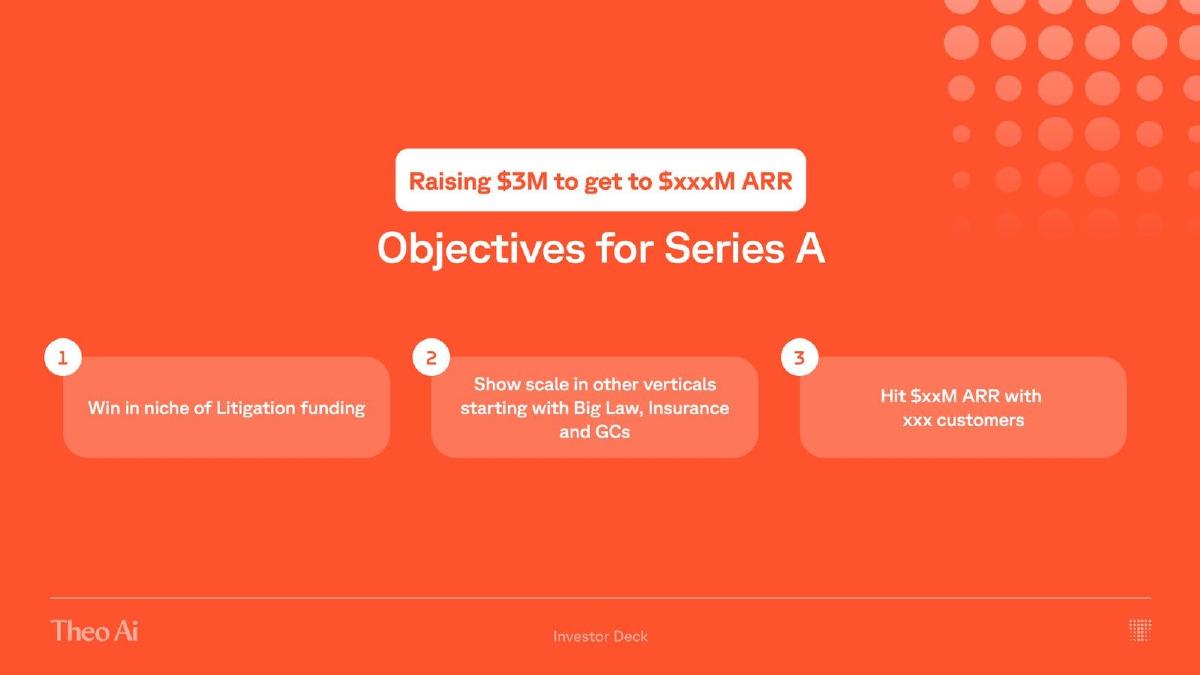
- The 'Ask' is clearly defined as $3M to reach specific Series A milestones, though final ARR targets are redacted in this version (Slide 7).
- The deck omits a traditional competitor matrix, relying instead on the uniqueness of their 'private data' collection strategy (Slide 3).
- The visual product preview shows a UI predicting a 'Probability of Winning' (13-20% vs 80-87%) and an 'Estimated Award' (Slide 4).
The Power of the Niche Beachhead
Theo Ai’s deck is a masterclass in the 'beachhead' strategy. In a world where every startup claims to be 'AI for everything,' Theo Ai explicitly states they started by building for Litigation Finance. This is a high-value, data-rich, and risk-sensitive niche. By proving the model here, they earn the right to talk about the $350B Big Law market. The deck, reported by Business Insider to have raised $3M in 2024, is remarkably short at only 8 slides, proving that density of information beats volume of slides.
Slide 1: The Hook
The title slide is minimalist: "Predict Your Next Case." It establishes the core value proposition immediately. There is no jargon about 'synergistic legal ecosystems.' It promises a specific outcome: prediction. The branding is clean, utilizing a dark background with high-contrast orange elements, signaling a modern, tech-forward approach to a traditionally conservative legal industry.
Slide 2: The Vision
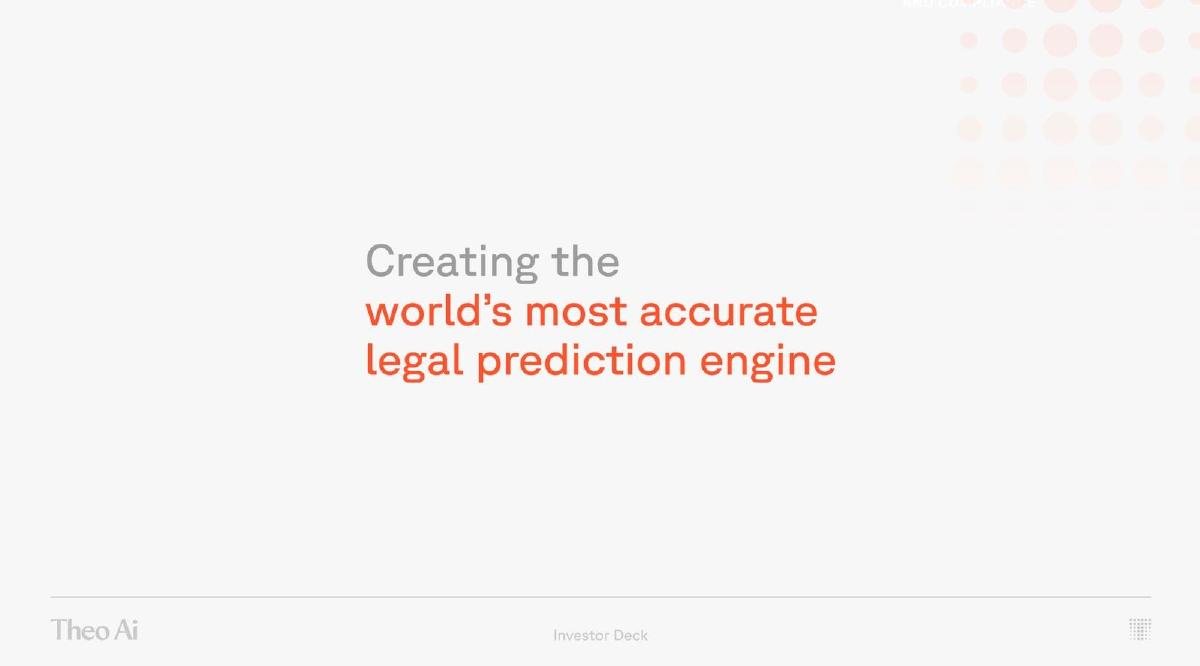
Slide 2 expands the mission: "Creating the world's most accurate legal prediction engine." This is a bold claim. In the legal world, accuracy is the only metric that matters. By framing themselves as an 'engine,' they position the company as a foundational layer of technology rather than just a simple interface or tool.
Slide 3: The Data Moat
This is one of the most important slides in the deck. It answers the 'Why now?' and 'How?' questions. Theo Ai claims to predict wins by "collecting everything." They categorize their data into six buckets: Contracts, Private Win Data, Operational Data, Lifecycle Data, Private Evidence Data, and External Data Sources. The inclusion of "Private" data is key. Public court dockets are a commodity; private law firm win rates and internal medical records are not. This slide tells investors that Theo Ai has a proprietary data advantage that competitors cannot easily replicate by just scraping the web.
Slide 4: The Product Architecture
Slide 4 breaks down the 'black box' of AI into five distinct agents: Doc-categorizer , Email Body Extractor , Customer Rules Agent , Facts Extractor , and Prediction Agent . This gives technical credibility to the pitch. It shows that the system isn't just a wrapper for a Large Language Model (LLM) but a pipeline of specialized tools. The slide also includes a product screenshot showing a 'Probability of Winning' (13-20% for Plaintiff vs 80-87% for Defendant) and an 'Estimated Award' (USD 152k - 175k). This visualizes the end-state for the user: clear, actionable financial data.
Slide 5: Market Expansion (TAM)
Having established the product and data, Slide 5 moves to the market opportunity. They show a progression from their beachhead to the broader sector:
Litigation Finance: 15.8B TAM · Personal Injury: 60B TAM · Big Law: 350B TAM · Insurance (Legal): 30B TAM · General Counsels: 150B TAM
This slide is crucial because it justifies a venture-scale investment. While they are starting small, the total addressable market (TAM) is massive. They also briefly explain how their 'Agents' adapt to each vertical—for example, the 'Case Killer Agent' for Big Law and the 'Pursue or Settle Agent' for General Counsels.
Slide 6: Traction and Proof of Concept
Slide 6 provides the 'hard proof.' It features a case study: "Mustang Litigation Finance went from $51K to $102K ARR in the first 4 weeks." Doubling revenue in a month is a powerful signal of product-market fit. The slide includes a bar chart showing projected growth through FY 2025, moving from Litigation Funders into Insurance and Big Law. Note that the specific dollar figures for future projections are redacted (marked as $xxxxxx), but the trajectory is clearly intended to show rapid scaling across segments.
Slide 7: The Ask and Milestones
The 'Objectives for Series A' slide is direct. They are raising $3M to reach three specific goals: winning the litigation funding niche, showing scale in other verticals, and hitting a specific (redacted) ARR target. This tells investors exactly how their capital will be used to de-risk the next round of funding. It creates a clear roadmap: Seed is for the beachhead; Series A is for the expansion.
Slide 8: The Team
For a Seed round, the team slide is often the most important, and Theo Ai’s is exceptionally strong. Patrick Ip (CEO) brings Google experience and a UCLA Law background. Tiago Luchini (CTO) is a 4x founder who sold a company to Accenture for over $100M. Jay Mandal (CPO) was a lead M&A attorney at Apple. Dr. Alex Liu (Advisor) was a Chief Scientist at IBM. This team combines deep legal expertise with high-level AI and engineering experience, which is exactly what is needed to build a 'prediction engine' for a complex field like law.
What Theo Ai Does Exceptionally Well
The most impressive aspect of this deck is its clarity of focus . Many founders try to show they can do everything for everyone on day one. Theo Ai does the opposite. They highlight a very specific customer (Mustang Litigation Finance) and a very specific result (doubling ARR). This specificity builds trust. If they can do it for one funder, they can do it for others.
Furthermore, the modular explanation of their AI (Slide 4) is a great way to handle the 'AI hype' problem. By naming specific agents (like the Email Body Extractor), they show they understand the messy reality of legal data, which often hides in unstructured formats like emails and handwritten notes.
What is Missing from the Deck
Despite its success, the deck has notable omissions that a more skeptical investor might flag:
Competition: There is no mention of existing legal research giants like LexisNexis or Westlaw, nor newer AI competitors like Harvey or Casetext. The deck assumes the 'private data' angle is enough to differentiate them, but a slide on why incumbents can't easily replicate this would have been helpful. · Unit Economics: While we see ARR growth, we don't see the cost of acquisition (CAC) or the churn rates. For a $3M Seed, this is often acceptable, but for the Series A they are targeting, these metrics will be mandatory. · Data Acquisition Strategy: Slide 3 mentions 'Private Win Data,' but it doesn't explain how they get law firms to hand over this sensitive information. In the legal world, data privacy and privilege are massive hurdles; explaining the legal/technical framework for this data sharing would strengthen the pitch.
Lessons for Founders
1. Lead with a Beachhead: Don't pitch the $350B market first. Pitch the $15B market you are currently winning, and show how it leads to the $350B market. Investors value a 'wedge' that works.
2. Quantify Success Early: The '4 weeks to double ARR' stat on Slide 6 is the strongest piece of evidence in the deck. If you have a pilot or a first customer, find a metric that shows immediate ROI.
3. Credentials Matter in Specialized Fields: In legal tech, you cannot just be a 'tech person.' You need JDs and people who have worked at the highest levels of the industry (like Apple's M&A team). If your team lacks industry depth, find advisors who fill that gap before you raise.
4. Keep it Short: Theo Ai raised $3M with 8 slides. If your deck is 25 slides long, you are likely over-explaining. Focus on the problem, the data, the proof, and the team.
Frequently asked questions
- How does Theo Ai differentiate its data source from other legal tech?
- According to Slide 3, Theo Ai focuses on 'collecting everything,' specifically highlighting 'Private Win Data' like law firm win rates and 'Private Evidence Data' such as medical records and police reports. This suggests they are not just scraping public court dockets but integrating deeply with client data to build a proprietary moat.
- What is the specific value proposition for litigation funders?
- Slide 5 states that their Legal Prediction Agent gives 'odds of success for funders to know which cases to take.' This directly addresses the core risk in litigation finance: deploying capital into cases that may not yield a return, thereby improving the funder's internal IRR.
- Who are the key members of the Theo Ai leadership team?
- The team (Slide 8) is highly credentialed. CEO Patrick Ip is a former Googler; CPO Jay Mandal was Head M&A Attorney at Apple; CTO Tiago Luchini previously sold a company to Accenture for $100M+; and AI Advisor Dr. Alex Liu is a former Chief Scientist at IBM.
- What are the primary growth targets mentioned in the deck?
- Slide 7 outlines three objectives for their Series A: winning the litigation funding niche, showing scale in Big Law, Insurance, and General Counsel verticals, and hitting a specific (redacted) ARR target with a set number of customers.
- Does the deck explain how the AI actually works?
- Slide 4 provides a functional overview of their 'Agents.' It lists a Doc-categorizer, Email Body Extractor, Customer Rules Agent, Facts Extractor, and a Prediction Agent. This explains the workflow from raw document ingestion to the final winning probability output.