The Mothership's 24-slide deck presents a sophisticated take on the eCommerce aggregator model. While many competitors focused exclusively on Amazon FBA 'acquire-and-optimize' strategies, The Mothership emphasizes a multi-channel approach to reduce platform dependency and increase margins. The deck relies heavily on the pedigree of its founding team, particularly their experience at MVF, a major performance marketing firm. They showcase a proprietary data tool, ASTA, and provide granular 'before and after' case studies of their first two acquisitions, TCU Trading and Vetwell Scientific. Despi…
Key takeaways
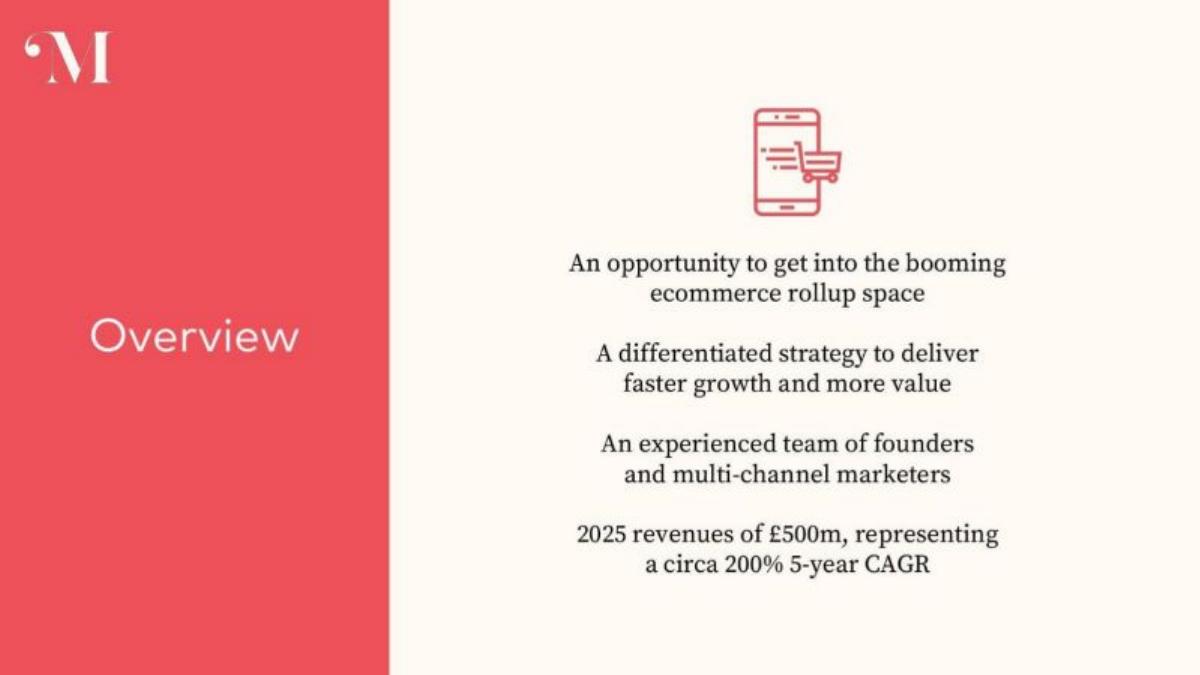
- The company projects 2025 revenues of £500m, representing a circa 200% 5-year CAGR (Slide 2).
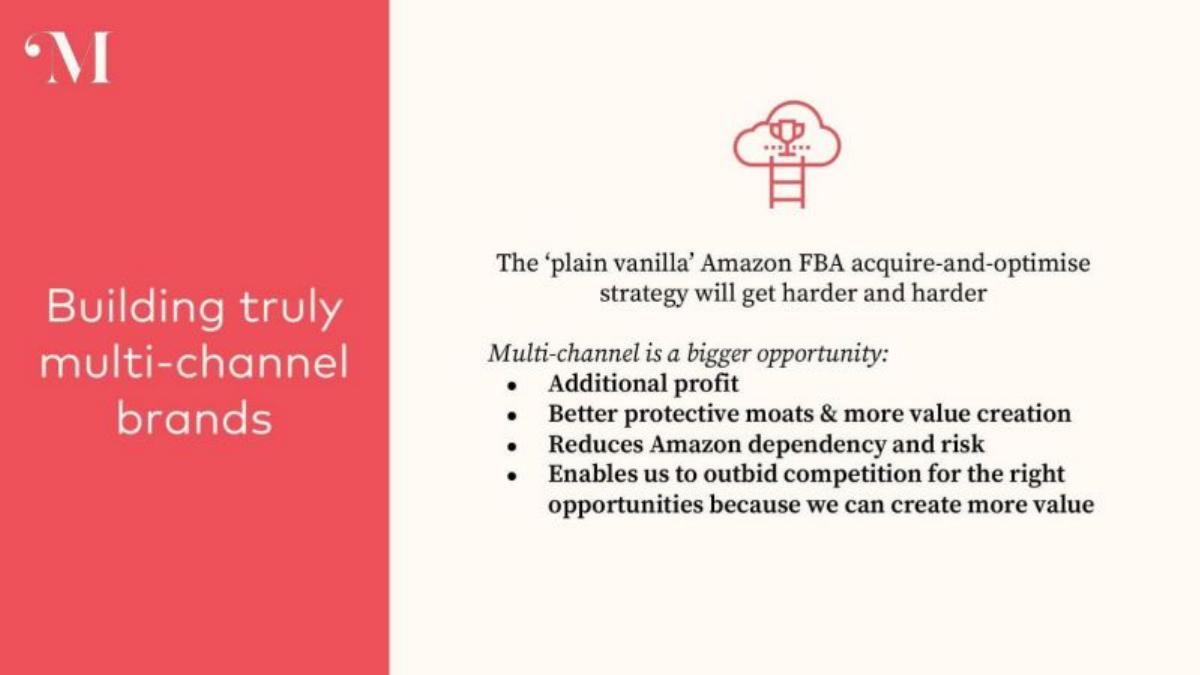
- The core strategy is to move beyond 'plain vanilla' Amazon FBA to a multi-channel model to reduce risk and increase profit (Slide 4).
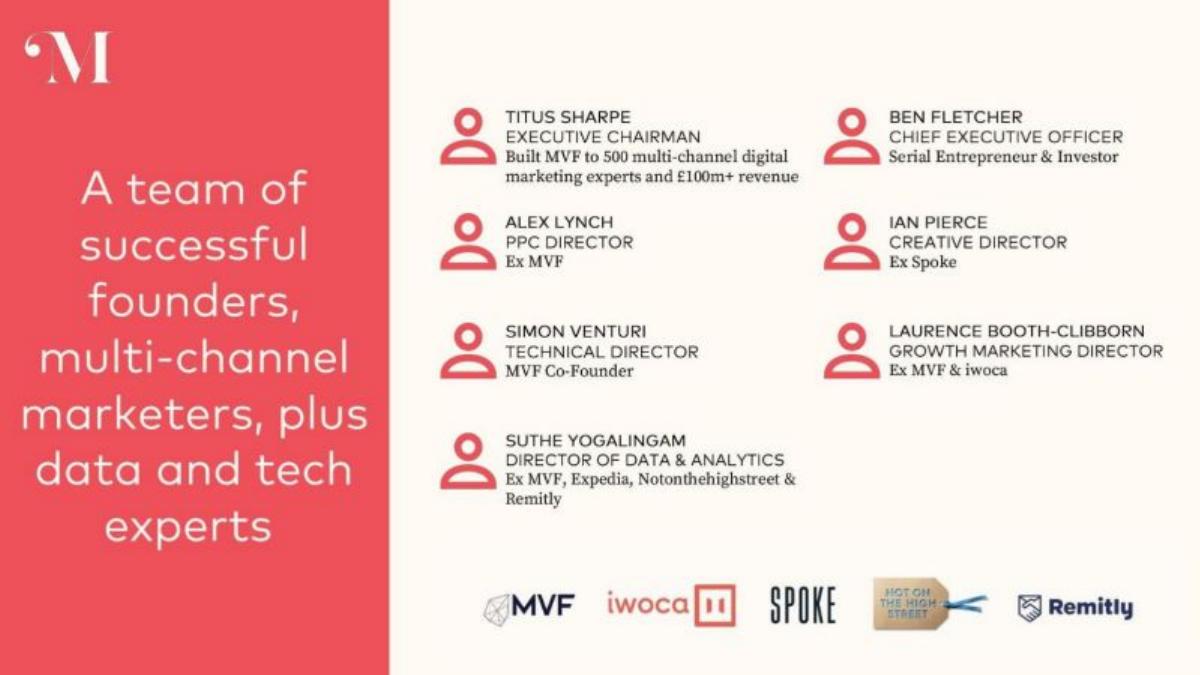
- The founding team includes six members from MVF, a performance marketing organization with £100m+ revenue (Slide 5 and 7).
- The Mothership uses a proprietary tool called ASTA (Acquisition Source Tracker and Analyser) which houses over 5 million data points (Slide 15).
- Initial progress includes a £2m founder investment and the completion of two acquisitions (Slide 16).
- Acquisition #1 (TCU Trading) saw a 72% Q-o-Q revenue growth and a 51% increase in units ordered following image optimization (Slide 17).
- Acquisition #2 (Vetwell Scientific) was migrated from WooCommerce to Shopify within the first 12 days to improve analytics (Slide 21).
- The investor return model is based on EBITDA arbitrage, acquiring at 5.5x and targeting a group valuation of up to 15x (Slide 13).
The Mothership Pitch Deck Analysis
The Mothership's 2022 pitch deck is a comprehensive look at the second wave of eCommerce aggregation. While the first wave was characterized by a frantic land grab of Amazon FBA sellers, The Mothership's deck argues for a more disciplined, marketing-led, multi-channel approach. With a team hailing from high-growth performance marketing backgrounds, the deck focuses on operational excellence and data-driven acquisition.
Slide 1: Title Slide
The deck opens with a clean, minimalist title slide. The brand name "Mothership" is prominent, accompanied by the tagline: "The best place for digital-native brands to grow." This positioning immediately establishes the company as a platform for growth rather than just a holding company.
Slide 2: Overview
The overview slide sets the stage with four high-level value propositions. It identifies the "booming ecommerce rollup space" as the primary opportunity but quickly pivots to their "differentiated strategy." Crucially, it introduces the team's marketing pedigree and a bold financial target: £500m in revenue by 2025, which they calculate as a 200% 5-year CAGR.
Slide 3: A Multi-Billion Dollar Opportunity
This slide addresses the Total Addressable Market (TAM). It cites a $14tn global consumer goods market and lists four drivers for growth: e-commerce expansion, the failure of traditional brands in digital marketing, generational shifts in brand loyalty, and emerging product categories. The note "it’s not winner takes all" is a subtle nod to investors that there is room for multiple successful aggregators in this fragmented market.
Slide 4: Building Truly Multi-Channel Brands
This is the core of The Mothership's differentiation. They explicitly state that the "plain vanilla" Amazon FBA strategy is becoming increasingly difficult. They argue that a multi-channel approach provides additional profit, better protective moats, and reduced dependency on Amazon. This slide is designed to de-risk the investment by showing they aren't beholden to a single platform's algorithm or policy changes.
Slide 5: The Founding Team
The team slide is exceptionally strong, focusing on "successful founders" and "multi-channel marketers." It lists key individuals like Titus Sharpe (Executive Chairman) and Ben Fletcher (CEO). The logos at the bottom—MVF, iwoca, Spoke, Not On The High Street, and Remitly—provide immediate social proof of high-growth experience.
Slide 6: The MVF Advantage
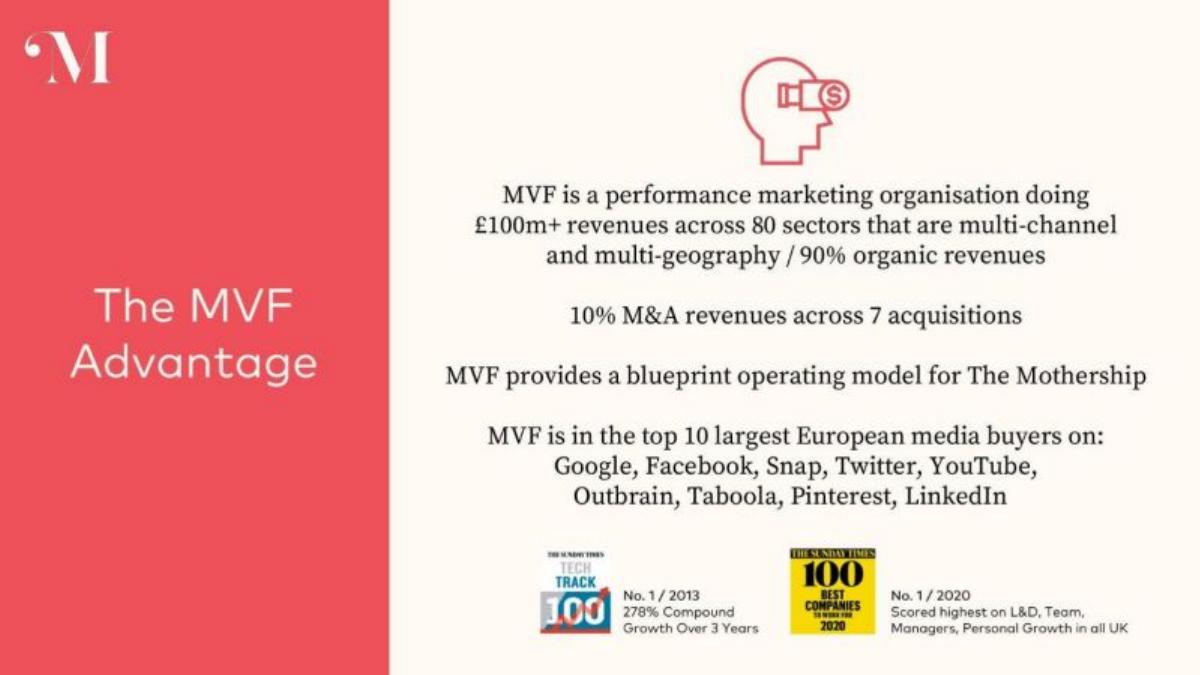
The Mothership leans heavily on the success of MVF, a performance marketing organization. They note that MVF generates £100m+ in revenue across 80 sectors with 90% organic revenue. By positioning MVF as the "blueprint operating model," they suggest that The Mothership is applying a proven, successful framework to the eCommerce space.
Slide 7: Our Recruitment Advantage
In a competitive talent market, this slide highlights a unique edge: access to a "massive talent pool from previous companies." They claim to have 6 "superstars" from MVF and 3 from Fast Growth Icons already on the founding team. This is presented as a way to remove recruitment bottlenecks and reduce the cost of failed hires.
Slide 8: Growth Ethos
The "Growth Ethos" slide moves away from high-level strategy into operational philosophy. They emphasize "long-term profit focus" and a "quality not quantity" approach, specifically targeting opportunities that can generate at least £10m in Gross Profit within 2-3 years. The mention of "hypothesis-based testing" aligns with their performance marketing roots.
Slide 9 & 10: Five Year Plan and Key Assumptions
These slides are heavily redacted in the public version of the deck. However, the structure indicates a detailed month-by-month or quarter-by-quarter projection of acquisitions, revenue, and headcount. For a potential investor, these slides would contain the meat of the financial model.
Slide 11: Efficiencies of Scale
This slide uses a line graph to show the "Per acquisition trend." It illustrates how Group Revenue is expected to outpace Product Level COGS, Direct Costs, and Group Costs over time. They list six synergies, including improved purchasing power, centralized support functions, and the ability to cross-sell sector-related products.
Slide 12: Exit Options
The deck outlines four clear exit paths: Strategic acquisition by a consumer goods giant, Private Equity (PE) buyout, acquisition by a larger aggregator, or an IPO. This shows the founders are thinking about the end game and understand how different types of buyers value these assets.
Slide 13: Investor Returns
This slide explains the financial engineering behind the rollup model. They highlight the "EBITDA arbitrage" opportunity: acquiring brands at a 5.5x multiple and targeting a group valuation of up to 15x. They also mention using £20m in non-dilutive debt to enhance equity returns, a standard tactic in the aggregator space.
Slide 14: Optimised Processes Driven by Tech & Data
The Mothership presents a four-stage lifecycle for their acquisitions: Identify, Evaluate, Integrate, and Accelerate. They mention a "55-step integration process," which suggests a high level of operational maturity and a repeatable playbook.
Slide 15: Proprietary Tool: ASTA
This slide introduces ASTA (Acquisition Source Tracker and Analyser). By showcasing a screenshot of a custom dashboard and citing "over 5 million data points," they position themselves as a tech-enabled business rather than just a brand holding company. This is a key differentiator in the eyes of VC investors who prefer software-like scalability.
Slide 16: Progress So Far
This traction slide lists five key milestones: £2m in founder investment, four brands in the group, two completed acquisitions, a significant pipeline, and—interestingly—a mention of "amazing opportunities that we can’t pursue due to lack of funds," which serves as a direct call to action for the current fundraise.
Slide 17, 18 & 19: Acquisition #1 - TCU Trading Limited
These slides provide a deep dive into their first acquisition. They show impressive growth metrics (72% revenue growth) and provide "before and after" visual examples of image optimization for products like hiking boot bags and garden tool belts. This makes the abstract concept of "optimization" very concrete for the investor.
Slide 20 & 21: Acquisition #2 - Vetwell Scientific
The second case study focuses on speed. Within 12 days of acquisition, they improved the logo, redesigned the website, and migrated the store from WooCommerce to Shopify. They report a 12% increase in Amazon revenue and a 23% increase in eBay marketing revenue in that short window.
Slide 22: Other Key Team Members
This slide introduces the supporting cast, including experts in M&A, Amazon advisory, logistics, and a Chief of Staff. The backgrounds include PwC, Goldman Sachs, and Octopus Investments, further reinforcing the professional and institutional nature of the team.
Slide 23: Contact
The deck concludes with contact information for CEO Ben Fletcher, including an email address and phone number.
What The Mothership Deck Does Well
Strong Team Pedigree: The deck successfully leverages the founders' previous successes to build immediate credibility. · Concrete Case Studies: The "before and after" slides for TCU Trading and Vetwell Scientific are excellent. They prove that the team can actually execute the growth they promise. · Clear Differentiation: By attacking the "plain vanilla" Amazon-only strategy, they carve out a unique position in a crowded market. · Tech Integration: The ASTA tool provides a "moat" narrative that moves the company beyond a simple private equity rollup.
What Is Missing From The Mothership Deck
The Ask: While the deck mentions a lack of funds to pursue opportunities, it does not explicitly state the amount they are looking to raise or the valuation they are seeking on any of the slides. · Unit Economics: While they show growth percentages, there is a lack of detailed unit economics (CAC, LTV, Contribution Margin) for the acquired brands. · Competitive Landscape: The deck mentions the "rollup space" generally but does not provide a competitive matrix or direct comparison to other major aggregators like Thrasio or Perch. · Risk Disclosure: The deck is very optimistic. It lacks a slide addressing potential headwinds such as supply chain disruptions, rising ad costs, or platform policy changes.
What Other Founders Should Copy
The "Blueprint" Narrative: If you have a successful previous company, show how its operating model serves as a proven blueprint for your new venture. · Visual Proof: Don't just say you optimize brands; show the actual images and website changes you made. It makes your expertise feel tangible. · Focus on Synergies: Clearly list how the group structure provides value that the individual brands couldn't achieve on their own. · Professional Design: The deck uses a consistent, professional color palette and layout that reflects a high-end consumer brand aesthetic.
Frequently asked questions
- What is The Mothership's primary business model?
- The Mothership operates as an eCommerce aggregator or 'rollup' business. They acquire digital-native brands and use their centralized expertise in performance marketing, logistics, and data analytics to scale them. Unlike many aggregators that stay strictly on Amazon, The Mothership focuses on building multi-channel brands to diversify revenue and increase profit margins.
- How does the team differentiate itself from other aggregators?
- The team highlights their background in performance marketing, specifically citing their experience at MVF. They claim this gives them a 'recruitment advantage' by accessing a proven talent pool and a 'growth ethos' based on hypothesis-based testing and scalable processes. They position themselves as expert marketers rather than just financial engineers.
- What proprietary technology does the company use?
- The deck introduces ASTA (Acquisition Source Tracker and Analyser). This custom-developed tool scans eCommerce platforms to identify brands meeting specific acquisition criteria. It reportedly houses over 5 million data points, allowing the team to focus on targets that satisfy their D2C and Amazon investment theses.
- What kind of growth has the company demonstrated with its acquisitions?
- The deck provides two case studies. For TCU Trading, they achieved a 72% Q-o-Q revenue growth and a 71% Q-o-Q gross profit growth. For Vetwell Scientific, they reported a 12% increase in Amazon revenue and a 23% increase in eBay marketing revenue within the first 12 days of acquisition, alongside a platform migration to Shopify.
- What are the projected financial outcomes mentioned in the deck?
- The Mothership targets £500m in revenue by 2025. Their financial model assumes an EBITDA arbitrage opportunity where they acquire businesses at roughly 5.5x EBITDA and aim for a group valuation of up to 15x. They also mention a target of £20m in initial non-dilutive debt to protect equity returns.