Liquid Marketplace’s 2022 Series A deck is a masterclass in leveraging social proof and market timing. By positioning collectibles as an inflation hedge and high-yield asset class, the company successfully raised $6M to build a fractional ownership platform. The deck relies heavily on the 'celebrity founder' effect, featuring Logan Paul prominently to signal a massive built-in audience. While the deck excels at defining the 'why now' through explosive ROI examples of NFTs and physical cards, it is notably light on traditional financial metrics like CAC, LTV, or a specific use-of-funds breakdo…
Key takeaways
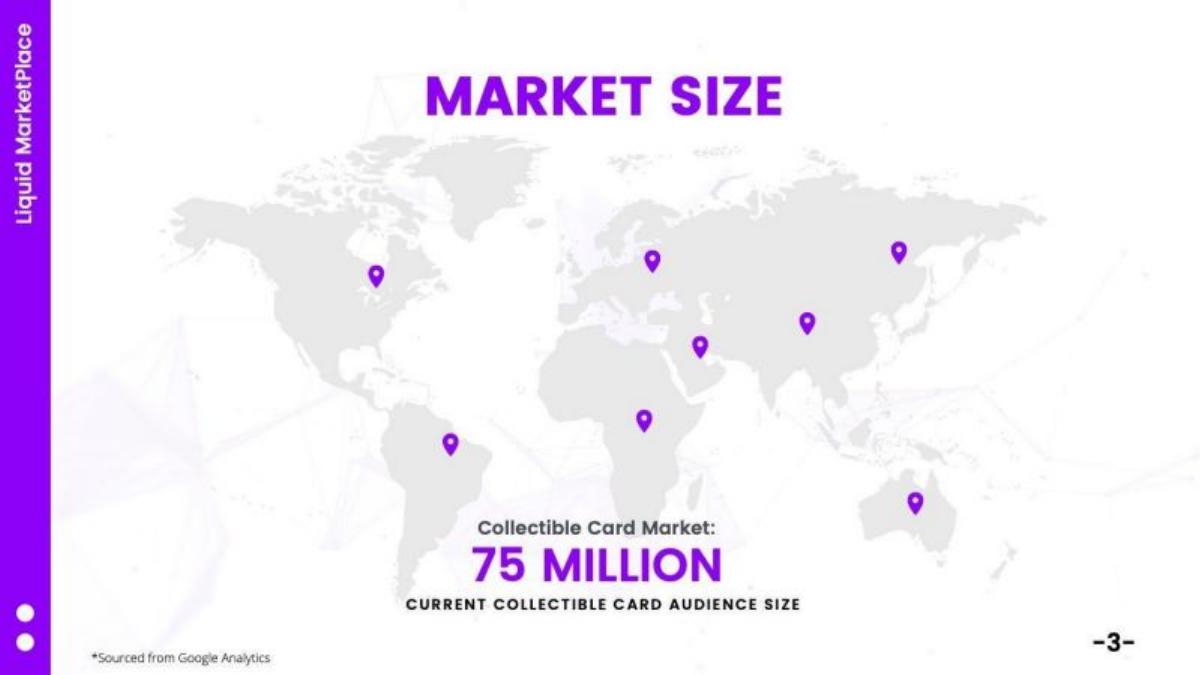
- The current collectible card audience size is estimated at 75 million people globally (Slide 3).
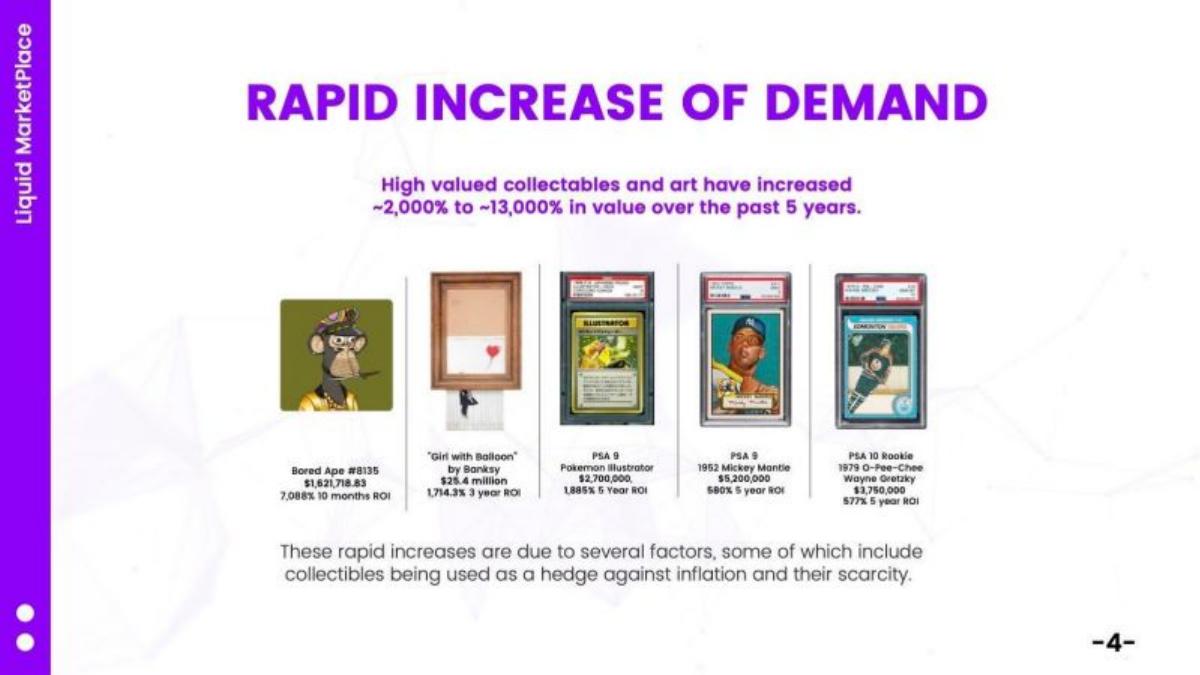
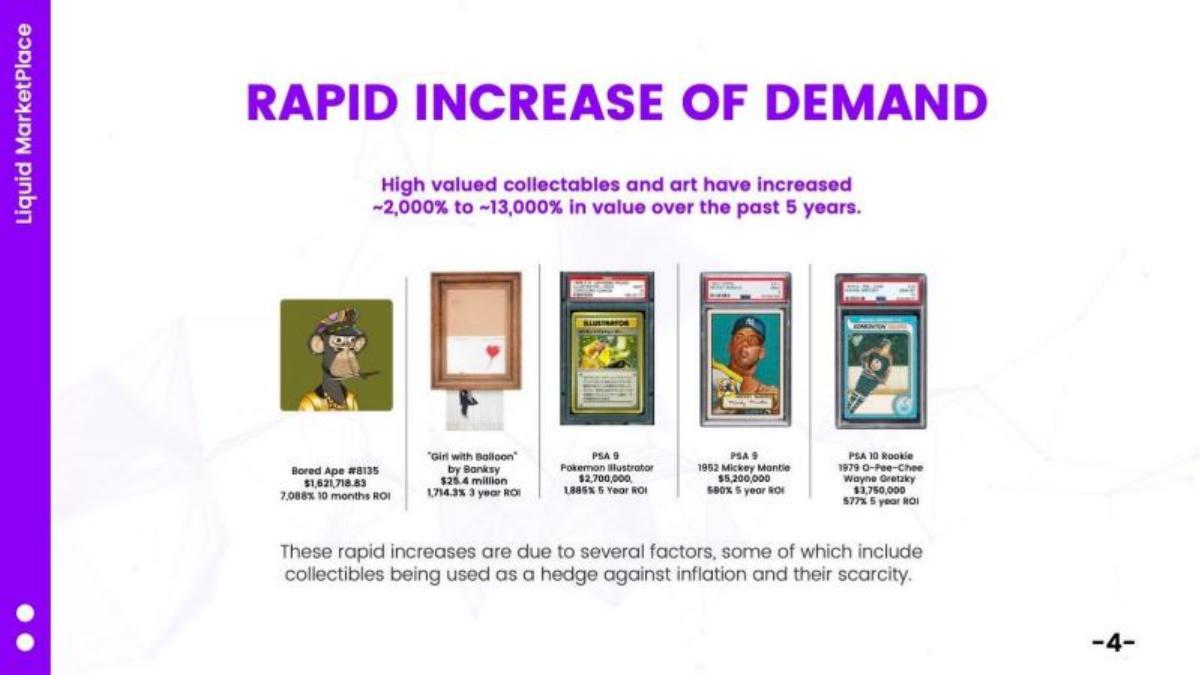
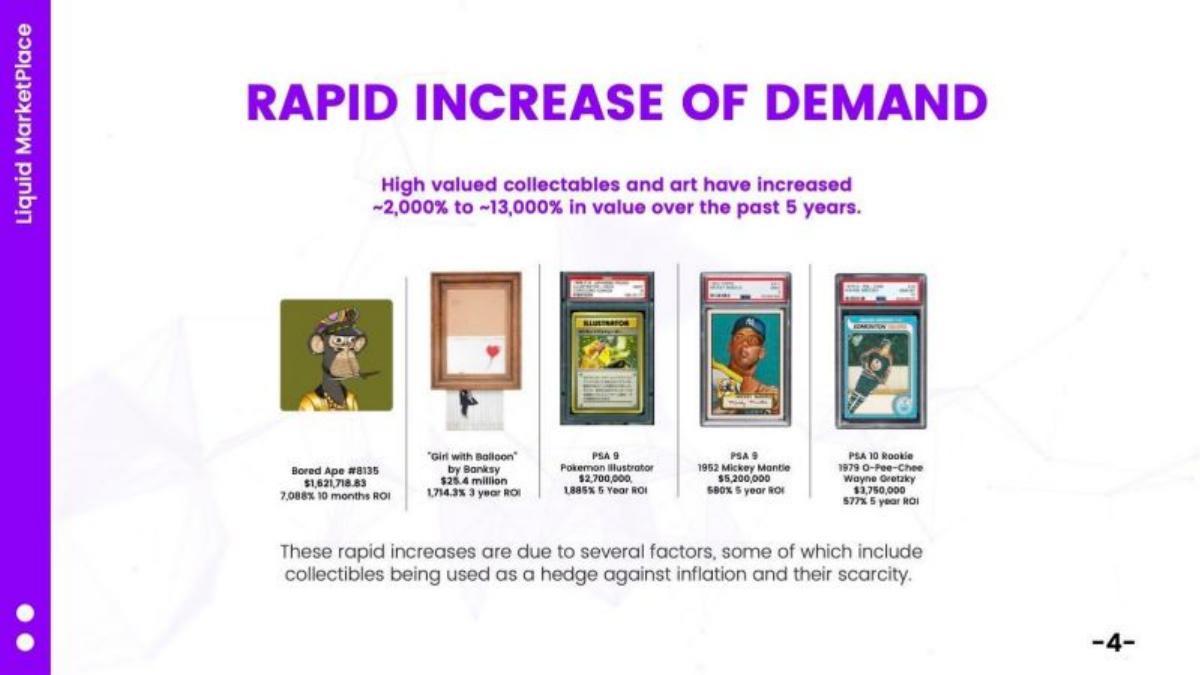
- High-valued collectibles and art are cited as having increased between 2,000% and 13,000% in value over the last five years (Slide 4).
- The platform solves for 'Long Wait Times' of 120 days or more typically found in traditional collectible logistics (Slide 5).
- Liquid Marketplace utilizes a physical vault system where assets are stored after verification and appraisal (Slide 7).
- The business model relies on a secondary market where 75%-100% of an asset is traded on a collateralized exchange (Slide 7).
- The company claims a competitive advantage over eBay and Heritage Auctions by offering 24/7 trading and cryptocurrency payment support (Slide 8).
- The deck highlights a social media following of over 35,000 and uses gamification tiers from 'Novice' to 'Grand Master' to drive engagement (Slide 16).
- The founding team includes internet celebrity Logan Paul, who is credited with over 100 million followers online (Slide 21).
Executive Summary: The Democratization of Rarity
Liquid Marketplace entered the scene in 2022, a time when the intersection of NFTs, sports cards, and fractional investing was at a fever pitch. Their Series A deck, which helped secure $6M in funding, focuses on moving high-value 'alternative assets' from the hands of the elite into a liquid, digital marketplace accessible to the 'average collector.' The deck is a study in narrative-driven fundraising, prioritizing market sentiment and team pedigree over granular unit economics.
The Hook: Social Proof and Market Sentiment (Slides 1-2)
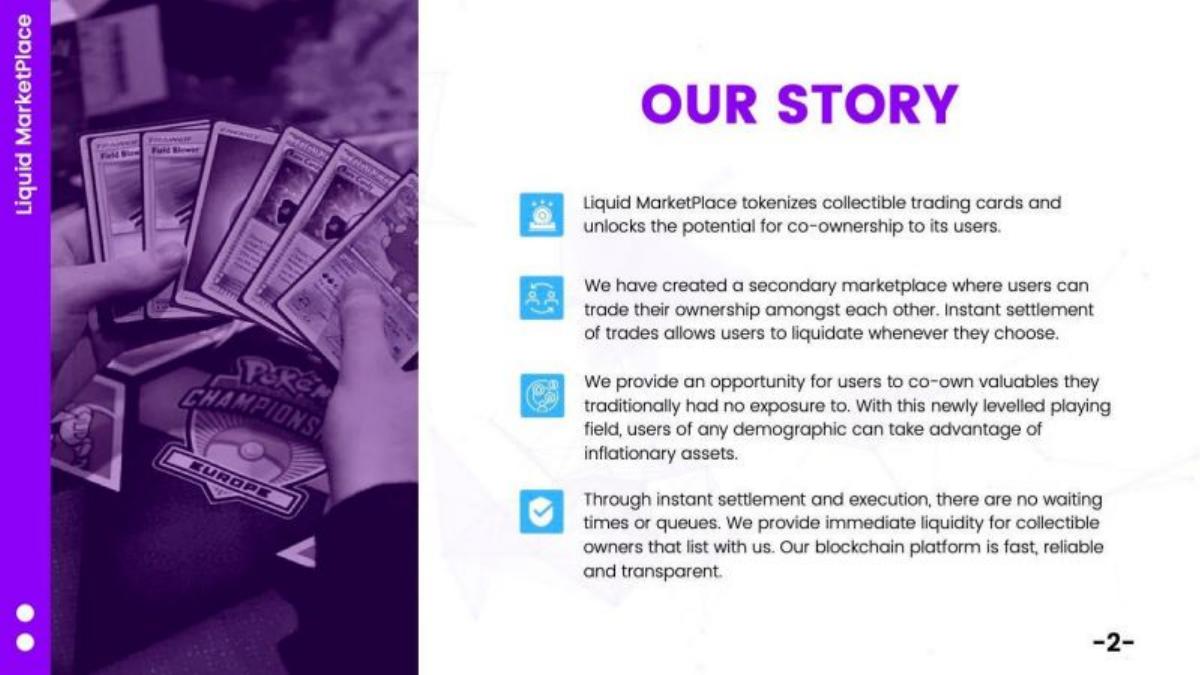
The deck opens with a 'Featured In' slide (Slide 1), showcasing logos from Business Insider, Time, The New York Times, and Financial Post . This is a standard but effective tactic for a Series A company to establish immediate credibility. By Slide 2, 'Our Story,' the mission is clear: tokenizing collectible trading cards to unlock co-ownership. They emphasize 'instant settlement' and 'immediate liquidity,' directly addressing the primary frustration of the traditional collectibles market: the inability to exit a position quickly.
Defining the Opportunity: The 75 Million Person Market (Slides 3-4)
On Slide 3, the company quantifies its target audience. Using Google Analytics as a source, they claim a 'Current Collectible Card Audience Size' of 75 million people . The map shows global hotspots, suggesting a borderless scaling strategy. Slide 4, 'Rapid Increase of Demand,' provides the 'greed' catalyst for investors. It lists eye-watering ROI figures for iconic items: a Bored Ape #8135 at 7,088% ROI in 10 months , a Banksy 'Girl with Balloon' at 1,714.3% ROI over 3 years , and a PSA 9 1952 Mickey Mantle at 580% ROI over 5 years . This slide frames collectibles not just as hobbies, but as a 'hedge against inflation' with returns ranging from 2,000% to 13,000%.
The Friction: Why the Status Quo is Broken (Slide 5)
The 'Problem' slide is concise. It identifies four barriers: Lack of diversification, Lack of market control (counterfeits), Limited payment options (no crypto), and Long wait times (120+ days) . This sets the stage for a technology-led solution that replaces manual, slow-moving logistics with a digital layer.
The Solution: Tokenization and Physical Vaulting (Slides 6-7)
Slide 6 introduces the product interface, though it notes that 'Current items shown are placeholders only.' The solution is built on four pillars: Tokenization, Liquidity, Security & Reliability, and Real-Time Trading . Slide 7, 'Our Process,' is perhaps the most important slide for understanding the business model. It explains that Liquid Marketplace Inc. takes physical possession of the asset, stores it in a 'secure site inside a physical vault,' and then tokenizes it. Interestingly, it notes that 0%-25% of the asset ownership remains with the original collector , while 75%-100% is traded on their exchange. This ensures the platform has a supply of high-quality assets by allowing current owners to 'cash out' partially while retaining some upside.
Competitive Landscape: The Feature War (Slide 8)
The competitive advantage matrix (Slide 8) compares Liquid Marketplace against Dibbs, Rally, PWCC, Collectable, eBay, Goldin Auctions (GA), and Heritage Auctions . Liquid Marketplace claims to be the only one offering the full suite of: Worldwide Access, 24/7 Trading, Cryptocurrency Payment Support, Curated Collectable Offerings, and Incentives for Asset Owners . By checking every box while incumbents miss several, they position themselves as the 'all-in-one' evolution of the industry.
Growth and Engagement: Gamification and Community (Slides 16-17)
The deck skips several numbers in the sequence (jumping to 16), focusing on 'Boosting User Engagement.' They showcase a gamification system with tiers ranging from 'Novice' to 'Grand Master' and claim a social media following of 35,000+ . Slide 17 shows a marketing example: a QR code offering 'ownership in an Ape for free.' This suggests a 'freemium' acquisition model where small fractions of high-profile assets are used as lead magnets to bring users into the ecosystem.
The Powerhouse Team: Celebrity and Expertise (Slides 21-22)
The 'Founding Team' slide (Slide 21) is the deck's strongest asset. It features Ryan Bahadori (CEO) , a commercial real estate entrepreneur, and Amin Nikdel (President) . However, the center of gravity is Logan Paul , described as an 'Internet celebrity, professional boxer... 100MM+ followers online.' For a retail-facing marketplace, having a founder who can reach 100 million potential customers for free is a massive unfair advantage. The 'Executive Team' includes specialized roles like a Chief Compliance Officer (Liana Falzone) and a Director of Assets (Matt Allen) , indicating they are prepared for the regulatory and logistical hurdles of fractionalized securities. The 'Advisory Committee' (Slide 22) adds further weight with Steve Aoki and Jeremy Padawer (a toy industry executive), alongside legal and market-making partners like Goodmans, Osler, and ITG .
The Final Word: Contacts (Slide 23)
The deck concludes with contact information for the founders and the Director of Marketing, Kateryna. It lists offices in Miami, Florida and Toronto, Ontario , reinforcing their North American footprint.
What Works in the Liquid Marketplace Deck
The 'Unfair Advantage' is Clear: By putting Logan Paul on the team slide, the company answers the 'How will you get users?' question without needing a complex marketing slide. · Visualizing the ROI: Slide 4 uses high-quality imagery of famous collectibles to make the abstract concept of 'fractional ownership' feel tangible and lucrative. · Process Clarity: Slide 7 demystifies how a physical card becomes a digital token, which is essential for investor trust in a crypto-adjacent business. · Addressing Compliance: Including a Chief Compliance Officer and multiple legal firm logos (Slide 22) signals that they are taking the 'security' aspect of tokenization seriously.
What is Missing from the Liquid Marketplace Deck
Financial Projections: There is no mention of how the company makes money (transaction fees? storage fees? listing fees?) or what the revenue targets are for the next 18-24 months. · The 'Ask': The deck does not state how much capital they are looking for or how they intend to spend it (e.g., 40% engineering, 30% asset acquisition). · Unit Economics: There is no data on the cost to acquire a customer (CAC) or the expected lifetime value (LTV), which are standard requirements for a Series A. · Technology Deep Dive: While they mention a 'blockchain platform,' they don't specify which chain they are building on or how they handle gas fees and wallet integration for non-crypto users.
What Founders Should Copy
The Problem/Solution Alignment: Each point in the 'Problem' slide (Slide 5) is directly answered in the 'Solution' slide (Slide 6). This logical flow is essential for a persuasive deck. · The Use of Social Proof: If you have press coverage or high-profile advisors, put them early. Liquid Marketplace uses Slides 1 and 22 to bookend the deck with authority. · Market Sizing with Context: Instead of just saying 'the market is big,' they use a map and a specific 'audience size' number (75M) sourced from Google Analytics, which feels more grounded than a generic $100B TAM figure. · Gamification as a Strategy: Showing the 'Novice to Grand Master' tiers (Slide 16) demonstrates that the founders are thinking about long-term user retention, not just the initial sign-up.
Frequently asked questions
- What is the core business model of Liquid Marketplace?
- Liquid Marketplace operates a fractional ownership platform for high-value collectibles. According to Slide 7, they acquire assets, verify and appraise them, store them in a physical vault, and then tokenize the ownership. Users can buy and sell fractions of these assets on a secondary market, with the platform facilitating real-time, 24/7 trading.
- How does the company leverage celebrity influence?
- Celebrity influence is a central pillar of their strategy. Slide 21 lists Logan Paul as a Founder, highlighting his 100M+ followers. Slide 22 includes Steve Aoki as an advisor. This suggests a low-cost customer acquisition strategy driven by the massive existing audiences of its leadership and advisory team.
- What specific problems in the collectibles market are they solving?
- Slide 5 identifies four main pain points: lack of diversification (high prices make top items unattainable), lack of market control (counterfeit risks), limited payment options (no crypto support), and long wait times (120+ days for logistics). Their solution uses blockchain for instant settlement and fractionalization for accessibility.
- What is the 'Our Process' workflow described in the deck?
- The process involves six steps: Asset Acquisition, Securing the Asset (physical vaulting), Tokenization, Ownership (the original collector retains 0-25%), Offering (listing on the marketplace), and Secondary Market trading (75-100% of the asset is traded) as detailed on Slide 7.
- Does the deck provide financial projections or a specific 'ask'?
- No. The 16 slides provided focus on the market opportunity, the product mechanism, and the team. There are no slides detailing revenue projections, burn rate, or the specific dollar amount being raised in this round, though external data confirms a $6M Series A.