Should a pitch deck show press logos and awards? Eleven real slides compared, including coverage counts and a deck that grew with no press: what media.
Press and Awards Slide: Pitch Deck Examples
Eleven real slides, shown in full, compare how startups use media coverage, coverage counts, app store features and awards as evidence, and one that makes a point of having no press at all.
TL;DR
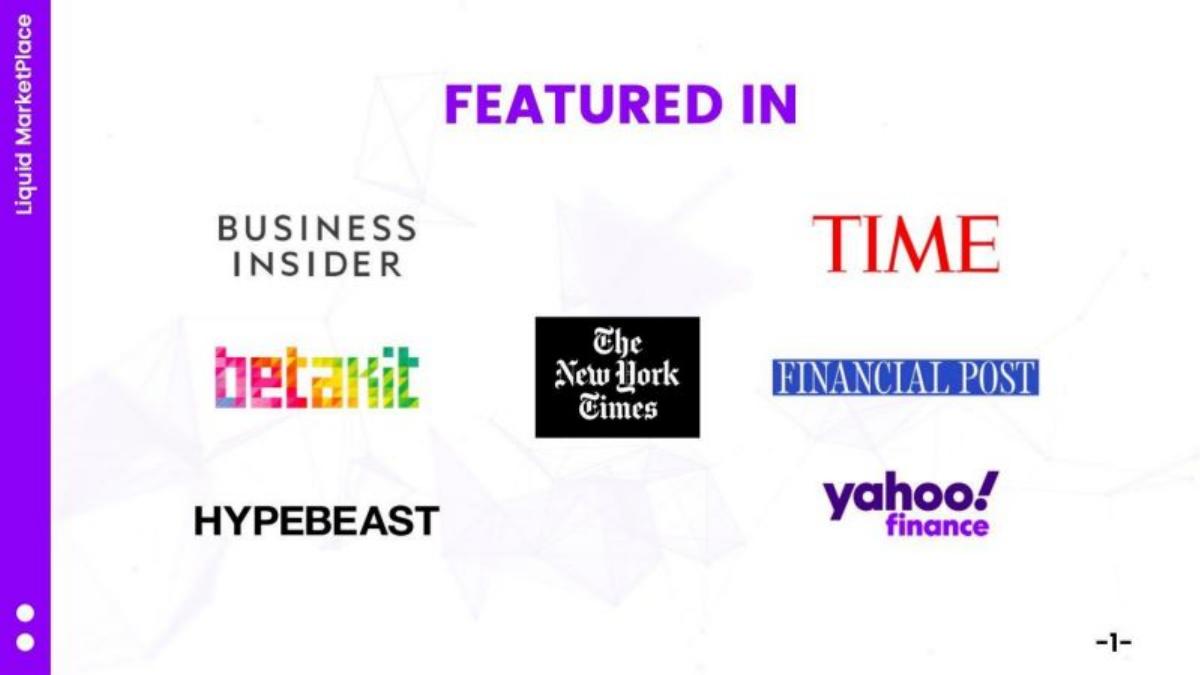
Press and awards show that someone outside the company noticed you. They do not show customers, revenue or retention, so investors weigh them lightly. The slides below that work best name the award and who gave it (Bower: "Named Top Civic Tech Project in Sweden by the Ministry of Enterprise and Innovation"), tie a feature to a channel result (By Rotation: "Featured in App Store over 3 times"), or put press beside hard numbers (House of Highness: "£100,000+ revenue over 12 months"). A wall of logos with no dates (Heyday, Liquid Marketplace) is weaker. Coverage counts (Folx Health: "382 total placements", "10.7B total impressions"; Hervé: "43,000,000 media impressions") look precise but measure reach, not customers, and none of the slides here says how they were counted. Freespot makes the opposite case: "2,000+ Users in Less than 6 Months with $0 Ad Spend and 0 Press Coverage!" Keep press to one slide or a strip, say what each mention was, and let traction lead.
Press and awards slides from real pitch decks
Each example shows the exact stored slide above its analysis and links to the full teardown. Claims are as shown on the slides; we have not verified them. Stage and year are given only where the slide or deck states them.
Bower press slide — slide 6
Recycling-rewards app, Sweden. A different slide from this deck appears in the executive summary guide. Stage and year are not stated on this slide.
Bower deck, slide 6. Exact stored slide matched to this analysis.
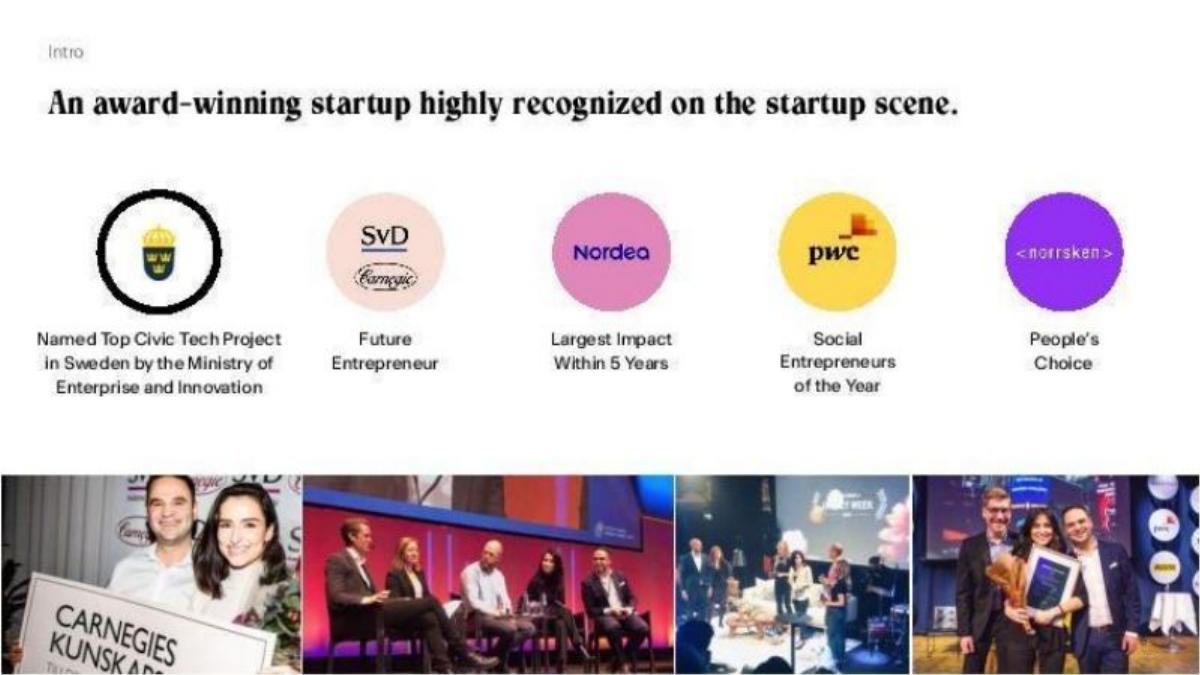
Our analysis: Each award is named with who gave it, so an investor can check it.
Evidence and limitation: No years. Add the year so investors know how recent each is.
What a founder can adapt: List each award with its name and who gave it.
Supporting analysis
What the deck claims: "An award-winning startup highly recognized on the startup scene." Five awards: Named Top Civic Tech Project in Sweden by the Ministry of Enterprise and Innovation; Future Entrepreneur (SvD); Largest Impact Within 5 Years (Nordea); Social Entrepreneurs of the Year (PwC); People's Choice (Norrsken). Photos from award events.
Presentation choice: Each award is named with who gave it, so an investor can check it.
When it does not fit: No years. Add the year so investors know how recent each is.
Peer-to-peer fashion rental app. The slide refers to January 2022.
By Rotation deck, slide 6. Exact stored slide matched to this analysis.
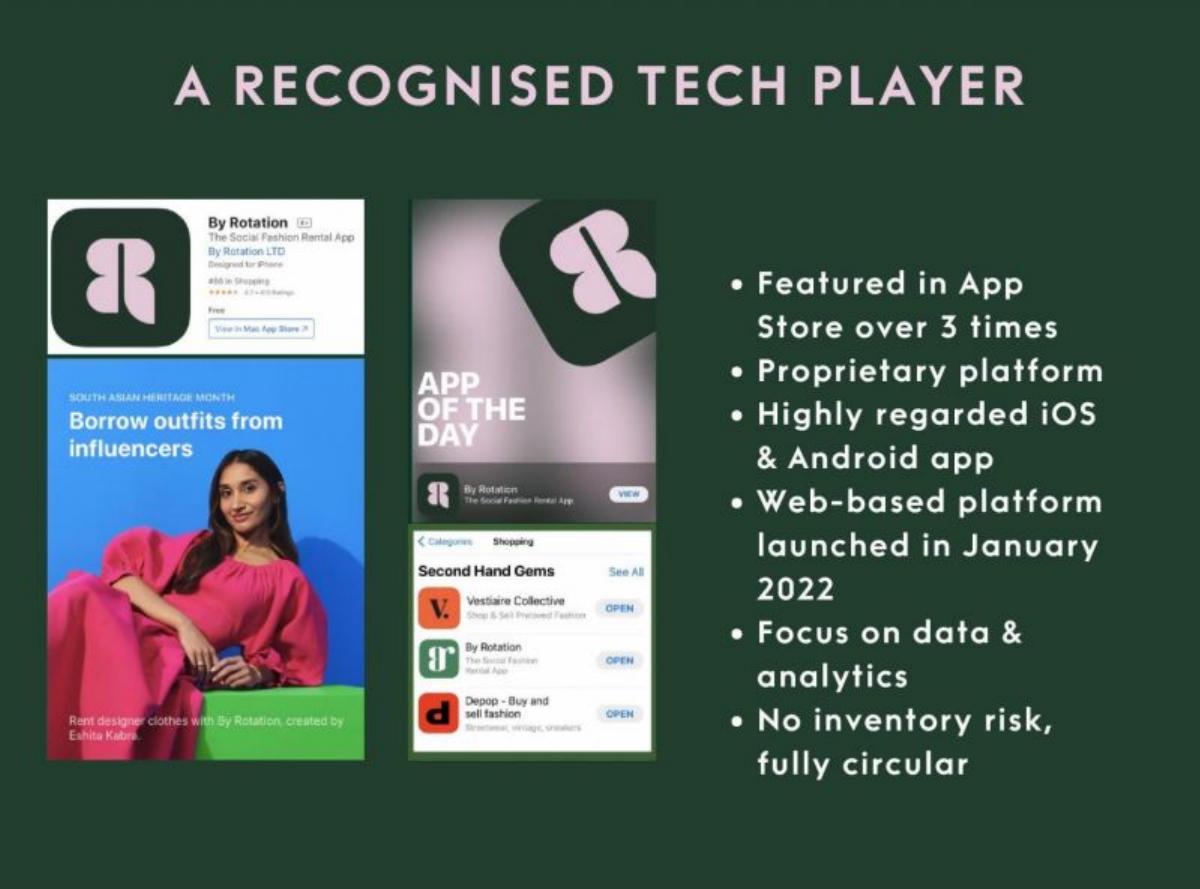
Our analysis: An App Store feature can bring users directly, so it's more than a logo.
Evidence and limitation: Download impact isn't shown. Add installs or signups from the feature.
What a founder can adapt: If a feature drove downloads, show the before-and-after.
Supporting analysis
What the deck claims: "A Recognised Tech Player": Featured in App Store over 3 times; proprietary platform; highly regarded iOS & Android app; web-based platform launched in January 2022; focus on data & analytics; no inventory risk, fully circular. Screenshots of App Store features including "App of the Day".
Presentation choice: An App Store feature can bring users directly, so it's more than a logo.
When it does not fit: Download impact isn't shown. Add installs or signups from the feature.
Consumer brand. Stage and year are not stated on the slide.
House of Highness deck, slide 4. Exact stored slide matched to this analysis.
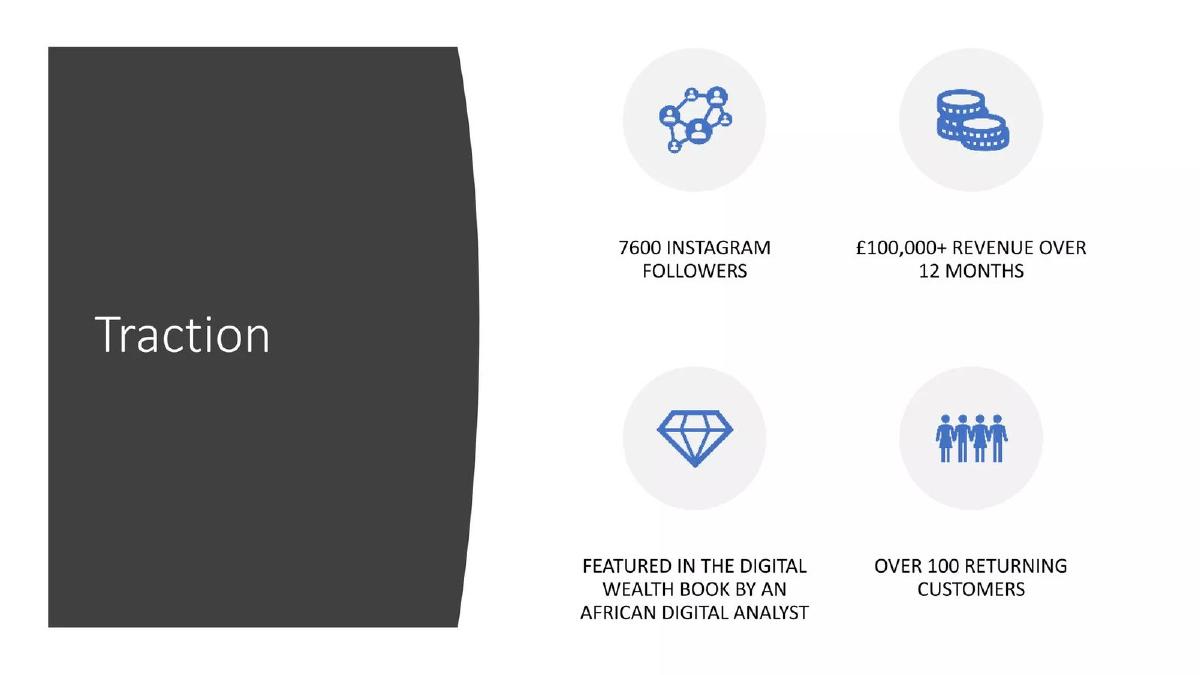
Our analysis: The press mention sits as one tile beside revenue and repeat customers, which is the right weight.
Evidence and limitation: The book and author aren't named in full. Name them so the mention can be checked.
What a founder can adapt: Put press alongside hard numbers, not in place of them.
Supporting analysis
What the deck claims: "Traction": 7600 Instagram followers; £100,000+ revenue over 12 months; featured in The Digital Wealth Book by an African digital analyst; over 100 returning customers.
Presentation choice: The press mention sits as one tile beside revenue and repeat customers, which is the right weight.
When it does not fit: The book and author aren't named in full. Name them so the mention can be checked.
Video creation software. Stage and year are not stated on the slide.
Shakr deck, slide 2. Exact stored slide matched to this analysis.
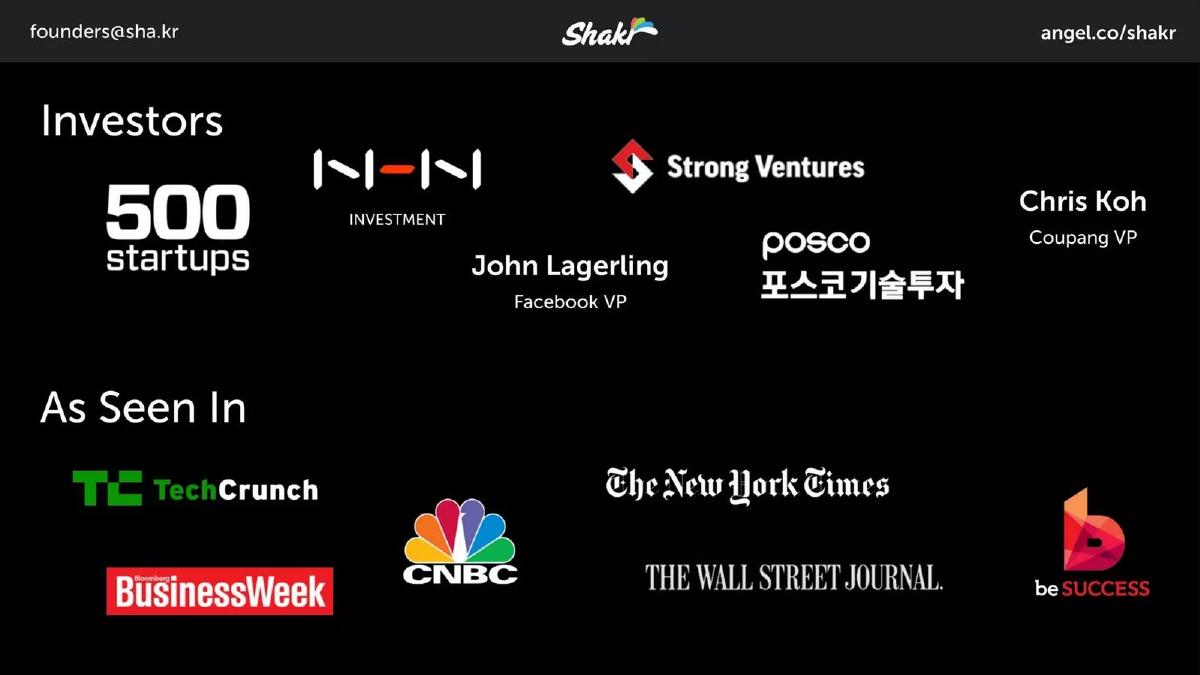
Our analysis: Press and investors together give a quick credibility read on an early slide.
Evidence and limitation: No dates or headlines. Link or date each article.
What a founder can adapt: If you pair press with investors, keep each group labelled, as Shakr does.
Supporting analysis
What the deck claims: "Investors": 500 Startups, NHN Investment, Strong Ventures, POSCO, John Lagerling (Facebook VP), Chris Koh (Coupang VP). "As Seen In": TechCrunch, BusinessWeek, CNBC, The New York Times, The Wall Street Journal, beSUCCESS.
Presentation choice: Press and investors together give a quick credibility read on an early slide.
When it does not fit: No dates or headlines. Link or date each article.
Conversational AI for retail, Montreal. Stage and year are not stated on the slide.
Heyday deck, slide 3. Exact stored slide matched to this analysis.
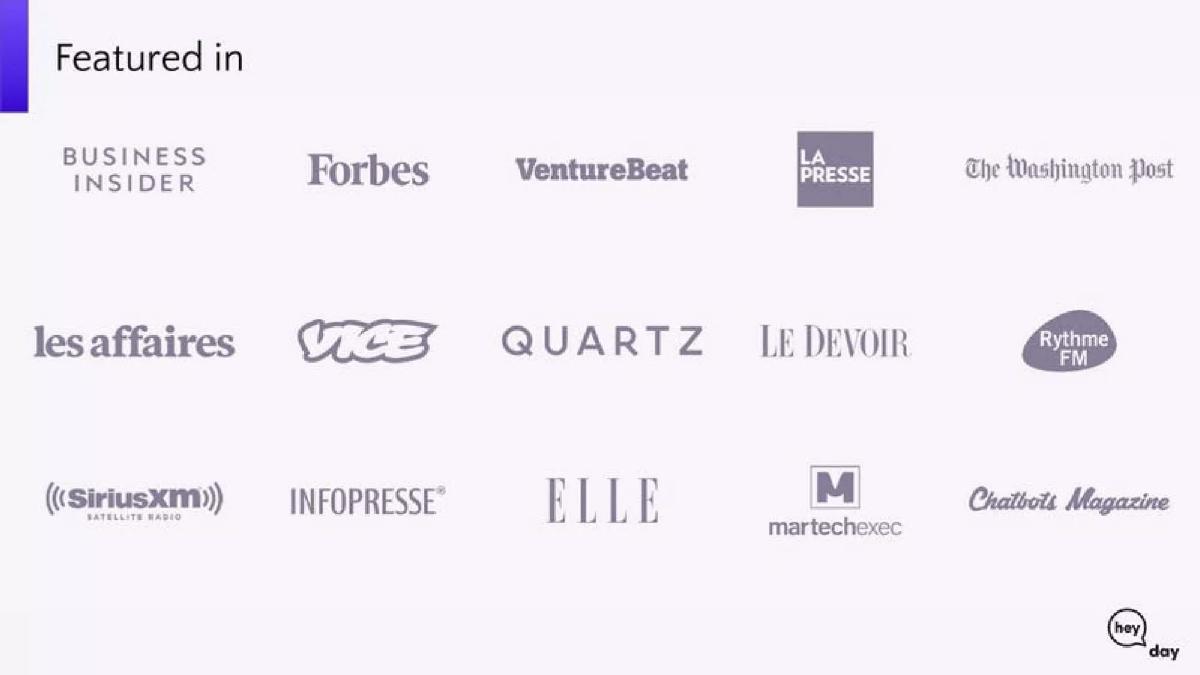
Our analysis: Fifteen outlets across English and French media show broad coverage.
Evidence and limitation: A full slide of logos with no dates or headlines. Shrink it to a strip.
What a founder can adapt: If you have many mentions, pick the three most relevant to your buyers.
Supporting analysis
What the deck claims: "Featured in": Business Insider, Forbes, VentureBeat, La Presse, The Washington Post, Les Affaires, Vice, Quartz, Le Devoir, Rythme FM, SiriusXM, Infopresse, Elle, MarTech Exec, Chatbots Magazine.
Presentation choice: Fifteen outlets across English and French media show broad coverage.
When it does not fit: A full slide of logos with no dates or headlines. Shrink it to a strip.
Athletic apparel brand. Stage and year are not stated on the slide.
RYU Apparel deck, slide 4. Exact stored slide matched to this analysis.
Our analysis: The rest of the slide is concrete; the award claim is the weakest line.
Evidence and limitation: "Award-winning" with no award named. Investors will ask which one.
What a founder can adapt: Treat this as a slide to improve on: name the award or drop the claim.
Supporting analysis
What the deck claims: "Highlights — Award-winning brand with large, loyal and active customer base in fast-growing athletic apparel category." Renewal: completed recapitalization of $4.8m with operational improvements (Shopify platform, cross-border warehousing, decommissioning inefficiencies, planned store reopenings). Leaders & partners: internal leadership, new industry hires, partnerships including Zoom Media, Canada Skateboard Olympic Team, Afterpay.
Presentation choice: The rest of the slide is concrete; the award claim is the weakest line.
When it does not fit: "Award-winning" with no award named. Investors will ask which one.
Healthcare provider for the LGBTQIA+ community. The slide's coverage figures are for 2021; its awards are dated 2021–2022.
Folx Health deck, slide 11. Exact stored slide matched to this analysis.
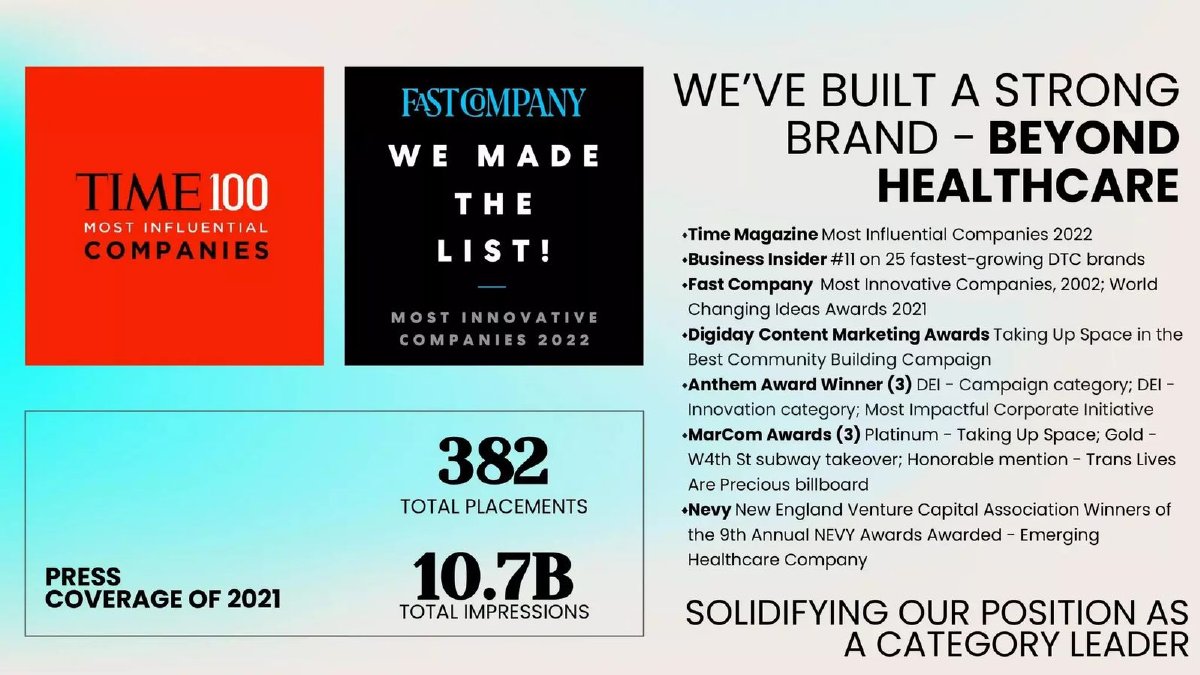
Our analysis: It is the only slide here that both dates its coverage and counts it, so an investor knows the period and the scale being claimed.
Evidence and limitation: Claimed (company-reported counts; no source or method shown).
What a founder can adapt: Give a placement count for a named period, and say which tool or agency produced it.
Supporting analysis
What the deck claims: "We've built a strong brand - beyond healthcare." Badges for Time 100 Most Influential Companies and Fast Company Most Innovative Companies 2022. A box headed "Press coverage of 2021": "382 total placements", "10.7B total impressions". A list of awards including Business Insider #11 on 25 fastest-growing DTC brands, three Anthem Awards, three MarCom Awards and a NEVY award (Emerging Healthcare Company). The list prints the Fast Company honour as "2002".
Presentation choice: It is the only slide here that both dates its coverage and counts it, so an investor knows the period and the scale being claimed.
When it does not fit: 10.7B impressions is an audience ceiling, not people reached. Pair it with signups or patients from the coverage.
Danish hardware startup making a hand heater for gamers. Stage and year are not stated on the slide.
Envavo deck, slide 10. Exact stored slide matched to this analysis.
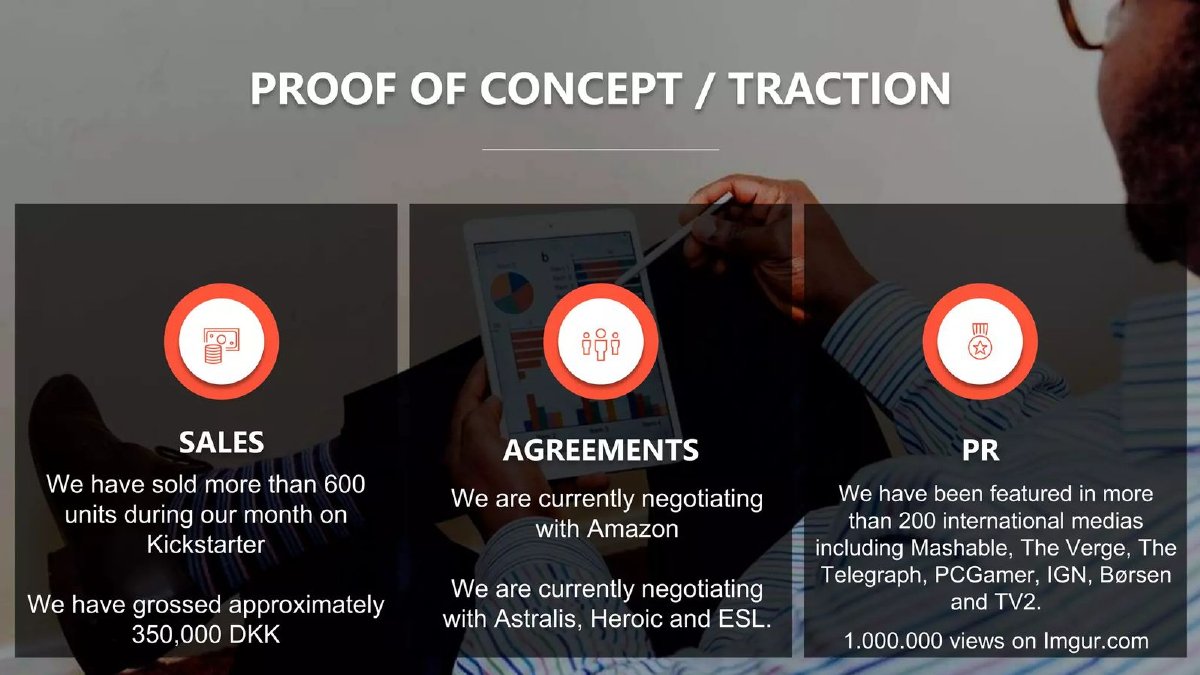
Our analysis: Press sits beside crowdfunding sales on one slide, so an investor reads attention and demand together instead of attention alone.
Evidence and limitation: Claimed (sales and coverage both company-reported; negotiations are not agreements).
What a founder can adapt: If coverage launched your campaign, say how many backers arrived in the days after the biggest feature.
Supporting analysis
What the deck claims: "Proof of concept / traction" in three columns. Sales: "more than 600 units during our month on Kickstarter", "grossed approximately 350,000 DKK". Agreements: negotiating with Amazon, and with Astralis, Heroic and ESL. PR: "featured in more than 200 international medias including Mashable, The Verge, The Telegraph, PCGamer, IGN, Børsen and TV2", "1.000.000 views on Imgur.com".
Presentation choice: Press sits beside crowdfunding sales on one slide, so an investor reads attention and demand together instead of attention alone.
When it does not fit: The slide never links the press to the 600 units. Without that link, the reader cannot tell which caused which.
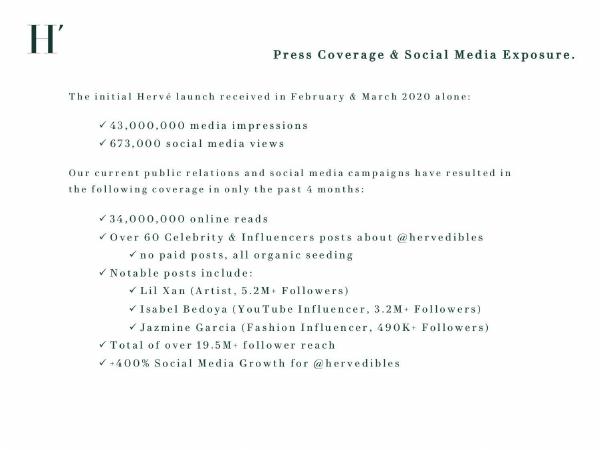
Edibles brand. Different slides from this deck (23–24) appear in the international expansion guide. The launch figures are dated February–March 2020.
Hervé deck, slide 29. Exact stored slide matched to this analysis.
Our analysis: Separating launch coverage from ongoing coverage, and saying the influencer posts were unpaid, tells an investor whether attention lasted and what it cost.
Evidence and limitation: Claimed (company-reported; the second period is undated).
What a founder can adapt: Date every period, including "the past 4 months", so figures can be placed in time.
Supporting analysis
What the deck claims: "Press Coverage & Social Media Exposure." Launch in February & March 2020: "43,000,000 media impressions", "673,000 social media views". "In only the past 4 months": "34,000,000 online reads", "Over 60 Celebrity & Influencers posts" ("no paid posts, all organic seeding"), three named influencers with follower counts, "Total of over 19.5M+ follower reach", "+400% Social Media Growth".
Presentation choice: Separating launch coverage from ongoing coverage, and saying the influencer posts were unpaid, tells an investor whether attention lasted and what it cost.
When it does not fit: Reach and reads with no sales, signups or retail placements after them. Add one commercial result.
Second-hand marketplace and delivery app, 2020 deck. The slide's printed number is 6; it is page 5 of the PDF.
Freespot deck, slide 5. Exact stored slide matched to this analysis.
Our analysis: It turns the absence of press into evidence: users arrived without paid or earned media, which suggests organic demand.
Evidence and limitation: Claimed (company-reported user count).
What a founder can adapt: If you have no coverage, say so and say what drove growth instead.
Supporting analysis
What the deck claims: "Traction: 2,000+ Users in Less than 6 Months with $0 Ad Spend and 0 Press Coverage!" Below, "What We Learned": users are loyal to outcomes not platforms; marketplace logistics problems exist everywhere; low-income and homeless customers are underserved.
Presentation choice: It turns the absence of press into evidence: users arrived without paid or earned media, which suggests organic demand.
When it does not fit: "Users" is undefined and no retention is shown. Add active users or repeat use to back the organic-demand claim.
Named, dated, linked-to-results mentions carry more weight.
Example
Type
Named source
Dated
Tied to results
Bower
Awards
Yes
No
No
By Rotation
App store features
Yes
Partly
No
House of Highness
Book mention
Partly
No
Beside revenue
Shakr
Press logos
Outlets only
No
No
Heyday
Press logos
Outlets only
No
No
Liquid Marketplace
Press logos
Outlets only
No
No
RYU Apparel
Award claim
No
No
No
Folx Health
Coverage count + awards
Yes
Yes (2021)
No
Envavo
Coverage count
Outlets named
No
Beside sales
Hervé
Impressions + social
Influencers named
Partly
No
Freespot
No press (contrast)
n/a
Within 6 months
Users
Key Takeaways
Press is outside attention, not traction. Keep it secondary.
Name the award and who gave it. Bower does.
App store features count if they brought users. Say how many.
Logo walls need dates and context to mean much.
An unnamed "award-winning" claim adds nothing. Name the award.
Impressions and placement counts are reach, not results. Say who counted and how.
Growth with no press can be the stronger signal. Freespot says so outright.
Build your press and awards slide
Only include mentions you can name and date.
Mentions. Which three mentions matter most to your buyers or investors?
Details. Outlet or awarding body, headline or award name, month and year?
Effect. Did any mention bring signups, sales or partners? How many?
Counts. If you show placements or impressions, who counted them, over what dates?
Placement. Full slide, strip on the traction slide, or appendix?
Copyable framework: [Award] from [body], [year]. Featured in [outlet] ([month year]): [result, e.g. 1,200 signups that week].
Illustrative example 1 — written by us
Before: Award-winning. As seen in: [logos]
After: Winner, [Award name], [Body], 2025. Featured in [Outlet], Mar 2025: 1,200 waitlist signups in 48 hours.
What improved: Our illustrative rewrite; names and figures are invented. It names the award and outlet, dates both, and shows the result.
What this guide adds
The testimonial guide covers customer quotes; the customer logo guide covers who buys. This guide covers third-party attention: media coverage, app store features and prizes.
Coverage counts: what impressions and placements prove
The first seven examples show which outlets or awards noticed a company. Four later examples answer a different question investors ask: how much coverage was there, and did it do anything? Folx Health, Envavo and Hervé put numbers on their press. Freespot puts a zero on it.
Placement and impression counts are company-reported reach figures. A placement is usually one article, segment or mention; an impression is an estimate of how many people could have seen it, often derived from each outlet's audience size. None of the three slides says who compiled its figures or how. Folx's "10.7B total impressions" across "382 total placements" for 2021 is our calculation of about 28 million potential readers per placement on average, which suggests audience totals for large outlets were added up rather than readers actually measured. Treat any impression total as a ceiling, not a count of people reached.
What investors look for next is a link from coverage to an outcome they care about. Envavo's slide comes closest by layout: its "PR" column ("featured in more than 200 international medias", "1.000.000 views on Imgur.com") sits beside "SALES" ("more than 600 units during our month on Kickstarter", "approximately 350,000 DKK"). The slide does not say the press drove the sales, and a reader should not assume it. Hervé lists organic influencer posts and follower reach, which is closer to a channel, but again no sales or signups follow.
Freespot shows why this matters. Its traction slide leads with "2,000+ Users in Less than 6 Months with $0 Ad Spend and 0 Press Coverage!" For an early marketplace, growth without press or paid spend is a claim about organic demand, and it can carry more weight than a page of logos. It is still a company claim: the slide gives no retention or activity figure for those users.
Measured, claimed or calculated
Every figure on these eleven slides is the company's own claim; none cites a media-monitoring report or analytics export. Folx dates its counts ("Press coverage of 2021"), and Hervé dates its launch figures ("February & March 2020") but not the "past 4 months" figures that follow, so an investor cannot place 34,000,000 online reads in time. The only calculation on this page is ours, the Folx per-placement average above.
One more detail a careful reader will spot: the Folx award list prints "Fast Company Most Innovative Companies, 2002" while the badge beside it reads "Most Innovative Companies 2022". We quote the slide as printed. A typo like this is small, but on a credibility slide it invites exactly the scrutiny the slide is meant to avoid.
For founders: if you show coverage numbers, name the source (a monitoring tool, your PR agency's report), date the period, and pair the number with one result you can attribute, such as signups in the week after a feature. If you have no press, say what you grew with instead, as Freespot does.
Common mistakes
Unnamed awards. Name the award and who gave it.
Undated logos. Add the month and year.
Press instead of traction. Put press beside revenue and customers, not in place of them.
Too many logos. Pick the three that matter to your audience.
Impressions as reach. Impression totals are audience estimates. Say who counted and pair them with a result.
Undated periods. "The past 4 months" means nothing in a deck read later. Give dates.
Diagnostic checklist
Each award names the award and the body.
Each mention is dated.
Any effect on signups or sales is shown.
Press sits after traction or as a strip.
Any coverage count names its source and period.
Frequently asked questions
Should I put media impressions on my pitch deck?
Only with the source, the period and a result beside it. Impressions estimate potential audience, not people reached; Folx Health's 10.7B across 382 placements averages about 28 million per placement (our calculation).
What if my startup has had no press coverage?
Leave the slide out, or make the point Freespot makes: it reports 2,000+ users in under six months with no ad spend and no press. Growth without press can be the stronger signal.
How we chose these examples
Corpus: published pitch deck teardowns on StartupFundraising.com. Founder-uploaded private decks are excluded.
Selection (2026-09-24): we searched extracted text of slides 2–6 for press and award terms (featured in, as seen in, award-winning, recognised), excluding fund decks, and inspected eight candidates. We excluded Marianna Naturals (text too small to read).
Overlap check: the testimonial and customer logo guides cover customer evidence. This guide covers third-party attention.
Update (2026-10-01): we searched the full extracted corpus for coverage metrics (placements, impressions, media reads, "0 press") and screened candidates against existing guides and the listed-company exclusion before checking images. Added Folx Health p11, Envavo p10, Hervé p29 and Freespot p5. Not used: a fund deck (Hack Fund V) and two listed companies (Goldmoney, GSRX).
Review (2026-10-01): the four added slides were rendered from the original deck files and every figure checked against the image (editorial model review). All are company claims; the only calculation is ours and is labelled.
Review: the original seven stored slide images were inspected on 2026-09-24 and matched to company, deck and slide number (editorial model review). No person has yet completed an editorial review of this page.
Claims are as shown on the slides. We make no claim that any slide caused a fundraising outcome.