Shakr raised $3.8 million with a concise 11-slide deck that prioritizes market dynamics and problem identification over complex financial modeling. The deck effectively uses social proof, leading with a heavy-hitting investor slide featuring 500 Startups and VPs from Facebook and Coupang. The narrative focuses on the 'broken math' of video advertising for small businesses, where creative costs often dwarf the actual media spend. By showcasing a library of over 550 templates and a seamless integration into platforms like Facebook and Google AdWords, Shakr demonstrates a clear product-market fi…
Key takeaways
- The deck leads with immediate social proof, listing 500 Startups and NHN Investment as backers on Slide 2.
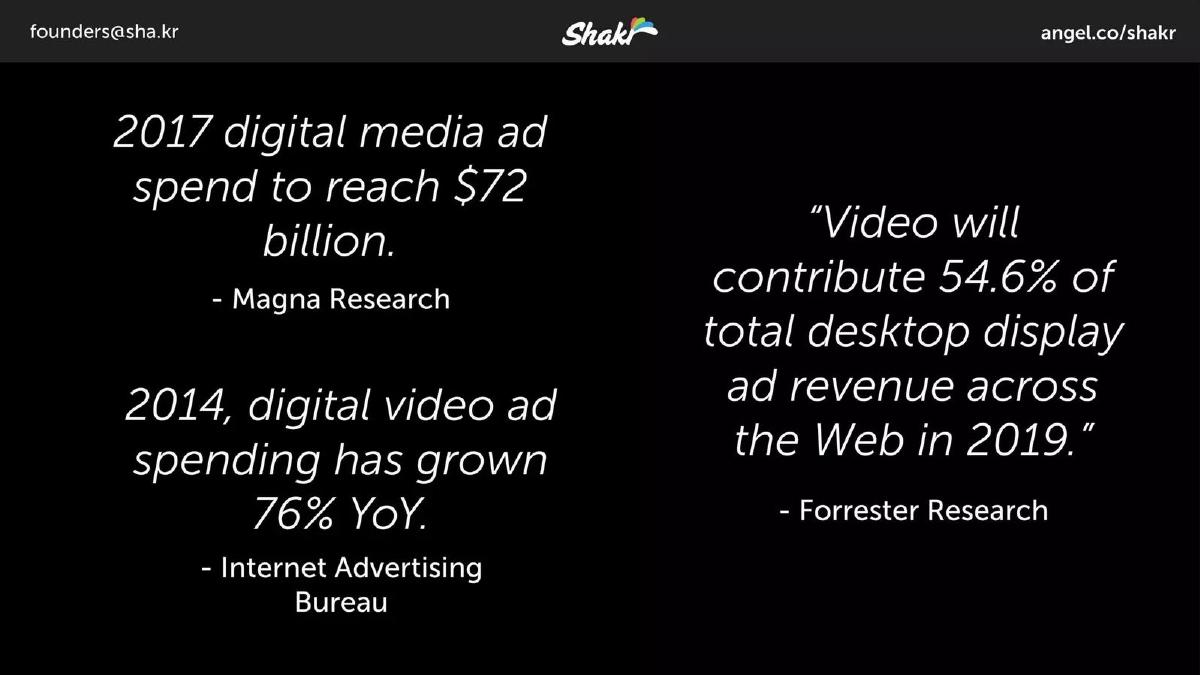
- Market timing is established using third-party data from Magna and Forrester, projecting a $72 billion digital ad spend by 2017 on Slide 5.
- The 'Problem' is framed as a mathematical impossibility for SMBs, where a $10,000 creative cost for a $2,000 campaign is labeled 'bad math' on Slide 10.
- A critical friction point in the Google AdWords funnel is identified on Slide 9, claiming 98% of SMBs drop out when asked to provide a video URL.
- The solution is quantified by scale, highlighting a library of 550+ templates on Slide 7.
- Product integration is demonstrated through UI mockups of Facebook and Google AdWords on Slides 8 and 9.
- The deck relies heavily on video placeholders (Slides 3, 4, 7, 8, and 11), suggesting the original presentation was highly interactive.
- There is a total absence of a dedicated team slide, which is unusual for a 'Later' stage round.
The Narrative of High-Volume Creative
Shakr’s pitch deck is a lean, visually-driven document that focuses on a single, compelling narrative: the democratization of video advertising. At a time when digital video spend was exploding, Shakr identified that the 'long tail' of small businesses was being left behind due to the high barrier to entry in video production. The deck is structured to move quickly from the macro-opportunity to the micro-friction point that Shakr eliminates.
Slides 1-2: Branding and Social Proof
Slide 1 is a standard title slide featuring the logo and the tagline: "Great video for everyone." It sets a tone of accessibility and simplicity.
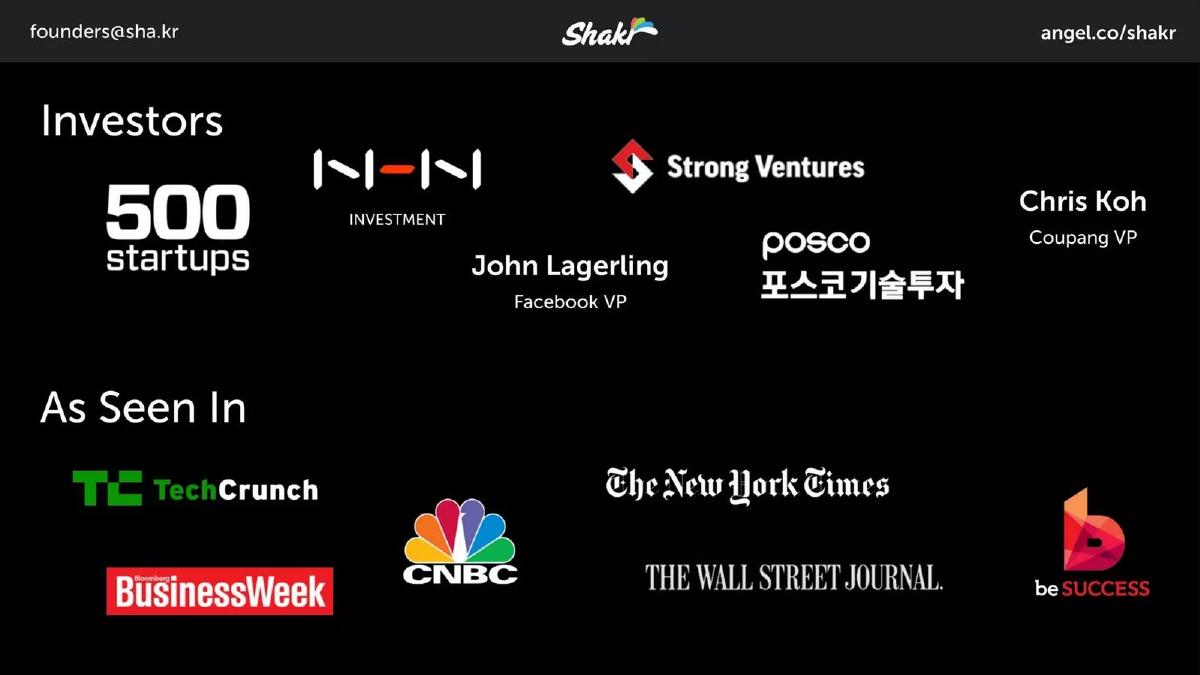
Slide 2 is arguably the most important slide for a company at this stage. It leads with 'Investors' and 'As Seen In.' By placing 500 Startups, NHN Investment, and Strong Ventures front and center, Shakr establishes immediate institutional credibility. The inclusion of John Lagerling (Facebook VP) and Chris Koh (Coupang VP) as investors/advisors signals that the company has deep ties to the platforms it intends to serve. The 'As Seen In' section features top-tier media outlets like TechCrunch, The Wall Street Journal, and The New York Times, further validating the brand's relevance.
Slides 3-5: The Market Opportunity
Slide 3 is a video placeholder. In the context of a video marketing platform, showing rather than telling is a strategic choice, though it leaves a gap in a static teardown.
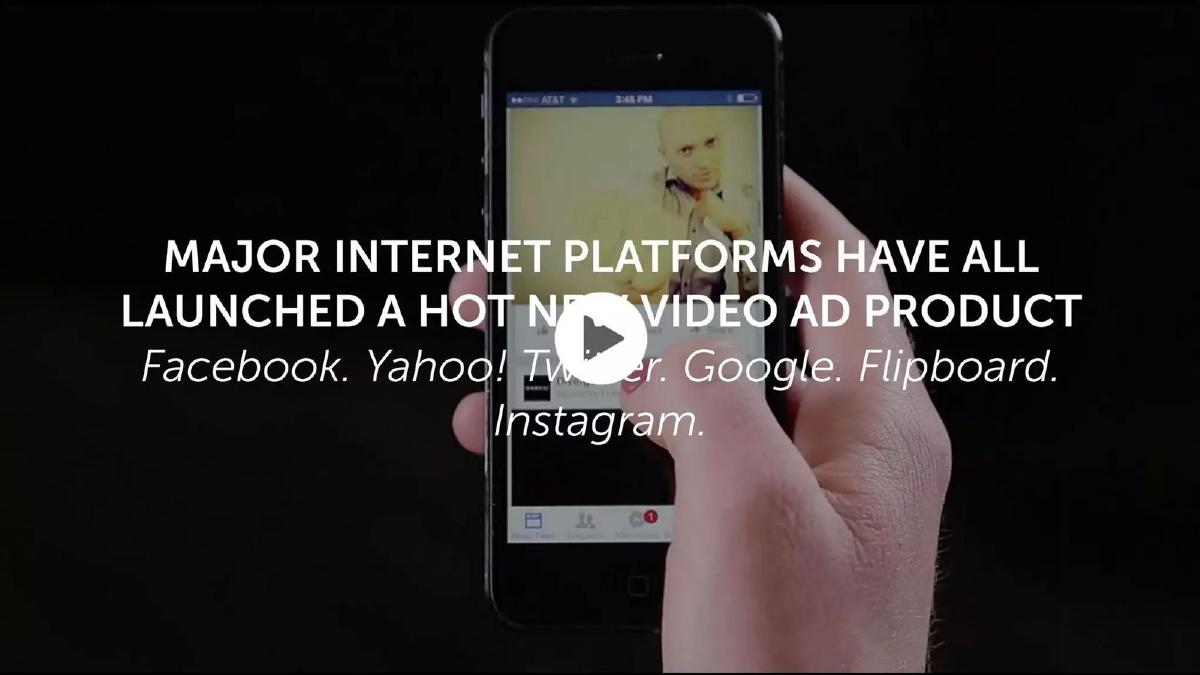
Slide 4 introduces the 'Why Now' factor. It lists major internet platforms—Facebook, Yahoo!, Twitter, Google, Flipboard, and Instagram—noting that they have all launched 'hot new video ad products.' This frames Shakr not as a standalone tool, but as a necessary utility for the world's largest ad ecosystems.
Slide 5 provides the data to back up the hype. It quotes Magna Research stating that 2017 digital media ad spend will reach $72 billion. It also cites the Internet Advertising Bureau's figure of 76% year-over-year growth in digital video ad spending for 2014. Finally, it uses Forrester Research to project that video will contribute 54.6% of total desktop display ad revenue by 2019. These figures serve to convince the investor that the 'tide' is rising rapidly.
Slides 6-7: The SMB Problem and the Shakr Solution
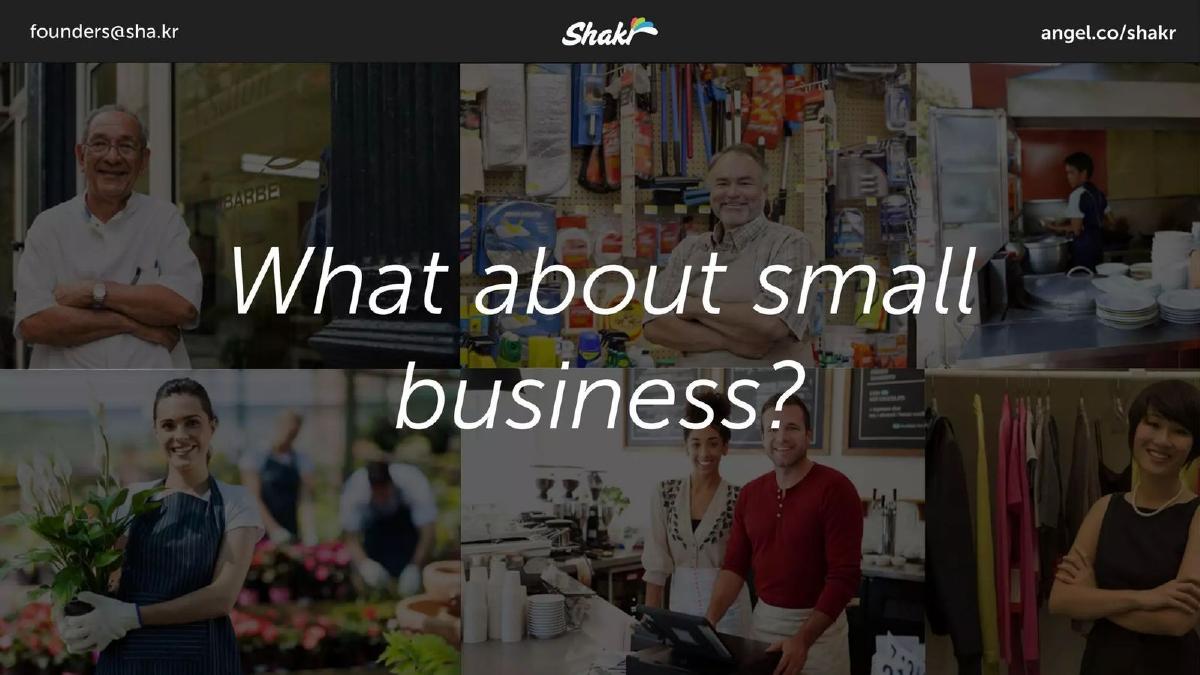
Slide 6 pivots to the target audience with a simple question: "What about small business?" The background is a collage of various SMB owners (florists, bakers, shopkeepers), humanizing the market segment that is currently underserved.
Slide 7 presents the solution. It shows a laptop screen with the Shakr interface, specifically a template called 'Jumbotron.' The key metric here is "550+ TEMPLATES TO CHOOSE FROM." This addresses the need for variety and scale, suggesting that any business, regardless of industry, can find a style that fits.
Slides 8-10: Identifying the Friction Point
Slide 8 shows a Facebook UI mockup with a 'Video Ads by Shakr' post. This demonstrates the end result: a professional-looking video ad appearing natively in a social feed.
Slide 9 is the 'Aha!' moment of the deck. It shows the Google AdWords (now Google Ads) campaign creation screen. A large red box highlights the 'Your video' input field where users must paste a YouTube URL. The text overlay states: "98% of SMBs dropout here." This is a powerful use of data to identify a specific, high-value problem. If Shakr can solve the reason for a 98% abandonment rate, they become an essential partner for the ad platforms themselves.
Slide 10 breaks down the economics. It compares the 'Before Shakr' scenario: a $2,000 ad campaign burdened by a $10,000 creative cost. The slide bluntly states, "This math is bad." It perfectly encapsulates the pain point of the SMB: video is effective, but the production cost-to-spend ratio is broken.
Slide 11: Vision and Scale
Slide 11 is a final video placeholder over a massive grid of video thumbnails. This visual represents the 'creative technology platform' mentioned in their description—a factory of content that can produce thousands of variations for thousands of different businesses.
What Works in the Shakr Deck
The '98% Dropout' Insight: Slide 9 is the strongest part of the deck. By pointing to a specific field in a Google AdWords form and attaching a failure rate to it, Shakr makes the problem tangible. Investors love 'bottleneck' businesses that sit at a point of high friction in a massive market.
Institutional Credibility: Leading with a heavy-hitting investor slide (Slide 2) is a smart move for a 'Later' stage deck. It tells the new investor that the previous rounds were led by people who know the space (Facebook and Coupang VPs).
Clear Economic Argument: Slide 10 simplifies a complex business problem into a single 'bad math' equation. It makes the necessity of the product feel like a mathematical certainty rather than a luxury.
What is Missing from the Shakr Deck
The Team Slide: There is no slide introducing the founders or the key executive team. While Slide 2 mentions high-profile investors, the absence of the actual operators is a significant omission for a $3.8M round.
Business Model and Unit Economics: The deck explains why the product is needed, but not how Shakr makes money. Is it a subscription (SaaS)? A per-video fee? A percentage of ad spend? There is no mention of CAC (Customer Acquisition Cost), LTV (Lifetime Value), or churn.
The Ask: The deck ends without a 'The Ask' slide. There is no information on how much capital is being sought, the milestones that capital will hit, or the intended use of funds.
Competition: The deck operates as if Shakr is the only player in the space. There is no competitive landscape analysis or 'moat' explanation to differentiate them from other template-based video editors like Animoto or Magisto.
What a Founder Should Copy
Use Platform Mockups: If your product lives inside another ecosystem (like Facebook or Google), show it there. Slides 8 and 9 do an excellent job of showing the 'native' feel of the solution.
Identify the Specific Friction Point: Don't just say 'video is hard.' Say '98% of people stop at this specific text box.' The more specific you can be about where the current process fails, the more essential your solution looks.
Lead with Social Proof if You Have It: If you have notable investors or press, don't hide them at the end. Shakr puts their biggest 'wins' on Slide 2, which ensures the investor views the rest of the deck through a lens of established credibility.
Keep the Text Minimal: Shakr uses very few words per slide. They rely on large images and single, punchy sentences. This is ideal for a deck intended to be presented in person or as a high-level teaser.
Frequently asked questions
- What is the primary problem Shakr is trying to solve?
- Shakr addresses the 'creative gap' for small and medium-sized businesses (SMBs). According to Slide 10, traditional video production costs (approx. $10,000) make it financially unviable for SMBs running modest $2,000 campaigns. This results in a 98% dropout rate on ad platforms like Google AdWords when users are prompted to upload a video, as shown on Slide 9.
- How does Shakr demonstrate product-market fit?
- The deck demonstrates fit by showing the product in the context of major ad ecosystems. Slide 8 shows a 'Video Ads by Shakr' post on Facebook, and Slide 9 shows where Shakr fits into the Google AdWords workflow. By offering 550+ templates (Slide 7), they provide the volume and variety needed to service the diverse SMB market.
- Who are Shakr's notable investors mentioned in the deck?
- Slide 2 lists several high-profile investors, including 500 Startups, NHN Investment, Strong Ventures, and POSCO. Individual angel investors and advisors include John Lagerling (VP at Facebook) and Chris Koh (VP at Coupang), providing significant industry credibility.
- What market data does Shakr use to justify its business model?
- Shakr cites Magna Research, the Internet Advertising Bureau, and Forrester Research on Slide 5. Key figures include a projected $72 billion digital media ad spend by 2017 and a 76% year-over-year growth in digital video ad spending as of 2014.
- Is there a clear 'Ask' or financial roadmap in this deck?
- No. The 11-slide deck is purely a narrative and product showcase. It does not include a slide detailing how much money is being raised, the valuation, or specific financial projections. It functions more as a high-level pitch for the vision and the 'why now' of the market.