The Shares pitch deck is a high-energy, visually driven presentation that prioritizes momentum and social proof over granular financial modeling. By positioning themselves at the intersection of 'Mass Affluent' and 'Shared Insights,' Shares successfully carved out a niche in a crowded fintech market. The deck leans heavily on the founders' previous successes at companies like Revolut and Stuart, while using App Store rankings and rapid valuation jumps—from $33.62M at Seed to $220M at Series A—to create a sense of inevitability. While it lacks detailed unit economics or a specific 'Ask' slide…
Key takeaways
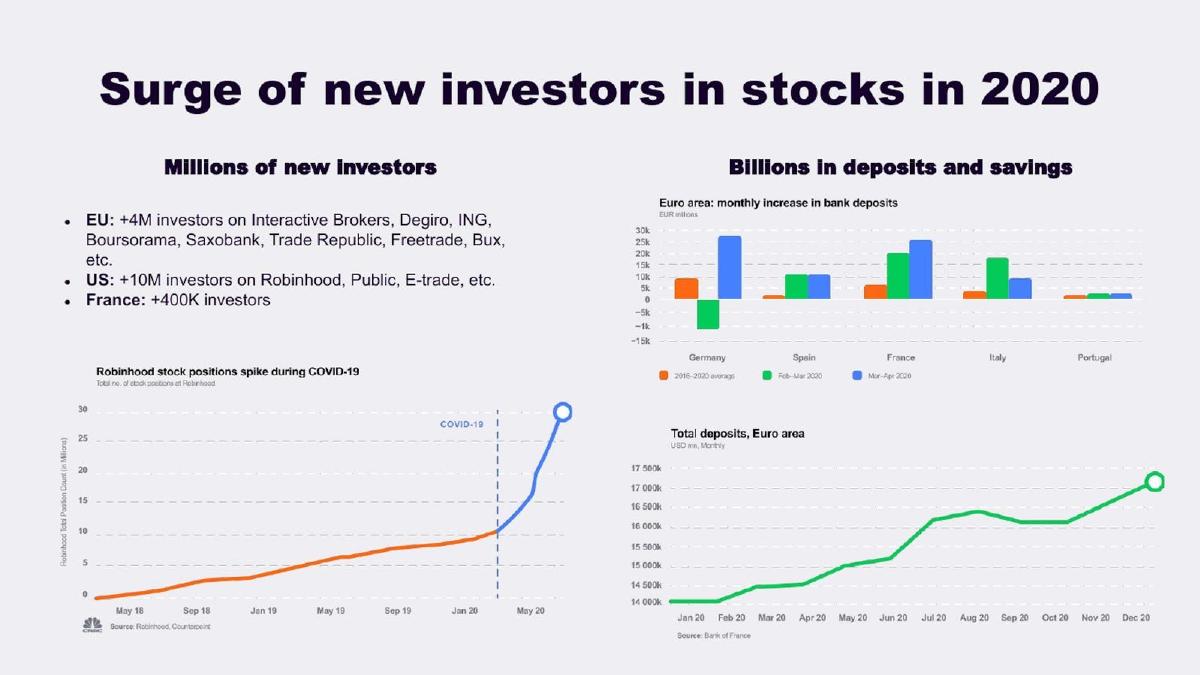
- The deck highlights a massive surge in new investors, citing +4M in the EU and +10M in the US during 2020 (Slide 3).
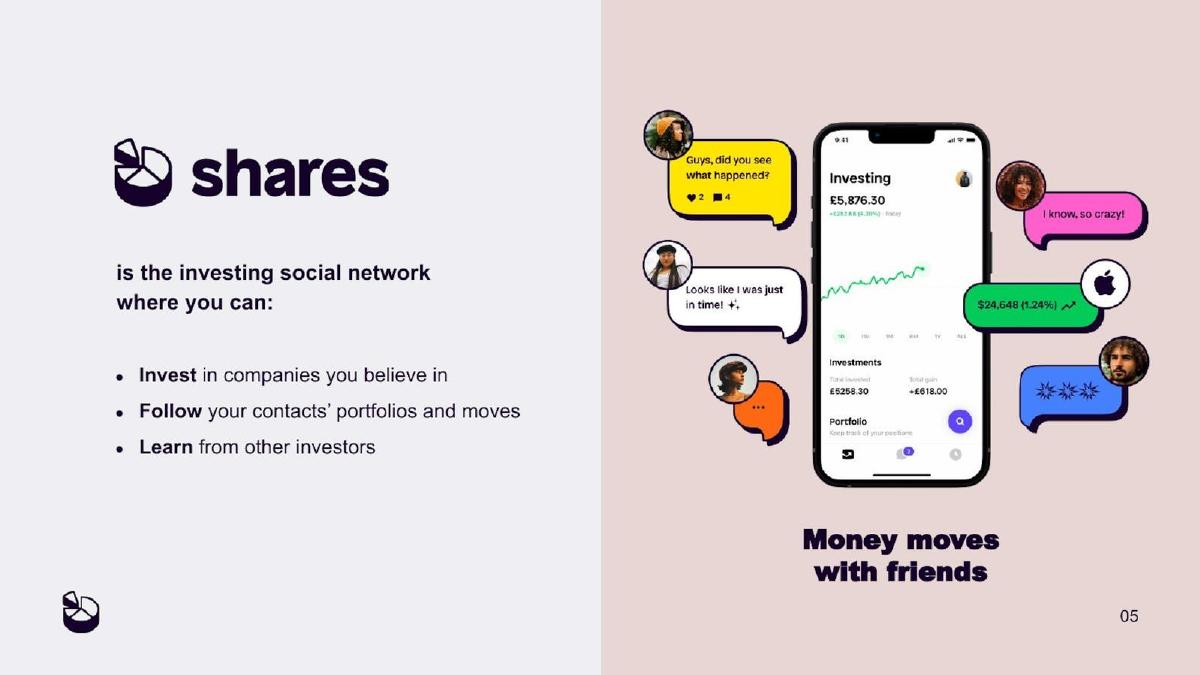
- Shares defines its unique value proposition as an 'investing social network' focused on following contacts' portfolios (Slide 5).
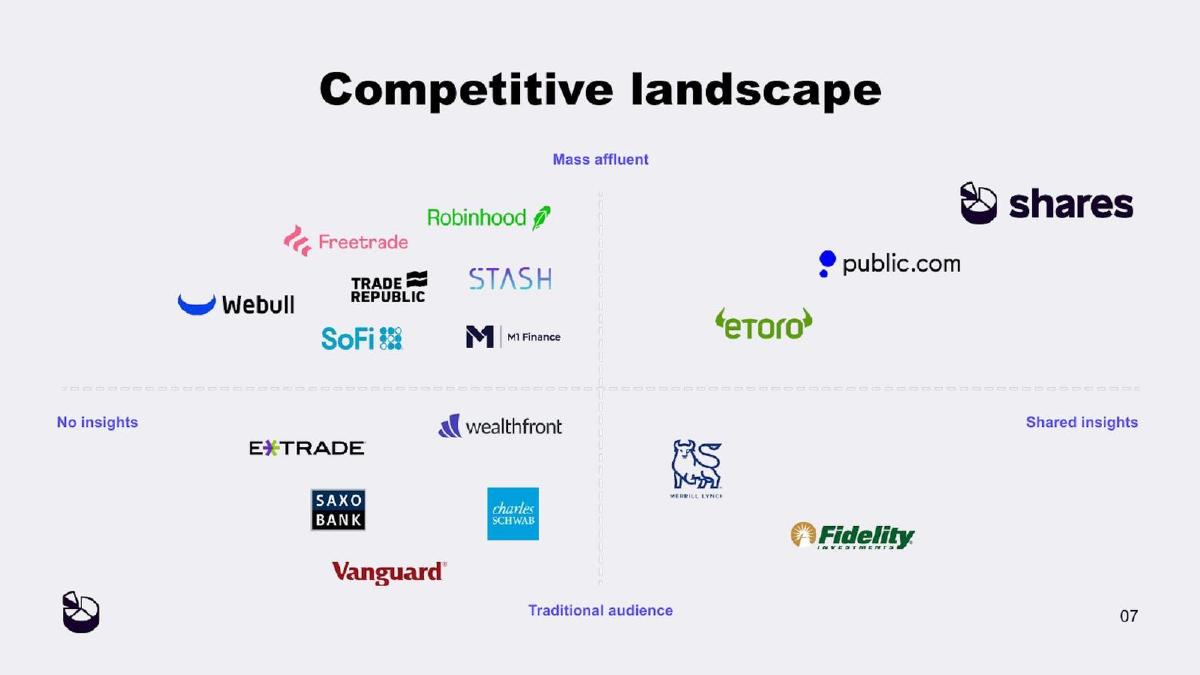
- The competitive landscape slide positions Shares in the top-right quadrant, combining 'Mass Affluent' appeal with 'Shared Insights' (Slide 7).
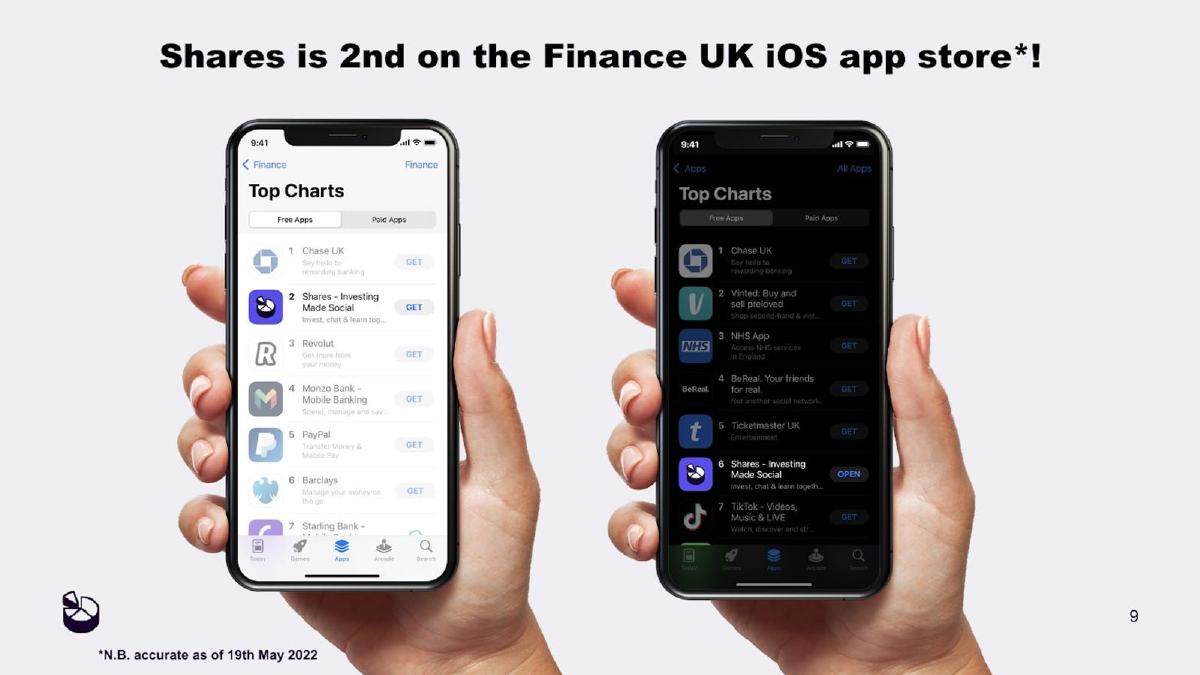
- Traction is validated by App Store rankings, showing Shares at #2 in the UK Finance category as of May 2022 (Slide 9).
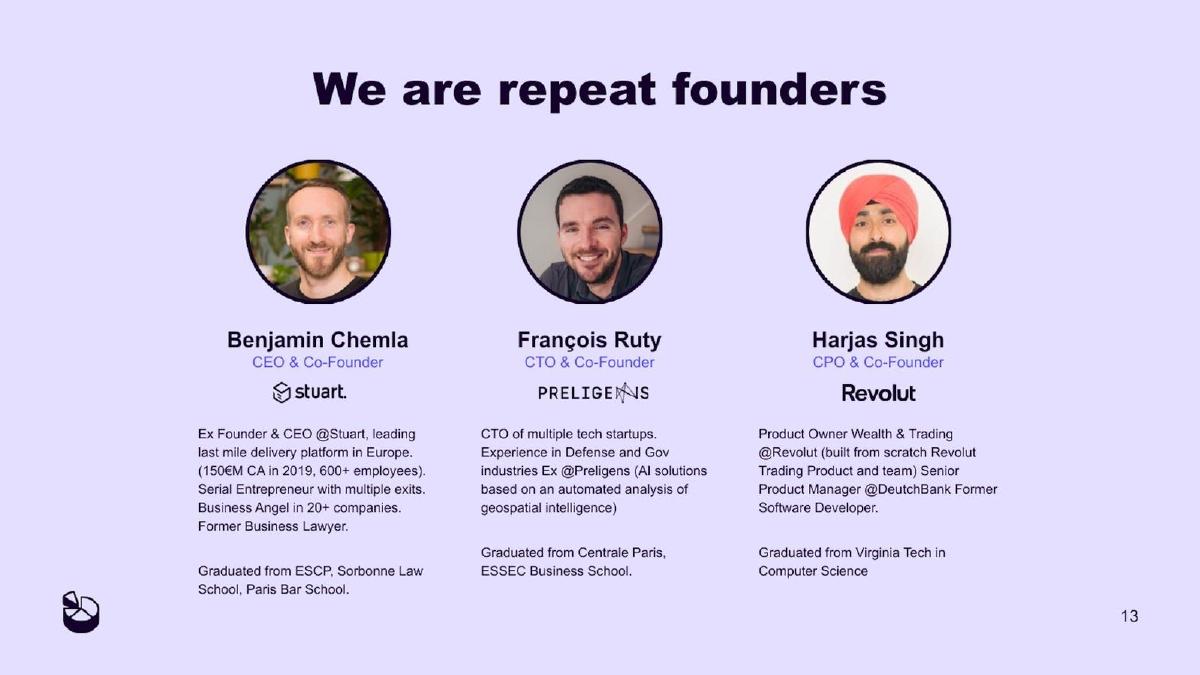
- The team slide emphasizes 'repeat founders' with specific exits, such as Benjamin Chemla's Stuart reaching 150M€ CA in 2019 (Slide 13).
- Valuation growth is explicitly disclosed, showing a jump from a $33.62M Seed valuation to a $220M Series A valuation (Slide 15).
- Expansion plans target an addressable market of ~50m people across 27 EU countries (Slide 17).
- The hiring strategy focuses on regional experts, including former leads from Revolut, Meta, and Coinbase (Slide 17).
The Shares Pitch Deck: Selling the Social Investing Revolution
Shares raised a $40M Series B in 2023, a period when fintech valuations were under intense scrutiny. The deck they used is a masterclass in narrative-driven fundraising. Rather than leading with complex spreadsheets, Shares leads with a cultural shift: the democratization of investing through social interaction. This teardown examines how they used 19 slides to convince investors that they could become the 'social' layer of the European stock market.
Slide 1-2: Brand Identity
The opening slides are minimalist, featuring only the Shares logo and brand name. This establishes the visual language of the company—clean, modern, and tech-forward. In a Series B deck, the brand is already expected to be established, and these slides act as a professional buffer before diving into the data.
Slide 3: The Macro Opportunity
Slide 3, titled Surge of new investors in stocks in 2020 , sets the stage. It uses four distinct charts to prove a massive market shift. It cites +4M new investors in the EU across platforms like Trade Republic and Freetrade, and +10M in the US on Robinhood. Crucially, it shows 'Total deposits, Euro area' climbing toward 17,500k USD mn by late 2020. This slide tells the investor: 'The money is there, and the behavior has changed. We aren't creating a market; we are capturing an existing surge.'
Slide 5: The Product Vision
Slide 5 defines the company: Shares is the investing social network . It lists three core pillars: investing in companies you believe in, following contacts' portfolios, and learning from other investors. The right side of the slide features a high-fidelity mobile mockup surrounded by social chat bubbles like 'Guys, did you see what happened?' and 'Looks like I was just in time!' This visualizes the 'Social' in 'Social Trading,' moving the product away from a lonely utility to a community experience.
Slide 7: Competitive Landscape
The Competitive landscape slide uses a standard 2x2 matrix, but the axes are chosen strategically. The Y-axis ranges from 'Traditional audience' to 'Mass affluent,' and the X-axis ranges from 'No insights' to 'Shared insights.' Shares places itself in the top-right corner. By doing so, they relegate giants like Vanguard and Charles Schwab to the 'Traditional/No insights' quadrant and position direct rivals like Robinhood and Freetrade as 'Mass affluent' but lacking the 'Shared insights' that Shares provides. This slide is essential for justifying why a new player is needed in a crowded market.
Slide 9: Traction and Validation
Slide 9 is a powerful 'show, don't tell' moment. It features screenshots of the UK iOS App Store showing Shares is 2nd on the Finance UK iOS app store as of 19th May 2022. It ranks above Revolut, Monzo, and PayPal. This is the ultimate proof of product-market fit. For a Series B investor, seeing a startup outrank multi-billion dollar incumbents in a major market is a significant de-risking signal.
Slide 11: Investor Pedigree
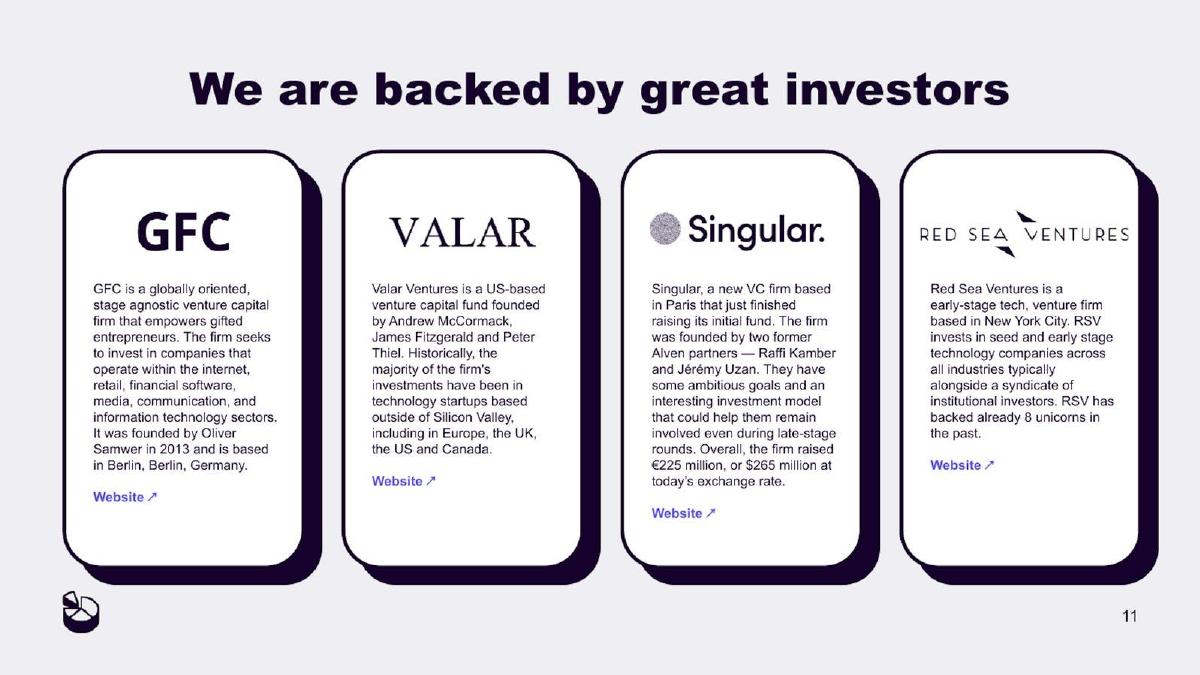
The deck highlights its existing backers on Slide 11: GFC, Valar, Singular, and Red Sea Ventures . By including descriptions of these firms—noting Valar's link to Peter Thiel and Singular's €225 million fund—Shares is borrowing credibility. They are signaling that 'smart money' has already done the due diligence and placed their bets.
Slide 13: The Repeat Founders
Slide 13, We are repeat founders , is one of the strongest in the deck. It profiles Benjamin Chemla (CEO), François Ruty (CTO), and Harjas Singh (CPO). The metrics here are specific: Chemla's previous company Stuart had 150M€ CA and 600+ employees. Singh is credited with building Revolut's Wealth & Trading product from scratch. This slide tells investors that the team has both the scale experience and the specific domain expertise to win in fintech.
Slide 15: Growth Trajectory
Slide 15 provides a timeline of the company's rapid ascent. It notes an Aug 2021 Seed Round of $10m at a $33.62m valuation , followed by a Mar 2022 Series A of $40m at a $220m valuation . The slide ends with the Q4 2022 Series B (the round this deck was likely supporting). The visual is a rising line graph that connects these funding milestones to operational achievements like 'Hiring of 60+ employees' and 'Shares available in 27 EU countries.' This slide creates a sense of unstoppable momentum.
Slide 17: Geographic Expansion
Slide 17, Expansion - Ready for EU launch , shows a map of Europe with the UK marked as 'Live' and the rest of the continent in yellow as 'Next up.' It claims access to an addressable market of ~50m people . More importantly, it shows the faces of the General Managers already hired for Eastern Europe, Southern Europe, the Nordics, and DACH, highlighting their previous roles at Revolut, Meta, and Coinbase. This proves that the $40M isn't just for 'testing'—it's for fueling a machine that is already built.
Slide 19: Media Coverage
The final slide showcases Media coverage from TechCrunch, Les Echos, Verdict, and UKTN. The quotes are selected to reinforce the narrative: 'Shares attempts to separate itself from the pack' and 'The new French broker who wants to become the European Robinhood.' This serves as a final layer of social proof, showing that the industry press is already bought into the vision.
What Works in the Shares Deck
The Shares deck excels at momentum signaling . By explicitly stating their valuation jumps and showing their App Store rankings, they make the company look like a 'rocket ship' that investors would be foolish to miss. The focus on 'Repeat Founders' is also a critical success factor; in a high-stakes Series B, investors are betting as much on the jockey as the horse. The deck also does a great job of visualizing the 'Social' aspect of the product, which is their primary differentiator. Instead of just saying 'we have a chat feature,' they show how that chat feature drives user engagement and investment decisions.
What is Missing from the Shares Deck
Despite its strengths, the deck has notable omissions. There is a complete lack of unit economics . We don't see the Customer Acquisition Cost (CAC), the Lifetime Value (LTV), or the churn rates. For a Series B, these are usually mandatory. There is also no detailed revenue model . While we know they are a broker, the deck doesn't explain if they make money via PFOF (which is restricted in the EU), commissions, or a subscription model. Finally, there is no 'Use of Funds' slide . While the expansion map hints at where the money goes, a specific breakdown of how the $40M would be allocated between marketing, R&D, and regulatory capital is missing from this version.
Founder Takeaways: What to Copy
Use App Store Rankings: If you are a B2C app, a screenshot of you outranking a major incumbent is worth more than ten slides of projections. · Highlight Founder Pedigree: If your team has exits or worked at 'unicorn' startups, put their former company logos front and center. It acts as an immediate trust signal. · Define Your Own Axes: When creating a competitive matrix, don't just use 'Price' and 'Quality.' Use axes that highlight your unique innovation, as Shares did with 'Shared Insights.' · Show the 'Machine': By showing that they had already hired General Managers from top-tier companies before the round closed, Shares proved they were ready to scale immediately. · Leverage Macro Trends: Slide 3 connects the company's existence to a broader global trend (the 2020 retail investing boom), making the business feel like a logical response to a market shift rather than just a random idea.
Frequently asked questions
- What was the primary goal of the Shares Series B deck?
- The primary goal was to demonstrate that Shares had achieved product-market fit in the UK and was ready for aggressive European expansion. By highlighting their #2 ranking on the UK App Store and the hiring of General Managers for Eastern Europe, DACH, and the Nordics, they signaled to investors that the model was ready to be replicated across 27 countries.
- How does Shares differentiate itself from Robinhood or Freetrade?
- Shares uses a 2x2 matrix on Slide 7 to differentiate. While Robinhood and Freetrade are categorized as 'Mass Affluent' but lacking in 'Shared Insights,' Shares claims the top-right corner. They position their platform not just as a trading tool, but as a social network where users learn from others and follow friends' moves.
- What metrics did Shares use to prove traction?
- Instead of focusing on Revenue or AUM, the deck focuses on user momentum and market share. Key metrics include their #2 Finance App ranking (Slide 9), the growth of bank deposits in the Euro area (Slide 3), and their rapid valuation increase from $33M to $220M in less than a year (Slide 15).
- Why is the founder pedigree emphasized so heavily?
- In fintech, regulatory and operational complexity is high. By highlighting that the CEO previously built a company with 600+ employees (Stuart) and the CPO built Revolut’s wealth product from scratch, Shares reduces 'execution risk' in the eyes of Series B investors.
- What is missing from the Shares pitch deck?
- The deck is notably light on unit economics (CAC, LTV, Payback periods) and specific revenue streams. It also lacks a formal 'Ask' slide detailing the exact breakdown of how the $40M would be spent, though the expansion map on Slide 17 implies the capital is for geographic scaling.