Shipium’s Series A deck is a masterclass in founder-market fit. By positioning the founders as the 'executives who built the modern ecommerce stack—twice,' the company bypassed the need for exhaustive feature lists. The narrative centers on the 'Prime Problem,' using third-party data to show how Amazon’s shipping experience is cannibalizing market share in sectors like beauty. The deck is notably light on specific financial metrics, with ARR figures redacted or generalized, suggesting that the $27.5M round was driven by the team's reputation and the clear, urgent pain point they solve for ent…
Key takeaways
- The deck leads with founder pedigree, noting Jason Murray ran a team of 8,000+ at Amazon for a decade (Slide 2).
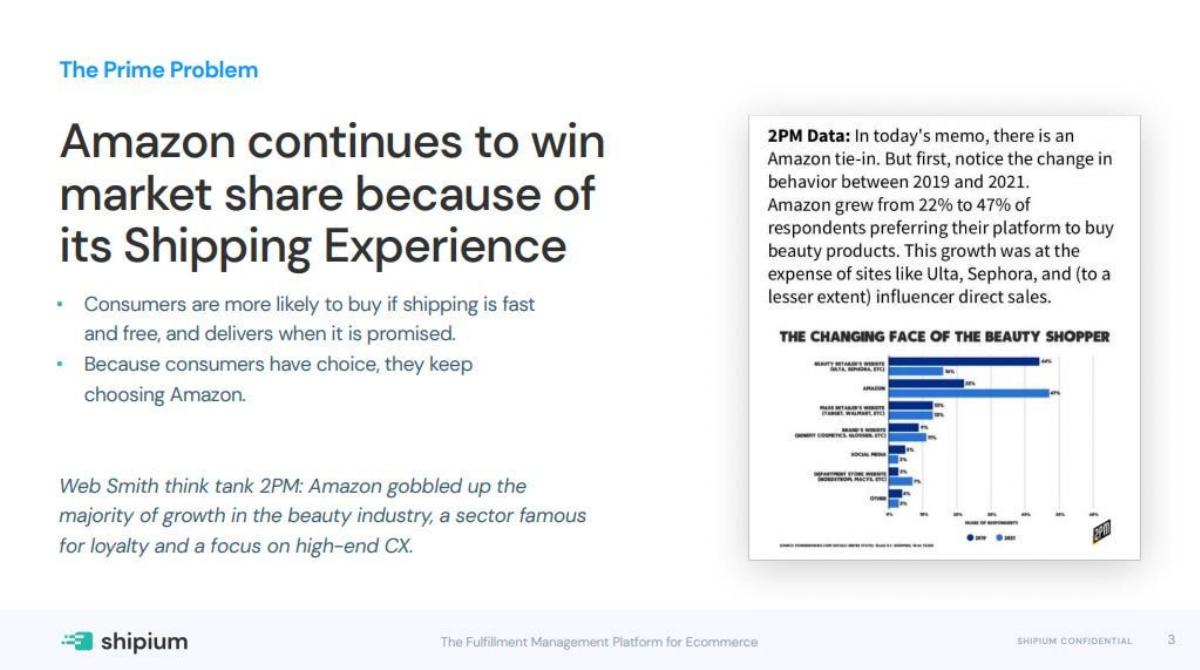
- Shipium identifies a specific market shift, citing 2PM data that Amazon grew from 22% to 47% preference in the beauty sector due to shipping (Slide 3).
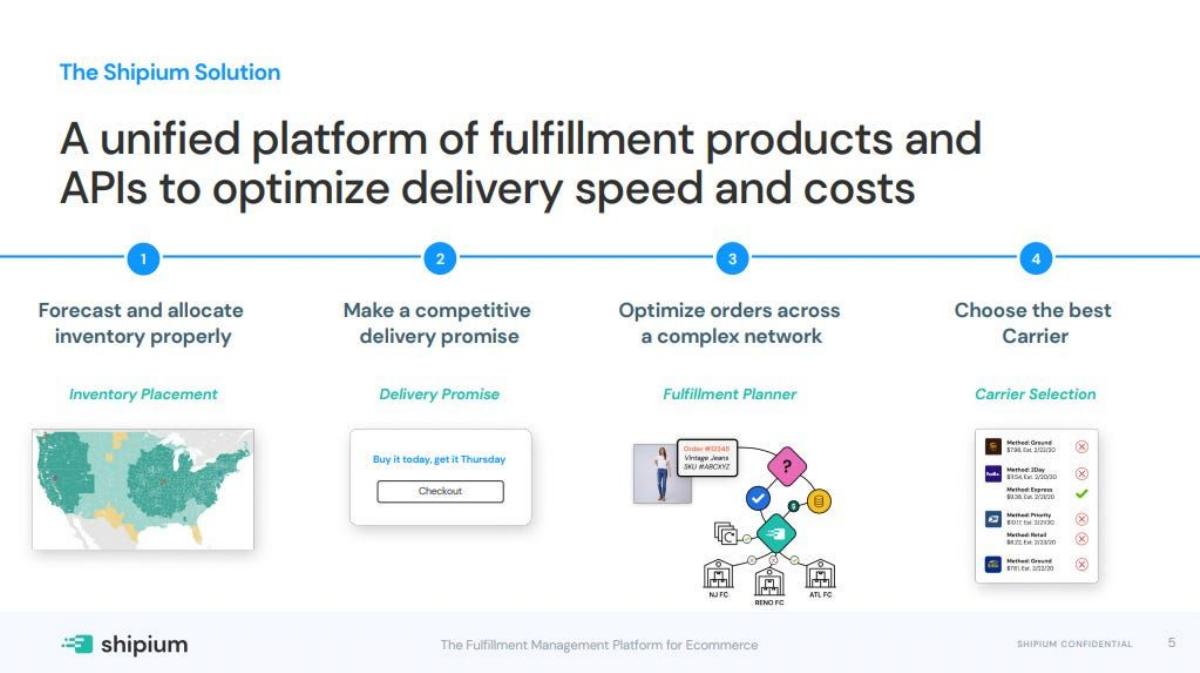
- The solution is presented as a four-step unified platform: Inventory Placement, Delivery Promise, Fulfillment Planner, and Carrier Selection (Slide 5).
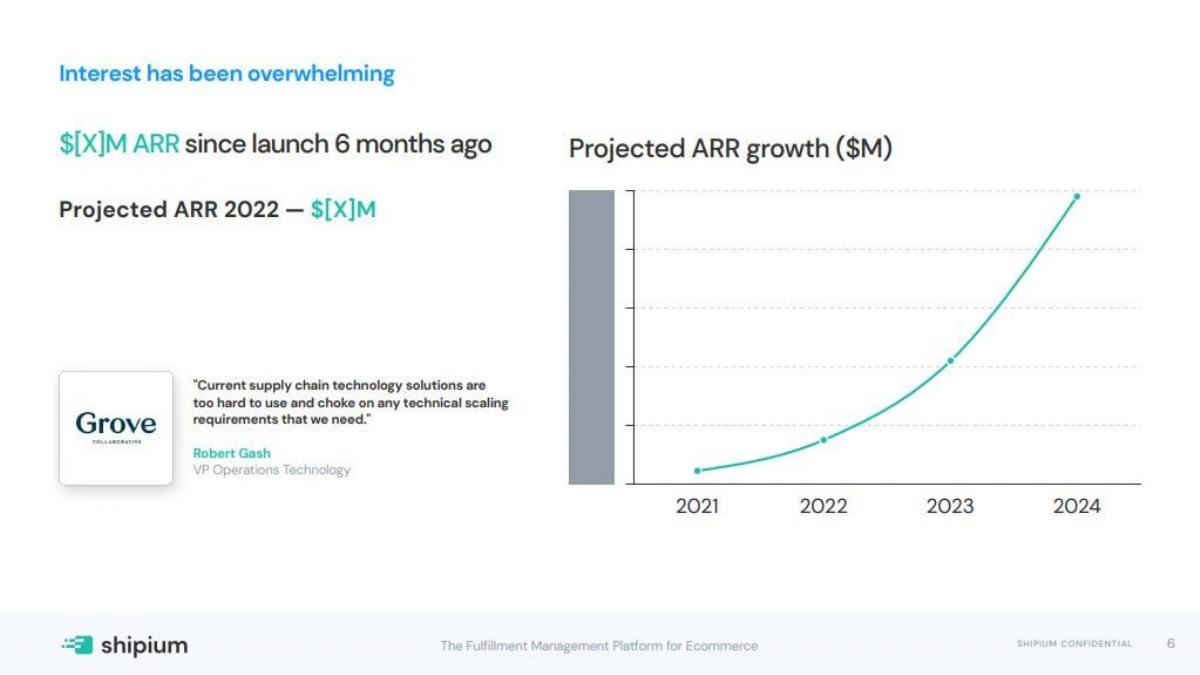
- Traction is framed through growth velocity, claiming significant ARR growth since a launch only six months prior to the deck's creation (Slide 6).
- The deck uses a quote from a 'Top 50 ecommerce retailer' to validate that their API-first integration is faster than legacy alternatives (Slide 8).
- Market sizing is presented as a comparison between 2022 TAM and a significantly larger 2026 projected TAM, though specific dollar values are redacted in this version (Slide 7).
- The financing history slide highlights a $10.3M Seed round backed by 'Good Friends,' a firm founded by the creators of Warby Parker and Allbirds (Slide 9).
- The deck omits a formal 'Ask' slide, a detailed Go-To-Market strategy, and a breakdown of the current employee headcount.
The Power of Pedigree in Enterprise SaaS
Shipium’s pitch deck for their $27.5M Series A is a concise, 10-slide presentation that relies heavily on the 'who' and the 'why' rather than the 'how.' In an industry as crowded as e-commerce logistics, the founders, Jason Murray and Mac Brown, chose to lead with their history at Amazon and Zulily. This teardown examines how they structured their narrative to turn a complex logistics problem into a high-stakes race for survival against Amazon.
Slide 1: Title Slide
The deck opens with a clean, minimalist title slide. It identifies Shipium as 'The Fulfillment Management Platform for Ecommerce.' By including the names of both founders and their roles (CEO and CTO) immediately, the deck signals that this is a team-led pitch. The imagery of a package being handed over reinforces the physical reality of their digital product.
Slide 2: The 'Industry Insiders' Team Slide
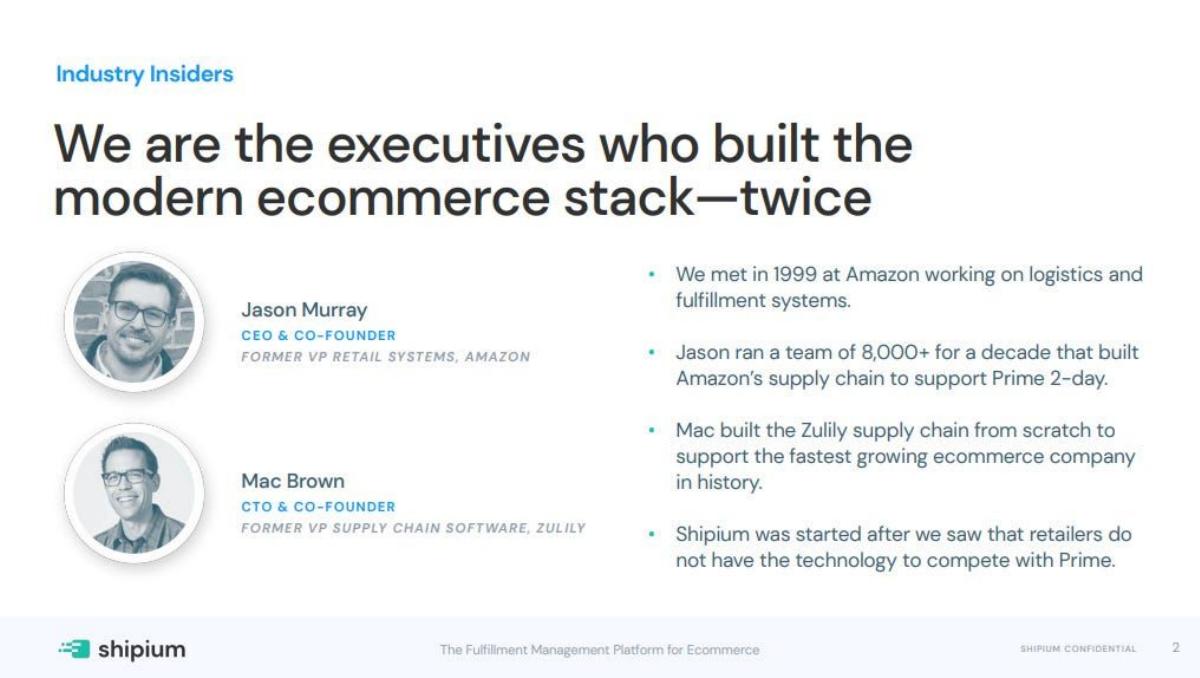
Usually, the team slide appears at the end of a deck. Shipium moves it to Slide 2, which is a strategic choice when the founders are the primary selling point. The slide states they 'built the modern ecommerce stack—twice.' The bullet points are high-impact: Jason Murray ran a team of 8,000+ for a decade at Amazon, and Mac Brown built the Zulily supply chain from scratch. This establishes immediate authority; they aren't just identifying a problem, they are the people who solved it for the market leader.
Slide 3: The Prime Problem
Slide 3 defines the enemy: Amazon. It uses data from the '2PM' think tank to show a specific case study in the beauty industry. The chart, 'The Changing Face of the Beauty Shopper,' illustrates Amazon’s growth from 22% to 47% market share between 2019 and 2021. The takeaway is clear: retailers aren't losing because their products are bad; they are losing because their 'Shipping Experience' cannot compete with Prime.
Slide 4: The Technology Gap
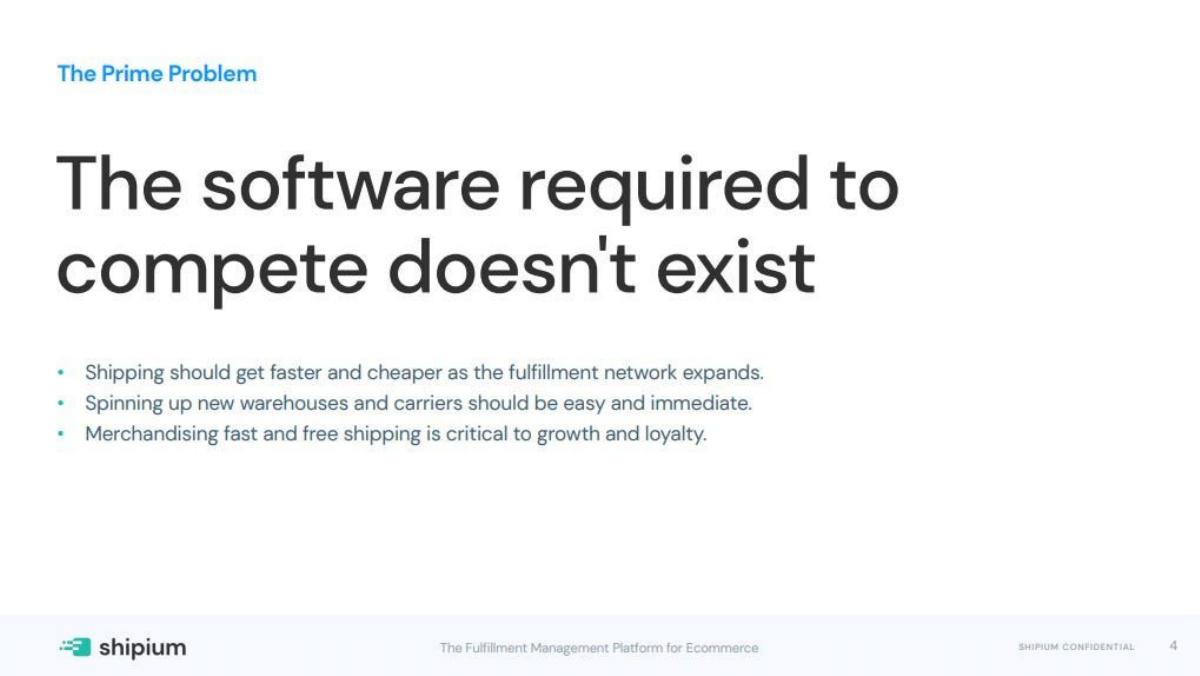
This slide bridges the problem to the solution by asserting that 'The software required to compete doesn't exist.' It lists three requirements: shipping must get faster/cheaper as networks expand, adding warehouses/carriers must be immediate, and fast shipping must be a merchandising tool. This sets the stage for Shipium to be the 'missing' infrastructure.
Slide 5: The Shipium Solution
Shipium breaks its platform into four distinct steps: 1. Inventory Placement (forecasting), 2. Delivery Promise (showing delivery dates at checkout), 3. Fulfillment Planner (optimizing orders), and 4. Carrier Selection (choosing the best shipping method). This slide is the most 'product-heavy' in the deck, using small screenshots and flowcharts to show that their API covers the entire lifecycle of an order, not just the final label printing.
Slide 6: Traction and Projections
Slide 6 uses the headline 'Interest has been overwhelming.' It mentions that the company launched only six months prior to this deck. While the ARR figures are redacted in this public version ($[X]M), the 'Projected ARR growth' chart shows a classic 'hockey stick' curve from 2021 through 2024. The inclusion of a quote from Robert Gash, VP of Operations Technology at Grove Collaborative, provides enterprise-level validation.
Slide 7: Market Tailwinds
The TAM (Total Addressable Market) slide focuses on growth and complexity. It cites an 11% CAGR through 2026, supported by Gartner and IDC data. The visual representation—a small 2022 TAM bubble inside a much larger 2026 bubble—emphasizes that the problem Shipium solves is becoming more valuable every year as logistics networks become more 'complicated.'
Slide 8: Competitive Differentiation
Instead of a standard 'feature checklist' grid, Shipium uses a text-based approach to competition. They highlight their 'API-first platform' and 'sophisticated data modeling.' A key claim is their 'access to data no company can obtain on their own if they choose to DIY.' The slide concludes with a powerful testimonial from a 'CTO at a Top 50 ecommerce retailer' who claims to be 'blown away' by the integration speed.
Slide 9: Financing History
This slide serves as a final layer of social proof. It notes that the company was formed in October 2019 and raised $10.3M in a Seed round closed in June 2021. By highlighting investors like Trilogy Equity and PSL Ventures, and specifically calling out 'Good Friends' (founded by the creators of Warby Parker and Harry's), Shipium aligns itself with the most successful names in modern retail.
Slide 10: Closing
The deck ends with a simple 'Thank You!' slide, repeating the founder names and titles. There is no 'Ask' slide in this version, which is common in high-profile Series A rounds where the terms are often negotiated based on the strength of the lead investor's interest rather than a fixed price set by the founder.
What Shipium Does Well
The deck is exceptionally focused. It doesn't waste time explaining what e-commerce is or why shipping matters in a general sense. It assumes the investor understands the market and focuses entirely on the technical gap between Amazon and everyone else. By positioning the founders as the architects of the very systems they are now disrupting, they create a sense of inevitability. The use of third-party data (2PM, Gartner) adds an objective layer to their claims, making the 'Prime Problem' feel like an industry-wide emergency rather than just a sales pitch.
What is Missing from the Deck
For a Series A, the deck is surprisingly light on operational metrics. There is no mention of Unit Economics (CAC, LTV, Payback Period), nor is there a Go-To-Market (GTM) slide explaining how they plan to acquire the next 50 enterprise customers. The competitive section is also quite vague; it doesn't mention specific rivals like Flexe, ShipStation, or Stord, which would be top-of-mind for a logistics investor. Finally, the lack of a Hiring Plan or 'Use of Funds' slide leaves the question of what the $27.5M will actually be spent on—though in a 'hot' round, these details are often moved to the due diligence data room rather than the main pitch deck.
Founder Takeaways
Founders should study how Shipium uses narrative framing . Instead of saying 'we have a better shipping API,' they say 'Amazon is winning because of a technology gap that we are uniquely qualified to bridge.' If you have a high-pedigree team, put them on Slide 2. If your market has a clear 'Goliath,' use their success as the primary justification for your existence. Shipium proves that you don't need 30 slides to raise $27M; you need a clear problem, a massive market, and a team that looks like they've already won the game before.
Frequently asked questions
- Why does the deck focus so much on Amazon?
- The founders' primary value proposition is that they built the systems Amazon uses to dominate. By framing Amazon as the 'Prime Problem' (Slide 3), they position Shipium as the only way for other retailers to access similar technology. It turns a competitor's strength into a sales catalyst for Shipium's software.
- What is missing from the traction slide?
- Slide 6 lacks raw numbers for ARR, CAC, or LTV. While the version shown has placeholders like $[X]M, even in a full deck, the focus is on the 'overwhelming' interest and the slope of the projection curve rather than granular unit economics, which is common for high-pedigree Series A rounds.
- How does Shipium differentiate itself from other shipping APIs?
- On Slide 8, they claim a 'unique ability to combine front end experiences with backend operations.' Unlike simple label-printing APIs, Shipium focuses on the entire fulfillment logic, from inventory placement to the 'Delivery Promise' shown at checkout.
- Who are the key investors mentioned in the deck?
- Slide 9 lists Trilogy Equity, PSL Ventures, and Good Friends. The latter is specifically noted as a VC firm started by the founders of iconic D2C brands Warby Parker, Harry's, and Allbirds, providing significant industry social proof.
- Is the market size slide effective?
- Slide 7 uses a simple bubble chart to show market expansion. While it lacks specific sub-sector breakdowns, it attributes growth to '11% CAGR' and the 'Covid growth lever,' framing the market as both large and increasingly complex, which justifies an enterprise software solution.