Shiplyst’s 2017 pre-seed deck is a masterclass in brevity, using just 9 slides to articulate a clear value proposition in the complex ocean freight industry. By highlighting a staggering 122-hour average quote time in the status quo and contrasting it with their 'few seconds' solution, the founders created immediate urgency. The deck relies on strong early traction, citing a 90%+ repeat order rate and 50%+ quarter-on-quarter growth throughout 2019. While it lacks a formal 'Ask' slide or detailed financial projections, the team slide serves as a significant trust signal, showcasing two founder…
Key takeaways
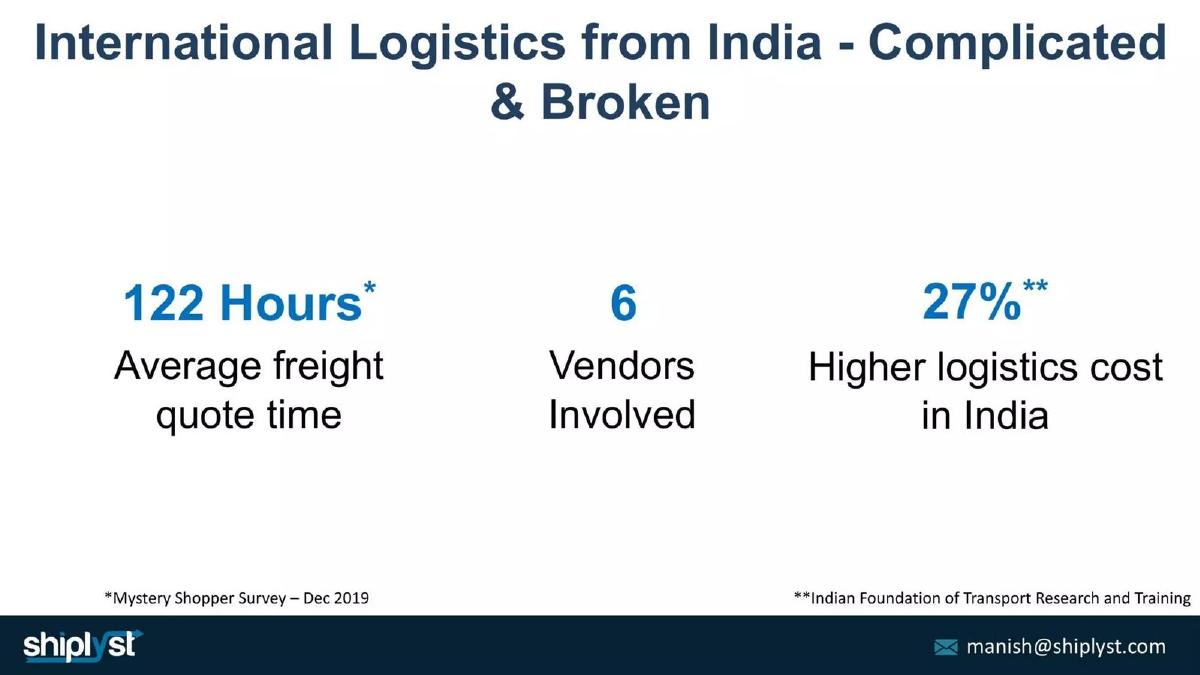
- The deck identifies a massive friction point: a 122-hour average freight quote time in India (Slide 2).
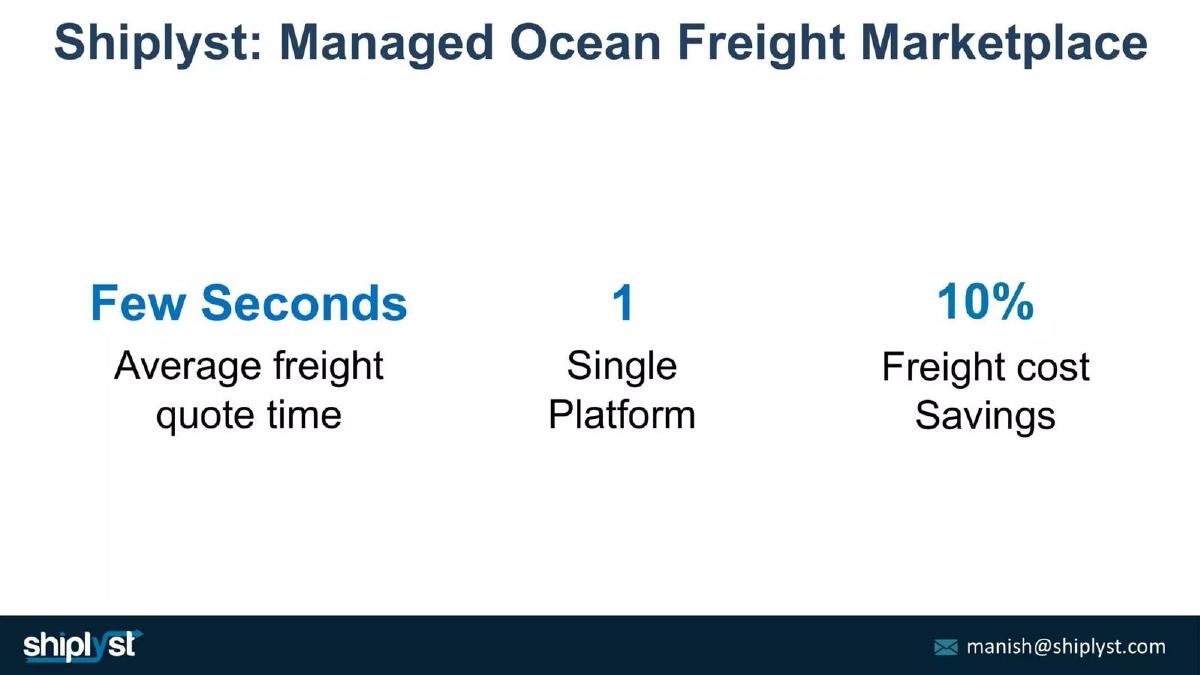
- Shiplyst claims to reduce this quote time to 'Few Seconds' through a single platform (Slide 3).
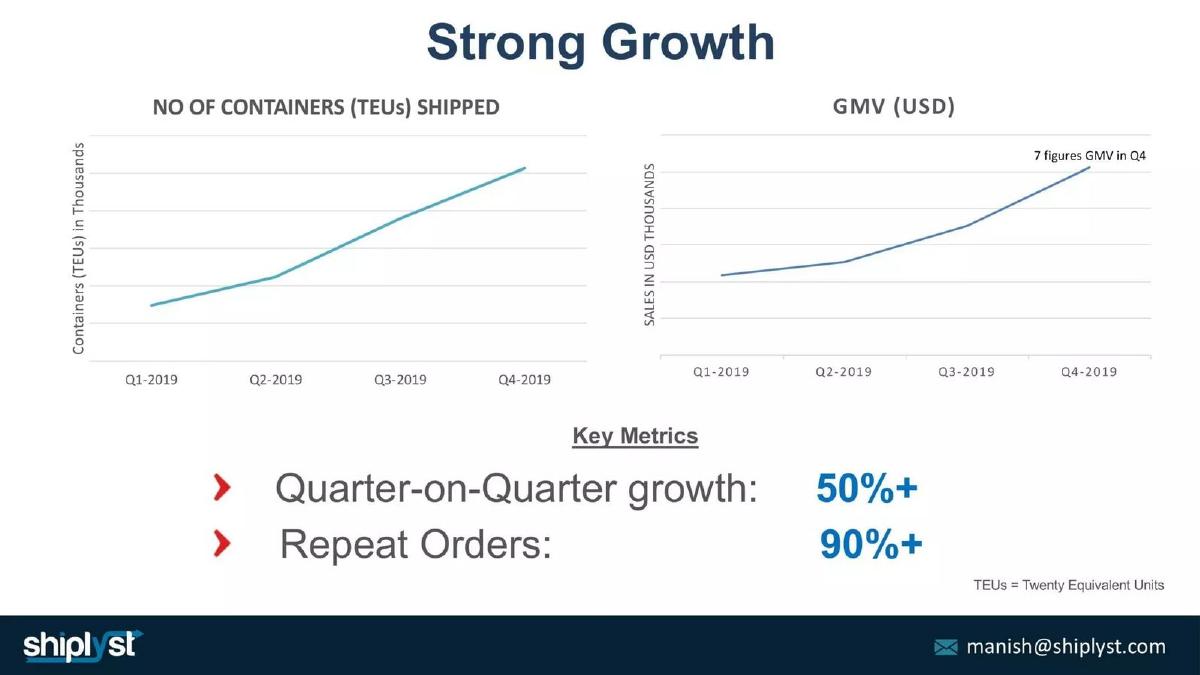
- Traction is demonstrated by a 90%+ repeat order rate and 50%+ quarter-on-quarter growth (Slide 4).
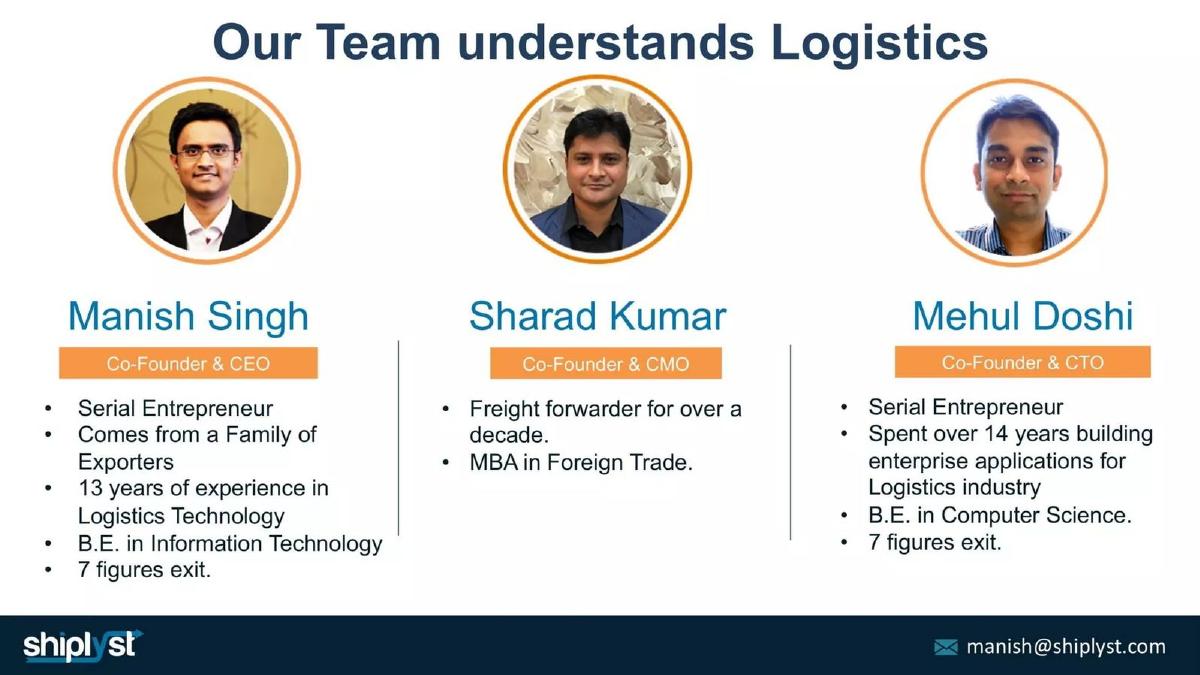
- The founders highlight significant domain expertise, including two team members with prior 7-figure exits (Slide 6).
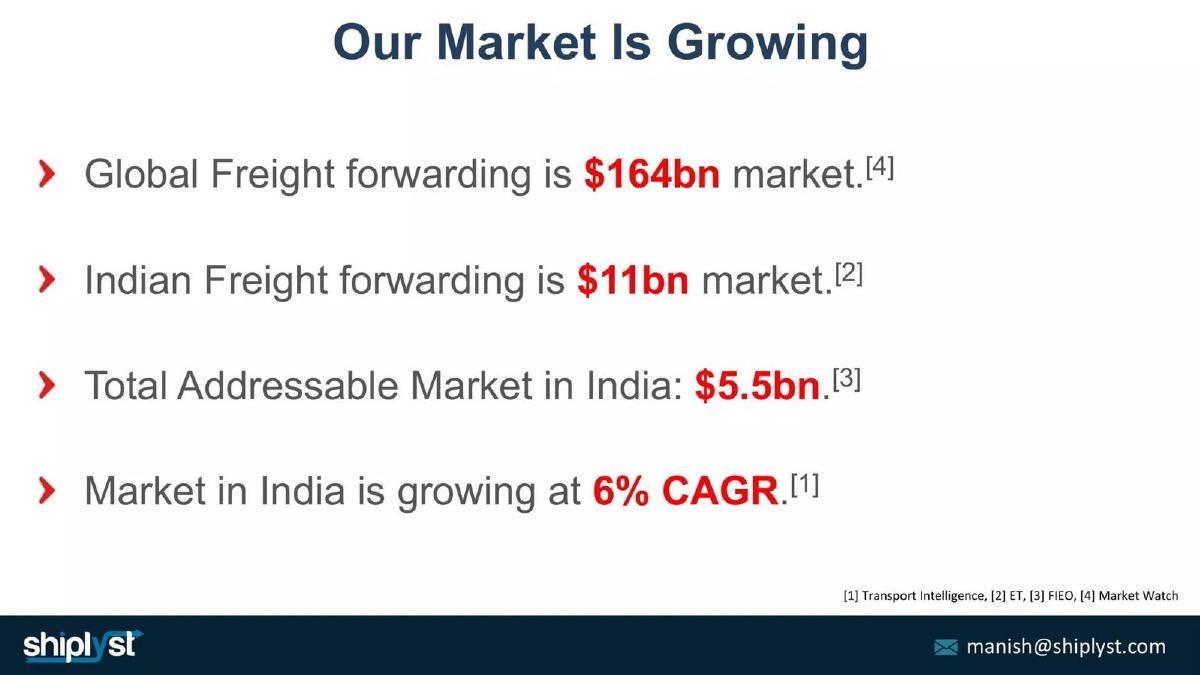
- The market opportunity is localized, citing an $11bn Indian freight forwarding market growing at 6% CAGR (Slide 5).
- Operational efficiency is a core claim, with the platform reportedly offering up to 6x improvement (Slide 7).
- The deck omits a specific funding ask, valuation, or use of funds breakdown (Omitted).
- A summary slide (Slide 8) consolidates all key metrics, including a customer base of 800+ signups.
Executive Summary: The 9-Slide Efficiency Play
Shiplyst’s pitch deck is a lean, high-impact document that prioritizes speed and clarity over exhaustive detail. In just nine slides, the company establishes a clear problem-solution fit within the Indian ocean freight market. By focusing on the extreme friction of the current manual process—specifically the 122-hour wait time for quotes—Shiplyst makes a compelling case for digitization. The deck is light on design but heavy on 'trust signals,' particularly the founders' previous exit history and high repeat customer rates.
Slide 1: Title and Tagline
The cover slide features a large container ship, immediately grounding the pitch in the physical reality of global trade. The logo is simple, incorporating an arrow to signify movement and progress. The tagline, 'YOUR SHIPPING CATALYST,' positions the company not just as a tool, but as an accelerant for business. Contact information for the CEO, Manish Singh, is prominently displayed at the bottom right, a practice maintained throughout the deck.
Slides 2-3: The Contrast of Inefficiency
Slide 2, titled 'International Logistics from India - Complicated & Broken,' uses three stark metrics to define the problem. It cites a '122 Hours' average freight quote time based on a 'Mystery Shopper Survey' from December 2019. It also notes that '6 Vendors' are typically involved and that India suffers from a '27%' higher logistics cost. This slide is effective because it quantifies the pain in a way that makes the solution feel necessary rather than optional.
Slide 3 provides the immediate counterpoint. It describes Shiplyst as a 'Managed Ocean Freight Marketplace' and claims to reduce the quote time to 'Few Seconds.' It promises a 'Single Platform' (reducing the vendor count from 6 to 1) and '10% Freight cost Savings.' The symmetry between Slide 2 and Slide 3 is a classic narrative technique that clearly defines the value proposition.
Slide 4: Traction and Growth
The 'Strong Growth' slide uses two line charts to show progress across 2019. The first chart shows the number of containers (TEUs) shipped, trending upward from Q1 to Q4. The second chart shows GMV (USD) in thousands, with a specific callout for '7 figures GMV in Q4.' Below the charts, two key metrics are highlighted: 'Quarter-on-Quarter growth: 50%+' and 'Repeat Orders: 90%+.' The repeat order rate is arguably the most important figure in the deck, as it proves product-market fit and customer satisfaction in a notoriously fickle industry.
Slide 5: Market Opportunity
Shiplyst frames its market starting with the global context and narrowing down to the Indian opportunity. It cites a '$164bn' global freight forwarding market and an '$11bn' Indian market. The 'Total Addressable Market in India' is pegged at '$5.5bn,' with a '6% CAGR.' While these numbers are large, the slide is grounded by citations from sources like Transport Intelligence, ET, and FIEO, which adds credibility to the projections.
Slide 6: The Team
The 'Our Team understands Logistics' slide is a significant strength of this deck. It features three co-founders: Manish Singh (CEO), Sharad Kumar (CMO), and Mehul Doshi (CTO). The bullet points emphasize deep experience: '40+ years of Logistics & Technology experience' collectively. Crucially, both the CEO and CTO are noted for having '7 figures exit' histories. This reduces the perceived risk for investors, as the leadership has a proven track record of building and selling companies.
Slide 7: Market Differentiator
This slide outlines why Shiplyst will win against incumbents and new entrants. It lists four pillars: 'Early mover advantage' in the Indian digital space, 'Relationships & Partnerships' with top shipping lines, a 'Fully automated platform' yielding '6x operational efficiency,' and the 'Managed Marketplace' model. The mention of 6x efficiency is a bold claim that suggests the company can scale without a linear increase in headcount.
Slide 8: The Summary Slide
Slide 8 acts as a 'cheat sheet' for the entire deck. It organizes information into four quadrants: 'About Us,' '12 months Company Statistics,' 'Differentiator & Advantages,' and 'Customers.' It reveals new information not found on previous slides, such as a 'Logistics & Technology Team of 30+' and an HQ in San Francisco with offices in Mumbai, Indore, and Bangalore. The customer section displays logos for companies like Crystal, Bilt, Schreiber, and Vadilal, providing social proof from established Indian enterprises.
Slide 9: Conclusion and Press
The final slide is a standard 'Thank You' page but includes logos for 'Startup India' and 'Make in India,' suggesting government recognition or alignment with national initiatives. It also features 'As Seen In' logos for TechCrunch, YourStory, and TechInAsia, further validating the company’s presence in the startup ecosystem.
What Works in the Shiplyst Deck
The primary strength of this deck is its quantified problem statement. Many founders describe problems qualitatively ('shipping is hard'), but Shiplyst uses a specific number—122 hours—to anchor the investor's understanding of the inefficiency. This makes the 'few seconds' solution feel like a massive technological leap.
Furthermore, the repeat order rate of 90%+ is a powerful indicator of a 'sticky' product. In the logistics world, where price-shopping is rampant, such a high retention rate suggests that the platform's workflow benefits (document exchange, live tracking) are as valuable to the customer as the price savings.
The founder-market fit is also exceptionally clear. By highlighting both technical exits and deep domain expertise (a decade as a freight forwarder), the team addresses the two biggest hurdles in logistics tech: building the software and understanding the arcane rules of global shipping.
What is Missing from the Shiplyst Deck
The most glaring omission is a formal 'Ask' slide. There is no mention of how much capital the company is seeking, the terms of the round, or the specific milestones they intend to hit with the new funding. While this information is often shared in a separate document or during the pitch, its absence in the deck makes the presentation feel more like a company update than a fundraising tool.
Additionally, the deck lacks unit economics. While GMV and container volume are growing, there is no data on the take-rate (the percentage Shiplyst keeps from each transaction) or the cost to acquire a customer (CAC). Without these, it is difficult for an investor to judge the long-term profitability of the marketplace.
Finally, the competitive landscape is largely ignored. The deck mentions an 'early mover advantage' but does not name or analyze other digital freight forwarders (like Flexport or BlackBuck) that might be entering the Indian market. A 'Competitor Matrix' would have helped define Shiplyst's unique moat more effectively.
What Founders Should Copy
Founders should emulate Shiplyst’s use of symmetry between the Problem and Solution slides. By using the same metrics (Quote time, Number of vendors, Cost) on both slides, they create a clear 'before and after' picture that is easy for an investor to digest in seconds.
The Summary Slide (Slide 8) is another excellent feature. Many investors skip through decks quickly; providing a single page that captures the team, traction, customers, and differentiators ensures that the most important facts are communicated even if the investor only looks at one slide.
Lastly, the inclusion of specific data sources for market size (Slide 5) is a best practice. It shows that the founders have done their homework and aren't just pulling 'billions' out of thin air to look impressive. Using recognized industry bodies for citations builds immediate trust in the founders' professionalism.
Final Verdict: Shiplyst’s deck is a highly efficient, data-driven pitch that relies on the sheer scale of the problem and the proven capability of its team. While it lacks some of the financial granularity expected in later rounds, for a pre-seed or seed-stage raise, it provides exactly what is needed: proof of a massive pain point and evidence that the team is already solving it for a growing, loyal customer base.
Frequently asked questions
- How much did Shiplyst raise with this deck?
- According to the catalogue listing, Shiplyst raised $271,000 in a Pre-Seed round in 2017. Interestingly, the deck itself features data from 2019, suggesting this version was likely used for follow-on discussions or a later bridge, despite the initial 2017 funding date noted in the records.
- What is the primary problem Shiplyst solves?
- The deck focuses on the 'complicated and broken' nature of international logistics in India. Specifically, it points to the involvement of 6 different vendors per shipment and a 27% higher logistics cost in India compared to global benchmarks, largely driven by manual processes that take over 120 hours for a single quote.
- Does the deck show financial projections?
- No. The deck is entirely focused on historical traction and market size. It shows GMV growth through Q4 2019, reaching '7 figures,' but it does not provide a forward-looking pro forma, burn rate analysis, or revenue targets for the coming years.
- Who are the founders and what is their background?
- The team consists of Manish Singh (CEO), Sharad Kumar (CMO), and Mehul Doshi (CTO). Singh and Doshi are both described as serial entrepreneurs with previous 7-figure exits. Kumar brings over a decade of experience as a freight forwarder, providing the necessary industry-specific 'insider' knowledge.
- What is missing from this pitch deck?
- The deck is missing several standard components: a specific 'Ask' (how much they are raising), a 'Use of Funds' slide, a detailed competitor matrix, and unit economics (CAC/LTV). It relies heavily on high-level growth percentages rather than granular financial health metrics.