SidelineSwap’s 2015 pitch deck is a masterclass in the 'niche marketplace' thesis. The deck avoids over-explaining the product, instead letting a $2MM GMV annual run rate and 20% month-over-month growth (Slide 5) do the heavy lifting. By positioning themselves alongside billion-dollar successes like Etsy and Poshmark (Slide 9), the founders framed the fragmented $60B sporting goods market (Slide 4) as a ripe opportunity for verticalization. The deck is notably light on technical details and unit economics, focusing almost entirely on top-line traction and the unique behavior of their 'athlete…
Key takeaways
- The deck leads with a massive $2MM GMV annual run rate on Slide 2 to immediately establish credibility.
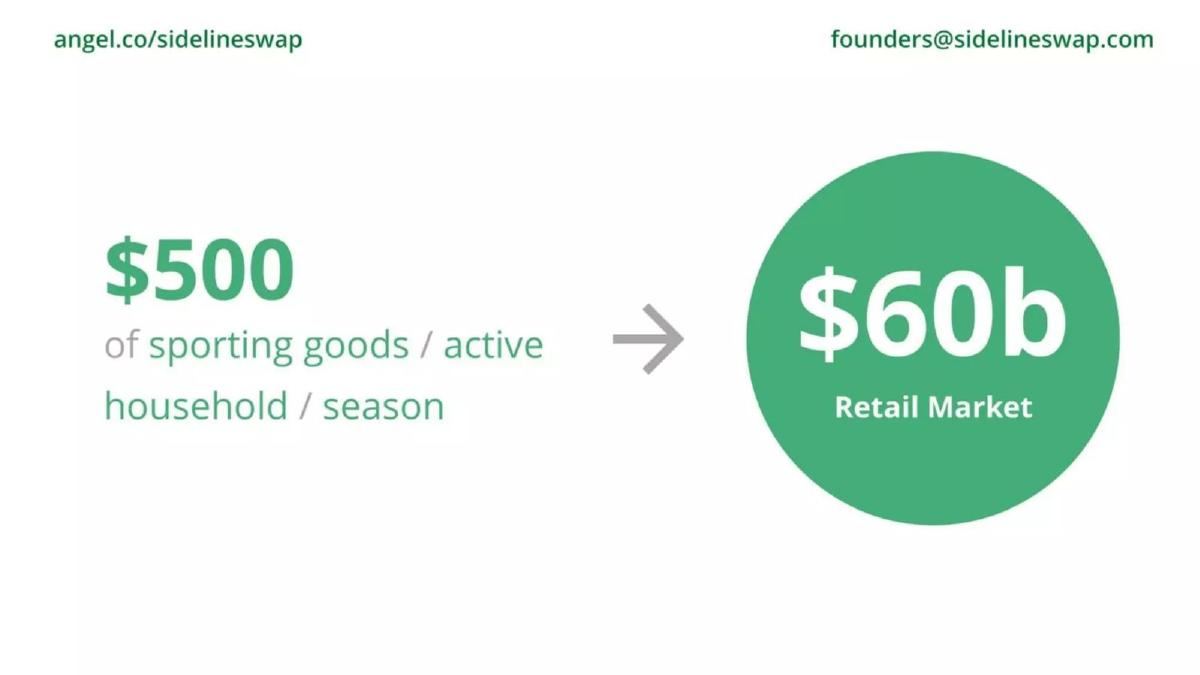
- Market size is framed as $500 of sporting goods per active household per season, leading to a $60B retail market (Slide 4).
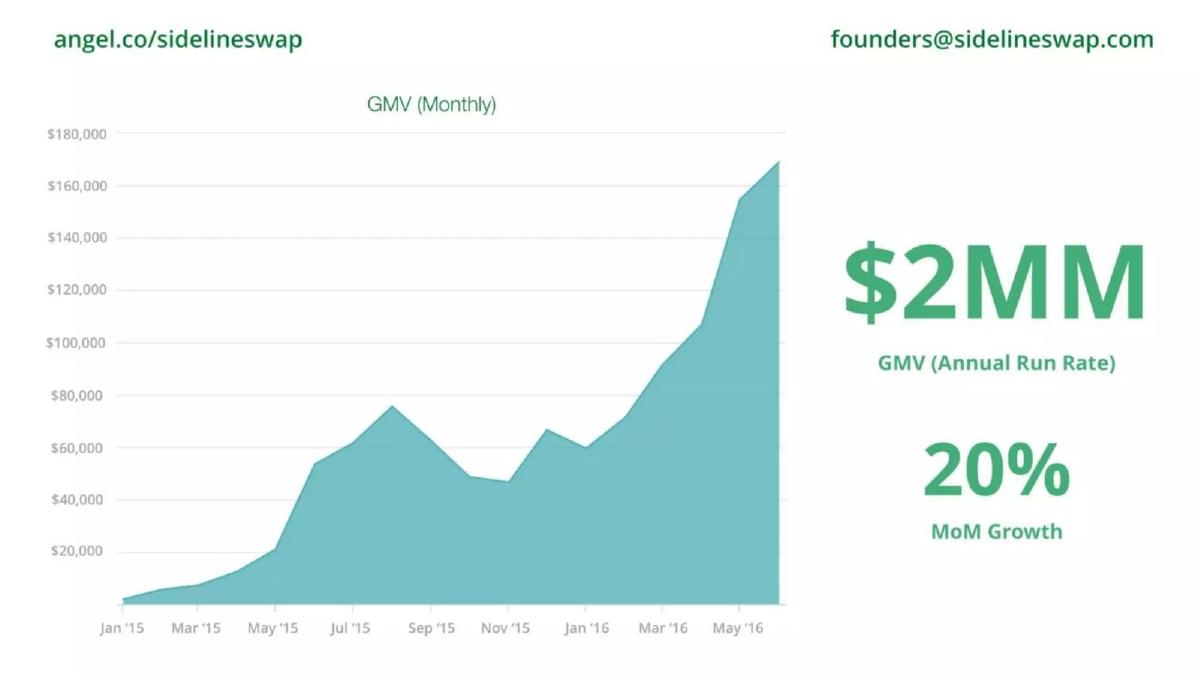
- Traction is visualized through a GMV chart showing a significant inflection point starting in early 2016 (Slide 5).
- User exclusivity is a key differentiator, with 95% of sellers having never sold on another marketplace (Slide 6).
- The company utilizes Instagram as a primary acquisition channel, signaling a modern, social-first growth strategy (Slide 7).
- The 'niche' marketplace thesis is explicitly stated, comparing the company to Poshmark, Etsy, and Reverb (Slide 9).
- The team slide highlights a mix of athletic backgrounds and tech experience from companies like Yelp and Skillshare (Slide 10).
- The deck omits a formal 'Ask' slide, financial projections, and detailed unit economics like CAC or LTV.
The Niche Marketplace Playbook
SidelineSwap’s 11-slide deck is a concise example of a Series A pitch that relies on traction over theory. In 2015, the 'unbundling of eBay' was a major investment theme. Startups were proving that by focusing on a single category—like fashion with Poshmark or handmade goods with Etsy—they could provide a superior user experience that generalist platforms couldn't match. SidelineSwap applied this logic to the $60B sporting goods market.
The Hook: Immediate Traction
Slide 1 & 2: The Intro and the Big Number The deck opens with a simple title slide featuring the tagline: "Where athletes buy and sell their gear." Immediately following the title, Slide 2 presents a single figure: $2MM GMV (Annual Run Rate) . This is a bold tactical choice. By putting the most impressive metric on the second slide, the founders eliminate any doubt about product-market fit before the investor even sees the problem or solution slides.
Defining the Problem and Market
Slide 3: The Visual Problem Instead of a bulleted list of pain points, Slide 3 is a full-bleed photograph of a cluttered garage filled with bicycles, lacrosse sticks, and bins. It is a visceral representation of the 'supply' sitting idle in American homes. It requires no text to explain that athletes have too much expensive gear they no longer use.
Slide 4: Market Sizing The deck quantifies the opportunity on Slide 4 . They estimate that an active household spends $500 on sporting goods per season. They then point to a $60B Retail Market . This slide bridges the gap between the 'messy garage' and a venture-scale opportunity. It suggests that the secondary market for sports gear is not a niche hobby, but a massive untapped financial asset class for families.
The Growth Engine
Slide 5: The Traction Curve This is the 'money slide' of the deck. It shows a monthly GMV chart from January 2015 to May 2016. While 2015 shows steady but slow growth, the chart depicts a sharp inflection point in early 2016, with May '16 ending near $170,000 for the month. The slide reiterates the $2MM GMV Annual Run Rate and adds a 20% MoM Growth figure. For a Series A investor, this 20% month-over-month growth is the primary signal of a scalable engine.
The User and the Product
Slide 6: The Exclusive Seller Slide 6 makes a powerful claim: "95% of sellers have never sold on another marketplace." This is a key defense against the 'eBay is already doing this' objection. It proves that the 'Athlete' is a specific persona that requires a specific community. The slide features a 'Power Seller' named @Callaugh who generated $9,638 in Year 1 sales, humanizing the data with a concrete success story.
Slide 7: Acquisition Channels The deck briefly touches on 'Why they use SidelineSwap?' highlighting three pillars: Acquired through new channels (Instagram) , Easy to list , and It works! The mention of Instagram is significant for 2015, as it shows the company was leveraging social commerce before it was a standard industry term.
The Vision and the Team
Slide 8 & 9: Retail and Comparables Slide 8 is a photo of a high-end hockey retail store, likely hinting at their future plans to work with retailers (as mentioned in their company description). Slide 9 then places SidelineSwap in the context of other 'Billion dollar marketplaces' like Poshmark, Etsy, and Reverb . This is a classic 'social proof' slide that uses the success of others to validate the company's own category potential.
Slide 10: The Team The team slide shows six members with backgrounds from State Farm, BU, Evertrue, NYU, Skillshare, Bucknell, Harvard, and Yelp . They also list their 'Coaching Staff' (advisors/accelerators), including MassChallenge, 500 Startups, and the Harvard Innovation Lab . This demonstrates they have been vetted by reputable startup ecosystems.
What Works in This Deck
Metric Forward: Leading with GMV and growth rates immediately qualifies the business as a high-growth startup. · Visual Storytelling: The 'garage' photo (Slide 3) and the 'power seller' profile (Slide 6) make the marketplace feel real and active. · The 95% Stat: The exclusivity of the seller base is the strongest argument for why this marketplace needs to exist independently of eBay. · Category Comparison: Aligning with Poshmark and Etsy helps investors understand the business model and potential exit scale without needing a complex explanation.
What Is Missing
The Ask: There is no slide stating how much capital is being raised or what the valuation expectations are. · Unit Economics: While GMV is great, the deck doesn't show the 'Take Rate' (revenue), Customer Acquisition Cost (CAC), or Lifetime Value (LTV). Investors need to know if that 20% MoM growth is profitable or sustainable. · Competitive Landscape: The deck ignores direct competitors in the used sports gear space (like Play It Again Sports or eBay), focusing only on positive comparables. · Product Roadmap: There is very little information on the actual technology or how the 'trade-in program' mentioned in their description actually functions.
What a Founder Should Copy
The 'Niche' Thesis: If you are building a vertical marketplace, use Slide 9's format to show that your category is the next logical step in the unbundling of a giant incumbent. · Simple Traction Charts: Slide 5 is a perfect example of how to display growth. It’s clean, the axes are clear, and the key takeaway (20% MoM) is written in large text. · Persona Focus: Defining the customer as 'The Athlete' (Slide 6) rather than just 'a user' helps in building a brand identity that investors can visualize.
Frequently asked questions
- What was the primary growth metric used in the SidelineSwap deck?
- The primary metric was Gross Merchandise Volume (GMV). The deck highlights a $2MM annual run rate and a consistent 20% month-over-month growth rate. By focusing on GMV rather than revenue, the founders emphasized the scale of the commerce occurring on their platform and the liquidity of their marketplace.
- How did SidelineSwap define its target market?
- They used a bottom-up approach to market sizing. Slide 4 calculates the market based on $500 spent on sporting goods per active household per season. This rolls up into a $60B total retail market, suggesting that a significant portion of this spend can be captured by a secondary peer-to-peer market.
- What is the significance of the '95% of sellers' statistic?
- On Slide 6, the deck claims 95% of sellers have never sold on another marketplace. This is a critical 'moat' argument. It suggests that SidelineSwap isn't just stealing users from eBay or Craigslist; it is expanding the market by providing a specialized experience that makes non-sellers become sellers.
- Which competitors are mentioned in the deck?
- The deck does not list direct competitors in the sports space. Instead, it lists 'comparables' on Slide 9: Poshmark (Fashion), Etsy (Arts & Crafts), and Reverb (Music Equipment). This strategy frames SidelineSwap as the inevitable winner of the sports category within the proven trend of verticalized marketplaces.
- What essential fundraising elements are missing from this deck?
- The deck is missing several standard slides: a clear 'Ask' (how much they are raising), a detailed 'Use of Funds,' a 'Competition' matrix, and 'Unit Economics' (CAC/LTV). It relies almost entirely on the momentum of the GMV growth curve to generate investor interest.