ManyChat’s Series A deck is an anomaly in the fundraising world, consisting of only 10 slides with minimal text and no traditional business plan components. It relies entirely on the 'Why Now'—the opening of messaging APIs—and a staggering traction curve showing 140,000+ bots created in under a year. The deck omits a team slide, financial projections, and a competitive landscape, choosing instead to emphasize its role as the 'visual bot builder' for a market of 900 million Facebook Messenger users. This teardown explores how ManyChat used extreme simplicity to signal product-market fit and ur…
Key takeaways
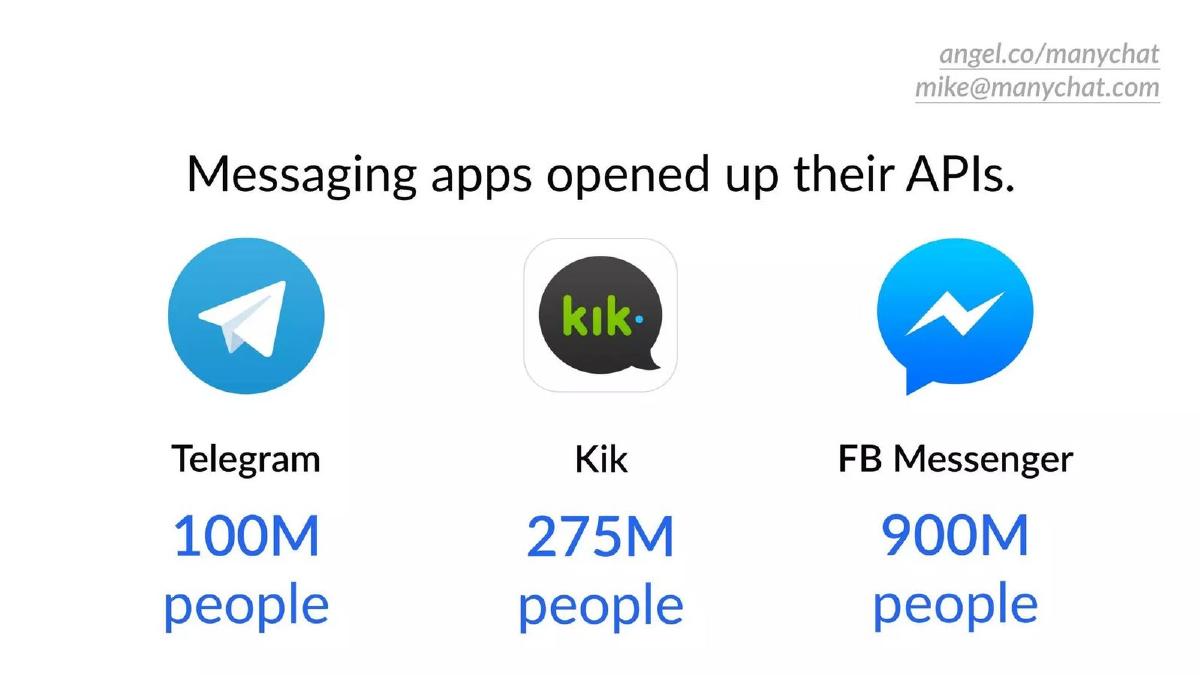
- The deck identifies a massive market shift: messaging apps opening their APIs to 1.275 billion combined users (Slide 2).
- ManyChat positions itself as a 'visual bot builder' to solve the technical barrier of coding, servers, and SSL certificates (Slide 5, 6).
- Traction is the centerpiece, showing a growth curve from zero in July 2015 to 140,000+ bots by April 2016 (Slide 8).
- The platform achieved a scale of 500 million messages per month before fully launching on Facebook Messenger (Slide 10).
- The deck completely omits a Team slide, an 'Ask' slide, and any mention of unit economics or monetization.
- The 'Why Now' is explicitly tied to Facebook Messenger's 900 million users and recent platform approval (Slide 2, 9).
- The presentation uses a 'billboard' style with fewer than 15 words on most slides to maintain high narrative velocity.
The Anatomy of a Momentum Deck
The ManyChat pitch deck is a fascinating artifact from the 2015-2016 era of 'Messenger Marketing.' While most Series A decks are dense with data, market sizing, and competitive moats, ManyChat opted for a high-velocity, minimalist approach. With only 10 slides and a total word count that barely exceeds a long tweet, this deck relies on the sheer force of its growth curve to do the talking. It is a 'momentum deck' in its purest form.
The Setup: Market Opportunity (Slides 1-4)
Slide 1: Title The deck opens with the company logo—an octopus-like bot—and the core value proposition: "Create Your Chat Bot in 5-Minutes." This immediately sets the expectation for speed and ease of use. The contact information for 'Mike' and an AngelList link are tucked in the corner, suggesting this deck was used for early outreach or as a follow-up to a demo.
Slide 2: The API Revolution This is the 'Why Now' slide. It lists three major platforms: Telegram (100M people), Kik (275M people), and FB Messenger (900M people). The headline is simple: "Messaging apps opened up their APIs." This signals a tectonic shift in the tech landscape, moving from closed ecosystems to open platforms where third-party developers can build.
Slide 3: The Thesis "Messengers are great for engagement and sales." This slide serves as a transition. It doesn't provide data yet; it simply states a belief that the investor must agree with for the rest of the deck to make sense. By highlighting 'engagement' and 'sales' in blue, ManyChat identifies the two primary use cases for their platform.
Slide 4: The Scalability Gap "The only scalable way to engage –" This is a cliffhanger slide. It sets up the problem of manual human interaction versus automated bot interaction. It implies that while messaging is great, it cannot scale for businesses without automation.
The Solution: Removing Friction (Slides 5-6)
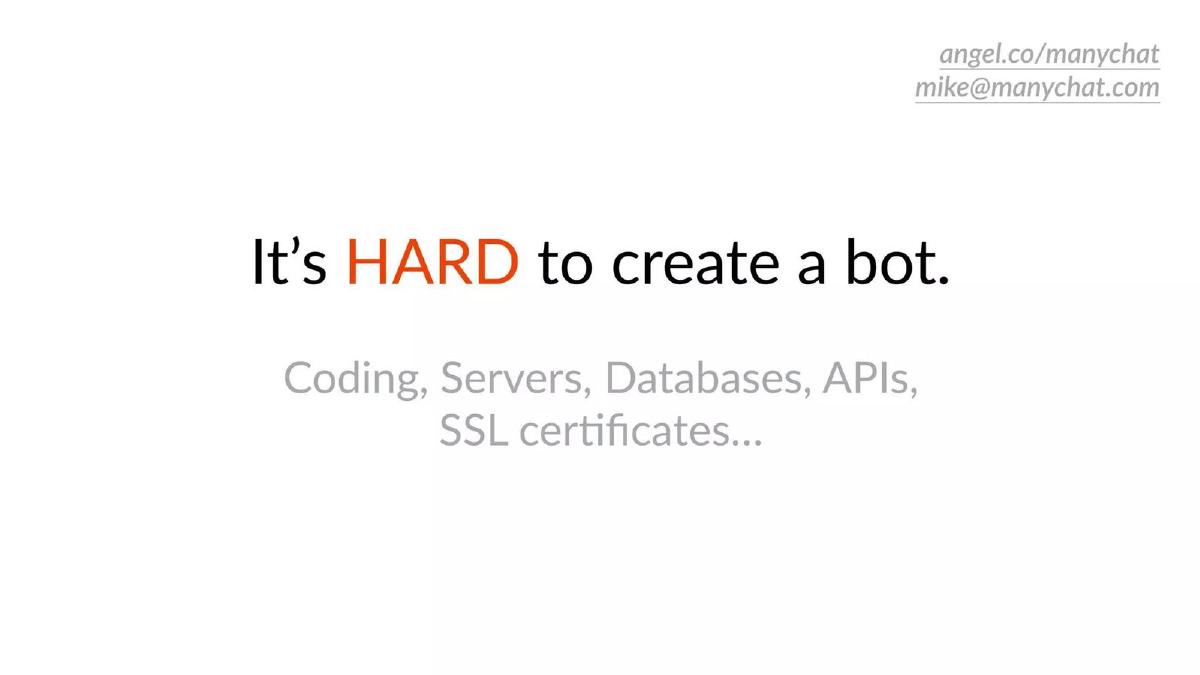
Slide 5: The Technical Barrier ManyChat identifies the pain point: "It’s HARD to create a bot." They list the technical requirements that scare off the average marketer: Coding, Servers, Databases, APIs, and SSL certificates. By highlighting 'HARD' in orange, they emphasize the friction that exists in the current market.
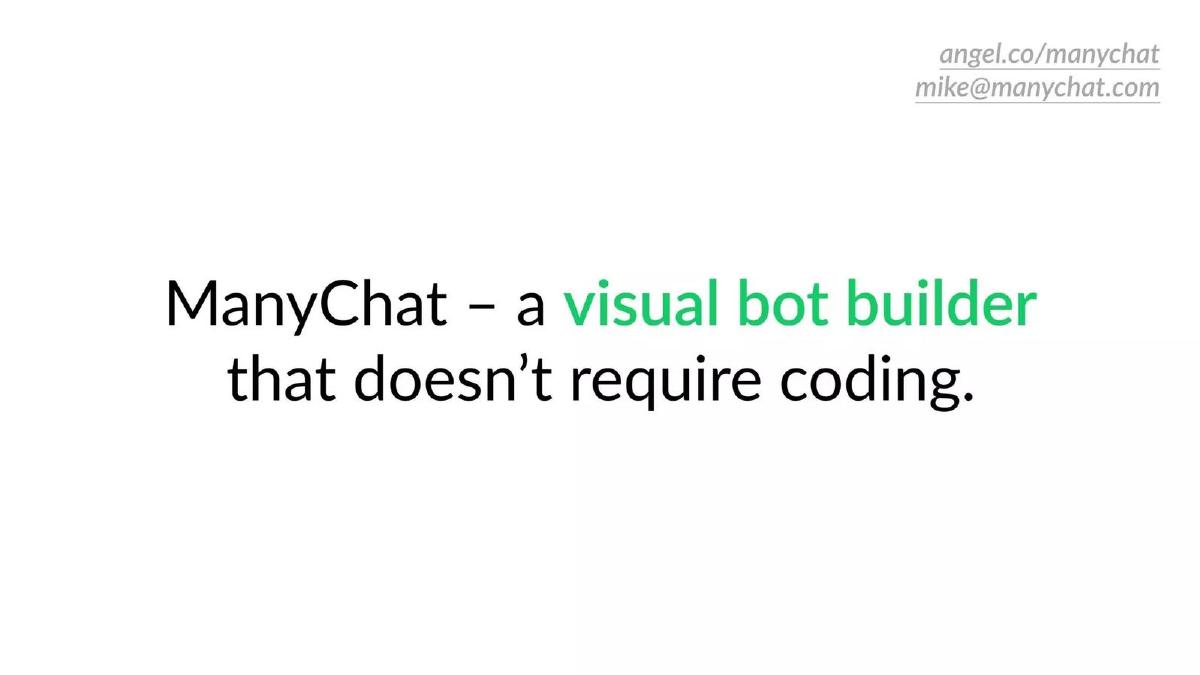
Slide 6: The Product Definition The solution is presented as "ManyChat – a visual bot builder that doesn’t require coding." This is a classic 'No-Code' value proposition. They aren't just building bots; they are democratizing the ability to build them. The use of green for 'visual bot builder' suggests growth and ease.
The Proof: Traction and Timing (Slides 7-10)
Slide 7: The Launch A simple three-word slide: "We launched." This serves as a psychological reset before the big reveal of the traction data. It builds anticipation for the results of the product described in the previous slides.
Slide 8: The Traction Curve This is the most important slide in the deck. It shows a 'Total Bots Created' chart from July 2015 to April 2016. The growth is nearly vertical, starting from zero and ending at over 140,000 bots. Two call-out boxes highlight the scale: "140,000+ bots" and "500M messages." This slide proves product-market fit more effectively than any theoretical argument could.
Slide 9: The Facebook Catalyst "Just got approved on Facebook Messenger." This slide addresses the biggest platform risk. In 2016, being approved by Facebook was the 'make or break' moment for any bot company. This slide tells investors that the gates have opened to the 900 million users mentioned on Slide 2.
Slide 10: The Summary The final slide repeats the key metrics: 140,000+ bots and 500M messages/month. It adds a final piece of urgency: "Launching on Facebook Messenger this month." It brings the narrative full circle, combining the proven traction on other platforms with the massive upcoming opportunity on Messenger.
What Works in the ManyChat Deck
1. Extreme Clarity: There is no jargon. A child could understand the problem (it's hard to build bots) and the solution (a visual builder). This clarity allows the investor to focus on the magnitude of the opportunity rather than trying to decipher the technology.
2. Narrative Velocity: The deck moves very fast. By using minimal text, ManyChat controls the pace of the presentation. Each slide is a single thought, which makes the 'story' of the company feel inevitable and fast-moving.
3. The Traction Anchor: Slide 8 is the 'mic drop.' When you have 140,000 users building on your platform in less than a year, you don't need to explain your marketing strategy or your team's pedigree as much. The numbers validate the execution.
What is Missing from the ManyChat Deck
1. The Team Slide: This is the most glaring omission. Investors usually bet on people at the Series A stage. While the traction is impressive, the deck provides zero information on who is building the company or why they are the right people to lead it through the next phase of growth.
2. Business Model and Unit Economics: There is no mention of how ManyChat makes money. Are these 140,000 bots on a free tier? What is the conversion rate to paid? What is the LTV/CAC? For a $23M Series A, these are usually mandatory details.
3. Competitive Landscape: The bot-builder space was incredibly crowded in 2016 (Chatfuel, It's Alive, etc.). ManyChat does not address why their 'visual builder' is superior to others or how they plan to defend their market share.
4. The Ask: The deck does not state how much money they are looking to raise or what they plan to do with the capital. While this might have been handled in a separate document or conversation, its absence makes the deck feel more like a teaser than a full investment proposal.
What a Founder Should Copy
1. The 'Hard vs. Easy' Framework: Slide 5 and 6 are perfect examples of how to frame a product. List the 5 things that make a task difficult for your customer, then show how your product removes all 5 of them in one sentence.
2. Focus on the 'Why Now': ManyChat didn't just say they were a good company; they showed they were at the center of a platform shift. If your startup relies on a new API, a new regulation, or a new consumer behavior, make that the 'hero' of your early slides.
3. Use 'Billboard' Slides: If you are presenting your deck in person or over Zoom, use the ManyChat style. Don't put paragraphs on slides. Put one big number or one big sentence. It keeps the audience's eyes on the slide for 3 seconds and their ears on you for the rest of the time.
Final Thoughts
The ManyChat deck is a high-risk, high-reward piece of fundraising collateral. It works because the traction was so undeniable that it rendered traditional slides unnecessary. However, for most founders who don't have a vertical growth curve, omitting the team and business model slides would be a mistake. This deck is a reminder that in fundraising, growth is the ultimate solvent —it dissolves concerns about competition, business models, and even missing slides.
Frequently asked questions
- Why does the ManyChat deck lack a team slide?
- At the Series A stage, traction often speaks louder than resumes. ManyChat likely leaned on their explosive growth—140,000 bots in nine months—to prove the team's execution capability. While risky, omitting the team slide suggests the founders believed the product's momentum was the most undeniable part of their story.
- How did ManyChat define its value proposition?
- They defined it through the removal of friction. Slide 5 lists the 'hard' parts of bot building: coding, servers, and SSL certificates. Slide 6 presents the solution: a 'visual bot builder that doesn't require coding.' This clear 'Before vs. After' narrative makes the product's utility immediately obvious to non-technical investors.
- What was the 'Why Now' for this raise?
- The 'Why Now' was the opening of the Facebook Messenger API. Slide 2 highlights that Messenger had 900 million people at the time. Slide 9 and 10 emphasize that ManyChat had 'just got approved' and was 'launching this month,' creating a sense of immediate opportunity and first-mover advantage.
- Is a 10-slide deck enough for a Series A?
- Generally, no. Most Series A decks are 15-20 slides and include financials and competition. However, ManyChat’s deck was likely a 'teaser' or a presentation deck meant to be spoken over. Its success proves that if your traction curve is vertical enough, you can ignore standard deck conventions.
- What metrics did ManyChat prioritize?
- They focused on two 'North Star' metrics: total bots created (140,000+) and monthly message volume (500 million). These metrics demonstrate both platform adoption by creators and end-user engagement, which are critical for a developer-tool or SaaS-platform play.