WeArena’s pitch deck, presented at Mapic 2016, outlines a strategy to capitalize on the growing VR/AR and eSports markets by creating physical 'Digital Theme Parks.' The company positions itself as a solution for retail and sporting venues looking to modernize their entertainment offerings. With a flagship opening scheduled for Summer 2017 at JVillage in partnership with Juventus FC, the deck projects high-volume foot traffic of 500,000 to 1,500,000 visitors per location. The financial model targets an EBITDA greater than 30% while maintaining accessible consumer pricing. However, the deck la…
Key takeaways
- The company projects the Virtual/Augmented Reality market to be worth 33.90 Bn € by 2020 (Slide 2).
- WeArena identifies a global entertainment and video game market size of 2.14 T€ (Slide 2).
- The business model is built around four core pillars: Edutainment, Live & Entertainment, Contest & Gaming, and VR/AR (Slide 3).
- A physical venue layout includes a '300-seat gallery' for gaming contests and dedicated 16 sqm spaces for VR experiences (Slide 4).
- The first location was scheduled to open in Summer 2017 at JVillage in partnership with Juventus FC (Slide 7).
- Venues are designed to occupy between 4,000 and 10,000 sqm (Slide 7).
- The company aimed for 20 European openings by 2021 within shopping and sporting areas (Slide 7).
- Financial projections include an EBITDA margin exceeding 30% (Slide 7).
Slide-by-Slide Analysis
Slide 1: Title Slide
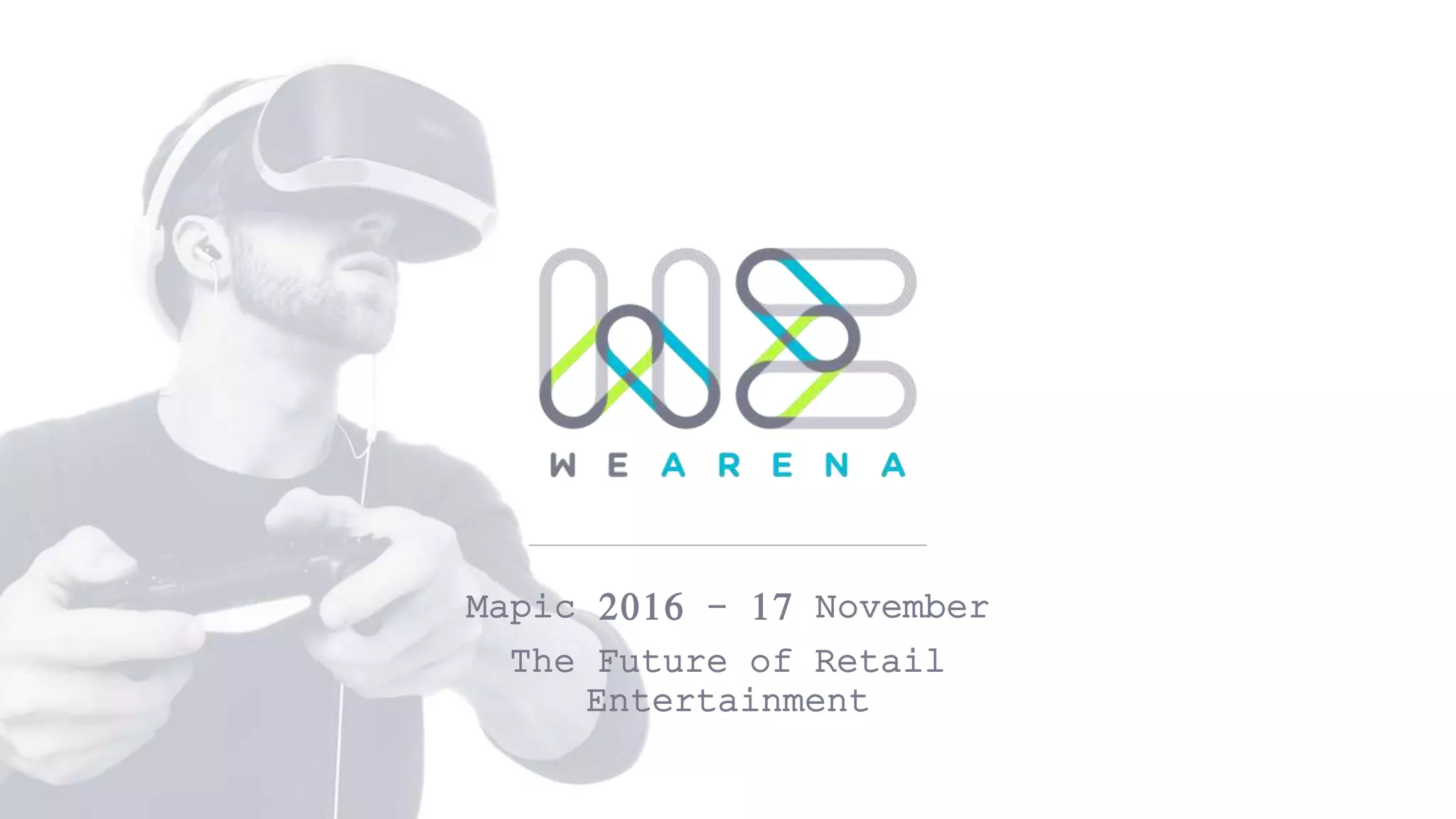
The cover slide establishes the brand identity for WeArena, dated November 17, 2016, for the Mapic conference. The subtitle, "The Future of Retail Entertainment," clearly defines the company's target sector: the intersection of physical retail spaces and digital entertainment. The imagery features a person using a VR headset and a game controller, immediately signaling the technological focus of the product.
Slide 2: General Overview & Market Background
This slide provides the macro-economic justification for the business. It breaks the market into three segments: Virtual/Augmented Reality Market , Theme Parks Market , and the Game Industry . Key figures cited include a projected VR market value of 33.90 Bn € by 2020 and a global entertainment/video game market of 2.14 T€ . The slide argues that "gaming has to go social," positioning WeArena as the physical "open place" where enthusiasts can meet and test new technologies. It notes that startups in the VR space raised 658 Mn € in 2015, suggesting strong investor interest in the underlying tech.
Slide 3: The Four Pillars of Experience
WeArena categorizes its offerings into four distinct quadrants: Edutainment (workshops and educational activities), Live & Entertainment (digital concerts and wearable device performances), Contest & Gaming (eSports and individual gaming), and VR/AR (headsets and gaming stations). This diversification is intended to broaden the appeal of the venue beyond hardcore gamers to families and event-goers. The central theme is providing "breathtaking moments" through these four areas.
Slide 4: Venue Layout and Zoning
This slide provides a 3D architectural render of a typical WeArena facility. It visualizes how the four pillars from the previous slide are physically distributed. Notable details include a "300-seat gallery" for the Contest & Gaming area and a specification that "each experience [in VR] is in 16 sqm." The layout also includes standard commercial amenities like a Management office , Main Entrance & Ticket Office , a Food Court , and a Shopping Area . This confirms the business model relies on multiple revenue streams, including ticket sales, F&B, and retail.
Slide 5: Edutainment Visualization
This is a conceptual render of the "Kids & Discovery Area." It shows a large-scale immersive screen featuring dinosaurs and groups of children participating in what appears to be a guided session. The visual emphasizes the "social" and "group" aspect of the experience, moving away from the isolated nature of home VR. The render is intended to demonstrate the scale and atmosphere of the physical environment.
Slide 6: Contest & Gaming Visualization
This render depicts the eSports and gaming zone. It shows rows of gaming stations equipped with monitors and controllers, branded with the WeArena logo. The environment is designed to look like a high-tech arena with overhead trusses, large digital displays, and spectator seating. This slide reinforces the company's intent to host organized competitions and serve as a hub for the eSports community.
Slide 7: Roadmap and Financial Targets
The final slide in this set, titled "GAME CHANGER," outlines the company's milestones and KPIs. The most significant claim is the "First Opening Summer 2017 in JVillage with Juventus FC." The slide defines the venue size as 4,000 to 10,000 sqm and projects 500,000 to 1,500,000 visitors per year per location . The financial goal is an Ebitda > 30% . The long-term vision includes 20 openings in Europe by 2021 and the selection of 3 Market Master Franchisees by the end of 2017. This slide serves as the primary "traction" and "future outlook" component of the deck.
What Works
Strategic Partnerships: The mention of Juventus FC and the JVillage development is a powerful validator. For a location-based entertainment (LBE) startup, securing a flagship site with a world-class sporting brand provides immediate credibility and a built-in audience.
Clear Zoning: The architectural layout in Slide 4 is excellent. It moves the pitch from abstract concepts to a tangible business plan. Investors can see exactly how the square footage is monetized and how the flow of visitors is managed between entertainment, food, and retail.
Market Timing: In late 2016, the "retail apocalypse" was a major talking point. By positioning themselves as the "Future of Retail Entertainment," WeArena addressed a specific pain point for mall operators: the need for non-retail anchors to drive foot traffic. The market data provided in Slide 2 aligns well with this narrative.
What is Missing
The Team: There is no team slide in the provided set. In early-stage fundraising, the background of the founders is often more important than the idea itself. Without knowing if the team has experience in real estate development, gaming technology, or hospitality management, the execution risk remains high.
The Ask: The deck does not specify how much capital is being raised or how those funds will be allocated. A professional pitch deck should clearly state the funding requirement and the milestones that the capital will enable the company to reach.
Unit Economics: While the deck mentions a 30% EBITDA margin, it lacks a breakdown of the cost to build a single 10,000 sqm venue (CAPEX) versus the ongoing operational costs (OPEX). For a capital-intensive business like a theme park, these details are crucial for assessing the ROI.
Competitive Landscape: The deck assumes a vacuum. There is no mention of other VR arcade chains, eSports arenas, or traditional family entertainment centers (like Dave & Buster's) that might compete for the same consumer time and spend.
Founder's Guide: What to Copy
Visualizing the Experience: If you are building a physical product or space, use high-quality renders like those on Slides 5 and 6. They help investors "feel" the brand and understand the scale of the ambition in a way that text never can.
The Quadrant Model: Slide 3 is a great example of how to simplify a complex product offering. By breaking the business into four clear pillars, the founders make it easy for the audience to categorize the revenue streams and target demographics.
Specific KPIs: Slide 7 uses specific numbers (sqm, visitor counts, EBITDA percentages, and dates). Even if these are projections, having concrete targets shows that the founders have modeled the business and have a clear definition of what success looks like.
Final Thoughts
The WeArena deck is a strong "vision" piece that effectively communicates the scale and excitement of their digital theme park concept. Its strength lies in its ability to link the digital gaming trend to the physical real estate market. However, as a fundraising tool, it is incomplete. The absence of a team slide and a clear financial ask suggests this may have been a general partnership pitch for the Mapic conference rather than a formal venture capital deck. For a founder looking to raise money, the conceptual clarity here is worth emulating, but it must be backed by rigorous financial data and a deep dive into the team's ability to execute such a massive operational undertaking.
Frequently asked questions
- What is the primary value proposition of WeArena?
- WeArena proposes 'Digital Theme Parks' that serve as social hubs for gaming and technology enthusiasts. By integrating VR/AR, eSports, and educational workshops into large-scale physical venues (4,000-10,000 sqm), they aim to revitalize retail and sporting areas with high-footfall entertainment that cannot be easily replicated at home.
- Who is WeArena's most significant partner mentioned in the deck?
- The deck highlights a major partnership with Juventus FC for their first opening in Summer 2017 at JVillage. This partnership serves as a key validation point for their ability to integrate into high-profile sporting and commercial developments.
- What are the projected visitor numbers for a WeArena location?
- WeArena projects between 500,000 and 1,500,000 visitors per year per location. These figures suggest a high-density entertainment model designed to drive significant traffic to the host shopping centers or sporting complexes.
- How does WeArena plan to scale its operations?
- The expansion strategy involves opening 20 locations across Europe by 2021. Additionally, the deck mentions the selection of three 'Market Master Franchisees' by the end of 2017, indicating a hybrid model of corporate-owned and franchised venues.
- What financial metrics does the deck provide?
- The deck is light on detailed financials but states a target EBITDA of over 30%. It also references market data such as an average gaming time of 25 minutes and an annual household average spending of 70€ on gaming to justify the market opportunity.