MapJam's 11-slide pitch deck, used to raise a $1.7 million seed round in 2012, prioritizes product demonstration and traction over traditional business metrics. The deck effectively uses a 'Problem/Solution' framework, contrasting the difficulty of coding custom maps with the simplicity of their drag-and-drop interface. A standout feature is the emphasis on distribution through high-profile partnerships with platforms like Weebly and Eventbrite, which fueled a reported 500% growth in embedded maps within a single month. While the deck lacks a formal 'Ask' slide, financial projections, or a de…
Key takeaways
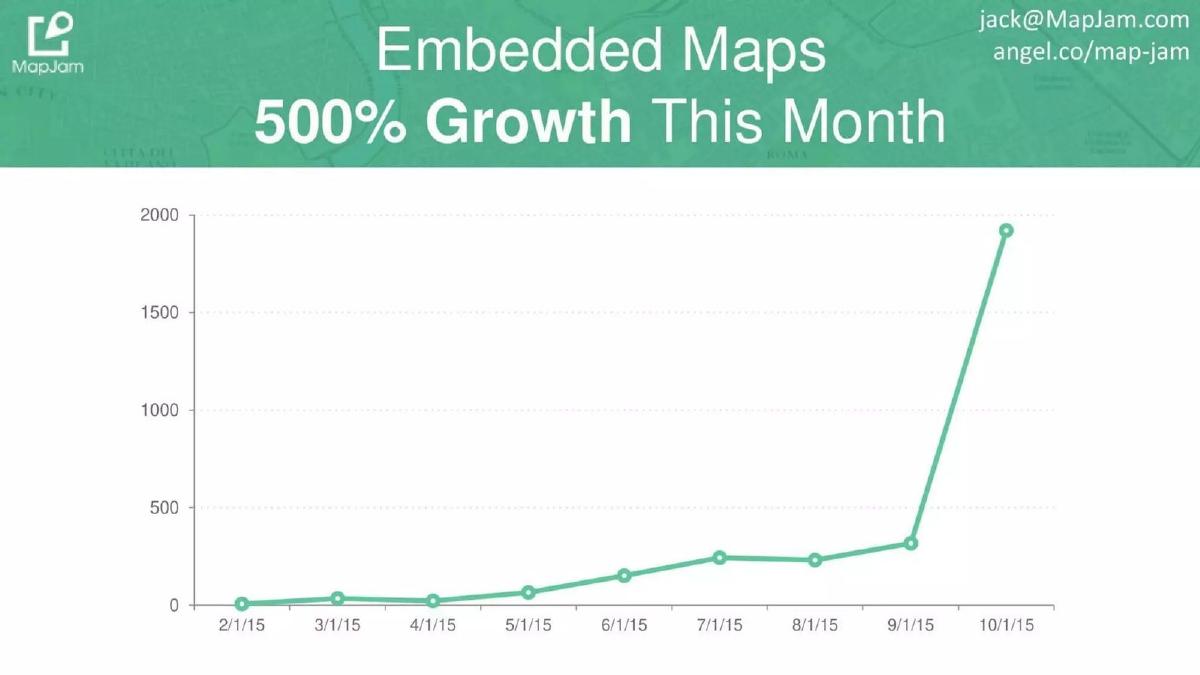
- The deck highlights a massive 500% growth in embedded maps between September and October 2015 (Slide 2).
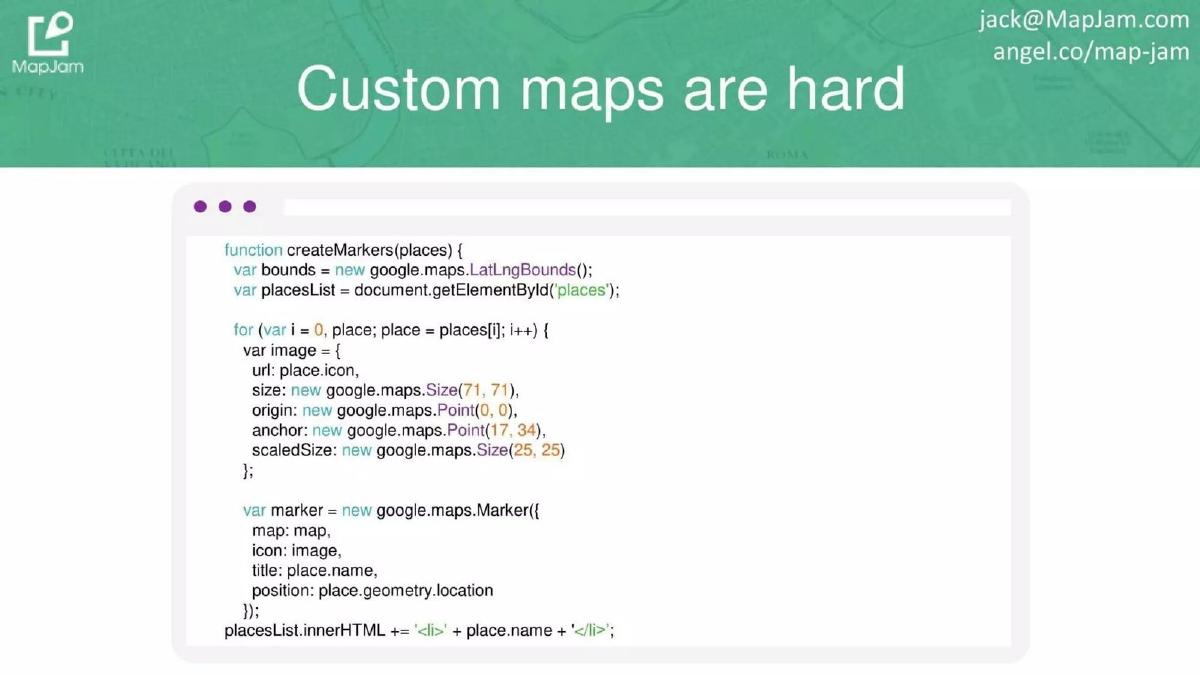
- It uses a direct contrast strategy, showing complex Google Maps API code on Slide 4 to define the problem of 'hard' custom maps.
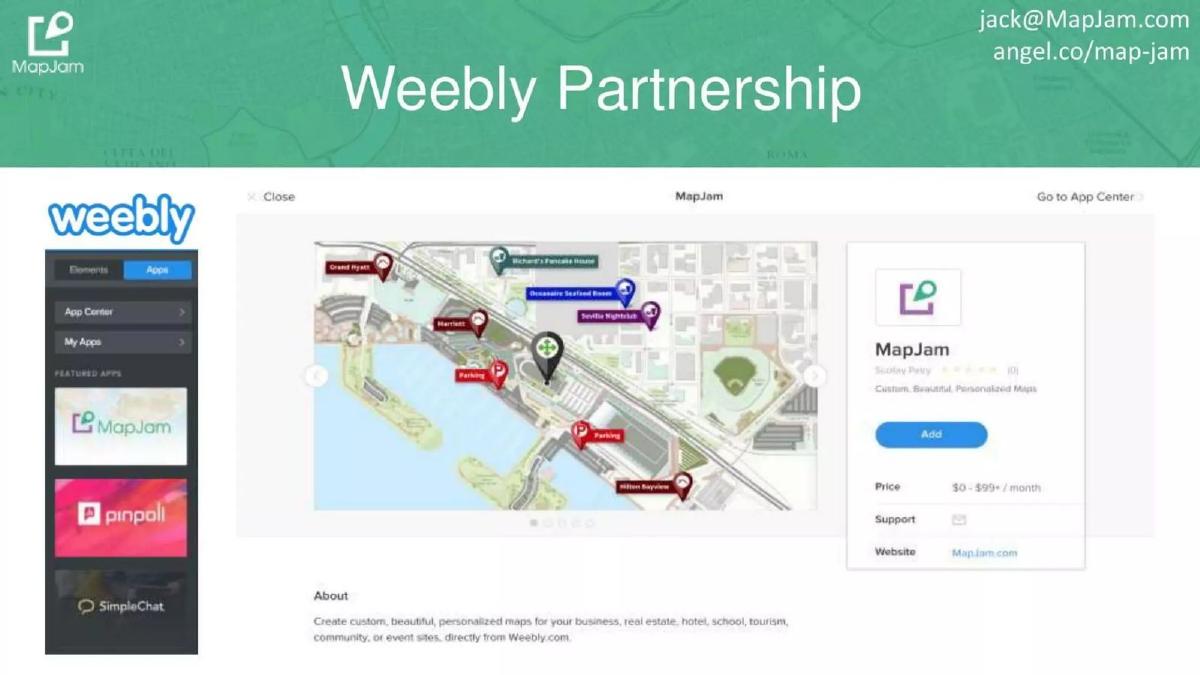
- MapJam showcases a live partnership with Weebly, including a screenshot of their app in the Weebly App Center (Slide 5).
- The product's versatility is demonstrated through an Eventbrite integration showing specialized parking and drop-off markers for a specific event (Slide 6).
- Distribution is a core theme, with Slide 9 listing logos from WordPress, Esri, Scotiabank, and Colliers International.
- The founders leverage a unique personal narrative, stating they met in a 1982 High School Geography class (Slide 10).
- The team's pedigree is established via logos from former employers including AOL, Time Life, and Booz Allen (Slide 10).
- The deck completely omits a financial 'Ask' slide, revenue models, or specific market size (TAM) calculations.
The MapJam Pitch Deck: A Visual Case for No-Code Mapping
Founded in 2012 and headquartered in San Francisco, MapJam entered a market dominated by Google Maps but underserved in terms of customization and ease of use for non-developers. Their 11-slide pitch deck is a focused narrative on how they simplify map publishing. While the catalogue data indicates a 2012 founding, the metrics in the deck reference data through October 2015, suggesting this specific version was used for a follow-on seed extension or a mid-stage update to investors.
The Hook and Immediate Traction
Slide 1: Title Slide The deck opens with a clear value proposition: "MapJam lets anyone create beautiful branded maps that are easy to share everywhere." The background uses a muted map of Rome, immediately establishing the sector.
Slide 2: Traction MapJam makes a bold move by placing traction second. The slide titled "Embedded Maps: 500% Growth This Month" shows a line graph starting in February 2015. The growth is relatively flat until September 2015, where it jumps from roughly 300 to nearly 2,000 embedded maps by October 1st. This creates immediate urgency for the investor.
Defining the Problem and the Solution
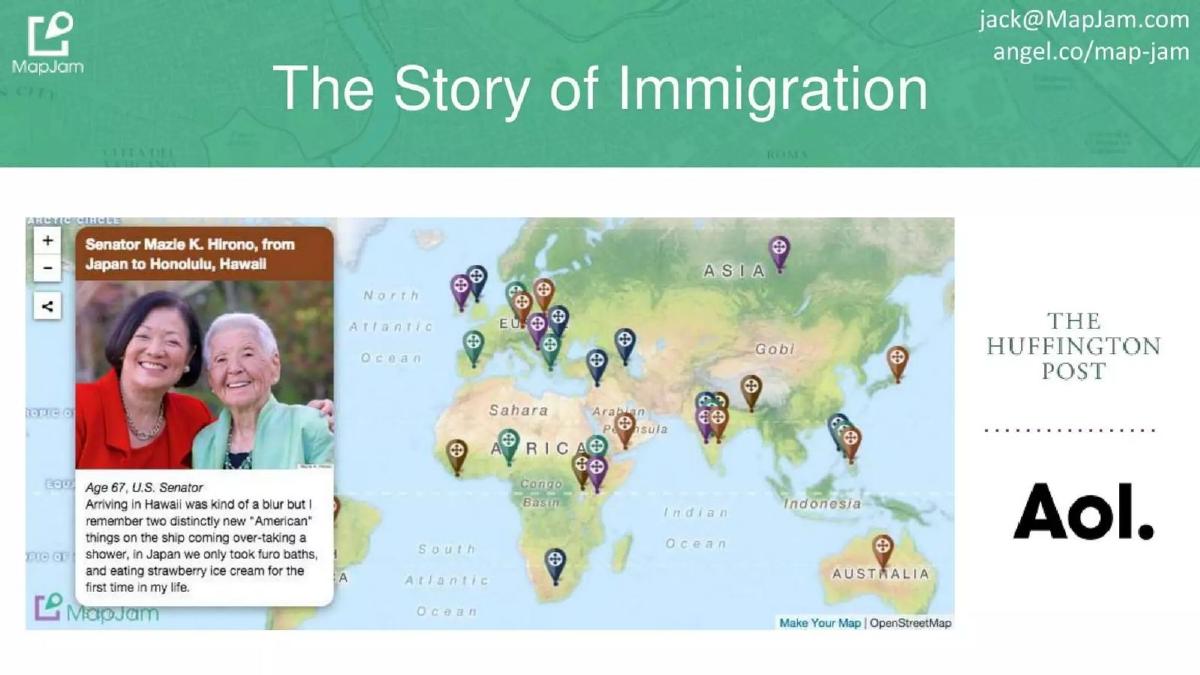
Slide 3: Real-World Use Case Titled "The Story of Immigration," this slide shows a live implementation of the product for The Huffington Post and AOL. It demonstrates a map with custom markers and a pop-up profile of Senator Mazie K. Hirono. This proves the product is already being used by major media entities to tell stories.
Slide 4: The Problem "Custom maps are hard." This slide is minimalist, showing a window of JavaScript code used to create markers in the Google Maps API. It effectively targets the pain point: you currently need a developer to make a map look unique.
Slide 5: The Weebly Partnership This slide highlights a key distribution channel. It shows the MapJam app within the Weebly App Center, listing a price range of "$0 - $99+ / month." This is the only hint at a business model in the entire deck, suggesting a freemium SaaS approach integrated into website builders.
Slide 6: Eventbrite Integration Furthering the utility narrative, this slide shows a map for the "San Francisco Fall Antiques Show." It highlights specific markers for "Parking" and "UBER Dropoff/Pickup." This demonstrates the "context" mentioned in the company's self-description—adding value that standard GPS maps often lack.
Slide 7: The Solution (Product Interface) Titled "Easy with MapJam," this slide shows the actual editor. It features a sidebar with controls for "Tail Visibility," "Size," and a color picker. It directly contrasts the code shown on Slide 4, proving that the "hard" task is now a simple UI interaction.
Growth and Distribution Strategy
Slide 8: The Boomerang Effect This slide repeats the graph from Slide 2 but overlays a boomerang graphic. While visually quirky, it reinforces the message of the 500% growth spike. It serves as a transition from the product demonstration back to the business's momentum.
Slide 9: More Distribution This is a classic "logo slide." It lists partners and customers: The Huffington Post, Weebly, Tripping, WordPress, Eventbrite, Scotiabank, Esri, Mixmax, and Colliers International. The inclusion of Scotiabank and Colliers suggests the product has enterprise applications in banking and real estate beyond just media storytelling.
The Team and Contact
Slide 10: Founder Pedigree The founders use a storytelling approach here, noting they "met in High School Geography Class" in 1982. This establishes a long-term working relationship. To balance the nostalgia, the right side of the slide lists heavy-hitting corporate logos: AOL, Time Life, Lend Lease, Idealab, IMP, and Booz Allen.
Slide 11: Contact The final slide features Jack Gonzalez, co-founder, with his email and a MapJam-specific URL. Interestingly, there is no "Ask" slide detailing how much money they want or what they will do with it.
What Works in the MapJam Deck
1. The Contrast Strategy: By showing the code required for custom maps (Slide 4) and then showing the visual editor (Slide 7), MapJam makes the value proposition undeniable. They aren't just selling a map; they are selling the time saved by not needing a developer.
2. High-Signal Partnerships: The deck relies heavily on the credibility of others. By showing the Weebly App Store and the Huffington Post use case, they prove product-market fit without needing to explain it in text. Investors see that large platforms have already vetted the technology.
3. Specificity of Use Cases: The Eventbrite example (Slide 6) is particularly strong. It shows that MapJam isn't just for "looking pretty"; it solves logistical problems like finding an Uber drop-off point at a crowded event. This expands the potential market from "bloggers" to "event organizers."
What is Missing from the MapJam Deck
1. The Financial Ask: There is no mention of the $1.7 million target or how the funds will be allocated. This suggests the deck was likely used as a visual aid for a verbal pitch rather than a standalone document sent via email.
2. Revenue and Unit Economics: While Slide 5 mentions a price range, there is no data on Average Revenue Per User (ARPU), Customer Acquisition Cost (CAC), or Churn. For a Seed round, investors usually want to see how the 500% growth in usage translates into dollars.
3. Competitive Landscape: The deck ignores competitors like Mapbox or CartoDB. While it positions itself against "doing it manually with code," it doesn't explain why a user would choose MapJam over other no-code mapping tools that were emerging at the time.
4. Market Size (TAM): There is no slide addressing how big the "branded map" market actually is. Founders often omit this if the market is self-evidently large, but it leaves a gap in the business case.
What a Founder Should Copy
1. The "Traction First" Approach: If you have a 500% growth month, do not hide it on Slide 12. MapJam put it on Slide 2. This immediately changes the tone of the meeting from "if this works" to "why is this working so fast?"
2. Visual Proof over Bullet Points: MapJam uses almost no bullet points. They use screenshots of the product in the wild. Seeing a MapJam map on an AOL property is more convincing than a slide saying "We have media interest."
3. Humanizing the Team: The high school geography class anecdote is memorable. In a sea of generic "Ex-Google, Ex-Facebook" team slides, a personal story that ties back to the company's mission (geography) helps the founders stand out in an investor's memory.
Final Analysis
The MapJam deck is a product-centric presentation that leans heavily on the "show, don't tell" rule. It successfully identifies a technical barrier—the difficulty of customizing maps—and demonstrates a working solution with significant early adoption. While it lacks the rigorous financial and market analysis found in later-stage decks, its focus on distribution partnerships (Weebly, Eventbrite) provides a clear roadmap for how the company intended to scale. For a Seed stage company, the combination of high-growth metrics and enterprise-level partnerships is often more persuasive than speculative five-year financial projections.
Frequently asked questions
- How much did MapJam raise with this deck?
- According to catalogue data from pitchdeckhunt.com, MapJam raised $1,700,000 in a Seed round in 2012. The deck itself does not state the amount being raised or the valuation sought, which is common in decks designed for presentation rather than as standalone reading material.
- What is the primary problem MapJam solves?
- The deck identifies that 'Custom maps are hard' (Slide 4). It illustrates this by showing a block of JavaScript code required to create markers on a standard map. MapJam positions itself as the no-code solution, allowing users to create branded, personalized maps via a visual interface shown on Slide 7.
- Which major companies were using MapJam at the time of the deck?
- Slide 9 lists several high-profile distribution partners and users, including The Huffington Post, Weebly, Tripping, WordPress, Eventbrite, Scotiabank, Esri, Mixmax, and Colliers International. Slide 3 specifically shows a map created for The Huffington Post and AOL regarding 'The Story of Immigration'.
- What metrics are included in the MapJam deck?
- The deck is light on traditional KPIs but heavy on a single growth metric. Slides 2 and 8 feature a line graph showing 'Embedded Maps' growth. The graph shows a sharp spike from approximately 300 units in September 2015 to nearly 2,000 units by October 1, 2015, which the deck labels as '500% Growth This Month'.
- Who are the founders and what is their background?
- The deck introduces Jack Gonzalez as a co-founder (Slide 11). Slide 10 provides a 'Founders' slide showing a 1982 high school photo and a list of corporate experience including AOL, Time Life, Lend Lease, Idealab, IMP, and Booz Allen. This suggests a team with significant enterprise and media experience.