Marpipe’s Series A deck is a masterclass in category creation. Rather than fighting for space in the crowded ad-tech or design-tool markets, the company argues that these two massive industries—Design Technology ($162Bn) and Digital Display Ad Spend ($165Bn)—are colliding due to privacy regulations. By defining a new 'Creative Data Industry,' Marpipe positions itself as the inevitable solution to a problem that existing 'scanner apps' and 'managed services' cannot solve. The deck is notably light on traditional metrics like ARR or churn, instead relying on the pedigree of its leadership team…
Key takeaways
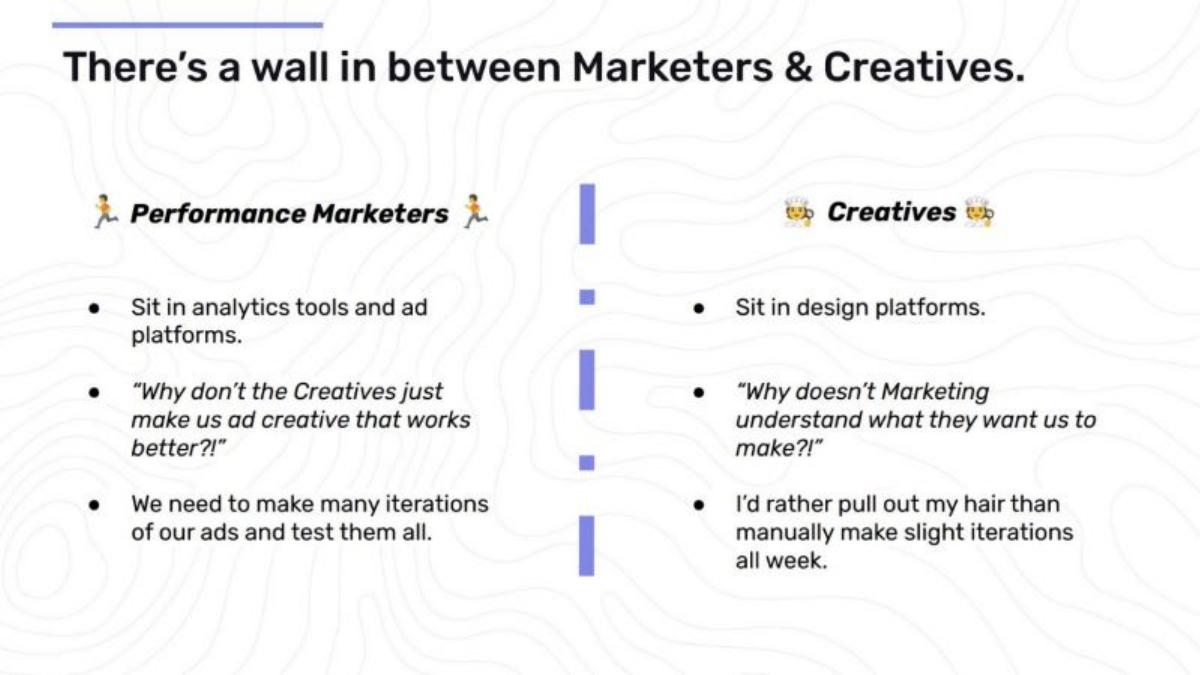
- The deck identifies a specific organizational friction: the 'wall' between performance marketers and creatives (Slide 2).
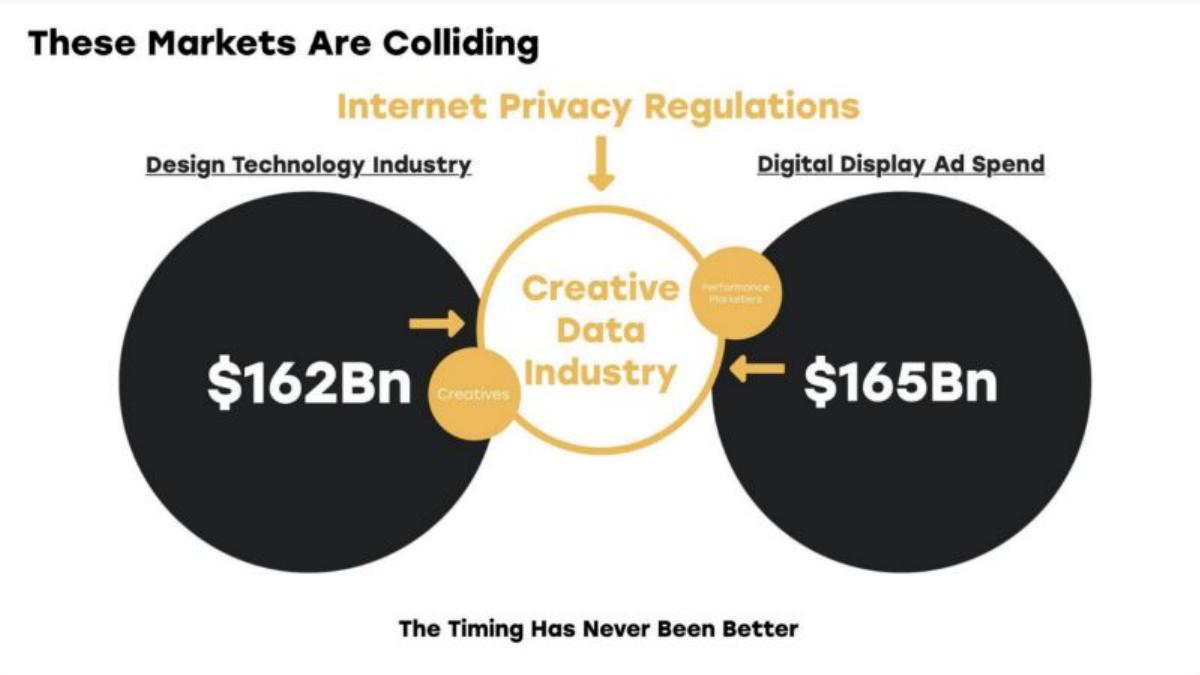
- Marpipe defines its market as the collision of the $162Bn Design Technology industry and the $165Bn Digital Display Ad Spend market (Slide 5).
- Internet privacy regulations are cited as the primary catalyst for the emergence of the 'Creative Data Industry' (Slide 5).
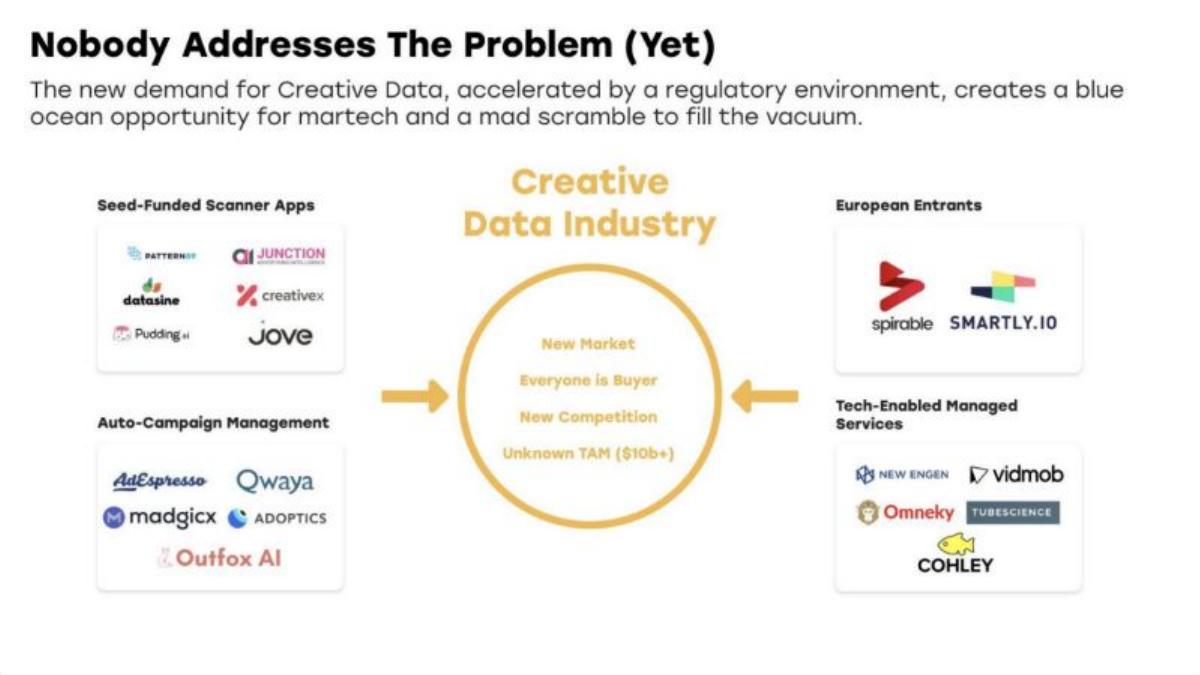
- The competitive landscape is segmented into four categories: Scanner Apps, European Entrants, Auto-Campaign Management, and Tech-Enabled Managed Services (Slide 6).
- The product roadmap aims to build the 'First API for Creative,' integrating with platforms like Facebook, Google, and Adobe (Slide 7).
- The leadership team features significant exits and industry experience, including a former CTO of Paintzen and a former Head of North America for Adobe Ad Cloud (Slide 8).
- The $8M funding ask is explicitly allocated with 80% going to the Engineering and Product team and 20% to the Revenue team (Slide 9).
- The deck completely omits current revenue figures, customer logos, and growth metrics, focusing entirely on the future market opportunity.
The Narrative of Category Creation
Marpipe’s 10-slide deck is a focused exercise in narrative. It does not lead with traction, revenue, or user growth. Instead, it leads with a psychological and operational problem: the disconnect between the people who make ads and the people who buy them. By the time the investor reaches the final slide, the company has attempted to prove that a multi-billion dollar vacuum exists in the market and that they are the only team qualified to fill it.
Slide 1: The Provocation
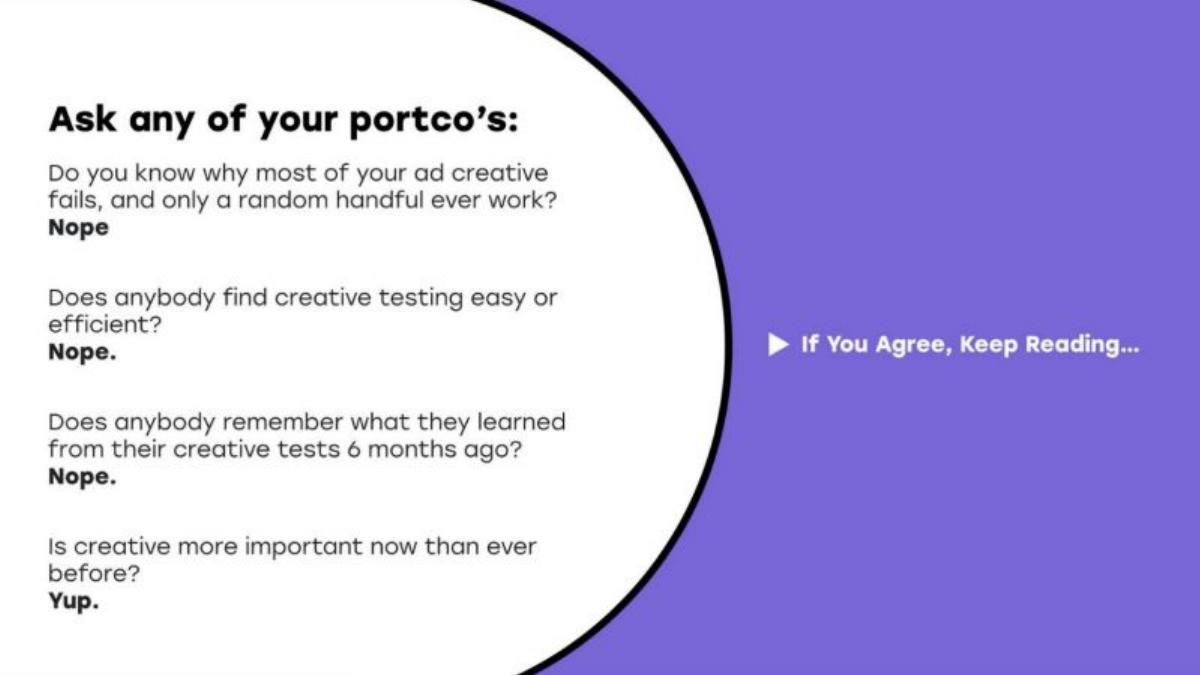
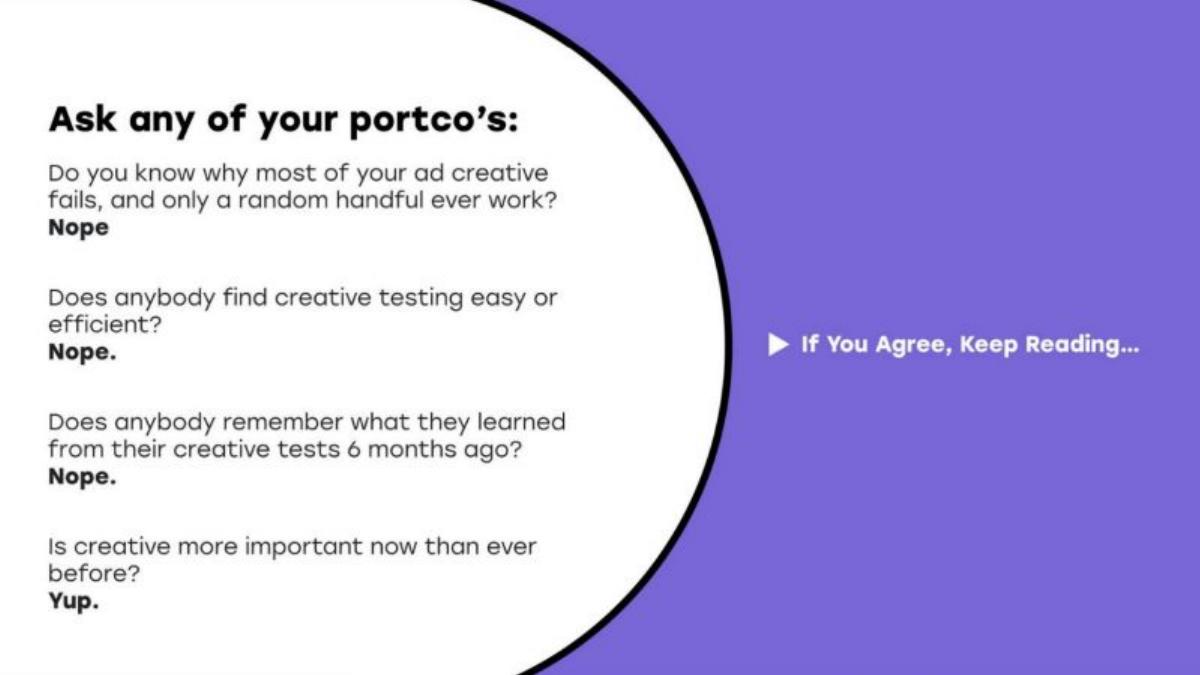
The deck opens with a series of questions directed at a Venture Capitalist’s portfolio companies. It asks if they know why creative fails, if testing is easy, or if they remember learnings from six months ago. The answer provided for all is "Nope." This slide establishes the pain point immediately: creative testing is currently inefficient, forgettable, and opaque. It sets a high-stakes tone by concluding that creative is "more important now than ever before."
Slide 2: The Organizational Wall
Slide 2 visualizes the problem as a literal wall. On one side, Performance Marketers sit in analytics tools wanting more iterations. On the other, Creatives sit in design platforms, frustrated by the manual labor of making slight iterations. This slide is effective because it identifies a human problem—frustration and inefficiency—rather than just a technical one. It frames Marpipe as a tool for organizational harmony, not just ad optimization.
Slide 3: The Solution as Connective Tissue
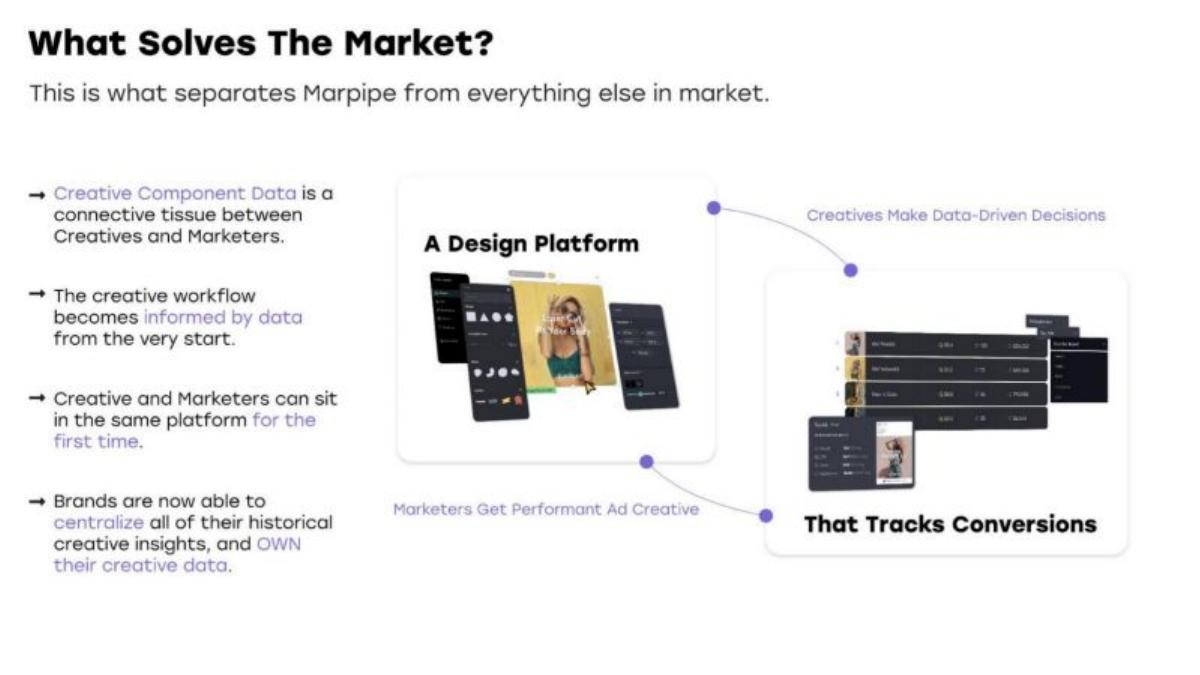
Marpipe defines its solution on Slide 3. It claims to separate itself from the market by making "Creative Component Data" the connective tissue between the two warring departments. The slide features a mockup of "A Design Platform" linked to a dashboard "That Tracks Conversions." The key takeaway here is the promise that brands can finally "OWN their creative data," implying that this data was previously lost or held by third parties.
Slide 4: Market Sizing
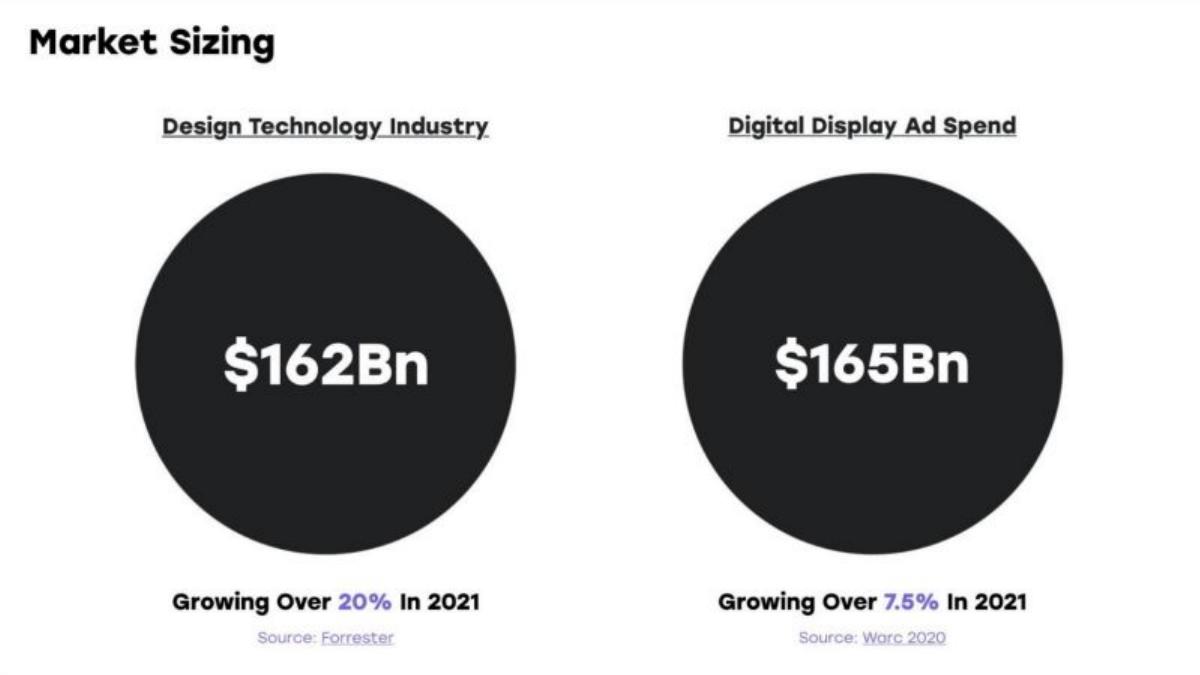
The deck moves into the TAM (Total Addressable Market) on Slide 4. It cites two massive figures: the Design Technology Industry at $162Bn (growing over 20% in 2021) and Digital Display Ad Spend at $165Bn (growing over 7.5% in 2021). By using sources like Forrester and Warc, Marpipe grounds its ambitions in third-party data, preparing the reader for the "collision" argument in the next slide.
Slide 5: The Collision Theory
This is the most important slide in the deck. It uses a Venn diagram to show the two previously mentioned markets colliding to form the "Creative Data Industry." Crucially, it identifies "Internet Privacy Regulations" as the force pushing these markets together. This provides a "Why Now?" factor that is essential for a Series A raise, suggesting that external market forces are making Marpipe’s success inevitable.
Slide 6: The Competitive Landscape
Slide 6 addresses competition by claiming "Nobody Addresses The Problem (Yet)." It categorizes competitors into four buckets: Seed-Funded Scanner Apps, Auto-Campaign Management, European Entrants, and Tech-Enabled Managed Services. By placing Marpipe in the center of a "Blue Ocean Opportunity," the deck argues that while others touch the space, no one has built a dedicated platform for the "Creative Data Industry" with an "Unknown TAM ($10b+)."
Slide 7: The Product Roadmap
The roadmap on Slide 7 is visualized through an octopus graphic representing "Centralized Creative Data." It shows integrations with Facebook, Instagram, Google, LinkedIn, and others. The formula presented is: Creative (Image/Video/Audio) + Centralized Data + Predictive Analytics Engine = The First API For Creative. This moves the company from a "tool" to "infrastructure," which justifies a higher valuation.
Slide 8: The Team
The team slide is a significant strength. It highlights Jeremy Bloom (CRO) , formerly of Adobe Ad Cloud and TubeMogul, and James Goldman (CTO) , who had a $75M exit to PPG. The slide also notes that the team has "40% Women And Minority Representation," a rare but professional inclusion in a Series A deck. The presence of a full engineering and product team (9 people shown) suggests the product is well beyond the MVP stage.
Slide 9: The Ask
Slide 9 details an $8m allocation (though the listing states $10M was raised). The pie chart shows a heavy lean toward Engineering / Product (80%) versus the Revenue Team (20%) . The stated goals for this capital are rapid integration with social/DSP channels, building a video/audio engineering team, and establishing a "data moat."
Slide 10: The BestPitchDeck.com Outro
The final slide is a standard promotional slide for the source library and does not contain Marpipe-specific information.
What Marpipe Omitted
The most striking aspect of this deck is what it lacks. There is no slide for unit economics, no slide for current ARR, and no slide for customer case studies or logos. In a typical Series A deck, investors expect to see a "Traction" slide showing a hockey-stick growth curve. Marpipe chooses to sell the vision of a new industry rather than the results of their current sales. This suggests either that the traction was so early that the vision was more compelling, or that the team's pedigree was sufficient to bypass the standard metrics requirement.
What Founders Should Copy
Founders should study Slide 5. The ability to take two existing, well-understood markets and show how a specific external catalyst (like privacy regulation) is forcing them to merge is a powerful way to explain a complex product. Additionally, the use of a "Wall" (Slide 2) to describe a workflow problem is a highly effective way to build empathy with an investor who may have seen similar frustrations in their own portfolio companies.
Final Analysis
Marpipe’s deck succeeded because it didn't try to be a better version of an existing tool; it tried to be the first tool in a new category. By framing the problem as an organizational and regulatory inevitability, they shifted the conversation from "How much revenue do you have?" to "How big could this new industry be?" For a $10M Series A, this narrative-first approach proved highly effective.
Frequently asked questions
- How much did Marpipe raise with this deck?
- According to the catalogue listing, Marpipe raised $10M in a Series A round in 2021. Interestingly, Slide 9 of the deck only mentions an $8M allocation breakdown, suggesting the final round size may have been upsized during negotiations or the slide represented a specific portion of the raise.
- What is Marpipe's core product value proposition?
- As stated on Slide 3, Marpipe positions itself as a design platform that tracks conversions. It aims to make creative component data the 'connective tissue' between creatives and marketers, allowing brands to own their historical creative insights rather than relying on agency-siloed data.
- Who are Marpipe's primary competitors?
- Slide 6 lists several competitors across four niches: Seed-funded scanner apps (like CreativeX and Pattern89), Auto-campaign management (AdEspresso, Madgicx), European entrants (Smartly.io, Spirable), and Tech-enabled managed services (VidMob, Omneky, Cohley).
- Why does Marpipe believe now is the right time for this technology?
- Slide 5 argues that 'Internet Privacy Regulations' are the catalyst. As traditional tracking becomes more difficult, the deck suggests that the industry is shifting toward 'Creative Data' as the primary lever for performance, making the timing for their platform better than ever.
- What is the background of the founding team?
- Slide 8 highlights a high-pedigree team. CEO Dan Pantelo previously ran a DTC agency; CRO Jeremy Bloom was the Head of North America for Adobe Ad Cloud; and CTO James Goldman was a 2x startup CTO with an exit to PPG for $75M.