Marshmallow’s pitch deck is exceptionally brief at just 9 slides, yet it successfully communicates a high-level vision of a technology-first insurance company. The deck emphasizes the speed of their service—claiming users can get car insurance in under 5 minutes (Slide 3)—and their operational efficiency, noting that over 60% of queries are resolved by an AI bot (Slide 3). While the deck lacks traditional components like a team slide, detailed financial projections, or a specific funding ask, it leans heavily on the technical moat of owning their own software stack built in Java microservices…
Key takeaways
- The deck claims a user can obtain car insurance in under 5 minutes (Slide 3).
- Marshmallow reports that over 90% of policy changes can be made online through a customer account (Slide 3).
- The company utilizes an AI bot to resolve over 60% of customer queries (Slide 3).
- Marshmallow positions itself against incumbents like Axa, Allianz, and Zurich, claiming they are less efficient due to their use of intermediaries (Slide 4).
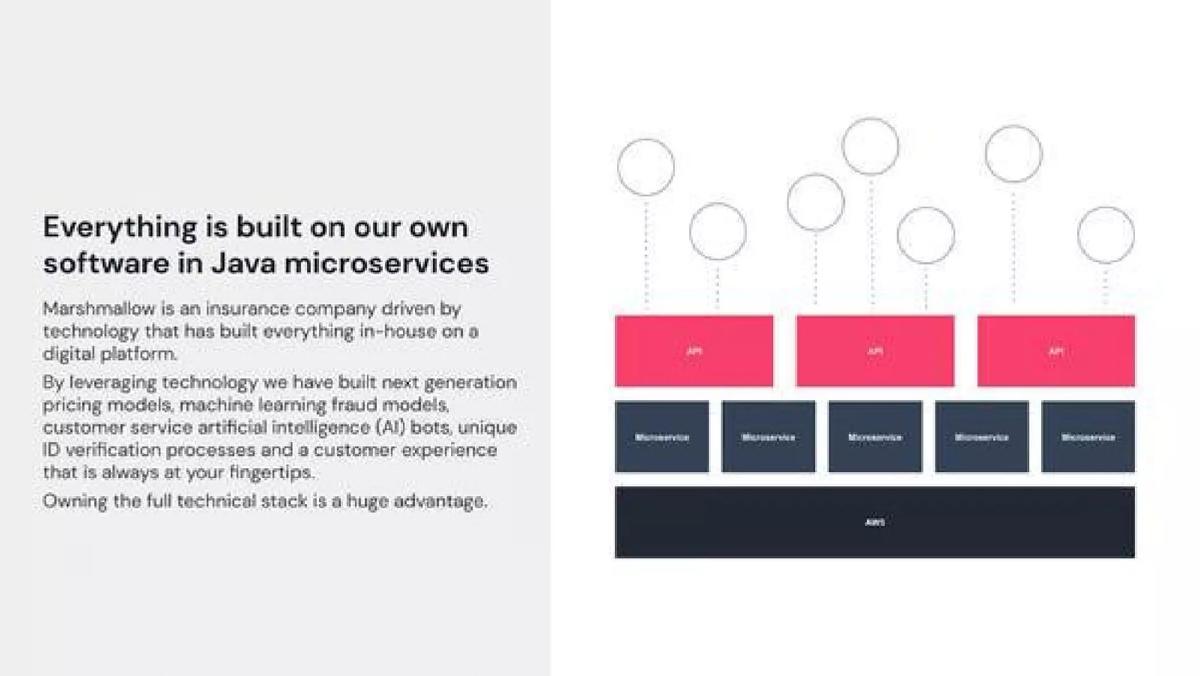
- The technical infrastructure is built entirely in-house using Java microservices (Slide 6).
- The company identifies the UK car insurance market as having 30 million insured cars, valued at $20+ billion (Slide 8).
- The long-term vision targets a global insurance market worth over $3 trillion (Slide 8).
- The deck completely omits a team slide, historical revenue data, and a specific investment ask.
The 9-Slide Vision: Marshmallow’s Minimalist Pitch
Marshmallow’s pitch deck is a striking example of 'less is more.' In an industry as complex and regulated as insurance, one might expect a 30-page tome detailing actuarial tables and regulatory compliance. Instead, Marshmallow delivered a 9-slide presentation that focuses almost entirely on the user experience and the technical 'moat' of their in-house software stack. According to catalogue facts, the company raised $116,200,000 in 2017, suggesting that this high-level approach was sufficient to capture the interest of top-tier investors.
Slides 1-2: Brand and Mission
Slide 1 is a simple title slide featuring the Marshmallow logo in pink lowercase text, accompanied by a minimalist illustration of a London-style townhouse and a hot air balloon. There is no subtitle or 'one-liner' here, letting the brand name stand alone.
Slide 2 serves as the mission statement: 'We use technology to build products that are affordable, instant and inclusive to build a world where insurance benefits everyone.' This slide establishes the three pillars of their product strategy: affordability, speed ('instant'), and accessibility ('inclusive'). It frames the company not just as an insurance provider, but as a technology company solving a social utility problem.
Slides 3-4: The Digital Experience and Efficiency
Slide 3 , titled 'Everything’s online,' provides the first concrete metrics of the deck. It claims that it takes 'under 5 minutes to get car insurance' from Marshmallow. This is a direct shot at the traditional insurance application process, which often involves lengthy forms or phone calls. The slide also highlights operational efficiency: 'over 90% of changes' can be made online by the customer, and 'over 60% of customer queries are solved by our customer experience AI bot.' A mobile app mockup on the right side of the slide reinforces the 'digital-first' nature of the product.
Slide 4 addresses the competitive landscape by name. Titled 'We offer scalable, efficient support,' it explicitly mentions 'Axa, Allianz and Zurich,' noting that they 'still use intermediaries' and are 'far less efficient' than direct-to-consumer insurers like Admiral and Direct Line Group. Marshmallow positions itself as the next evolution of this efficiency, claiming to be 'significantly more efficient' than even the direct-to-consumer incumbents. This slide is crucial because it identifies the 'archaic' nature of the industry as the primary opportunity for disruption.
Slides 5-6: The Technical Moat
Slide 5 focuses on 'Next-generation pricing.' It describes a hybrid approach that combines 'traditional insurance pricing models' with 'data science techniques' and 'machine learning models.' The slide mentions the use of both 'structured and unstructured data sources' fed through 'sophisticated pipelines' to make accurate predictions. The visual on this slide is an abstract network graph, which serves to illustrate complexity without revealing proprietary algorithms.
Slide 6 is perhaps the most important for a technical investor. Titled 'Everything is built on our own software in Java microservices,' it emphasizes that Marshmallow has built its entire digital platform in-house. The text argues that 'Owning the full technical stack is a huge advantage.' The slide includes a block diagram showing APIs, microservices, and an AWS foundation. By highlighting their ownership of the 'full value chain'—from pricing to claims—Marshmallow distinguishes itself from 'thin' insurtechs that merely act as lead-generation tools for legacy carriers.
Slides 7-9: The Future and Market Size
Slide 7 is a simple transition slide containing only the words 'Our future.'
Slide 8 outlines the growth strategy: 'From here we want to launch other products and countries.' It uses three circles to visualize the market opportunity. The first circle represents the 'UK Car Insurance' market at '$20+ billion' with 30 million insured cars. The second circle expands to 'Global car insurance' at '$500+ billion.' The final, largest circle represents 'Global Insurance' at '$3+ trillion.' This slide follows the standard TAM/SAM/SOM logic, though it presents the figures in reverse order of how they are usually discussed, starting with the immediate beachhead market.
Slide 9 is a closing slide, featuring the Marshmallow logo in white against a solid pink background. There is no contact information, no call to action, and no summary of the 'Ask.'
What Works in the Marshmallow Deck
The strength of this deck lies in its clarity of purpose . By focusing on a few key metrics—like the 5-minute sign-up time and the 60% AI resolution rate—Marshmallow makes a compelling case for its operational superiority. The decision to name-check incumbents like Axa and Allianz (Slide 4) adds a layer of boldness, showing that the founders understand exactly who they are competing against and why those competitors are vulnerable.
Furthermore, the emphasis on owning the full stack (Slide 6) is a powerful differentiator. In the insurtech world, companies that own their own 'paper' (insurance licenses) and their own technology are generally valued much higher than those that are merely brokers. Marshmallow leans into this 'full-stack' identity, which justifies a higher valuation and larger capital requirements.
What is Missing from the Marshmallow Deck
While the deck is aesthetically pleasing, it is dangerously light on details for a typical venture capital pitch. The most glaring omission is the Team Slide . In early and growth-stage investing, the pedigree and experience of the founders are often the most important factors. There is no mention of who is building this technology or their background in insurance or data science.
Additionally, the deck lacks Unit Economics . While it mentions market size and operational efficiency, it does not provide data on Customer Acquisition Cost (CAC), Lifetime Value (LTV), or Loss Ratios. In insurance, the loss ratio (the ratio of claims paid to premiums earned) is the ultimate measure of a company's success, and its absence here is notable. Finally, there is no Ask Slide . A pitch deck is a fundraising tool, yet this document does not state how much capital is being sought or how that capital will be deployed to reach the '$3+ trillion' market mentioned on Slide 8.
What a Founder Should Copy
Founders should emulate Marshmallow’s minimalist design and focused messaging . Each slide has a single, clear takeaway. For example, Slide 3 is about speed and automation, while Slide 6 is about technical ownership. This prevents the 'wall of text' problem that plagues many decks and ensures that the investor remembers the core value propositions.
Another element to copy is the direct comparison to incumbents . Instead of using a generic 'competitor matrix' with checkmarks, Marshmallow explains the structural reason why they are better: the use of intermediaries by legacy firms versus their own direct-to-consumer, AI-driven model. This provides a logical foundation for their claims of 'significant efficiency' that is more persuasive than a simple feature list.
Final Thoughts
The Marshmallow deck is a 'teaser' style presentation. It is designed to spark curiosity and demonstrate a modern brand sensibility rather than provide a deep dive into the business's mechanics. Given the $116 million raised, it is highly likely that this deck was accompanied by a much more substantial data room containing the financial and actuarial details missing from these nine slides. For founders, the lesson is that a clean, high-level narrative can be a powerful door-opener, provided the underlying technology and market opportunity are as massive as those presented here.
Frequently asked questions
- What is the primary value proposition of Marshmallow according to the deck?
- Marshmallow focuses on speed, inclusion, and efficiency. By building their own technology stack and owning the insurance company, they claim to offer a faster onboarding experience (under 5 minutes) and a more efficient support model than traditional insurers like Axa or Allianz, who rely on intermediaries.
- How does Marshmallow use technology to lower operational costs?
- The deck highlights two main technical drivers of efficiency: an AI bot that handles over 60% of customer queries and a self-service portal where customers can perform 90% of policy changes themselves. This reduces the need for human-intensive support centers common in the 'archaic' insurance industry.
- What market segments does Marshmallow target?
- The company started with the UK car insurance market, which it values at $20+ billion with 30 million insured cars. However, the deck makes it clear that their ambition is to expand into multiple insurance products and geographies, eventually targeting the $3+ trillion global insurance market.
- What are the most notable omissions in this pitch deck?
- This is a very lean deck. It lacks a team slide, which is unusual for a company raising significant capital. It also omits unit economics (CAC/LTV), a detailed roadmap, a competitive landscape matrix, and a specific 'Ask' slide detailing how much money they are raising and for what purpose.
- What is unique about Marshmallow's technical approach?
- Unlike many insurtechs that act as front-end layers for traditional carriers, Marshmallow emphasizes owning their full technical stack. They specify that their software is built in Java microservices and uses a combination of traditional pricing models and machine learning to deliver 'next-generation pricing' based on structured and unstructured data.