Mmob’s 11-slide deck focuses heavily on the shift from fintech disruption to collaboration. By positioning themselves as the '1-to-many' infrastructure layer, they successfully raised $6.6M in Seed funding in 2022. The deck is notable for its clean aesthetic and clear value proposition: reducing complex partnership integrations to a single line of code. However, the deck is light on hard metrics, omitting specific user growth numbers, revenue figures, or a detailed breakdown of the $6.6M ask. It relies on the pedigree of a management team with deep banking and startup experience to bridge the…
Key takeaways
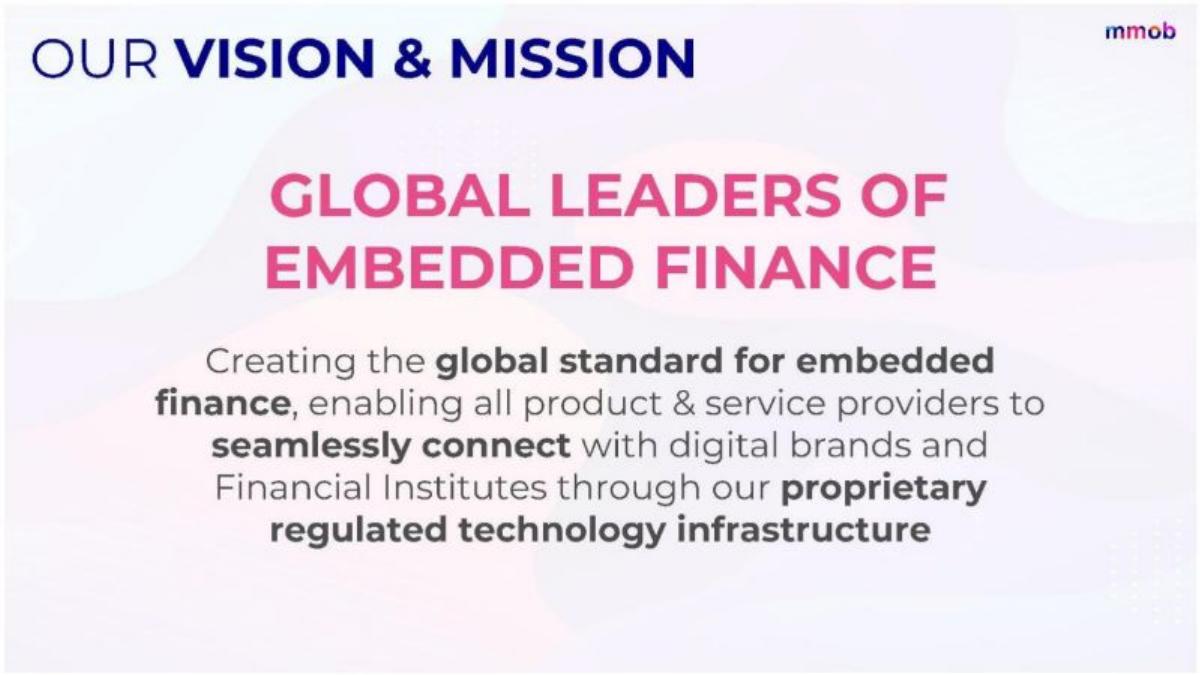
- The company positions itself as a 'proprietary regulated technology infrastructure' on slide 2.
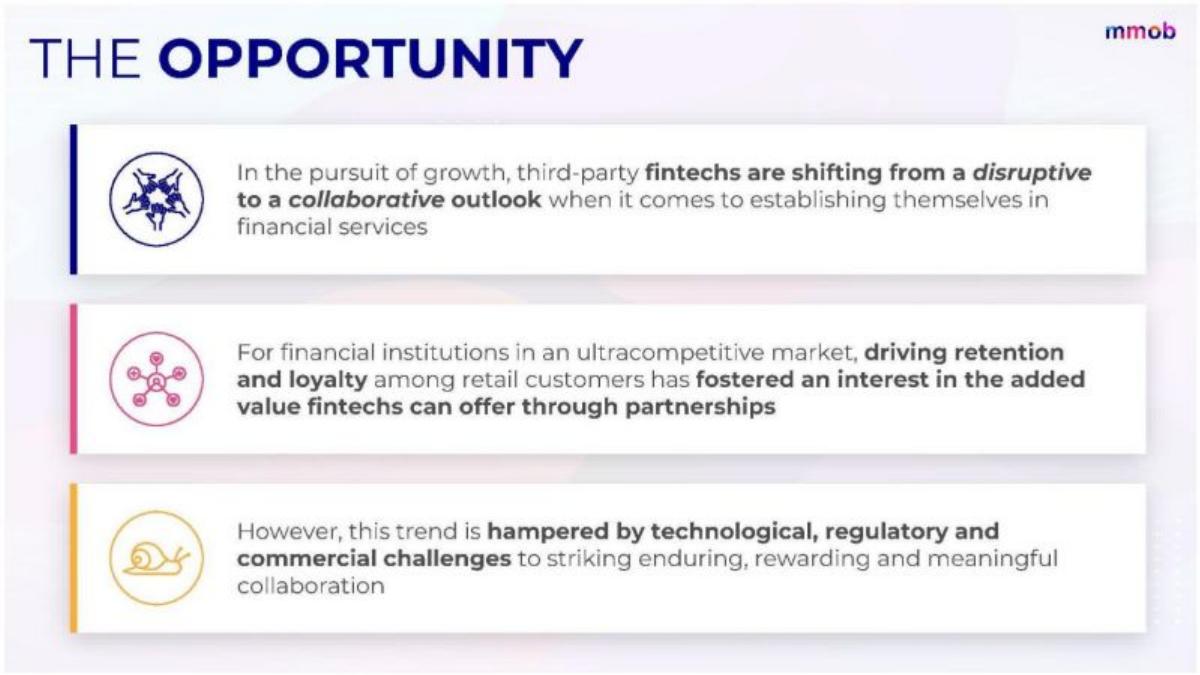
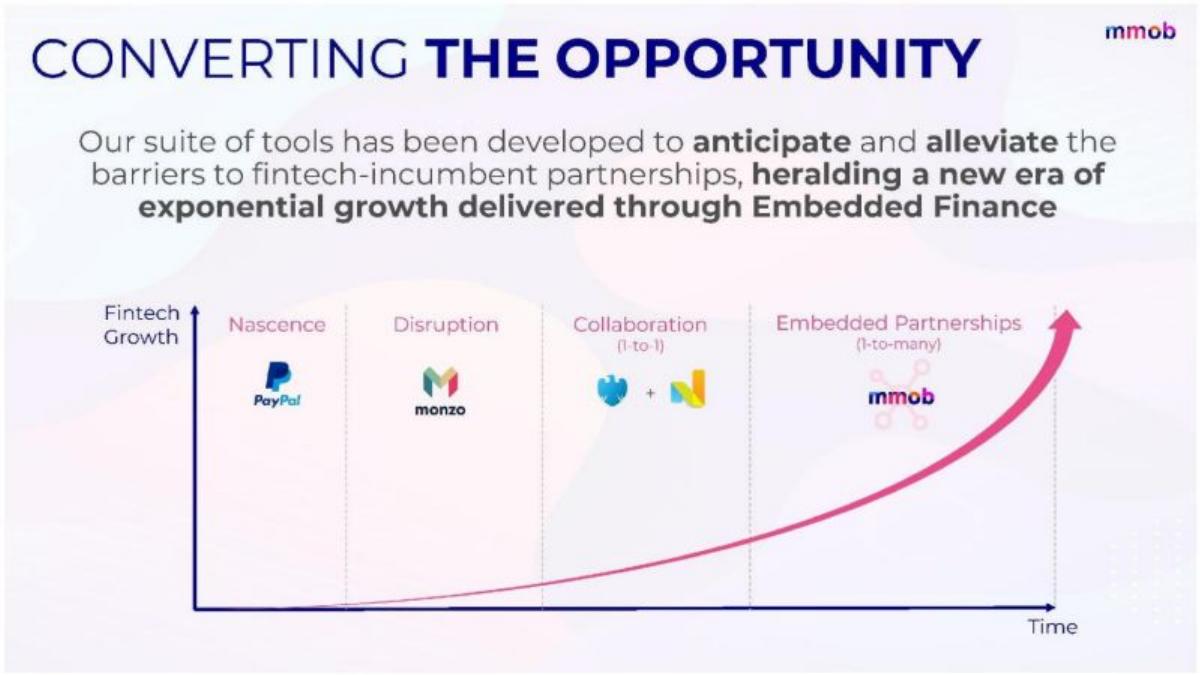
- Mmob identifies a market shift from 'disruptive' to 'collaborative' outlooks in fintech on slide 3.
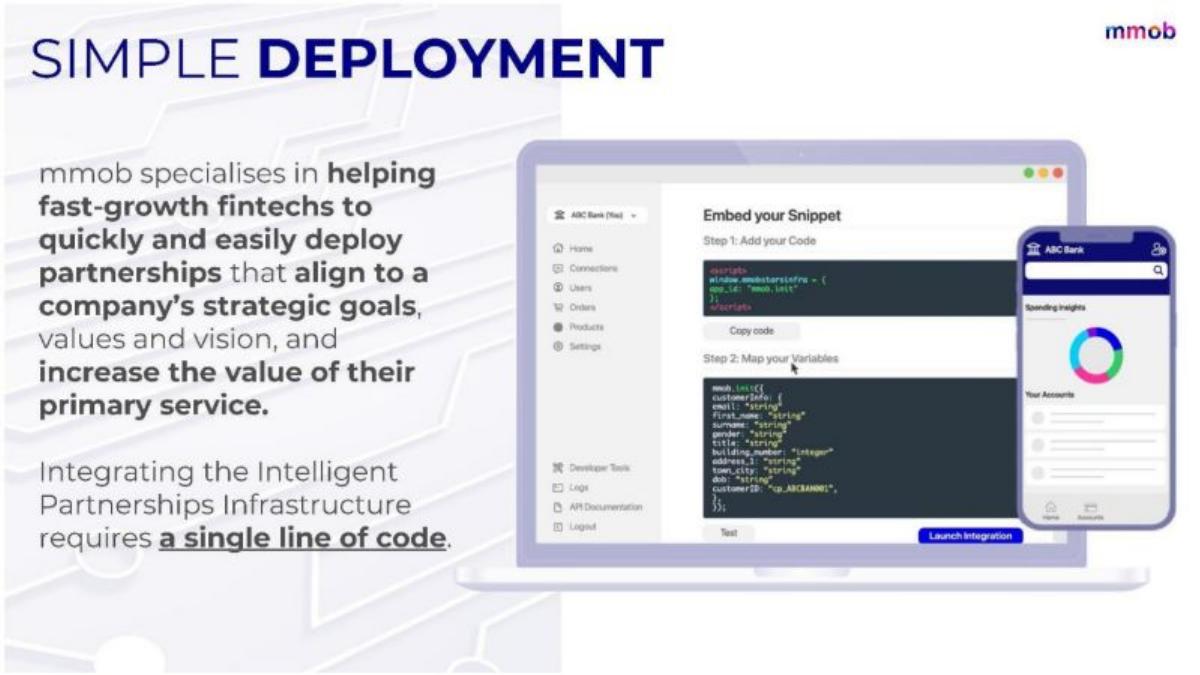
- The core product promise is reducing partnership deployment to a 'single line of code' as shown on slide 6.
- The deck claims the product is the result of 3 years of R&D on slide 7.
- Mmob targets multiple verticals including Wealth, Utilities, Insurance, Credit, Lifestyle, and Payments on slide 8.
- The competitive matrix on slide 9 places Mmob in a unique 'low rivalry' quadrant compared to high-rivalry challenger banks and API providers.
- The management team features founders with experience at HSBC and exits from FCA-regulated fintechs on slide 10.
- There is no financial slide, no use of funds breakdown, and no specific traction metrics included in this version of the deck.
The Vision: Moving from Disruption to Collaboration
Mmob’s deck begins by framing the current state of the fintech market. Rather than focusing on the 'death of banks,' they lean into the reality of the 2020s: banks and fintechs need each other. This narrative is essential for a Seed stage company looking to raise $6.6M, as it suggests a massive, untapped enterprise market rather than a niche consumer play.
Slide 1: Title Slide
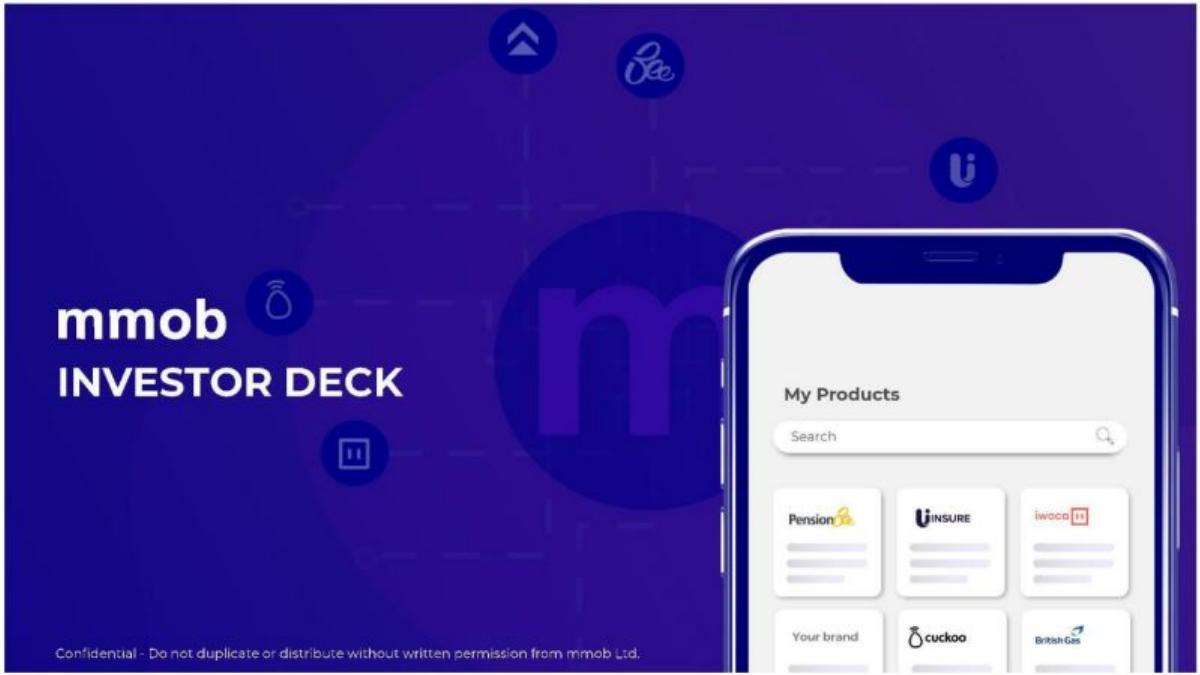
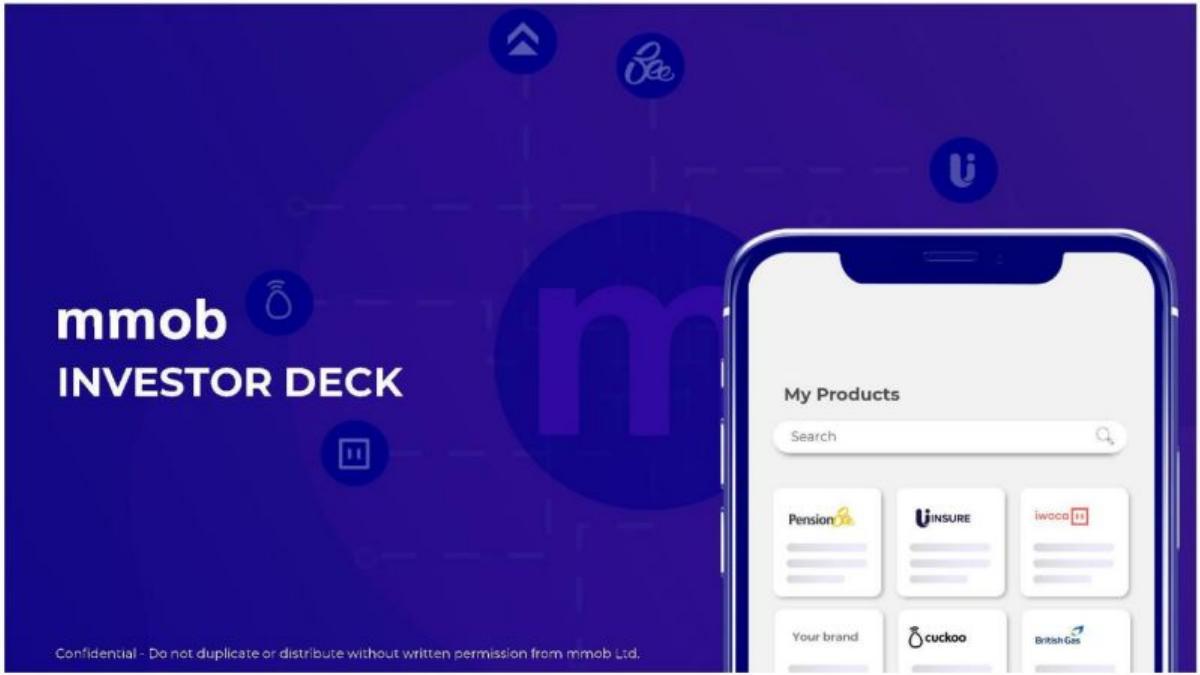
The title slide is minimalist, featuring the company logo and a mobile device mockup. The mockup shows a 'My Products' screen with logos for PensionBee, Uinsure, and Iwoca. This immediately signals to the investor that Mmob is an aggregator or an integration layer for established financial services. The footer includes a standard confidentiality notice.
Slide 2: Our Vision & Mission
Slide 2 defines Mmob as the 'Global Leaders of Embedded Finance.' The mission statement emphasizes creating a 'global standard' through 'proprietary regulated technology infrastructure.' The use of the word 'regulated' is a key trust signal in the FinTech space, suggesting they have cleared the significant legal hurdles required to handle financial data and transactions.
Slide 3: The Opportunity
This slide breaks down the market dynamics into three pillars: fintechs are moving from disruptive to collaborative; financial institutions are seeking retention through partnerships; and the current trend is 'hampered by technological, regulatory and commercial challenges.' By identifying these friction points, Mmob sets the stage for their product as the necessary lubricant for the industry.
Slide 4: Converting the Opportunity
Slide 4 uses a growth curve to show the evolution of fintech. It maps 'Nascence' (PayPal), 'Disruption' (Monzo), and 'Collaboration 1-to-1' (Barclays + Nimbla). Mmob places itself at the top of the curve under 'Embedded Partnerships (1-to-many).' This is a classic 'evolution of the market' slide that justifies why Mmob is the logical next step in the industry's progression.
Slide 5: Delivering Embedded Finance
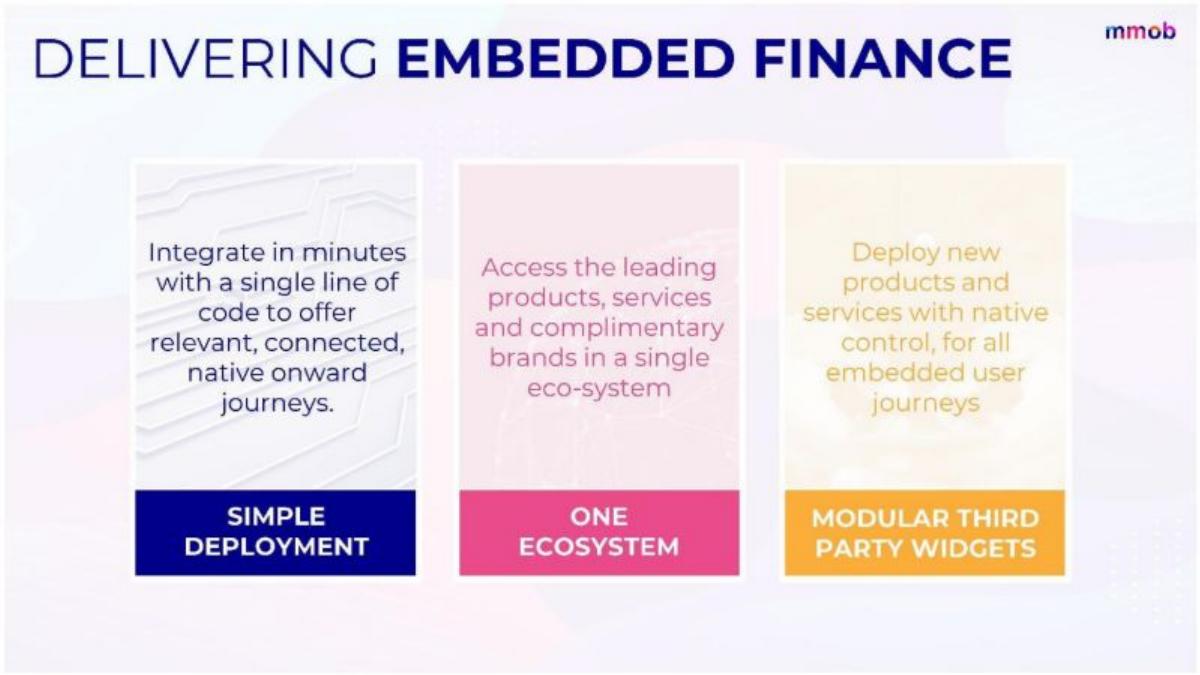
This slide introduces the three pillars of their solution: Simple Deployment, One Ecosystem, and Modular Third Party Widgets. It serves as a transition from the 'Why' of the market to the 'How' of the product.
Slide 6: Simple Deployment
This is the most technical slide in the deck. It claims that integrating their infrastructure requires 'a single line of code.' The visual shows a developer dashboard with a script tag and a variable mapping section. For investors, the promise of 'minutes' for integration is a powerful value proposition, as traditional bank-fintech partnerships often take months or years to deploy.
Slide 7: One Ecosystem
Slide 7 highlights the '3 years of R&D' behind the platform. It mentions two paths for integration: a 'No code' proprietary version and a 'TPP E2E API driven' version. This suggests the product is versatile enough to serve both non-technical business teams and sophisticated engineering departments.
Slide 8: Modular Third-Party Widgets
This slide focuses on the end-user experience and ROI. It lists the verticals Mmob covers: Wealth, Utilities, Insurance, Credit, Lifestyle, and Payments. The mention of 'real-time feedback' and 'toggle on-off flexibility' suggests a dashboard that allows clients to optimize their offerings based on user behavior without needing to rewrite code.
Slide 9: Competition
The competitive matrix is a standard 2x2 grid. The axes are B2C vs. B2B and Open Banking vs. Embedded Finance. Mmob places itself in the B2B/Embedded Finance quadrant, noting 'Rivalry: LOW.' They contrast this with 'High Rivalry' areas occupied by Challenger Banks (Monzo, Revolut), Traditional Banks (HSBC, Barclays), and API Providers (Plaid, Tink). This positioning is designed to show investors that Mmob has found a 'blue ocean' in a crowded market.
Slide 10: Our Management Team
The team slide is strong, featuring six key members. Irfan Khan (CEO) is noted as a 'seasoned start-up COO.' James Fell (COO) is highlighted for having 'Exited first FinTech B2C regulated by the FCA.' The inclusion of Mia Allus (GM Malaysia) suggests an early international focus, specifically in the ASEAN region. The team combines deep technical expertise (18 years for the Head of Tech) with institutional banking experience (HSBC).
Slide 11: Closing Slide
The final slide is a promotional graphic for the source of the deck, bestpitchdeck.com, rather than a company-specific closing. In a live environment, this would typically be the 'Ask' slide or a contact information page.
What Works in this Deck
Clear Market Evolution: Slide 4 is the strongest part of the narrative. It doesn't just say Mmob is good; it says Mmob is the inevitable result of how the fintech market has matured. This makes the investment feel like a bet on a macro trend rather than just a single company.
Technical Simplification: The 'single line of code' promise on slide 6 addresses the biggest pain point in enterprise fintech: integration hell. By showing the actual code snippet, they move the claim from marketing fluff to a tangible product feature.
Strategic Positioning: The competition slide (slide 9) is well-thought-out. Instead of listing every fintech company as a competitor, they categorize them by business model. This allows them to claim a 'low rivalry' position while acknowledging the giants in the adjacent spaces.
What is Missing
Traction and Metrics: For a Seed round of $6.6M, investors usually expect to see some proof of life. There are no mentions of signed pilots, current revenue, or the number of end-users currently interacting with Mmob widgets. The deck relies entirely on the 'Opportunity' and the 'Team.'
The 'Ask': The deck does not specify how much they are raising or how they plan to use the capital. While the catalogue data confirms a $6.6M raise, the deck itself is silent on the financial requirements of the business.
Unit Economics: There is no explanation of how Mmob makes money. Is it a SaaS fee? A transaction take-rate? A lead-generation commission? Without a business model slide, the 'One Ecosystem' remains a technical concept rather than a commercial engine.
Founder Lessons
Sell the 'Next Step': If you are entering a crowded market like FinTech, don't try to compete with everyone. Do what Mmob did on slide 4: define the previous eras of the industry and position yourself as the leader of the next era. It changes the conversation from 'Why are you better than Plaid?' to 'How do you pick up where Plaid leaves off?'
Visualizing the Product: If your product is 'infrastructure,' it can be hard to visualize. Mmob handles this well by showing both the developer side (code) and the user side (mobile app mockups). Founders building 'invisible' backend tools should always show the two ends of the pipe: how it’s built and how it’s seen.
Team Pedigree Matters: In regulated industries, who you are is as important as what you built. Mmob highlights their FCA regulation experience and their history in major banks like HSBC. If you are building in a high-compliance sector, your team slide needs to scream 'we won't get you sued.'
Frequently asked questions
- What is Mmob's core business model based on the deck?
- Mmob operates as a B2B infrastructure provider for embedded finance. According to slide 2, they enable product and service providers to connect with digital brands and financial institutions. Their primary value proposition is technical simplification, allowing partners to integrate via a 'single line of code' (slide 6) to offer third-party services like insurance or credit within their own apps.
- How does Mmob differentiate itself from competitors like Plaid or Tink?
- On slide 9, Mmob categorizes Plaid and Tink as 'API / Data Providers' in a high-rivalry quadrant of the Open Banking space. Mmob positions itself in the 'Embedded Finance' quadrant, claiming 'Low Rivalry.' They argue their '1-to-many' partnership model (slide 4) is the next evolution beyond the 1-to-1 collaborations seen between traditional banks and fintechs.
- What technical evidence does the deck provide for their solution?
- Slide 6 provides a visual representation of their 'Intelligent Partnerships Infrastructure,' showing a code snippet and a variable mapping interface. Slide 7 further notes that the platform is built on three years of R&D and supports both 'No code' proprietary journeys and 'TPP E2E API driven' journeys, suggesting a flexible integration layer for different technical capabilities.
- Who are the key people behind Mmob?
- The management team (slide 10) includes Founder & CEO Irfan Khan, a seasoned startup COO with an MBA from Bayes Business School; COO James Fell, who founded a P2P fintech and had an exit; and Head of Technology Blai Pratdesaba, a software engineer with 18 years of experience. The team also includes senior leadership with backgrounds at HSBC and Kings College London.
- What is missing from the Mmob pitch deck?
- The deck is missing several standard venture capital slides. There are no financial projections, no detailed 'Ask' slide explaining how the $6.6M will be spent, and no specific traction metrics (e.g., current revenue, number of active integrations, or user volume). It functions more as a high-level vision and product overview than a data-driven performance report.