How fintech startups show competition against banks, other fintechs and specialist lenders: price comparisons, user counts, category maps and feature grids.
Fintech Competition Slide: Banks, Fintechs and Price
A fintech competes with banks that already hold the customer, with other fintechs chasing the same gap, and often with specialist providers charging far more. Money products can also be compared on price in a way most software can't. This guide compares seven real fintech competition slides, from a dated APR chart against 21 UK lenders to grids where the startup ticks every box.
TL;DR
Compare on a number customers actually choose by — price, rate, fees or users — and date and source it. Fintern plots its 18.8% APR against 21 UK lenders for a £1,000 loan on a stated date, and says why bank headline rates don't apply. PayMaster lists each rival's user count and age from a named source. Group rivals by type (banks, factoring, alternative lenders) rather than logos. A grid where the startup ticks every row and every rival fails every row tells investors little.
Fintech competition slides from real pitch decks
Each example shows the slide above its analysis and links to the full teardown. Slides that compare on a measurable basis come first. Claims are as shown on the slides; comments are ours.
Fintern competition slide — slide 9
UK consumer lender using open banking data.
Fintern deck, slide 9. Exact stored slide matched to this analysis.
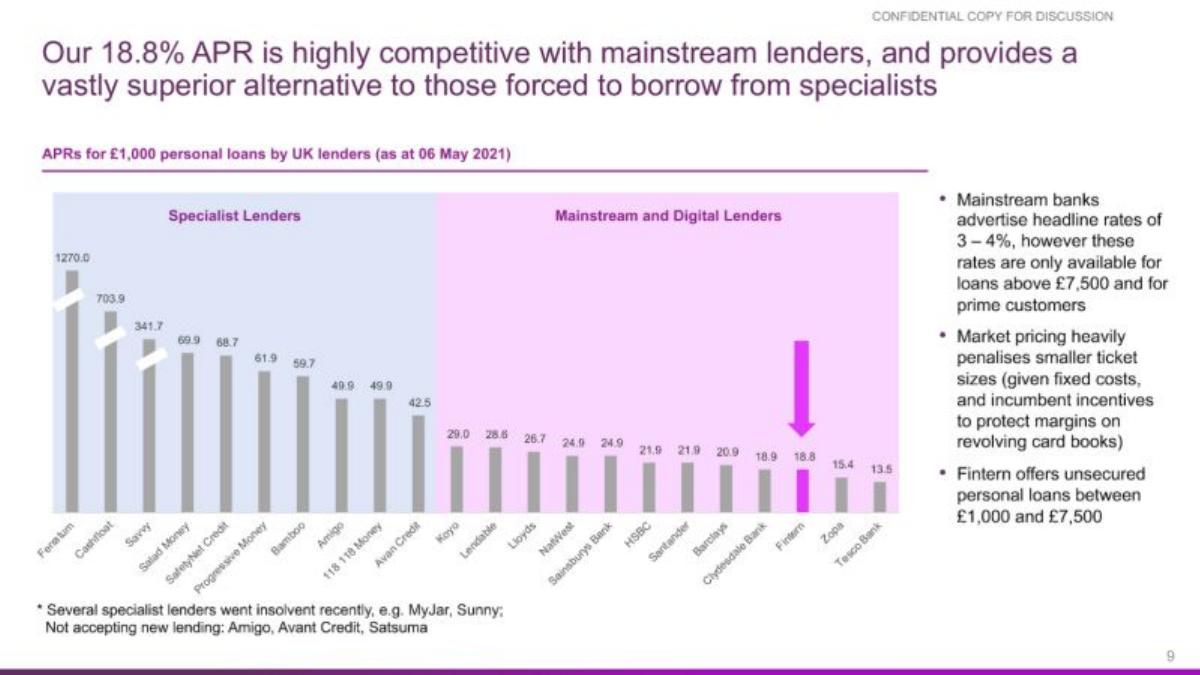
Our analysis: Price, like for like.
Evidence and limitation: One loan size, one date, 21 named lenders, and an honest placement: two lenders (Zopa 15.4%, Tesco Bank 13.5%) are cheaper. The note on 3–4% headline rates heads off the obvious objection. The chart doesn't say which customers get each rate.
What a founder can adapt: "[Rate/fee] for [product, size] from [n] named providers, as at [date]; [why headline rates don't apply]."
Supporting analysis
What the deck claims: "Our 18.8% APR is highly competitive with mainstream lenders, and provides a vastly superior alternative to those forced to borrow from specialists." Chart: "APRs for £1,000 personal loans by UK lenders (as at 06 May 2021)" — specialist lenders from 1270.0% down to 42.5%; mainstream and digital lenders from 29.0% (Koyo) to 13.5% (Tesco Bank), with Fintern at 18.8%. "Mainstream banks advertise headline rates of 3 – 4%, however these rates are only available for loans above £7,500 and for prime customers." "Fintern offers unsecured personal loans between £1,000 and £7,500." Footnote: several specialist lenders insolvent or not accepting new lending.
Presentation choice: Investors can check the claim and see where the company isn't cheapest.
Sri Lankan payments app. The page before (a feature grid) appears in the main competition guide.
PayMaster deck, slide 5. Exact stored slide matched to this analysis.
Our analysis: Adoption, with a source.
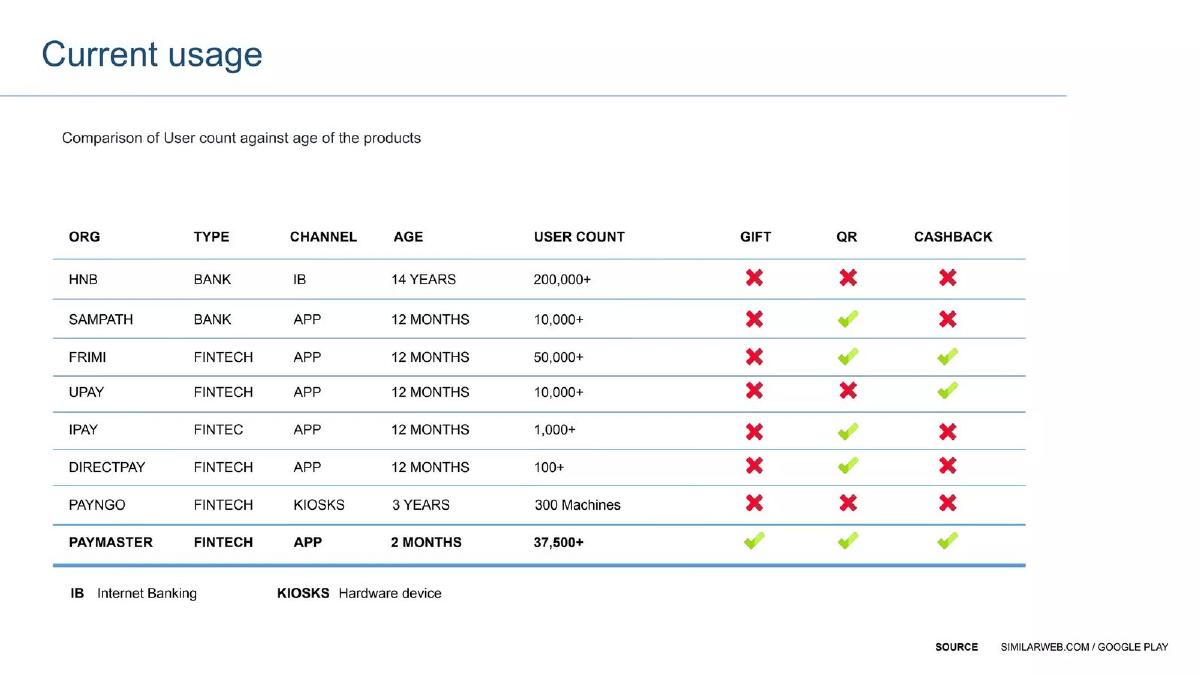
Evidence and limitation: User counts with product age turn a feature grid into adoption. Two months and 37,500+ users against 12-month rivals is a strong comparison, sourced. App-store install bands aren't active users, and the bank's 200,000+ is internet banking, a different product.
What a founder can adapt: "[Rival]: [type], launched [date], [users] ([source, date])." Say whether users are installs or active.
Supporting analysis
What the deck claims: "Current usage — Comparison of User count against age of the products." HNB, bank, internet banking, 14 years, 200,000+. Sampath, bank, app, 12 months, 10,000+. FriMi, fintech, app, 12 months, 50,000+. UPay 10,000+, iPay 1,000+, DirectPay 100+ (all 12 months). PayNGo, kiosks, 3 years, 300 machines. "PayMaster, fintech, app, 2 months, 37,500+." Gift, QR and cashback ticks. Source: "SimilarWeb.com / Google Play."
Presentation choice: It compares how fast customers chose each product, not what each can do.
When it does not fit: Comparing installs with active users.
40Seas deck, slide 13. Exact stored slide matched to this analysis.
Our analysis: Types of rival, fairly scored.
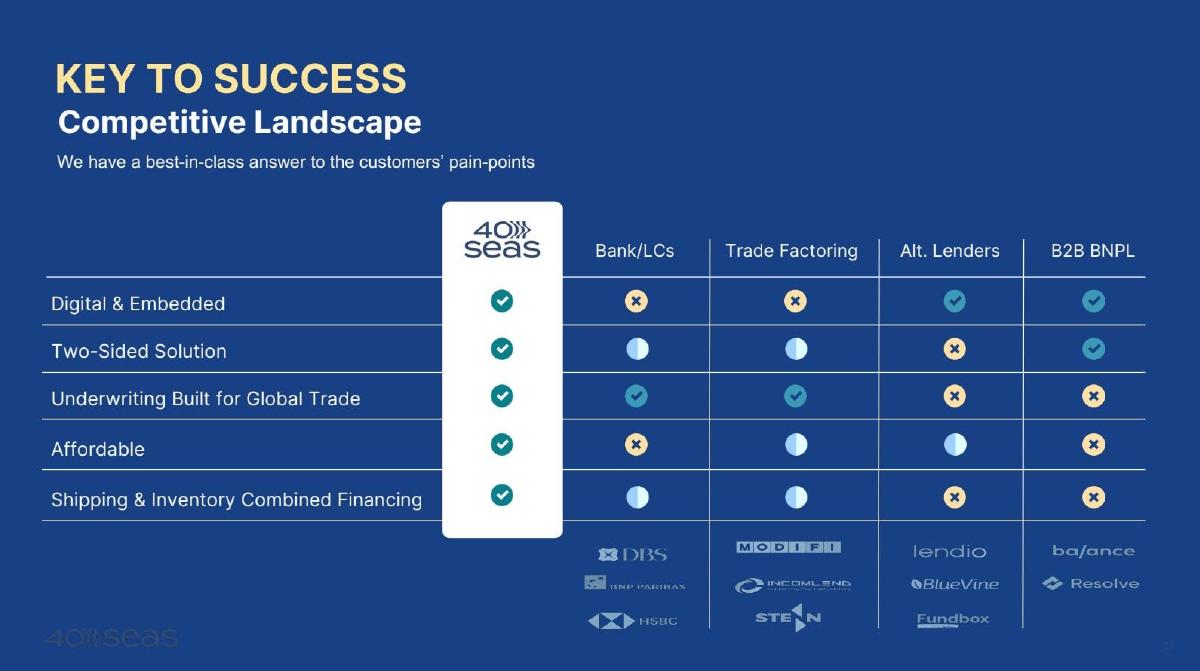
Evidence and limitation: Rivals grouped by type with three names each, and each group gets credit where it has it. "Affordable" has no price behind it.
What a founder can adapt: Keep the groups; replace "affordable" with a rate or fee range per group.
Supporting analysis
What the deck claims: "Key to success — Competitive Landscape. We have a best-in-class answer to the customers' pain-points." Columns: Bank/LCs (DBS, BNP Paribas, HSBC), Trade Factoring (Modifi, Incomlend, Stenn), Alt. Lenders (Lendio, BlueVine, Fundbox), B2B BNPL (Balance, Resolve). Rows: digital and embedded; two-sided solution; underwriting built for global trade; affordable; shipping and inventory combined financing. Banks and factoring tick underwriting for global trade; alternative lenders and BNPL tick digital and embedded; partial marks elsewhere.
Presentation choice: It shows the gap between banks that understand trade and digital lenders that don't.
When it does not fit: Unmeasured rows like "affordable".
Mmob deck, slide 9. Exact stored slide matched to this analysis.
Our analysis: Category map, generous to itself.
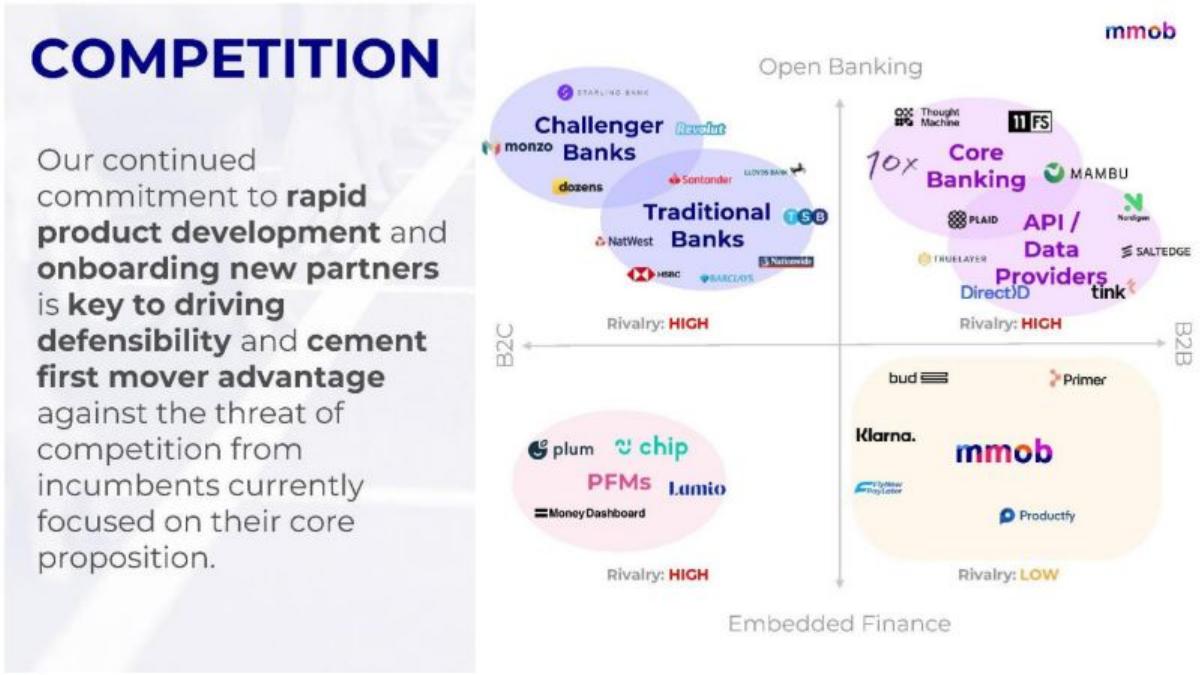
Evidence and limitation: A useful map of where about 30 fintechs and banks sit. But Mmob's own quadrant contains five named rivals and is still marked low rivalry, and the rivalry ratings have no basis.
What a founder can adapt: Keep the map; replace rivalry labels with one reason per quadrant.
Supporting analysis
What the deck claims: "Competition." 2x2: open banking vs embedded finance, B2C vs B2B. Challenger banks (Starling, Monzo, Revolut, Dozens) and traditional banks (NatWest, HSBC, Barclays, TSB, Santander) — "Rivalry: HIGH". Core banking and API/data providers (Thought Machine, 10x, Mambu, Plaid, TrueLayer, Tink) — HIGH. PFMs (Plum, Chip, Lumio, Money Dashboard) — HIGH. Embedded finance B2B: Mmob with Bud, Primer, Klarna, Fly Now Pay Later, Productfy — "Rivalry: LOW". Text: rapid product development and onboarding partners "is key to driving defensibility and cement first mover advantage."
Presentation choice: It orients an investor in a crowded field quickly.
When it does not fit: Calling your own crowded quadrant low rivalry.
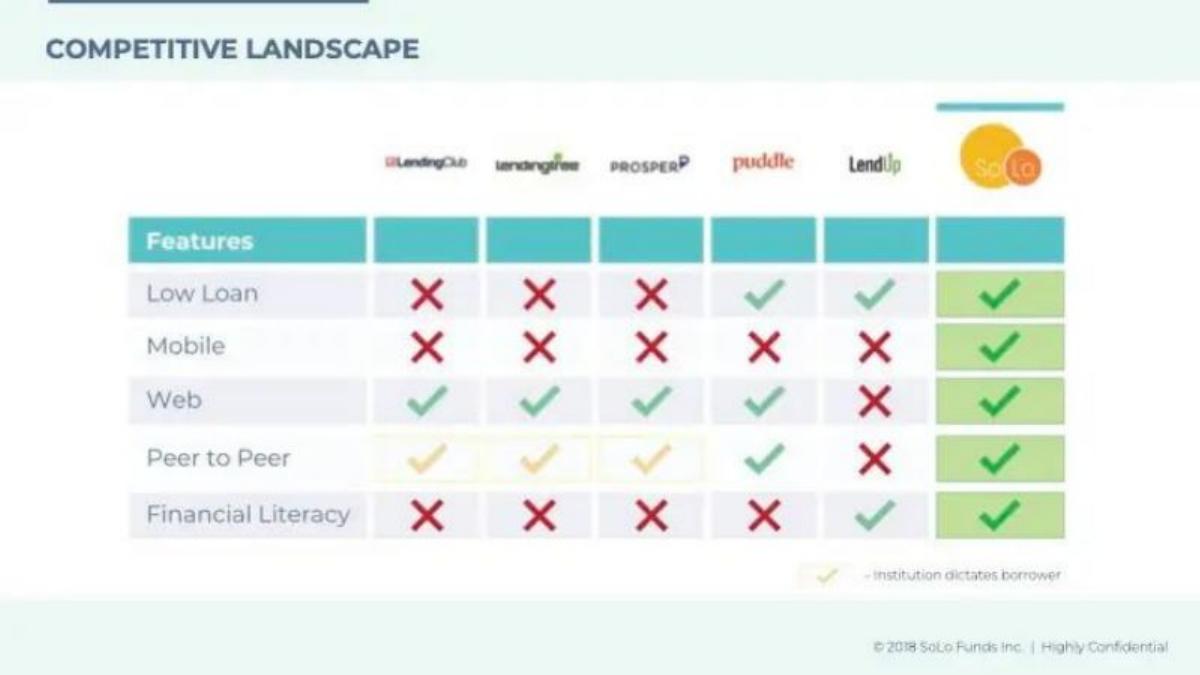
Peer-to-peer small-dollar lending (2018 deck). Another page appears in the fintech solution guide.
SoLo Funds deck, slide 8. Exact stored slide matched to this analysis.
Our analysis: Named rivals, weak rows.
Evidence and limitation: Named rivals and some credit given, and the footnote explains a real difference in how peer-to-peer works. But "mobile" and "web" are channels, not reasons to choose, and no price or loan size is shown.
What a founder can adapt: Replace "mobile" and "web" with loan size and cost: "$[x]–$[y], [fee]" per rival.
Supporting analysis
What the deck claims: "Competitive Landscape." LendingClub, LendingTree, Prosper, Puddle, LendUp, SoLo. Features: low loan, mobile, web, peer to peer, financial literacy. SoLo ticks all five; Puddle and LendUp tick low loan; LendingClub, LendingTree and Prosper get a lighter tick for peer to peer, footnoted "Institution dictates borrower".
Presentation choice: The footnote is the most useful thing on the slide.
When it does not fit: Channels as competitive rows.
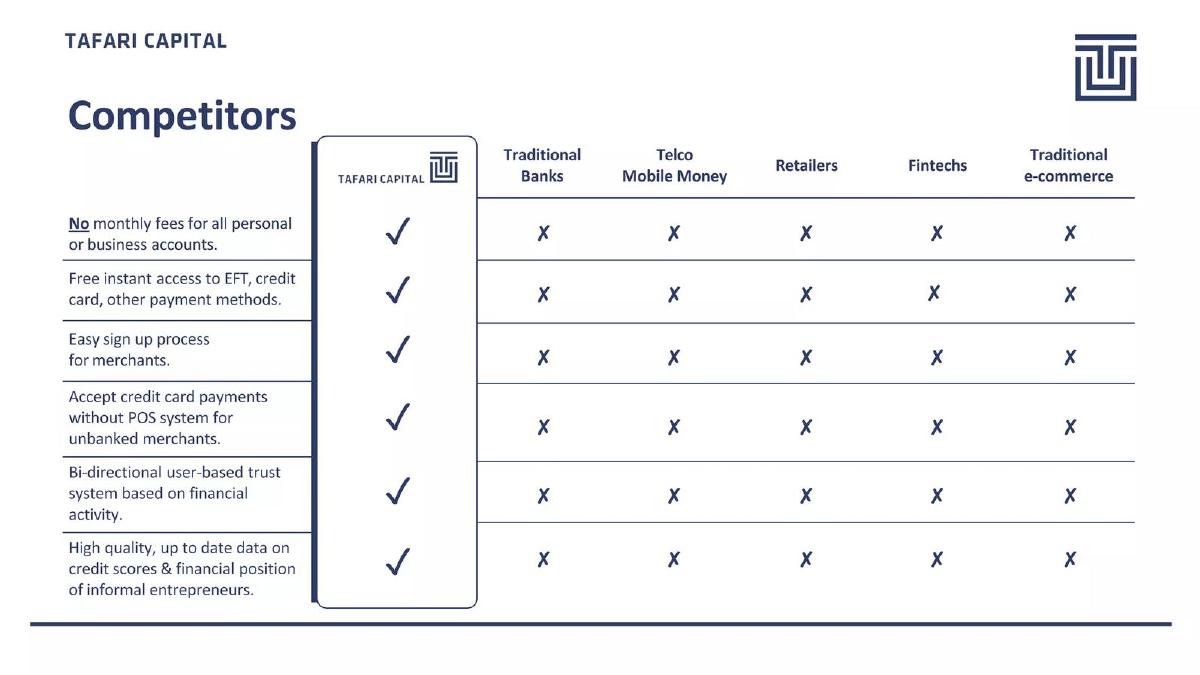
South African payments and credit for informal businesses. Weaker example.
Tafari Capital deck, slide 16. Exact stored slide matched to this analysis.
Our analysis: Every box ticked.
Evidence and limitation: No rival is named, and "fintechs" failing all six rows — including easy merchant sign-up — is hard to believe. Types without names can't be checked.
What a founder can adapt: Name two rivals per type and give each the ticks it earns.
Supporting analysis
What the deck claims: "Competitors." Columns: traditional banks, telco mobile money, retailers, fintechs, traditional e-commerce. Rows: "No monthly fees for all personal or business accounts"; "Free instant access to EFT, credit card, other payment methods"; "Easy sign up process for merchants"; "Accept credit card payments without POS system for unbanked merchants"; "Bi-directional user-based trust system based on financial activity"; "High quality, up to date data on credit scores & financial position of informal entrepreneurs." Tafari ticks all six rows; every rival type fails every row.
Presentation choice: Shows why an all-ticks grid reads as not knowing the market.
When it does not fit: Rival categories that fail every row.
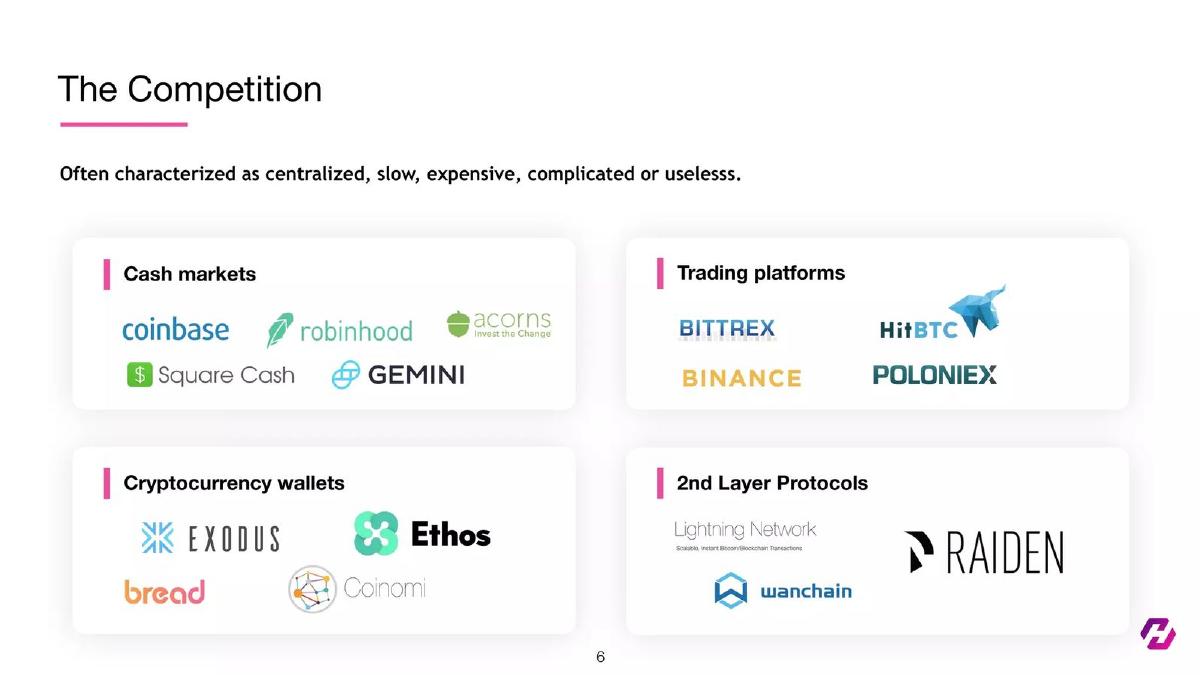
Crypto wallet and trading app. Weaker example; another page appears in the fintech solution guide.
Hoard deck, slide 6. Exact stored slide matched to this analysis.
Our analysis: Logos grouped, nothing compared.
Evidence and limitation: A clear grouping of 16 rivals, but no comparison at all: the one line of critique applies to all of them without saying which is slow and which expensive.
What a founder can adapt: Per group: "[group] charges [fee] / takes [time]; we [number]."
Supporting analysis
What the deck claims: "The Competition. Often characterized as centralized, slow, expensive, complicated or useless." Four groups of logos: cash markets (Coinbase, Robinhood, Acorns, Square Cash, Gemini); trading platforms (Bittrex, HitBTC, Binance, Poloniex); cryptocurrency wallets (Exodus, Ethos, Bread, Coinomi); 2nd layer protocols (Lightning Network, Raiden, Wanchain).
Presentation choice: Grouping is a start; the comparison is missing.
When it does not fit: One insult for every competitor.
Explain where incumbents' headline prices don't apply.
Group rivals by type: banks, fintechs, specialists.
Give rivals credit where they have it.
Write your fintech competition slide
Start from the number customers compare.
Price. What rate, fee or margin would a customer compare, for what product size?
Rivals. Which banks, fintechs and specialists does a customer consider?
Source. Where did each figure come from, and on what date?
Incumbents. Why can't the bank simply match you?
Copyable framework: [Product, size]: us [rate/fee] vs [rival] [rate/fee], [rival] [rate/fee] (as at [date], [source]). Banks: [why headline rate doesn't apply].
Illustrative example 1 — written by us
Before: Traditional banks ✗ ✗ ✗ ✗ ✗ ✗ — Tafari Capital ✓ ✓ ✓ ✓ ✓ ✓
After: Monthly fee: us R0; [bank] R[x]; [mobile money provider] R[y] (as at [date]).
What improved: Our illustrative rewrite of Tafari Capital's grid; bracketed text is a placeholder, not company fact.
What's different about fintech competition
Financial products have prices customers compare directly: APR, fees, exchange margins. That lets a fintech show competition as a number instead of a feature list. Rivals also come in kinds that behave differently — banks with customers and cheap funding, fintechs with similar products, specialists with high prices — so the grouping matters as much as the names.
What investors check
Whether a price comparison is like for like: same loan size, same customer, same date. Whether a bank could match the offer, and why it hasn't. Whether the grid's rows are ones customers choose by, or ones picked so only the startup qualifies. Licences are covered in the fintech licence guide.
How we read each slide
We quote the text on the slide images. We have not checked competitor prices, user counts or features. None of these pages was in our stored image set, so we rendered each from the original deck file in our library.
Common mistakes
Every box ticked. Give rivals the ticks they earn.
Unmeasured rows. Replace "affordable" with a price.
Undated prices. Rates change; show the date.
Installs as users. Say what the count measures.
Types, not names. Name at least two rivals per type.
Diagnostic checklist
One measurable comparison: price, rate or users.
Every figure dated and sourced.
Cheaper or bigger rivals shown.
Why banks don't match you.
Frequently asked questions
How should a fintech show competition in a pitch deck?
Compare on something customers choose by — rate, fee or users — with a date and source. Fintern plots its 18.8% APR against 21 UK lenders for a £1,000 loan as at 6 May 2021; PayMaster lists rivals' user counts from SimilarWeb and Google Play.
Should I include banks on a fintech competition slide?
Yes, and explain why they don't already win. Fintern notes that banks' 3–4% headline rates apply only to loans above £7,500 for prime customers. 40Seas credits banks with trade underwriting while marking them down on digital delivery.
How we chose these examples
Corpus: published pitch deck teardowns on StartupFundraising.com. Founder-uploaded private decks are excluded.
Selection (2026-09-26): we searched fintech teardowns for competition headings naming banks, lenders or fintechs, rendered nine candidate decks with neighbouring pages, and kept seven.
Excluded: Card Blanch (its competition slide is already in the main competition guide), Mambu (deck file not found in our library). PayMaster's feature grid is in the main guide; we use its separate user-count page here.
None of the chosen pages was in our stored image set; we rendered them from the original deck PDFs and stored them with the existing slide-image workflow. All seven decks were confirmed as published teardowns on 2026-09-26.
Competitor prices, user counts and features are quoted from the slides and not independently verified.
Review: slide images were checked on 2026-09-26 and matched to company, deck and page (editorial model review). No person has yet completed an editorial review of this page. We make no claim that any slide caused a fundraising outcome.