40Seas, a Middle Eastern fintech startup, raised $6M in Seed funding in 2023 with a deck that prioritizes market magnitude and institutional credibility. The presentation identifies a massive $3T annual financial loss in global trade, attributed to outdated manual processes and restricted access to capital. By positioning itself as a 'two-sided' digital platform that combines flexible financing with SaaS workflows, 40Seas targets the inefficiencies between importers and exporters. The deck is notable for its 'Key Facts' slide, which reveals a significant $100M credit facility alongside its eq…
Key takeaways
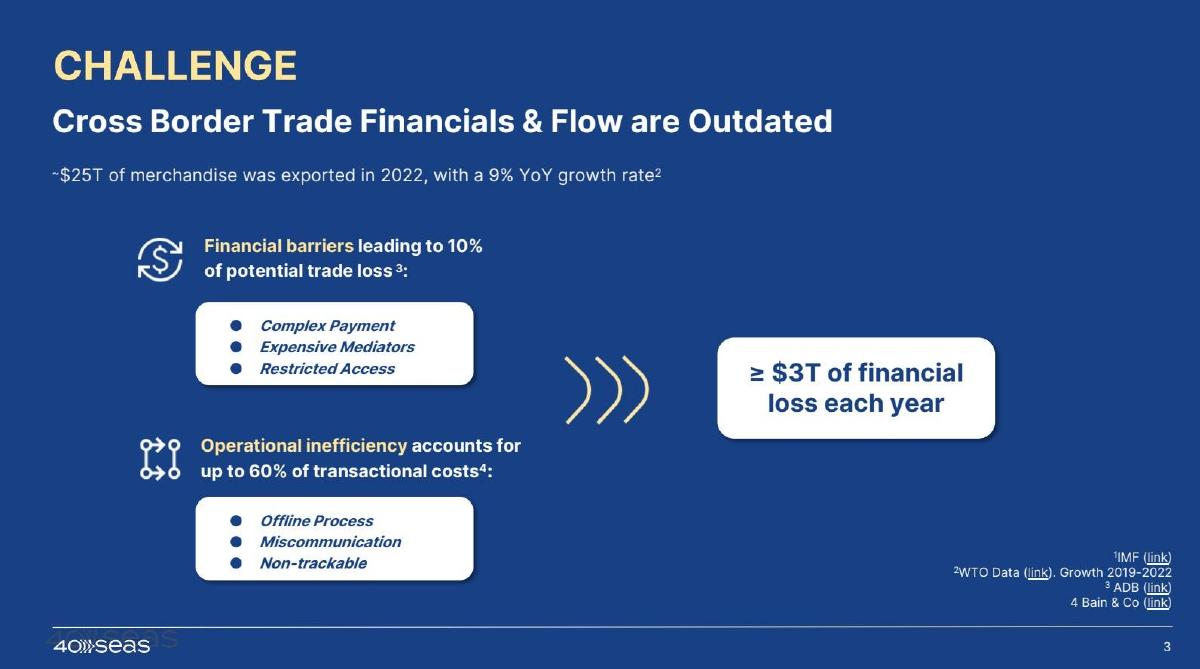
- The deck identifies a massive market opportunity, citing $25T in exported merchandise in 2022 and a $3T annual financial loss due to inefficiencies (Slide 3).
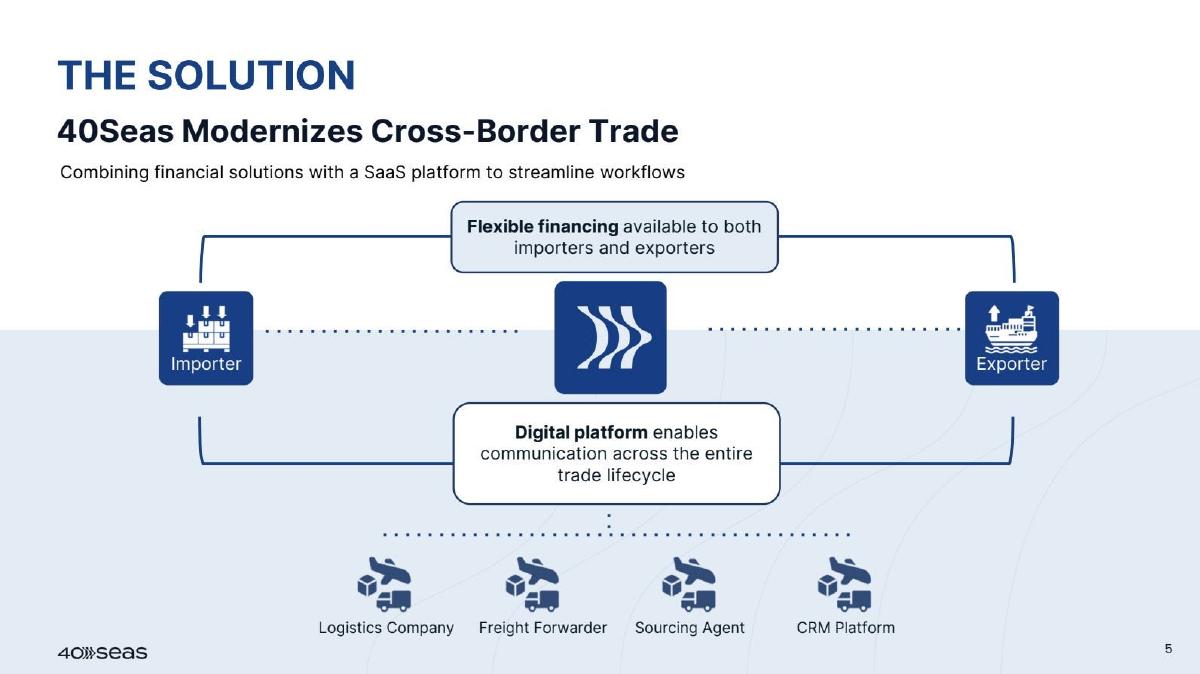
- 40Seas positions its solution as a hybrid of flexible financing and a SaaS communication platform for the entire trade lifecycle (Slide 5).
- The business model relies on paying exporters upon shipment and collecting from importers on the invoice due date, supported by internal underwriting (Slide 7).
- The company highlights a significant $100M credit facility in addition to its $17M Seed round, signaling high institutional confidence (Slide 11).
- The team's pedigree is a central selling point, featuring experience from Amazon, Ant Financial, AliExpress, and Payoneer (Slide 11).
- 40Seas differentiates itself from traditional banks and B2B BNPL players by offering 'Shipping & Inventory Combined Financing' (Slide 13).
- The deck lacks a dedicated slide for unit economics, customer acquisition costs, or specific revenue projections.
- The competitive landscape slide explicitly names rivals like Modifi, BlueVine, and Resolve to demonstrate market awareness (Slide 13).
40Seas: A Masterclass in High-Signal Fintech Credibility
The 40Seas pitch deck is a lean, 14-slide presentation that successfully navigated the difficult 2023 fundraising environment to secure a $6M Seed round (with the deck claiming a total of $17M in equity and a $100M credit facility). The deck is a textbook example of how to pitch a complex B2B fintech solution by focusing on market enormity, operational friction, and team pedigree. It avoids the trap of over-explaining the technology, instead focusing on the flow of capital and the reduction of 'friction' in a $25T market.
Slide 1-2: Title and Branding
The deck opens with a clean, professional aesthetic. The tagline 'Streamlining Cross Border Trade' is simple and direct. The use of maritime imagery (shipping containers and ports) immediately anchors the company in the physical reality of global logistics, despite being a digital fintech solution. There is no fluff here; the deck moves straight to the macro-economic context.
Slide 3: The Challenge
Slide 3 is the 'hook.' It establishes the scale of the problem using high-authority data sources like the IMF, WTO, and ADB. By stating that $25T of merchandise was exported in 2022 and that inefficiencies lead to ≥ $3T of financial loss each year , 40Seas makes the case that even a small improvement in efficiency represents a multi-billion dollar opportunity. The slide breaks the 'Challenge' into two buckets: Financial (complex payments, restricted access) and Operational (offline processes, non-trackable). This dual-threat approach justifies why a combined 'Financing + SaaS' solution is necessary.
Slide 5: The Solution Overview
This slide introduces the 40Seas ecosystem. It positions the company as the central hub between the Importer and the Exporter. Crucially, it mentions that the platform is a 'Digital platform [that] enables communication across the entire trade lifecycle.' By including icons for Logistics Companies, Freight Forwarders, and Sourcing Agents at the bottom, 40Seas signals that they aren't just a payment button, but a workflow tool that integrates with the existing supply chain stack.
Slide 7: The Mechanics of 'How do we do it?'
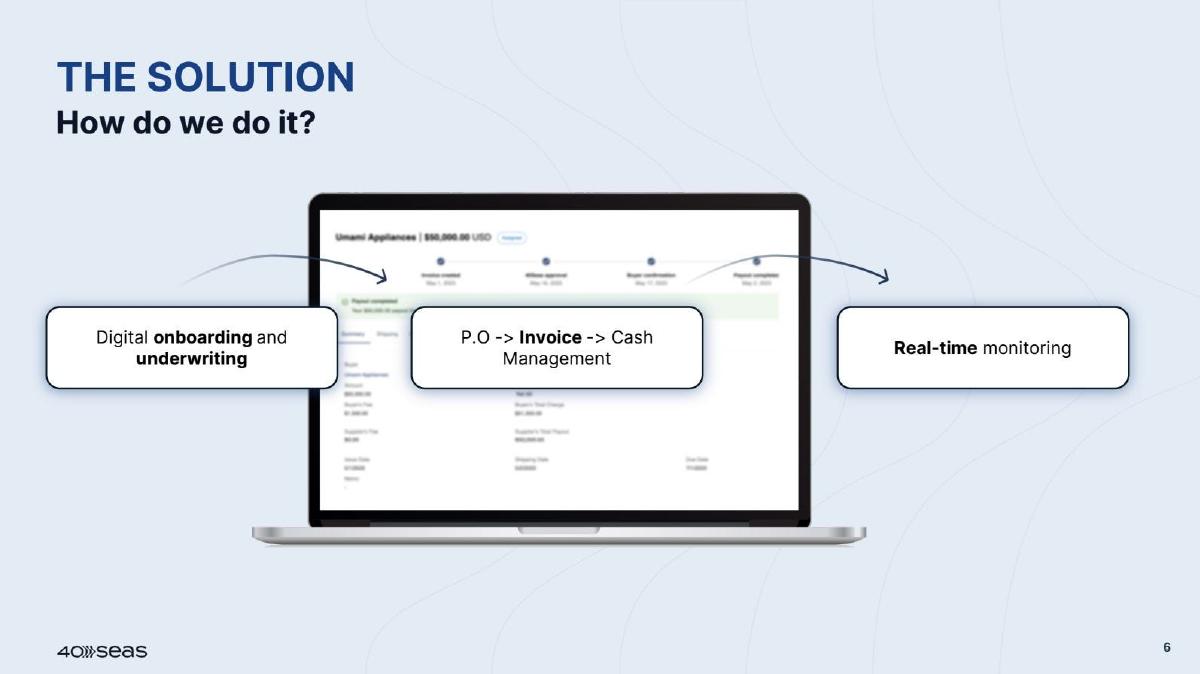
Slide 7 explains the transaction flow, which is essential for any fintech deck. The process is a circular flow: The Importer chooses terms, 40Seas pays the Exporter upon shipment, and then 40Seas collects from the Importer on the invoice due date. The bottom of the slide highlights two internal core competencies: Underwriting and Risk and Payment Reconciliation . This tells investors that 40Seas is taking on the hard work of risk assessment, which is where the value (and the moat) lies in trade finance.
Slide 9: Removing Friction
This slide acts as a bridge between the problem and the specific benefits. It uses a 'Pain vs. Solution' framework. Under 'Pain,' it lists 'Endless paperwork' and 'Costly financing.' Under '40Seas Solution,' it promises 'Full digitization' and 'Working Capital.' The 'Overall Benefits' column (Cost Reduction, Risk Reduction, Enhanced Trust) serves as the value proposition for the end customer. This slide is effective because it translates technical features into business outcomes.
Slide 11: Key Facts and Pedigree
This is arguably the strongest slide in the deck. It lists four 'Key Facts': Founded in 2022, Raised $17M (Seed) + $100M credit facility , 15 FTE headcount, and global locations (Tel-Aviv, Shenzhen, Toronto, NY). The mention of a $100M credit facility is a massive signal to investors; it means institutional lenders have already vetted their underwriting model and are willing to provide the debt capital necessary to scale. The 'Early Employees & Advisors' section is a 'logo wall' of giants: Amazon, Ant Financial, AliExpress, and Payoneer . This slide screams 'execution capability' and 'market expertise.'
Slide 13: Competitive Landscape
The final content slide is a classic competitive matrix. 40Seas compares itself against Banks/LCs, Trade Factoring, Alt. Lenders, and B2B BNPL. It claims to be the only solution that is 'Digital & Embedded,' 'Two-Sided,' 'Affordable,' and offers 'Shipping & Inventory Combined Financing.' By naming specific competitors like Modifi, BlueVine, and Resolve , the founders show they have a realistic understanding of the market. The 'Shipping & Inventory Combined Financing' row is their claimed 'unfair advantage,' suggesting they finance the goods and the transit, which others do not.
What 40Seas Does Well
The 40Seas deck excels at signal density . In just 14 slides, it communicates a massive TAM, a clear product-market fit, and a team that has 'been there, done that' at the highest levels of global fintech. The inclusion of the $100M credit facility is a masterstroke for a Seed-stage company, as it removes the 'how will you fund the loans?' question that kills most lending startups. The visual design is consistent, professional, and uses white space effectively to keep the focus on the data points.
What is Missing from the 40Seas Deck
Despite its strengths, the deck has notable omissions that a Series A investor would likely demand. First, there is no mention of unit economics . We don't know the take rate, the cost of capital, or the expected default rates. Second, there is no traction data . While the deck mentions the team and the funding, it doesn't state how many transactions have been processed or what the current GMV (Gross Merchandise Volume) is. Finally, the Go-To-Market (GTM) strategy is vague . It mentions being 'embedded,' but doesn't explain which platforms they are embedding into or what their primary acquisition channels are.
What Founders Should Copy
Founders in complex industries (Fintech, Healthtech, Insurtech) should copy the 'Key Facts' slide (Slide 11) . Instead of long-winded bios, 40Seas uses high-authority logos to establish trust instantly. Additionally, the 'Challenge' slide (Slide 3) is a perfect example of how to use third-party data to validate a problem. If you are solving a multi-trillion dollar problem, you must prove the math with sources like the IMF or WTO. Finally, the transaction flow diagram (Slide 7) is a must-have for any company that moves money; it simplifies a complex back-end process into a digestible three-step loop that any investor can understand.
Frequently asked questions
- How much did 40Seas raise with this deck?
- According to publisher-reported facts from Business Insider, 40Seas raised $6M in a Seed round in 2023. However, Slide 11 of the deck itself notes a total of $17M raised in Seed funding plus a $100M credit facility, suggesting the deck may have been updated during the fundraising process or reflects total capital commitments.
- What is the core problem 40Seas is solving?
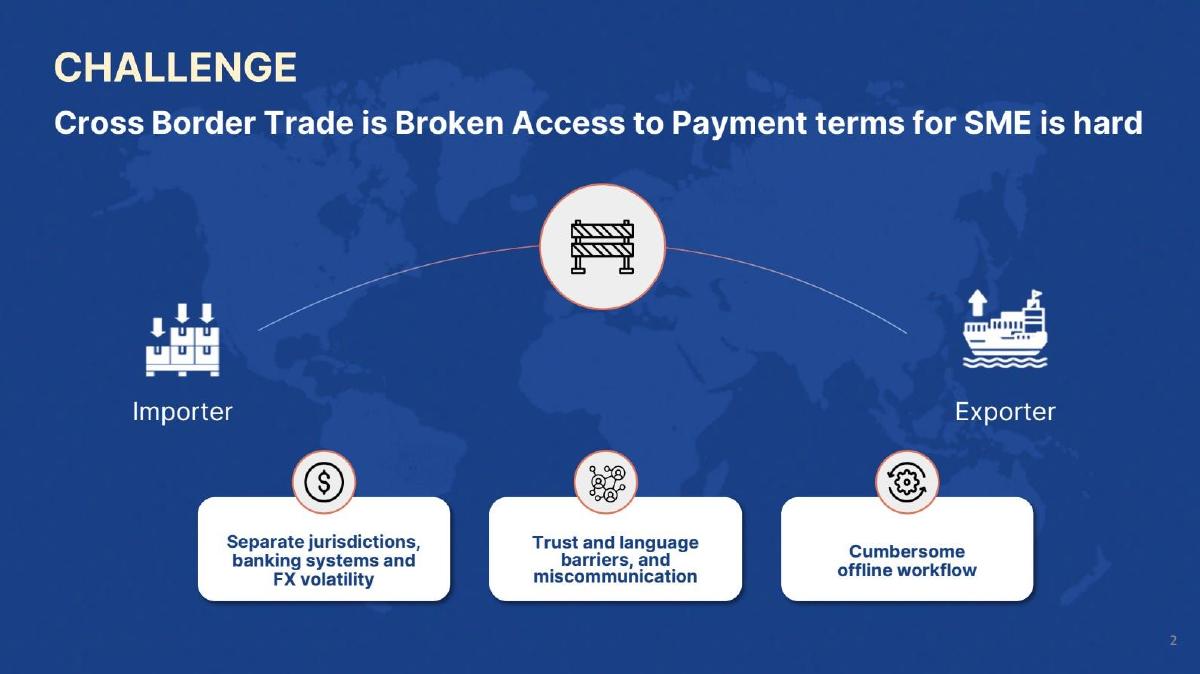
- The deck focuses on 'outdated' cross-border trade financials. Slide 3 quantifies this as a $3T annual loss, driven by financial barriers (complex payments, expensive mediators) and operational inefficiencies (offline processes, lack of tracking) that account for up to 60% of transactional costs.
- Who are the primary users of the 40Seas platform?
- Slide 5 illustrates a two-sided ecosystem. The primary users are Importers and Exporters, but the platform also integrates with Logistics Companies, Freight Forwarders, Sourcing Agents, and CRM platforms to streamline the entire trade lifecycle.
- What makes the 40Seas team unique?
- The deck leans heavily on institutional pedigree rather than individual bios. Slide 11 highlights that early employees and advisors come from global fintech and e-commerce leaders including Amazon, Ant Financial, AliExpress, and Payoneer, providing immediate credibility in cross-border trade.
- How does 40Seas compare to traditional banks?
- Slide 13 shows that while banks offer underwriting, they fail in 'Digital & Embedded' solutions and 'Affordability.' 40Seas claims to be the only player offering a 'Two-Sided Solution' combined with 'Shipping & Inventory Combined Financing,' which traditional banks and alternative lenders lack.