The 43 Layers pitch deck is a model of brevity, utilizing just 10 slides to communicate a marketplace for mass-customized event goods. The deck excels by moving quickly from a massive $130B total addressable market to a highly specific $30B wedding beachhead. It leans heavily on visual evidence of the product in the real world, showing custom cufflinks and cake toppers to bridge the gap between 'customization' and 'utility.' Most impressively, it showcases a 290% compounded monthly growth rate in its early months, albeit starting from a very low base. While it lacks a formal 'Ask' slide and d…
Key takeaways
- The deck identifies a $130B annual spend on weddings and other life events as the primary market opportunity on slide 2.
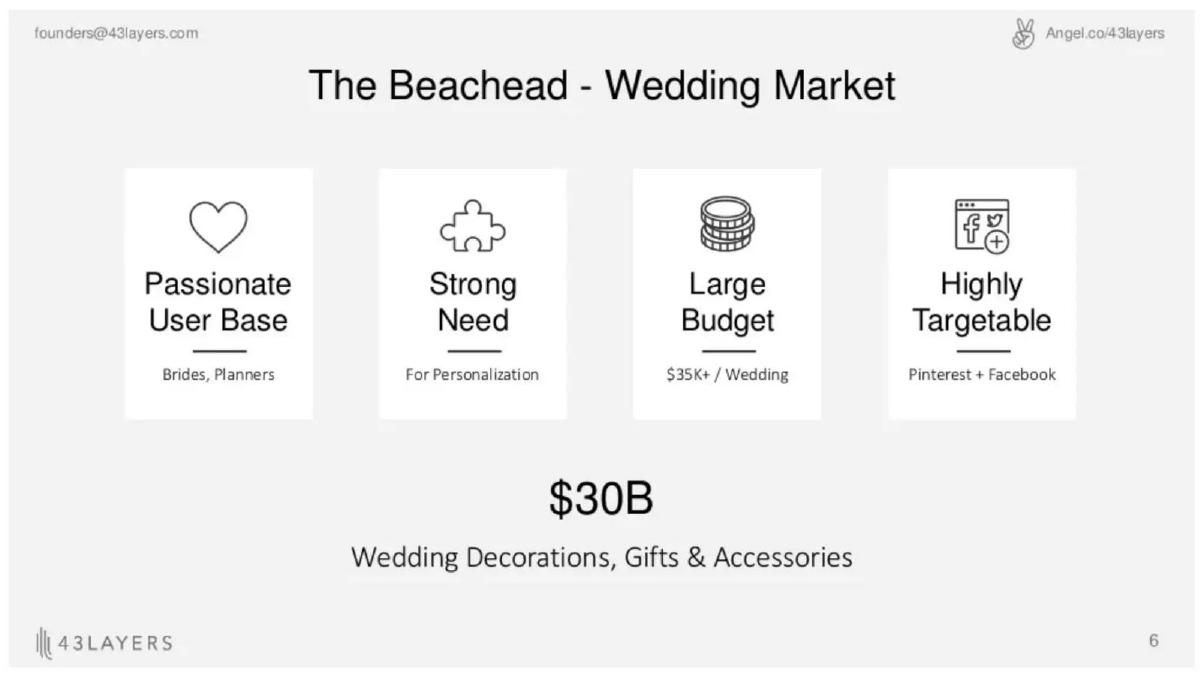
- A specific beachhead strategy is defined on slide 6, targeting the $30B wedding decorations, gifts, and accessories market.
- The business model relies on a 35% take rate, as explicitly stated on the metrics slide (slide 8).
- Early traction shows a 290% compounded monthly growth rate between July and October, reaching over $8,000 in monthly revenue (slide 7).
- The product offers two distinct user paths: a 'Self Serve' interface and a 'Connect with a Designer' option (slide 3).
- High-value transactions are highlighted with an Average Order Value (AOV) of $340 on slide 8.
- The team slide (slide 9) emphasizes relevant industry experience with logos from Gilt, Autodesk, and Raymond James.
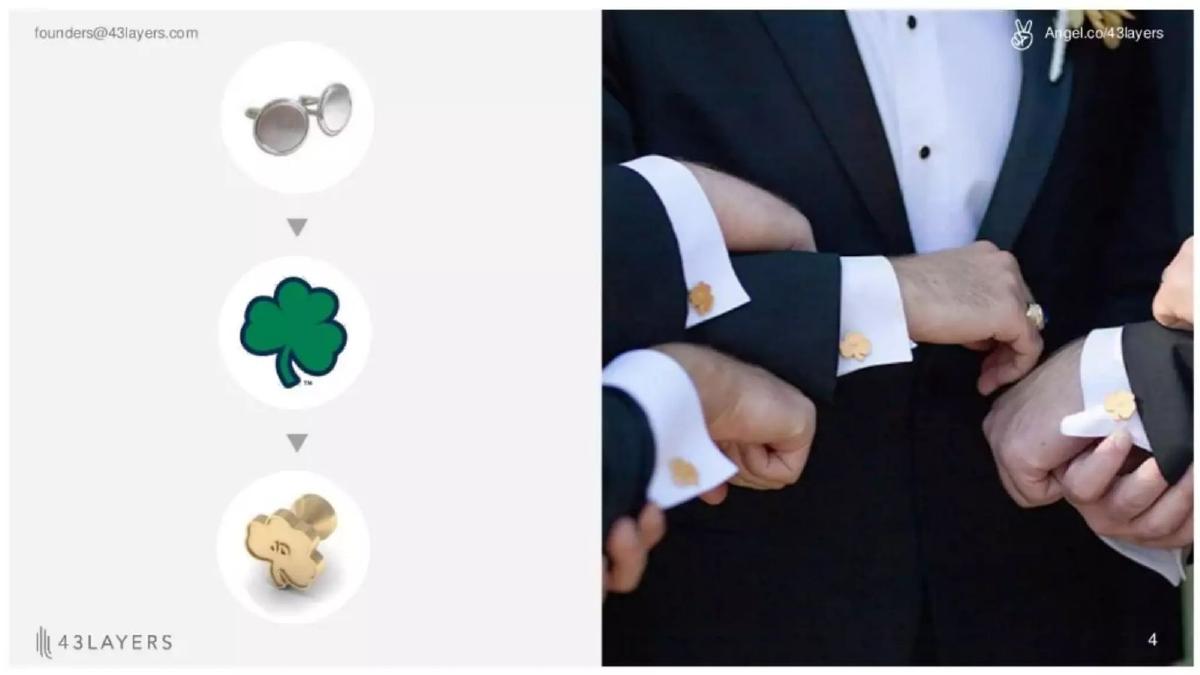
- Visual proof is prioritized over text, with slides 4 and 5 dedicated entirely to showing finished custom products in use.
The 43 Layers Pitch Deck: A Study in Minimalist Traction
The 43 Layers pitch deck, dating from 2014, is a lean 10-slide presentation that focuses on the high-growth potential of the custom e-commerce market. At a time when 3D printing and mass customization were emerging as viable consumer trends, 43 Layers sought to bridge the gap between complex design tools and the average consumer planning a major life event. The deck is notable for its extreme brevity and its reliance on visual storytelling over dense data blocks.
Slides 1-2: The Hook and the Macro Problem
Slide 1: Title Slide The deck opens with a stark black background, the company logo, and the tagline: "You dream it. We make it." This is a classic 'B2C' style opening—simple, aspirational, and focused on the end-user benefit rather than the underlying technology. It includes contact information and a link to their AngelList profile in the corners, which was a common practice for seed-stage startups in the mid-2010s.
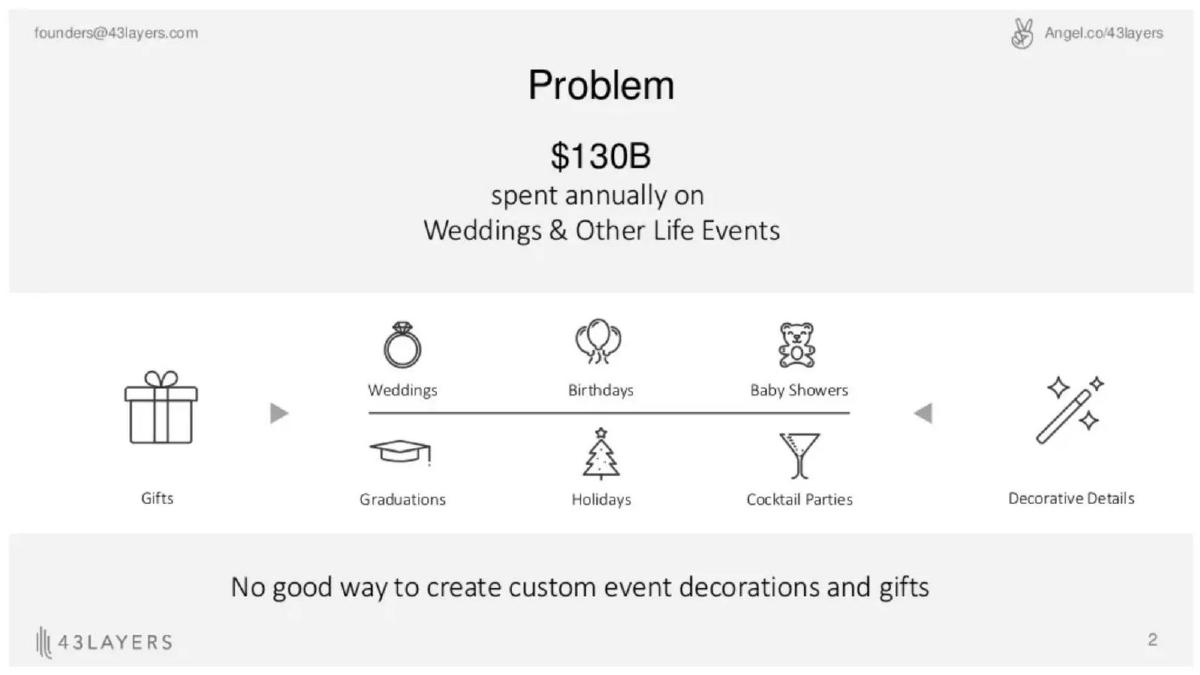
Slide 2: The $130B Problem Slide 2 identifies the market opportunity. It cites a $130B annual spend on "Weddings & Other Life Events." The slide uses icons to represent the various categories they intend to disrupt: Gifts, Weddings, Birthdays, Baby Showers, Graduations, Holidays, Cocktail Parties, and Decorative Details. The problem statement at the bottom is concise: "No good way to create custom event decorations and gifts." By framing the problem this way, they are positioning themselves against generic, mass-produced items found at big-box retailers.
Slides 3-5: The Solution and Visual Proof
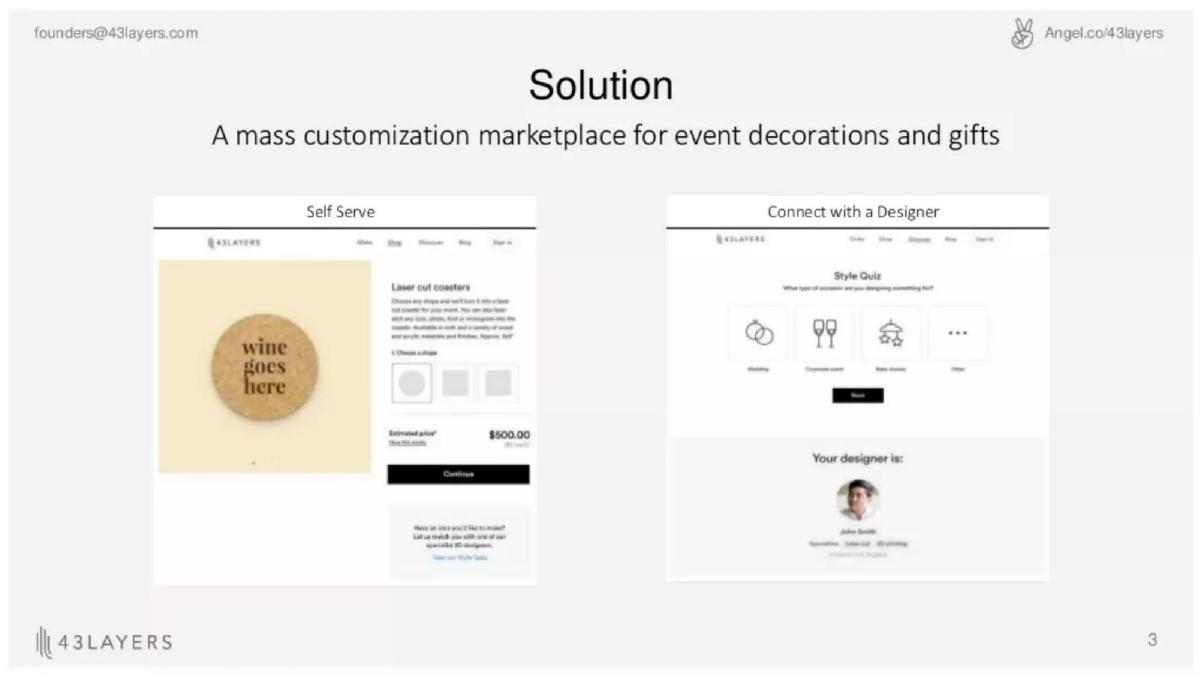
Slide 3: The Marketplace Solution This slide defines the product as a "mass customization marketplace." It shows two distinct user journeys through website screenshots. The first is "Self Serve," featuring a laser-cut coaster with an estimated price of $500.00 . The second is "Connect with a Designer," which uses a "Style Quiz" to match users with a specialist. This dual-path approach suggests the company is trying to capture both the low-touch, high-volume market and the high-touch, premium market.
Slide 4: Product Visualization (Cufflinks) Slide 4 is almost entirely visual. It shows a three-step process: a blank cufflink, a logo (a shamrock), and the finished 3D-rendered product. To the right, a high-quality lifestyle photo shows the finished product being worn at a wedding. This is a critical slide because it proves the "customization" isn't just theoretical—it results in a tangible, high-quality physical good.
Slide 5: Product Visualization (Cake Toppers) Continuing the visual proof, slide 5 shows a custom wedding cake topper. It compares a generic topper to a custom-made version that replicates the actual couple's clothing (specifically, t-shirts from "Joe Jost's"). This slide reinforces the emotional value of the product; it’s not just a decoration, it’s a personalized artifact of the event.
Slides 6-8: The Beachhead and The Data
Slide 6: The Beachhead - Wedding Market Realizing that "Life Events" is too broad for a seed-stage startup, slide 6 narrows the focus to the Wedding Market. They value this specific segment at $30B for decorations, gifts, and accessories. They list four reasons for this choice: a Passionate User Base (Brides, Planners), a Strong Need for personalization, a Large Budget ( $35K+ per wedding ), and the fact that the audience is Highly Targetable via Pinterest and Facebook. This is the strongest strategic slide in the deck, as it shows a clear path to market entry.
Slide 7: Traction The traction slide shows a revenue bar chart from July to October. While the absolute numbers are small—starting at near-zero and reaching just over $8,000 in October—the growth curve is aggressive. The deck highlights a 290% Compounded Monthly Growth rate. The October bar includes a "Projected" segment (light gray), suggesting this deck was likely finalized in mid-to-late October.
Slide 8: Metrics Slide 8 provides three key data points that define the business model's health:
$340 Average Order Value: This is exceptionally high for a consumer gift marketplace and explains how they can achieve significant revenue with a smaller user base. · 35% Take Rate: This is a healthy margin for a marketplace, significantly higher than the 10-20% typically seen in commodity marketplaces. · 29% Repeat Purchase Rate: For an event-based business, nearly 30% of customers returning is a strong indicator of product-market fit.
Slides 9-10: The Team and Closing
Slide 9: Team The team slide features three founders: TJ Ross (CEO), BJ Terry (Product), and Emerson Knapp (Engineering). Rather than long bios, they use logos to establish credibility. The logos include Gilt, Autodesk, Raymond James, and Revolution Partners . This suggests a team that understands high-end e-commerce (Gilt), design software (Autodesk), and finance/M&A (Raymond James).
Slide 10: Thank You The final slide is a simple "Thank you!" over a lifestyle image of custom drink stirrers. It repeats the contact email and AngelList link. Notably, there is no "Ask" slide here—no mention of how much they are raising or what the valuation is.
What Works in the 43 Layers Deck
The primary strength of this deck is its visual clarity . In a business that sells aesthetics, the deck itself must be aesthetic. The use of high-quality lifestyle photography (slides 4, 5, and 10) bridges the gap between a tech platform and a luxury goods company. It makes the "mass customization" concept feel premium rather than "DIY."
The Metric Selection on slide 8 is also highly effective. By highlighting a $340 AOV, the founders immediately answer the investor's question: "Can you make enough money per customer to offset acquisition costs?" In the wedding industry, where customer acquisition is notoriously expensive, a high AOV is a prerequisite for survival. The 35% take rate further reinforces that this is a high-margin opportunity, not a low-margin logistics play.
Finally, the Beachhead Strategy (slide 6) shows maturity. Many early-stage founders try to claim the entire $130B market at once. By explicitly stating that they are starting with the $30B wedding niche because it is "highly targetable," they demonstrate a realistic understanding of marketing and operations.
What is Missing from the 43 Layers Deck
The most glaring omission is The Ask . A pitch deck is a fundraising tool, yet this deck fails to state how much capital is being sought, the terms of the round, or the specific milestones the team intends to hit with the new funding. This forces the investor to ask for basic information that should have been used to frame the entire conversation.
There is also a complete lack of Competitive Analysis . In 2014, companies like Etsy were already dominant in the handmade and custom space, and 3D printing startups like Shapeways were gaining traction. 43 Layers does not explain how it differs from these incumbents or why a bride would choose their platform over an established seller on Etsy.
Furthermore, the Supply Side of the marketplace is a mystery. The deck says "We make it," but it doesn't explain if they own the manufacturing equipment, use a network of local makers, or outsource to a centralized factory. For a marketplace, the supply-side dynamics are just as important as the demand-side metrics, and this deck ignores them entirely.
What a Founder Should Copy
Founders should emulate the Traction Visualization on slide 7. Even though the revenue is low in absolute terms ($8k/month), the use of a compounded growth percentage and a clear bar chart makes the progress feel inevitable. It focuses the investor on the velocity of the business rather than the current scale.
The "Show, Don't Tell" approach to product on slides 4 and 5 is also worth copying. Instead of explaining the technical specifications of their customization engine, they show a shamrock becoming a cufflink. This is much more persuasive to an investor who may not be a technical expert but can easily understand the value of a finished, personalized product.
Lastly, the Metric Slide (slide 8) is a masterclass in picking the three numbers that matter most. By focusing on AOV, Take Rate, and Repeat Rate, they cover the three pillars of marketplace unit economics: transaction size, platform power, and customer loyalty. Every seed-stage deck should have a version of this slide that distills the business model into its most vital signs.
Company: 43 Layers · Sector: E-Commerce / Marketplace · Stage: Seed · Year: 2014 · Slides: 10 · Deck Type: Seed Pitch Deck · Outcome: Raised Seed Funding (Amount not specified in deck) · HQ: Not specified in deck
Frequently asked questions
- What is the core value proposition of 43 Layers?
- 43 Layers positions itself as a mass customization marketplace for event decorations and gifts. The value prop is summarized by the tagline 'You dream it. We make it.' on slide 1. It aims to solve the problem that there is 'no good way to create custom event decorations and gifts' by providing both a self-serve platform and access to professional designers to create high-quality, personalized items for life events.
- How does the company plan to acquire customers?
- According to slide 6, the company views the wedding market as 'highly targetable' through platforms like Pinterest and Facebook. They specifically target brides and wedding planners, leveraging the 'passionate user base' and 'large budget' ($35K+ per wedding) associated with the wedding industry to drive growth.
- What are the key financial metrics mentioned in the deck?
- The deck highlights three primary metrics on slide 8: an Average Order Value (AOV) of $340, a 35% Take Rate on transactions, and a 29% Repeat Purchase Rate. Additionally, slide 7 shows revenue growth from near-zero in July to over $8,000 in October, representing a 290% compounded monthly growth rate.
- Who are the founders and what is their background?
- The team consists of TJ Ross (CEO), BJ Terry (Product), and Emerson Knapp (Engineering). Their collective experience includes roles at notable companies such as Gilt, Autodesk, Raymond James, and Revolution Partners, providing a mix of e-commerce, design software, and financial expertise as shown on slide 9.
- What is missing from this pitch deck?
- The most significant omission is a 'The Ask' slide; the deck never specifies how much money they are raising or what the milestones for that capital will be. It also lacks a competitive landscape analysis, a detailed marketing/CAC breakdown, and a clear explanation of the manufacturing or fulfillment side of the marketplace (the 'how it gets made' part).