7Bridge, branded in this deck as Bridge US, utilizes a high-impact, low-word-count strategy to demonstrate product-market fit in the immigration technology sector. Launched in Q1 2015, the company reported reaching a $1M revenue run rate and 70% gross margins within its first year. The deck is notable for its 'traction-first' structure, placing key metrics and a logo wall of 100+ corporate customers—including names like Gusto and Rent The Runway—immediately after the title slide. While it effectively establishes the problem of the U.S. skills gap and the $30B spent on foreign talent, the deck…
Key takeaways
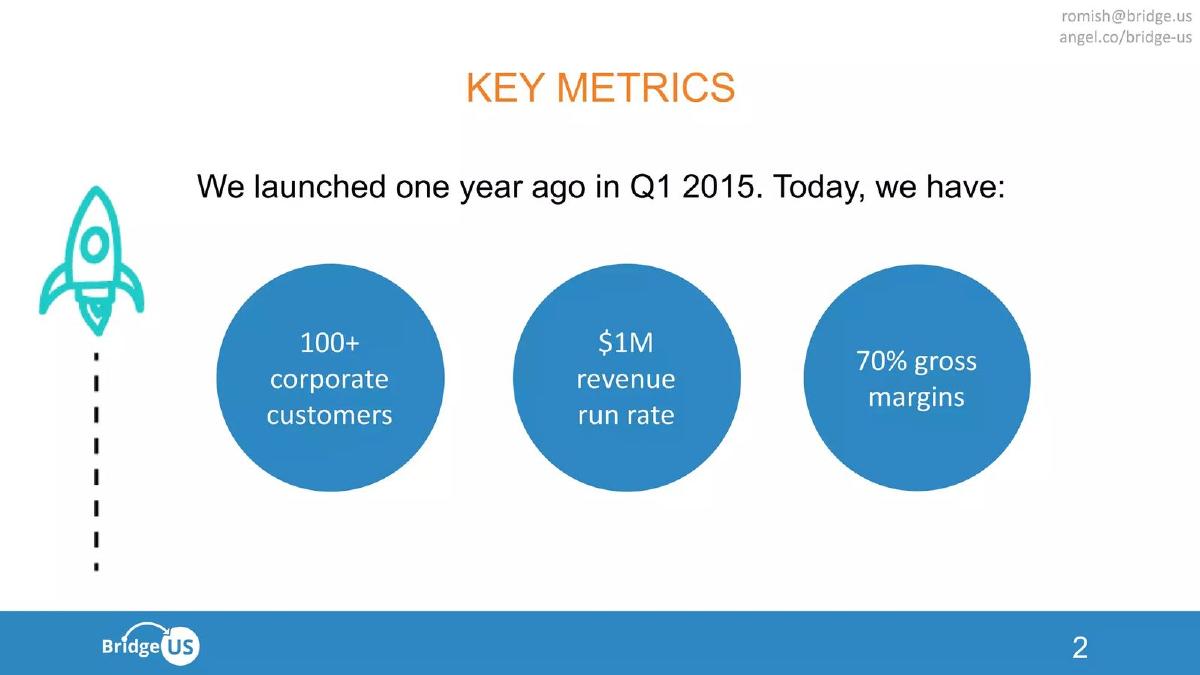
- The company achieved a $1M revenue run rate within one year of its Q1 2015 launch (Slide 2).
- Bridge US maintains high efficiency for a service-oriented tech platform with 70% gross margins (Slide 2).
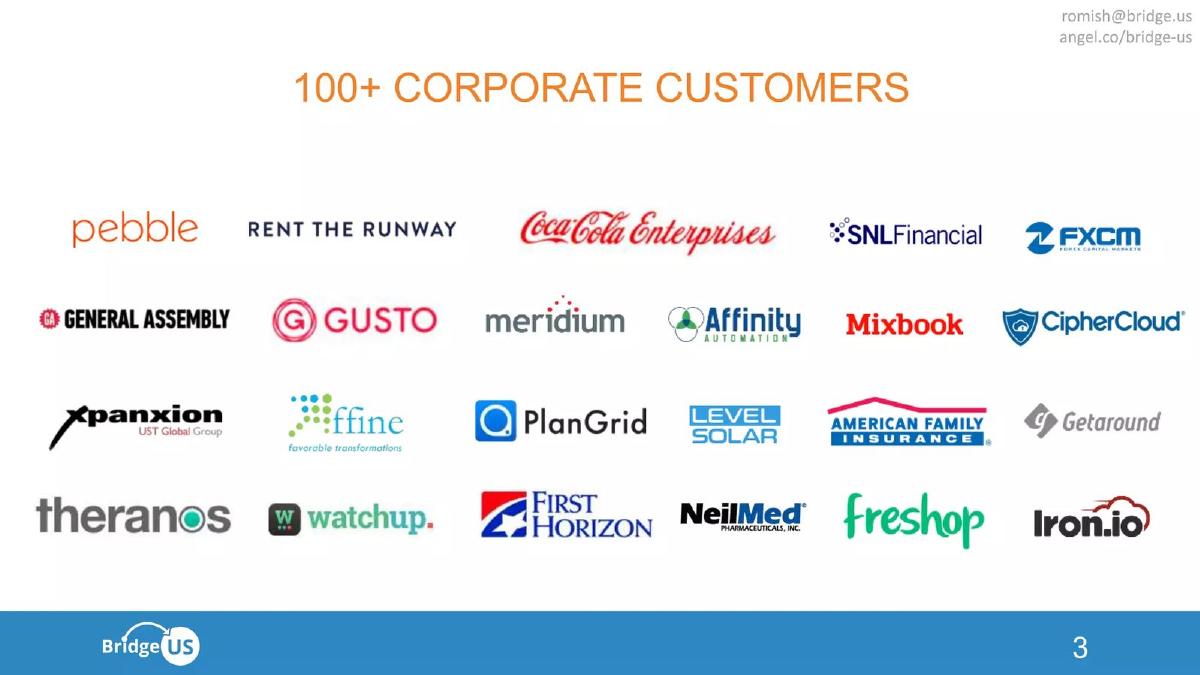
- The deck features a robust logo wall of 100+ corporate customers, including high-profile startups like Pebble, Gusto, and PlanGrid (Slide 3).
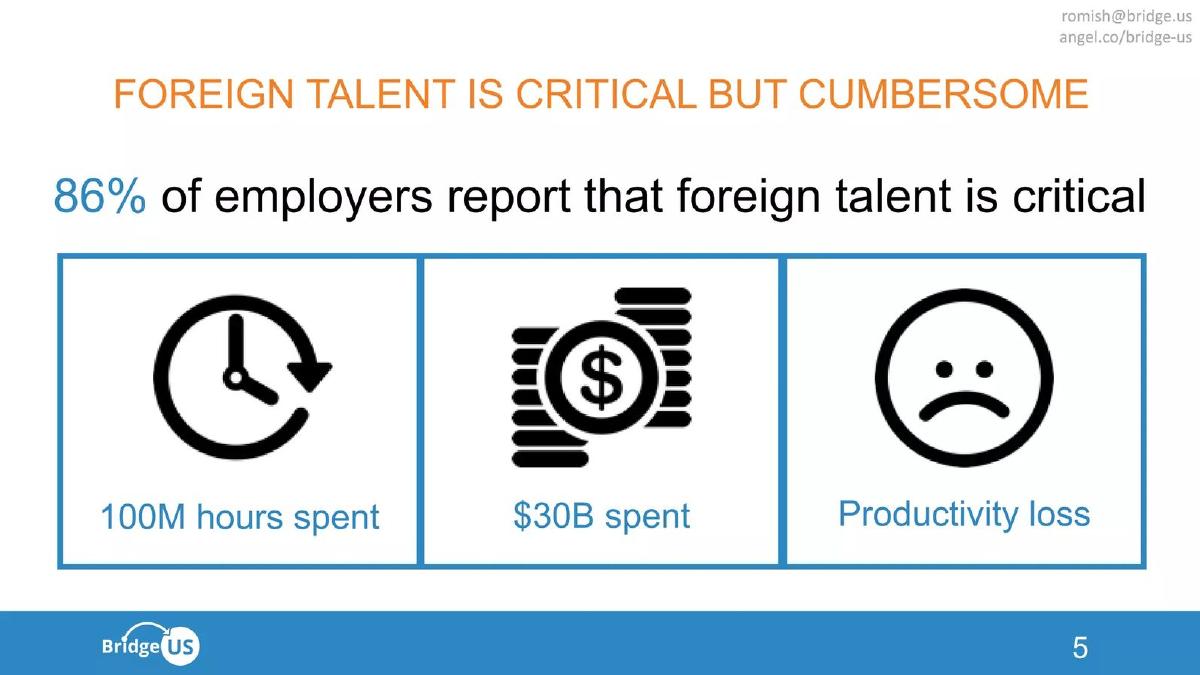
- Market pain is quantified by 100M hours and $30B spent by employers on foreign talent (Slide 5).
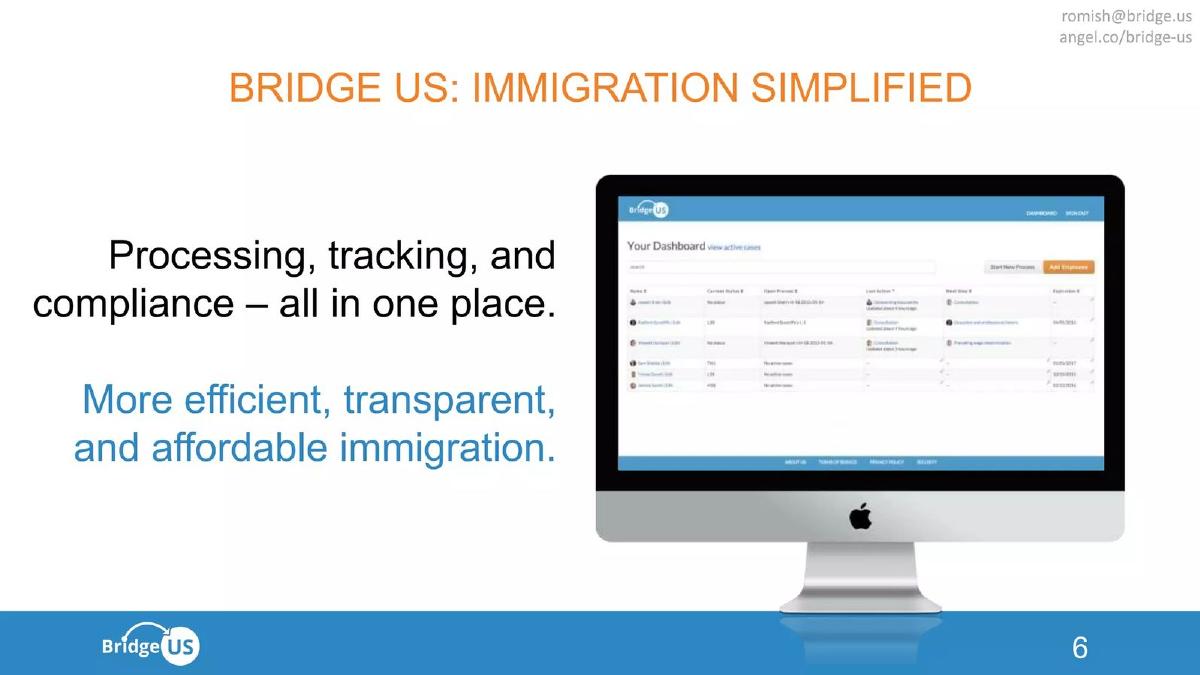
- The solution is presented as a unified dashboard for processing, tracking, and compliance (Slide 6).
- The founding team includes a CEO from Harvard/ZocDoc and a CTO from Google/ITA Software (Slide 7).
- The deck projects a 50% growth in global mobility by 2020 as a primary tailwind (Slide 8).
- There is no mention of a specific funding goal, valuation, or use of proceeds in the 9-slide presentation.
Executive Summary: The Traction-First Teaser
The 7Bridge (Bridge US) deck is a masterclass in brevity. At only 9 slides, it avoids the common pitfall of over-explaining the legal complexities of immigration, instead focusing on the commercial validation the company has already achieved. By leading with a $1M run rate and a 70% gross margin, the founders immediately signal that they have solved the unit economics of a notoriously difficult, service-heavy industry.
Slide 1: Title and Branding
The deck opens with the Bridge US logo and the tagline "Immigration Simplified." The branding is clean, utilizing a blue color palette associated with professional services and trust. The visual of an arrow bridging into a "US" circle clearly communicates the company's focus area: inbound United States immigration.
Slide 2: Key Metrics
This is the most critical slide in the deck. Rather than starting with a long-winded problem statement, Bridge US leads with results. They state a launch date of Q1 2015 and report three major milestones: 100+ corporate customers , a $1M revenue run rate , and 70% gross margins . Highlighting gross margins is a strategic move to differentiate themselves from traditional law firms, which typically have much higher overhead and lower scalability.
Slide 3: The Logo Wall
Slide 3 provides the evidence for the "100+ corporate customers" claim. The slide is packed with recognizable logos from the mid-2010s tech ecosystem, including Pebble, Rent The Runway, Coca-Cola Enterprises, Gusto, PlanGrid, and Getaround . Notably, the slide also includes Theranos , which serves as a reminder of the deck's era. The sheer volume of logos serves as social proof that the product is viable for both small startups and large enterprises.
Slide 4: The Skills Gap
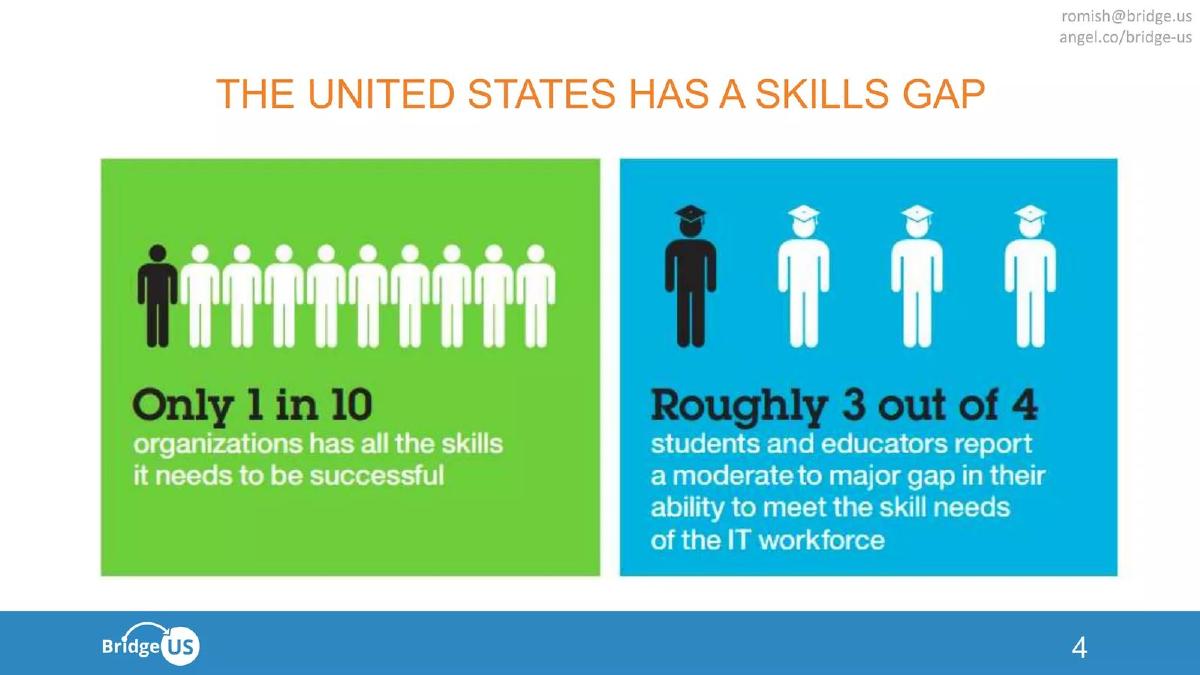
The deck finally moves to the problem statement. It uses simple infographics to show that "Only 1 in 10 organizations has all the skills it needs to be successful" and that "Roughly 3 out of 4 students and educators report a moderate to major gap" in the IT workforce. This frames immigration not just as a legal hurdle, but as a macroeconomic necessity for US business growth.
Slide 5: The Cost of Friction
This slide quantifies the pain point for the employer. It claims that 86% of employers report that foreign talent is critical , yet the current process results in 100M hours spent and $30B spent annually. The inclusion of a "Productivity loss" icon emphasizes the hidden costs of immigration delays beyond just the legal fees.
Slide 6: The Solution
The solution slide is minimalist. It shows a screenshot of the Bridge US dashboard on an iMac. The text highlights "Processing, tracking, and compliance – all in one place." The value proposition is summarized as "More efficient, transparent, and affordable immigration." By showing the UI, the company asserts that they are a technology company first, rather than a tech-enabled law firm.
Slide 7: The Team
The "Incredible Team" slide features three key figures. Romish Badani (CEO) brings pedigree from Harvard Business School and ZocDoc. Forrest Blount (CTO) brings technical credibility from Google and ITA Software. Michael Serotte provides the domain expertise as the Lead Attorney Partner, connected to Serotte Law and Unshackled. This combination of elite business education, big-tech engineering, and specialized legal knowledge is a strong signal for investors.
Slide 8: Market Growth
Slide 8 uses a world map with red arrows indicating global migration patterns. A callout bubble predicts "50% growth by 2020" in global mobility. This slide is intended to show the "Why Now?" and the potential for the company to expand beyond just US-inbound cases into a global mobility platform.
Slide 9: Contact Information
The deck concludes with the logo and contact details for Romish Badani, including his email and an AngelList link. There is no "Ask" slide detailing the amount of capital sought or the valuation, which suggests this deck may have been used for initial outreach or as a follow-up to a conversation rather than a final pitch.
What Works in This Deck
Immediate Credibility: By putting the $1M run rate on Slide 2, the founders bypass the skepticism usually reserved for early-stage startups. They prove people are willing to pay for the solution before they even explain what the solution is.
Visual Simplicity: The deck is not cluttered. Each slide has one clear message. The use of icons and large-format text makes it easily digestible in under two minutes.
Domain Authority: The team slide perfectly balances the three pillars needed for this specific vertical: business execution, technical scale, and legal compliance.
What Is Missing
The Business Model: While we know they have $1M in revenue, the deck doesn't explain how they make money. Is it a SaaS subscription for the software, a per-application fee, or a percentage of legal spend? Investors need to know if the 70% margin is sustainable as they scale.
Competitive Landscape: The immigration tech space (LegalTech) is crowded with both traditional firms and newer players like Envoy Global or LawLogix. The deck makes no mention of how Bridge US wins against incumbents.
The Ask: A pitch deck without a funding goal is a brochure. Without knowing how much capital is needed and what milestones that capital will unlock, an investor cannot evaluate the opportunity's risk-reward profile.
Founder Takeaways
Front-load your wins: If you have revenue and high-profile customers, do not wait until Slide 10 to show them. Bridge US puts their best foot forward immediately. · Quantify the macro problem: Don't just say the process is "hard." Use figures like the $30B spend and 100M hours to show the scale of the inefficiency you are solving. · Use social proof: A logo wall of 20+ companies is often more persuasive than three detailed case studies in an initial pitch. It demonstrates broad market appeal. · Keep it brief: You don't need 20 slides to get a meeting. 9 slides that prove traction and team quality are often enough to secure a follow-up call.
Frequently asked questions
- What is the core value proposition of Bridge US?
- Bridge US aims to simplify the immigration process for corporations. According to slide 6, the platform provides a single location for processing, tracking, and compliance. The goal is to make hiring foreign talent more efficient, transparent, and affordable compared to traditional methods that currently cost employers $30B annually.
- How much traction did the company have at the time of this deck?
- The company reported significant early traction on slide 2. Having launched in Q1 2015, they reached over 100 corporate customers and a $1M revenue run rate within twelve months. They also reported 70% gross margins, suggesting a scalable software-plus-services model.
- Who are the key members of the 7Bridge team?
- The team is led by Co-Founder & CEO Romish Badani (Harvard Business School, ZocDoc) and Co-Founder & CTO Forrest Blount (Google, ITA Software). They are supported by Lead Attorney Partner Michael Serotte of Serotte Law and Unshackled, providing the necessary legal expertise for an immigration tech startup (Slide 7).
- What market problem is the company addressing?
- The deck identifies a 'skills gap' in the United States, noting on slide 4 that only 1 in 10 organizations has all the skills needed to be successful. Slide 5 highlights that 86% of employers view foreign talent as critical, yet the process involves 100M hours of work and significant productivity loss.
- What is missing from this pitch deck?
- The deck is missing several standard components: a specific investment 'ask' (how much they are raising), a detailed business model (pricing tiers), a competitive analysis, and a roadmap of future product features. It functions more as a high-level teaser than a comprehensive due diligence document.