8base’s 2022 Series A deck is a masterclass in market timing and category positioning. By leaning heavily on Gartner and Morgan Stanley research, the company framed its low-code platform as the solution to a 1.4 million developer shortage in the US. The deck successfully balances high-level market trends with granular technical features, such as its auto-generated GraphQL API and serverless architecture. While the deck lacks a traditional team slide or detailed financial historicals, it compensates with a clear 'Round Dynamics' slide that explicitly states a goal of 10x recurring revenue grow…
Key takeaways
- The deck identifies a massive supply-demand gap, citing a shortage of 1.4 million developers in the US as of 2021 on slide 13.
- 8base positions itself specifically for 'Professional Developers' while contrasting with no-code tools like Bubble on slide 3.
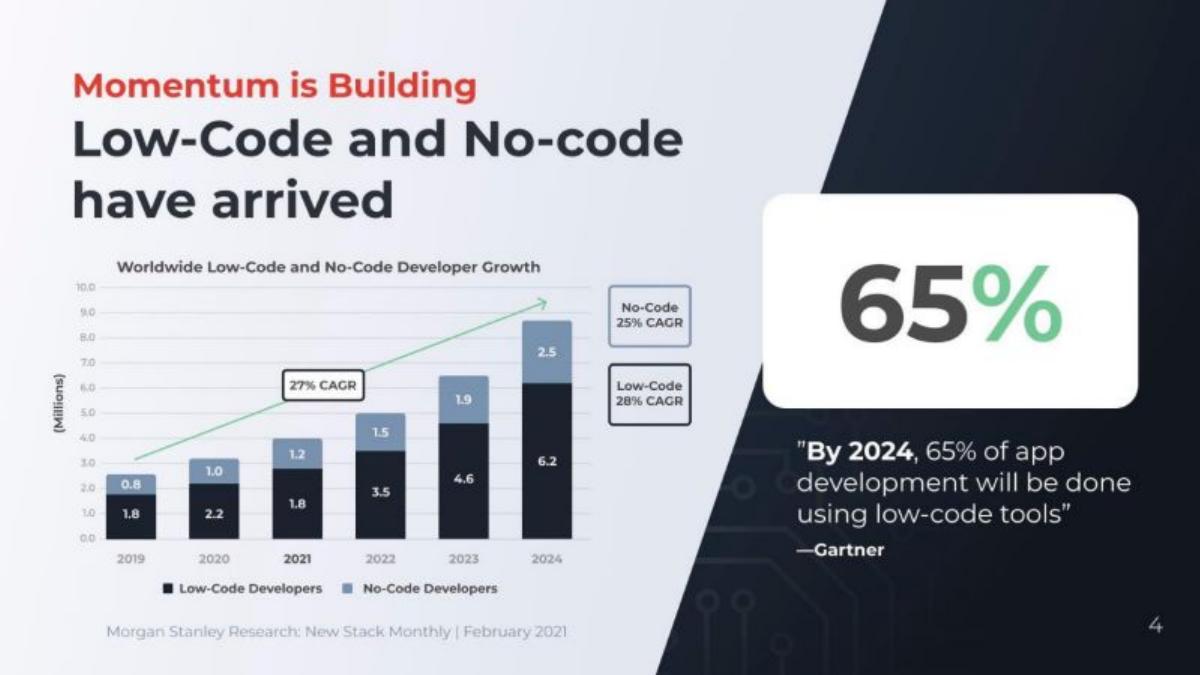
- Market momentum is validated using a Gartner prediction that 65% of app development will be low-code by 2024 on slide 4.
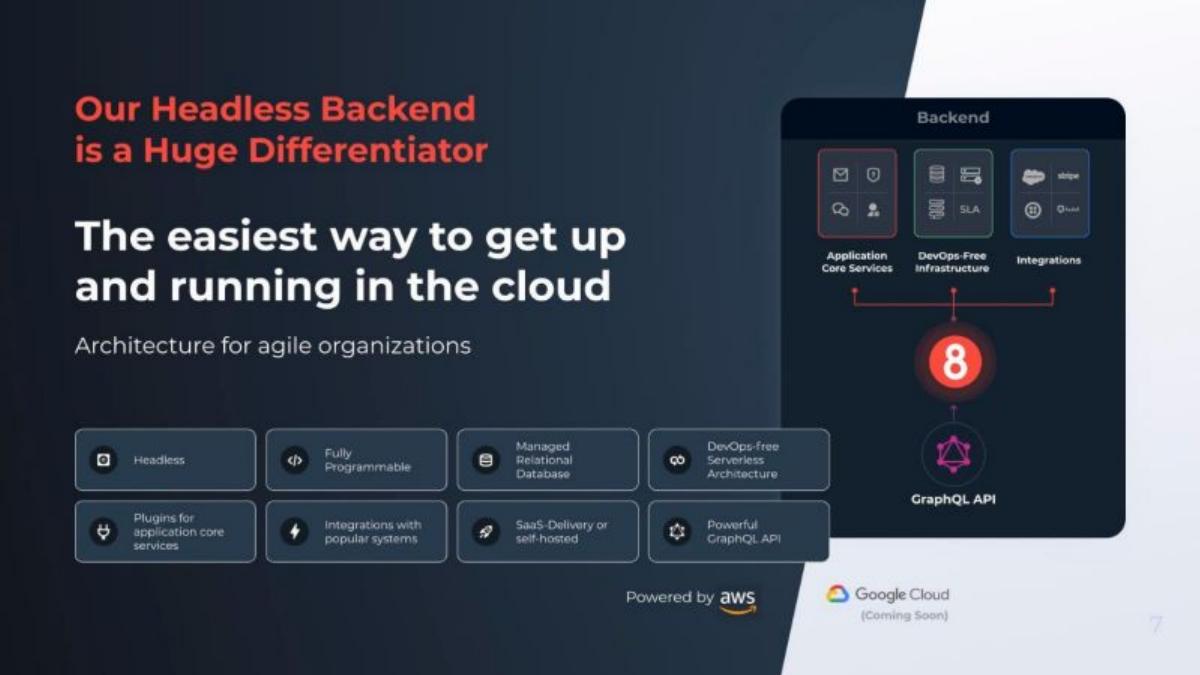
- Technical differentiation is centered on a 'Headless Backend' that includes a managed relational database and GraphQL API on slide 7.
- The platform's versatility is demonstrated through six distinct use cases, ranging from multi-tenant SaaS to field workforce apps on slide 9.
- Enterprise traction is established via a customer success slide featuring IBM, NATO, and FIU on slide 10.
- The $10 million round is tied to specific operational goals, including a 10x recurring revenue target on slide 15.
- The deck omits a dedicated team slide, featuring only the Founder and CEO on the final contact slide.
The 8base Pitch Deck Teardown
8base entered the market during a period of intense interest in the 'democratization' of software development. Their 2022 Series A deck, which secured $10.6M, focuses on the transition from traditional hand-coding to accelerated low-code delivery. This teardown explores how they justified a $10 million round by mapping their product to a $500 billion market opportunity.
Slide 1: Title and Round Overview
The cover slide is functional and direct. It defines 8base as a 'Low-code foundation for building and running digital products, internal apps and more.' Crucially, it includes the round size immediately: '$10 million equity round.' This sets the stage for an institutional-grade conversation from the first second.
Slide 2: The Problem
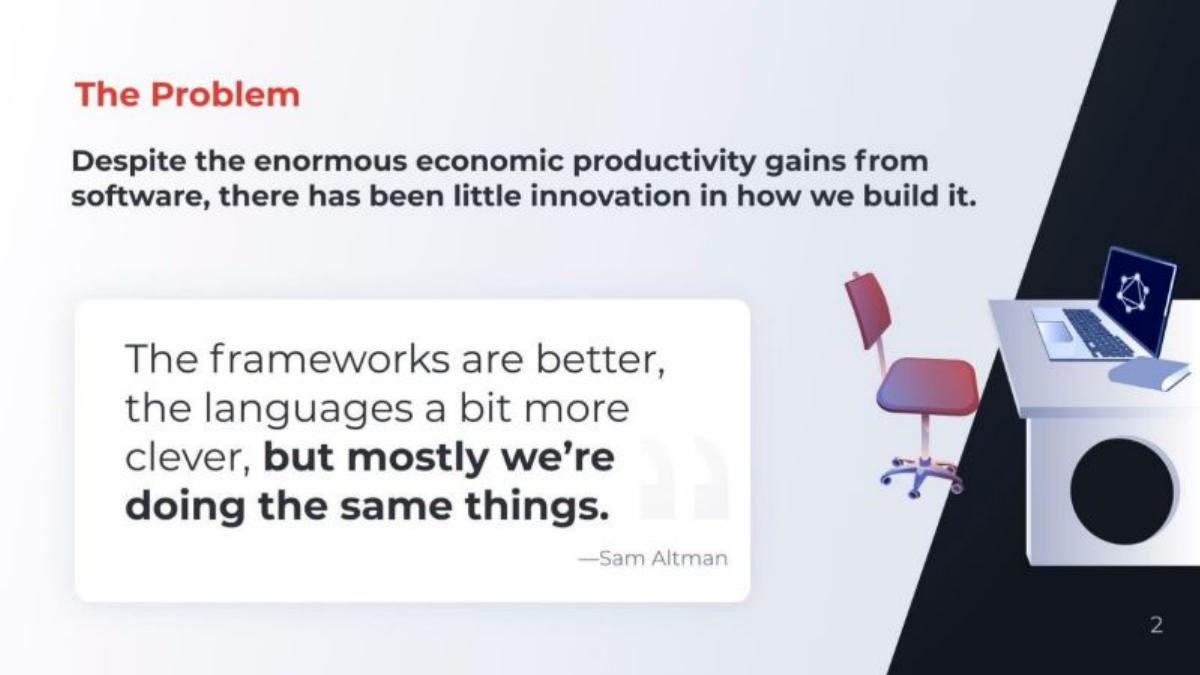
8base uses a quote from Sam Altman to anchor their problem statement: 'The frameworks are better, the languages a bit more clever, but mostly we’re doing the same things.' The slide argues that despite economic productivity gains from software, the actual process of building it has seen little innovation. This is a high-level philosophical problem that requires the subsequent slides to provide concrete data.
Slide 3: The Solution Landscape
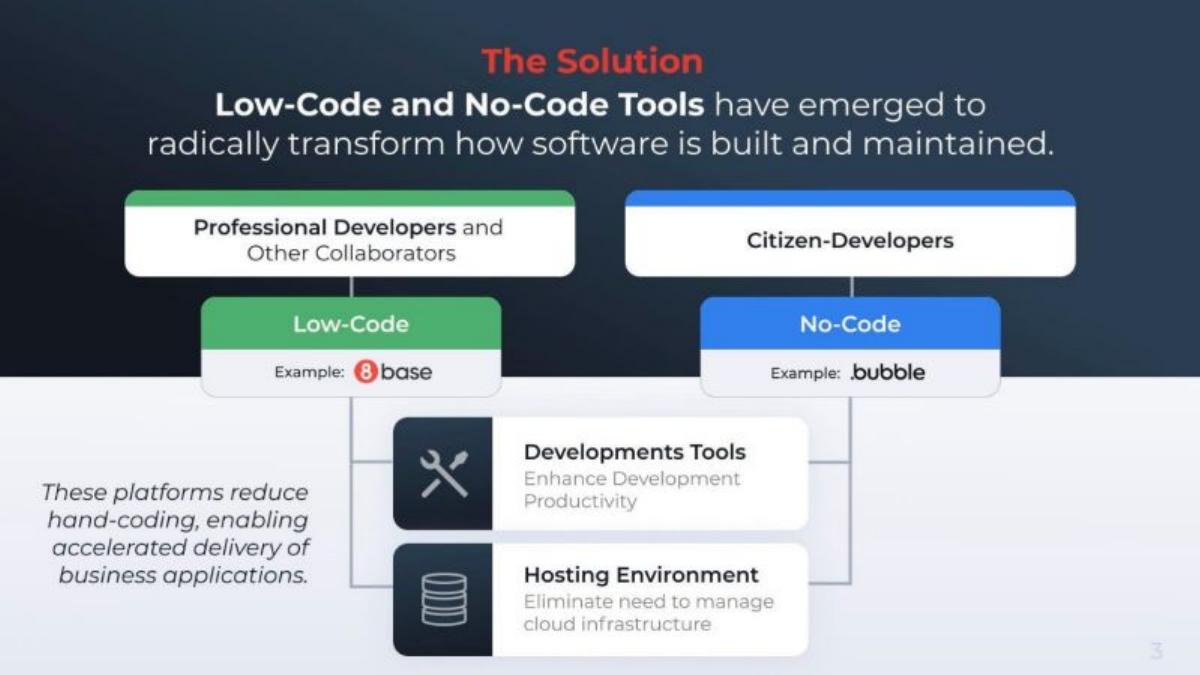
This slide is a positioning map. It divides the market into 'Low-Code' (for Professional Developers) and 'No-Code' (for Citizen-Developers). 8base places itself in the Low-Code category, using Bubble as the example for No-Code. By doing this, they signal to investors that their tool is for building 'real' software, not just simple prototypes. They highlight two core value drivers: Development Tools to enhance productivity and a Hosting Environment to eliminate cloud infrastructure management.
Slide 4: Market Momentum
8base leans on third-party validation here. They cite Morgan Stanley Research showing a 27% CAGR for low-code/no-code developer growth. The standout metric is a Gartner quote: 'By 2024, 65% of app development will be done using low-code tools.' This slide is designed to prove that the 'Low-Code' trend is an inevitability, not a fad.
Slide 5: Product - Backend Development Tools
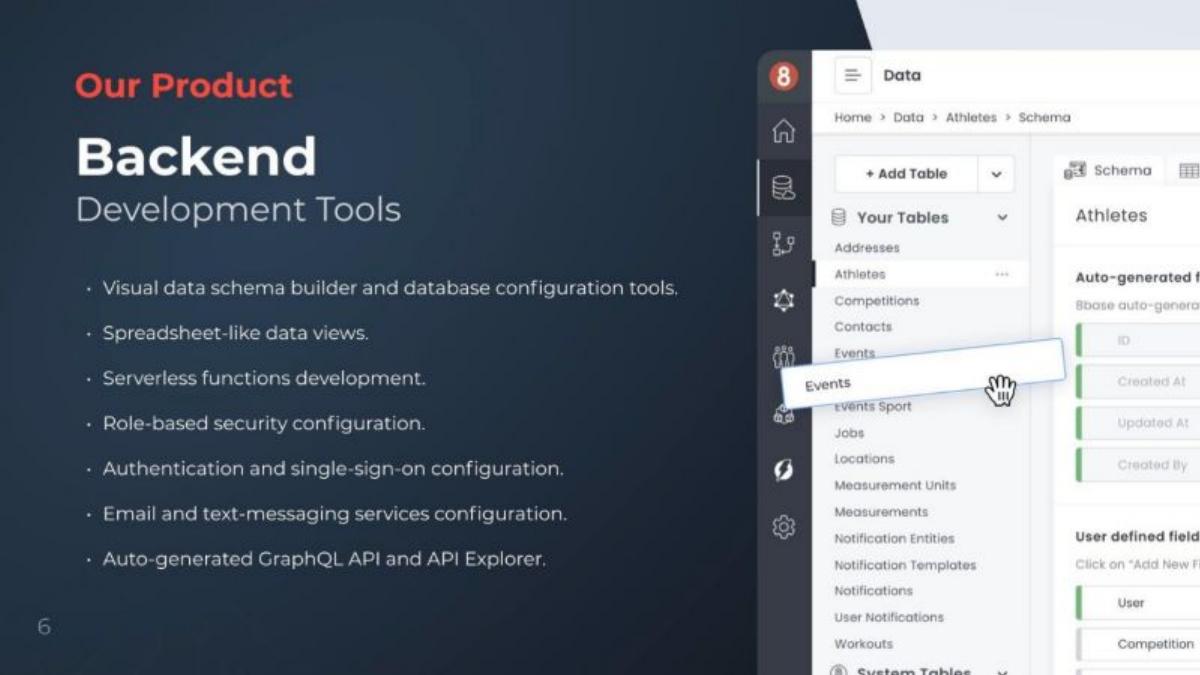
The deck moves into the 'How.' Slide 6 (labeled 6 in the deck) lists eight specific backend capabilities, including a visual data schema builder, serverless functions, and an auto-generated GraphQL API. The inclusion of a product screenshot provides visual proof that the platform is mature and functional.
Slide 7: Technical Differentiation
This is one of the most important slides for a technical founder to study. 8base describes their 'Headless Backend' as a 'huge differentiator.' They break down the architecture into three pillars: Application Core Services, DevOps-Free Infrastructure, and Integrations. By explicitly mentioning 'Powered by AWS' and 'Google Cloud (Coming Soon),' they align themselves with the existing cloud ecosystem rather than trying to replace it.
Slide 8: Product - Frontend Development Tools
Having covered the backend, slide 8 focuses on the 'App Builder.' It highlights a 'powerful drag-and-drop interface' and 'fully code-extensible components.' The phrase 'Connects to any backend' is a key selling point, suggesting that while 8base offers a full stack, it is not a closed garden.
Slide 9: Use Cases
To prevent the product from seeming too abstract, slide 9 lists six specific types of applications users can build: Multi-tenant SaaS, Marketplaces, Portals, Business Process Management, Consumer Apps, and Field Workforce Applications. This demonstrates the breadth of the Total Addressable Market (TAM).
Slide 10: Customer Success
Social proof is delivered via a logo wall. 8base shows they can serve both startups (Vizsla, Photag) and massive established organizations (IBM, NATO, FIU). This mix is vital for a Series A deck as it proves the product can scale from a single developer to a global enterprise.
Slide 11: Expanding Opportunity
Slide 12 (labeled 12) discusses the roadmap for 'swimming up market.' They identify two levers for growth: expanding integrations (Salesforce, GitHub, Oracle) and achieving SOC II compliance. This tells investors exactly how the company will increase its Average Contract Value (ACV) over time.
Slide 12: Macro Trends
Slide 13 returns to the 'Why Now?' question. It splits the opportunity into Supply (developer shortage, bootcamp-born developers) and Demand (digital transformation, startup frenzy). The figure '1.4 million developers' shortage in the US is the 'scary' number that makes a productivity tool like 8base feel like a necessity.
Slide 13: The Market Size
Slide 14 quantifies the opportunity. It shows a bar chart of 'Projected Low-Code Development Growth' from $2.8B in 2016 to over $21B in 2022. The headline claim is that Low-Code is 'cannibalizing the $500B Worldwide Custom Software Development Market.' This is a classic 'market expansion' argument.
Slide 14: Round Dynamics
Slide 15 is the 'Ask.' It reiterates the $10 million figure and sets a bold performance target: '10x recurring revenues in 18-24 months.' It then lists four areas of spend: Marketing, Partner Ecosystem, Executive Team, and Product Development. This is a high-transparency slide that gives investors a clear scorecard for the next two years.
Slide 15: Contact
The final slide features Founder and CEO Albert Santalo. Notably, this is the only mention of the team in the entire deck. While Santalo is a known entity in the Miami tech scene, the omission of a broader 'Team' slide with pedigrees and previous exits is a significant departure from standard pitch deck structure.
What 8base Did Well
Strong Category Positioning: By explicitly separating themselves from 'No-Code' tools like Bubble, they defended their territory as a tool for professional engineers. · Data-Driven Urgency: Using Gartner and Morgan Stanley data to frame the developer shortage makes the product feel like a solution to a systemic economic problem. · Clear Architecture: The 'Headless Backend' slide (Slide 7) does an excellent job of explaining a complex technical product through simple iconography and clear pillars.
What Was Missing
Team Slide: There is no slide detailing the experience of the engineering or leadership team. For a $10M Series A, investors usually want to see the 'bench strength' beyond the founder. · Historical Financials: While they mention a goal of 10x revenue growth, they do not show where the revenue currently stands or the month-over-month growth rate leading up to the round. · Competition: Aside from a brief mention of Bubble, there is no competitive matrix. In a crowded field with players like Retool, OutSystems, and Mendix, this is a notable omission.
What Other Founders Should Copy
The 'Round Dynamics' Slide: Every founder should include a slide like Slide 15. It tells the investor exactly what the 'North Star' metric is (10x revenue) and exactly what the money will buy. · Use Case Visuals: Slide 9 is a great way to show product versatility without getting bogged down in technical jargon. It helps investors visualize the actual end-products. · The 'Why Now' Supply/Demand Split: Slide 13 is a very effective way to organize market trends. It shows that the company isn't just lucky, but is positioned at the intersection of two powerful forces.
Frequently asked questions
- How much did 8base raise with this deck?
- According to the catalogue facts and slide 1, 8base raised a $10 million equity round (later reported as $10.6M) in 2022. The deck explicitly labels this as a 'Company and Investment Overview' for that specific round.
- What is the primary problem 8base is solving?
- The deck identifies a lack of innovation in software construction despite productivity gains elsewhere. Slide 13 specifically highlights a 'Supply' problem: a shortage of 1.4 million developers and increasing technology complexity that requires expensive specialists.
- Who is the target user for 8base according to the deck?
- 8base distinguishes itself from no-code platforms by targeting 'Professional Developers and Other Collaborators.' While slide 3 mentions 'Citizen-Developers' in the context of the broader market, 8base is positioned firmly in the 'Low-Code' category for building complex, code-extensible applications.
- What are the key technical features of the 8base platform?
- The platform consists of Backend and Frontend tools. Key features include a visual data schema builder, serverless functions, auto-generated GraphQL APIs (slide 6), and a drag-and-drop frontend interface with a rich component library (slide 8).
- What are the planned uses for the $10 million investment?
- Slide 15 outlines four primary objectives: enabling a marketing engine, transitioning services to an ecosystem of solution partners, expanding the executive team, and doubling down on product development.