7 Bridges addresses the inefficiency of modern logistics, where businesses reportedly spend 50% more than necessary due to fragmented data and complex supplier networks. The deck highlights a massive £2.2 trillion addressable market, growing at 4.6% annually, and positions 7 Bridges as a unified AI platform that integrates UIs, APIs, and a global supplier ecosystem. By automating execution and providing real-time optimization, the company claims it can reduce logistics costs by 50% and shipping time by 90%. The team, led by experts from World Courier, IBM, and various high-growth startups, br…
Key takeaways
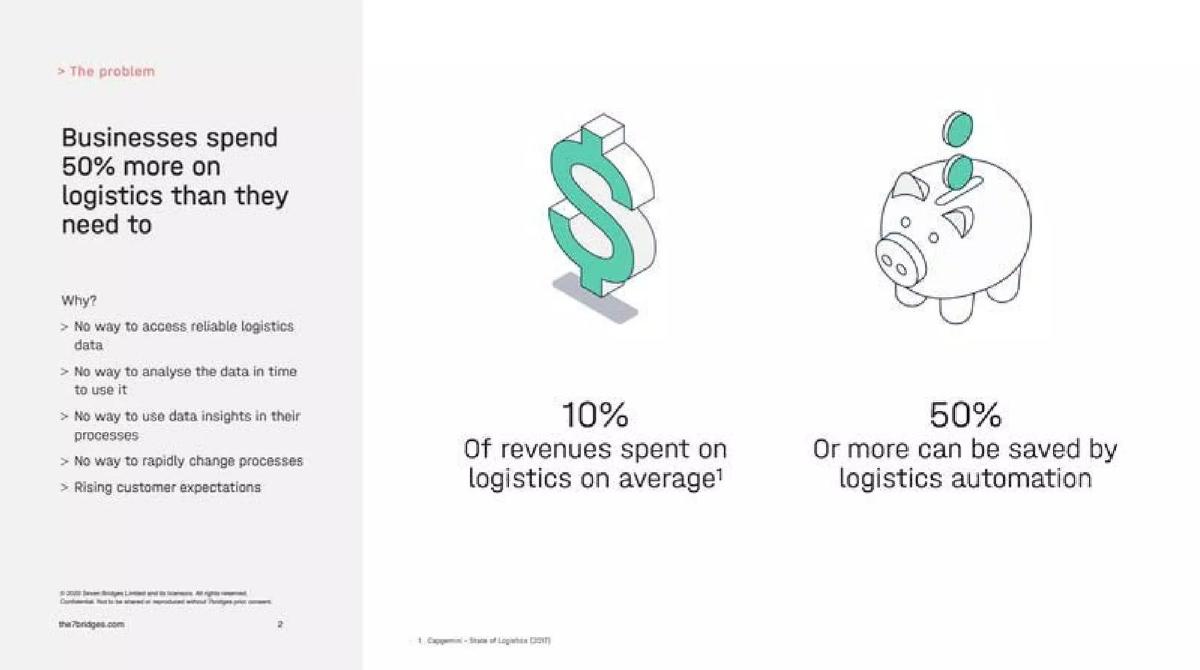
- Businesses spend an average of 10% of revenues on logistics, with automation potentially saving 50% or more (Slide 2).
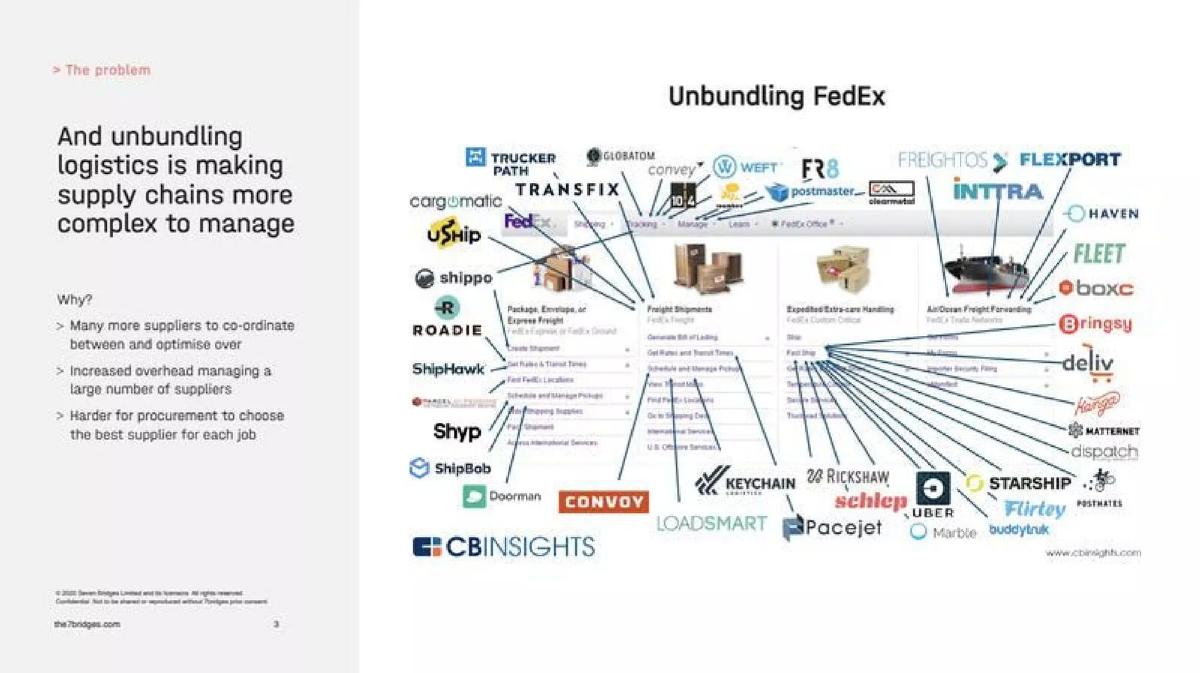
- The 'unbundling' of traditional carriers like FedEx has led to a fragmented ecosystem of specialized startups, increasing management complexity (Slide 3).
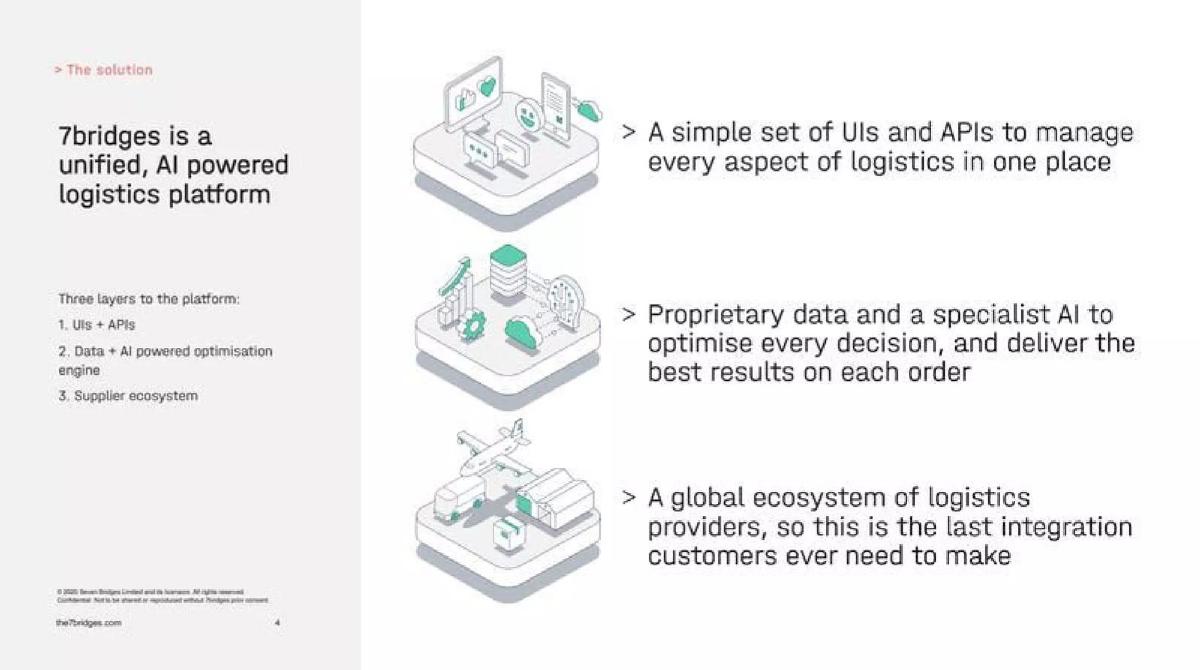
- The platform consists of three layers: UIs/APIs, a data/AI optimization engine, and a global supplier ecosystem (Slide 4).
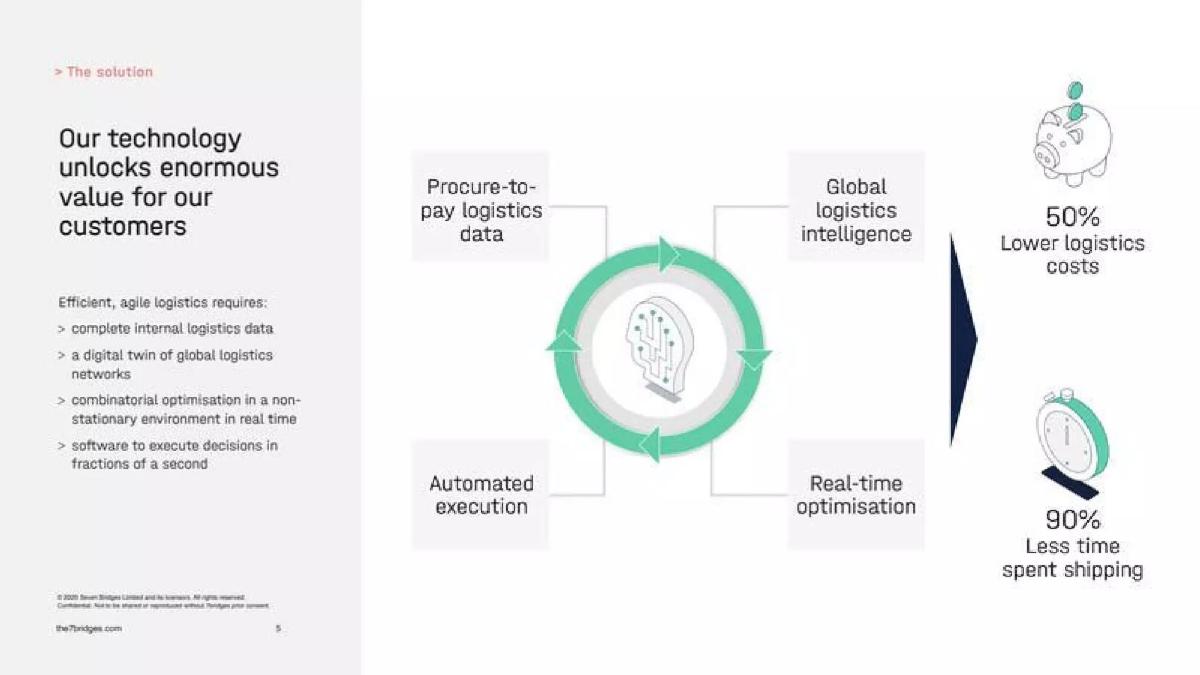
- 7 Bridges claims to deliver 50% lower logistics costs and 90% less time spent shipping through automated execution and real-time optimization (Slide 5).
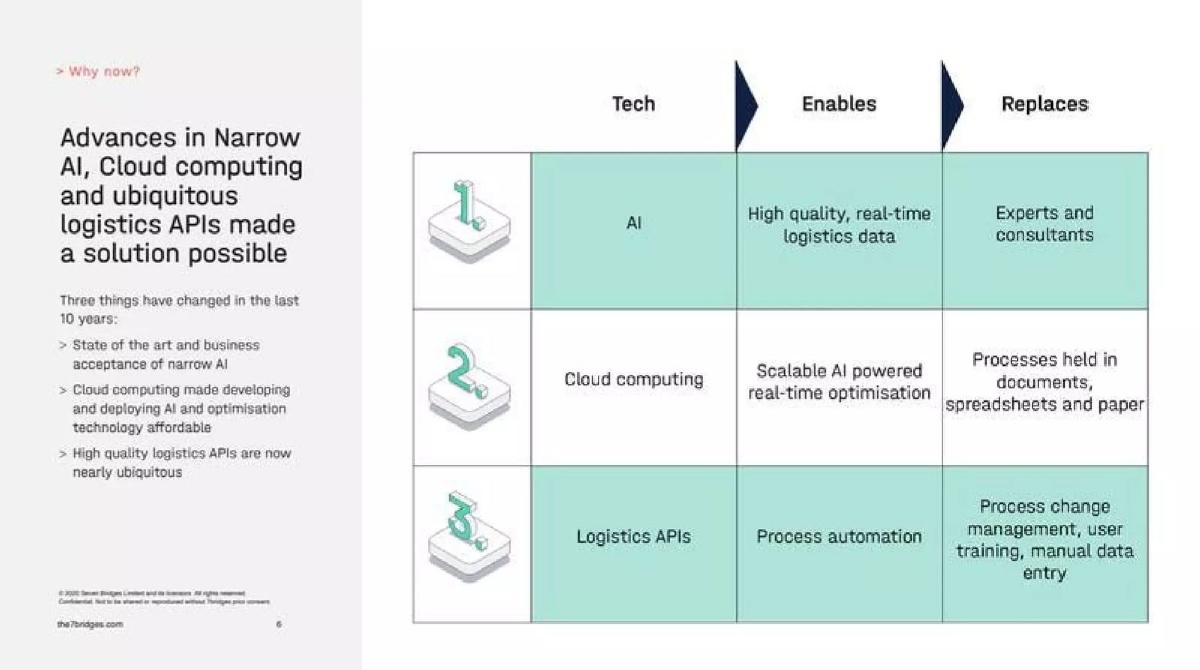
- The convergence of narrow AI, cloud computing, and ubiquitous logistics APIs has recently made this level of automation possible (Slide 6).
- The total addressable logistics spend is valued at £2.2 trillion globally, with a £12 billion niche in the UK courier and express market (Slide 7).
- The founding team features deep domain expertise from World Courier, IBM Big Data, and enterprise software engineering for organizations like The World Bank and BMW (Slide 8).
- The deck concludes with a call to 'raise capital to accelerate growth' but lacks a specific dollar amount or valuation target (Slide 9).
7 Bridges Pitch Deck Teardown: Navigating the Logistics Labyrinth
Logistics is the backbone of global commerce, yet it remains one of the most fragmented and inefficient sectors. The 7 Bridges pitch deck presents a compelling vision for how AI and automation can transform this landscape. By focusing on the 'unbundling' of traditional logistics giants and the rise of specialized service providers, 7 Bridges positions itself as the essential connective tissue for modern supply chains. This teardown examines their nine-slide deck, analyzing their problem-solution fit, market analysis, and team strength.
Slide 1: Title and Vision
The deck opens with a clean, minimalist title slide. The 7 Bridges logo—an isometric '7b'—is centered on a teal background. Below it, a concise vision statement sets the stage: 'The 7bridges platform unleashes the power of logistics. Our smart technology enables businesses to gain competitive advantage by transforming outdated, rules-based processes into agile, automated systems that continuously adapt to change.' This statement effectively communicates the company's core value proposition: agility and automation in an industry often bogged down by legacy systems.
Slide 2: The Problem - Inefficiency and Waste
Slide 2 hits hard with a bold headline: 'Businesses spend 50% more on logistics than they need to.' This is a powerful hook for any investor. The slide breaks down the 'why' into five key points: lack of reliable data, inability to analyze data in time, failure to use data insights in processes, difficulty in changing processes rapidly, and rising customer expectations. Two key metrics are highlighted: '10% of revenues spent on logistics on average' and the potential for '50% or more' to be saved through automation. Citing a Capgemini 'State of Logistics' report adds credibility to these figures.
Slide 3: The Problem - The Complexity of Unbundling
This is perhaps the most visually striking slide in the deck. Titled 'Unbundling FedEx,' it features a CB Insights graphic showing dozens of startups—like Flexport, Convoy, and ShipBob—that have emerged to handle specific parts of the logistics chain once dominated by giants like FedEx. The slide argues that while these specialized services offer benefits, they make supply chains 'more complex to manage' due to the increased overhead of coordinating many suppliers and the difficulty in choosing the best one for each job. This slide perfectly sets up the need for a unified platform like 7 Bridges.
Slide 4: The Solution - A Unified AI Platform
Slide 4 introduces 7 Bridges as the solution: a 'unified, AI powered logistics platform.' It describes three layers to the platform: UIs and APIs for management, a data and AI-powered optimization engine, and a global supplier ecosystem. The promise is that this will be the 'last integration customers ever need to make.' The use of isometric icons for each layer maintains the deck's clean, modern aesthetic and helps visualize the platform's architecture.
Slide 5: Unlocking Value Through Technology
This slide delves deeper into how the technology works and the specific value it creates. It lists four requirements for efficient, agile logistics: complete internal data, a digital twin of global networks, real-time combinatorial optimization, and sub-second decision execution. A circular diagram shows how these elements feed into each other, ultimately leading to the two headline benefits: '50% Lower logistics costs' and '90% Less time spent shipping.' These are bold claims that would likely be a primary focus of due diligence.
Slide 6: Why Now? The Convergence of Tech
The 'Why Now?' slide is crucial for any tech startup. 7 Bridges points to three major shifts in the last decade: the business acceptance of 'narrow AI,' the affordability of cloud computing for deploying optimization tech, and the ubiquity of high-quality logistics APIs. A table format clearly shows how each technology 'Enables' a new capability and 'Replaces' an outdated method (e.g., AI replaces 'Experts and consultants,' Cloud computing replaces 'Processes held in documents, spreadsheets and paper'). This slide effectively argues that the 7 Bridges solution was not technically or economically feasible until very recently.
Slide 7: The Market Opportunity
Slide 7 quantifies the opportunity. The headline states that addressable logistics spend is '£2.2trn and growing at 4.6% annually.' A series of concentric circles visually represents the market size across different geographies and service types. It starts with the global market (£2.2tn), narrows to North America and Europe (£1tn), then Europe (£151bn), and finally the UK (£12bn). This breakdown shows that while the total market is vast, 7 Bridges has a clear understanding of its immediate and expanding target segments. The note that logistics has 'not yet experienced digital transformation at scale' further emphasizes the untapped potential.
Slide 8: The Team
The team slide is strong, showcasing three founders with complementary expertise. Philip Ashton (CEO) brings domain knowledge from World Courier. Matei Beremski (CPO) offers big data and analytics experience from IBM and BNP Paribas. Ben Ede (CTO) provides engineering leadership from high-growth startups and work with major organizations like The World Bank and BMW. The combination of logistics, data science, and software expertise is exactly what a platform like 7 Bridges requires. Their educational backgrounds (Cambridge, Oxford, UWE Bristol) add further academic weight.
Slide 9: The Ask
The final slide returns to the teal background and logo, with the simple call to action: 'Raising capital to accelerate growth.' It includes the company website but notably lacks a specific funding target, valuation, or use-of-funds breakdown. While this keeps the deck flexible for different stages of conversation, it leaves a key question unanswered for potential investors.
What Works Well in This Deck
Strong Visual Storytelling: The 'Unbundling FedEx' slide is a masterclass in visualizing market fragmentation and the resulting need for a consolidator. · Clear Value Proposition: The deck repeatedly emphasizes two key metrics—50% cost savings and 90% time savings—making the benefits of the platform easy to grasp and remember. · Credible Problem Definition: By citing third-party reports and detailing the specific reasons for logistics inefficiency, the founders demonstrate a deep understanding of their customers' pain points. · Logical 'Why Now?': The convergence of AI, cloud, and APIs provides a solid technological justification for why this solution is emerging now.
What Is Missing or Could Be Improved
Financial Projections: The deck is entirely focused on the market and the product, with no mention of the company's own revenue model, current traction, or future financial goals. · Competitive Landscape: While the 'Unbundling' slide shows many other startups, it doesn't explicitly state how 7 Bridges competes with or complements them. A more traditional competitive matrix would be helpful. · Specific 'Ask': As mentioned, the final slide is very vague. Investors want to know how much capital is being sought and what specific milestones it will fund. · Case Studies or Proof of Concept: While the deck makes bold claims about cost and time savings, it doesn't provide any real-world examples or pilot results to back them up.
Lessons for Other Founders
Visualize Complexity: If your startup is solving a complex problem in a fragmented industry, find a way to visualize that fragmentation. The 'Unbundling' graphic is a great example of how to make a complex market situation immediately understandable. · Focus on High-Impact Metrics: Identify the one or two metrics that matter most to your customers (in this case, cost and time) and make them the centerpiece of your value proposition. · Build a 'Why Now?' Case: Don't just say your technology is great; explain why the current moment in time makes your solution both possible and necessary. · Balance Domain and Tech Expertise: A team that combines deep industry knowledge with high-level technical skill is a powerful draw for investors, especially in complex sectors like logistics.
Frequently asked questions
- What is the primary problem 7 Bridges is solving?
- 7 Bridges targets the inefficiency and rising costs in logistics. According to Slide 2, businesses spend 50% more on logistics than necessary because they lack access to reliable data, cannot analyze it in real-time, and struggle to adapt processes to rising customer expectations. The fragmentation of the logistics market, shown in Slide 3, further complicates management by requiring coordination across many specialized suppliers.
- How does the 7 Bridges platform work?
- The platform is described as a 'unified, AI-powered logistics platform' with three layers: a set of UIs and APIs for management, a proprietary data and AI engine for decision optimization, and a global ecosystem of logistics providers. This structure aims to be the 'last integration' a customer needs to make, providing a single point of control for all logistics operations (Slide 4).
- What are the claimed benefits for customers?
- The deck highlights two major value propositions on Slide 5: a 50% reduction in logistics costs and a 90% reduction in time spent shipping. These results are achieved through 'procure-to-pay' logistics data, global intelligence, real-time optimization, and automated execution, effectively creating a 'digital twin' of global logistics networks.
- What is the market size for this solution?
- Slide 7 identifies a massive global addressable logistics spend of £2.2 trillion, growing at 4.6% annually. The deck breaks this down geographically, showing a £1 trillion market in North America and Europe, £151 billion in Europe specifically, and a £12 billion focus area in the UK for outsourced courier, express, and parcels.
- Who are the founders of 7 Bridges?
- The team consists of Philip Ashton (CEO), formerly Head of Business Intelligence at World Courier; Matei Beremski (CPO), a former senior consultant in IBM's Big Data and Analytics Group; and Ben Ede (CTO), who has 12 years of experience with enterprise businesses like BMW and The World Bank. Their combined expertise covers logistics, data science, and software engineering (Slide 8).