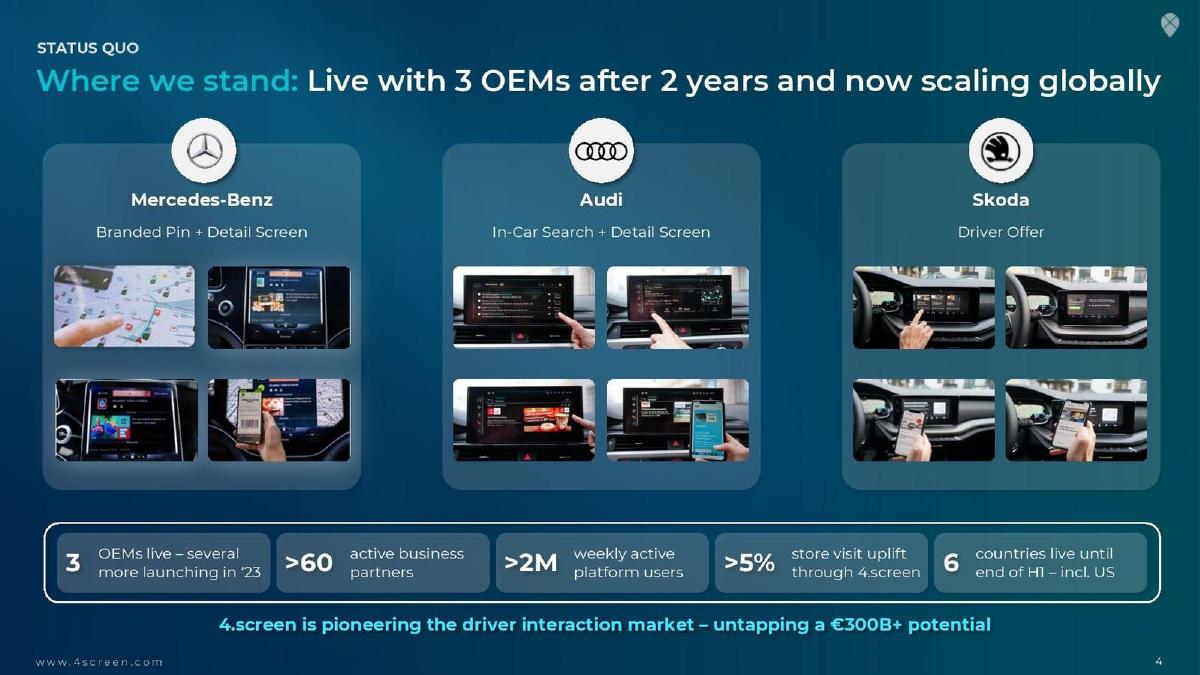
4.screen’s deck is a masterclass in ecosystem positioning, framing their technology as the essential 'rails' for a new category of in-car advertising. By targeting a €310B market by 2030, the Munich-based startup successfully raised $23M in a Series A round in 2024. The deck relies heavily on the pedigree of its founding team—all three co-founders are ex-BMW leads—and the support of industry titans like the former CEOs of VW and Audi. While the deck lacks specific revenue figures or unit economics, it compensates with a clear value proposition for three distinct stakeholders: businesses, driv…
Key takeaways
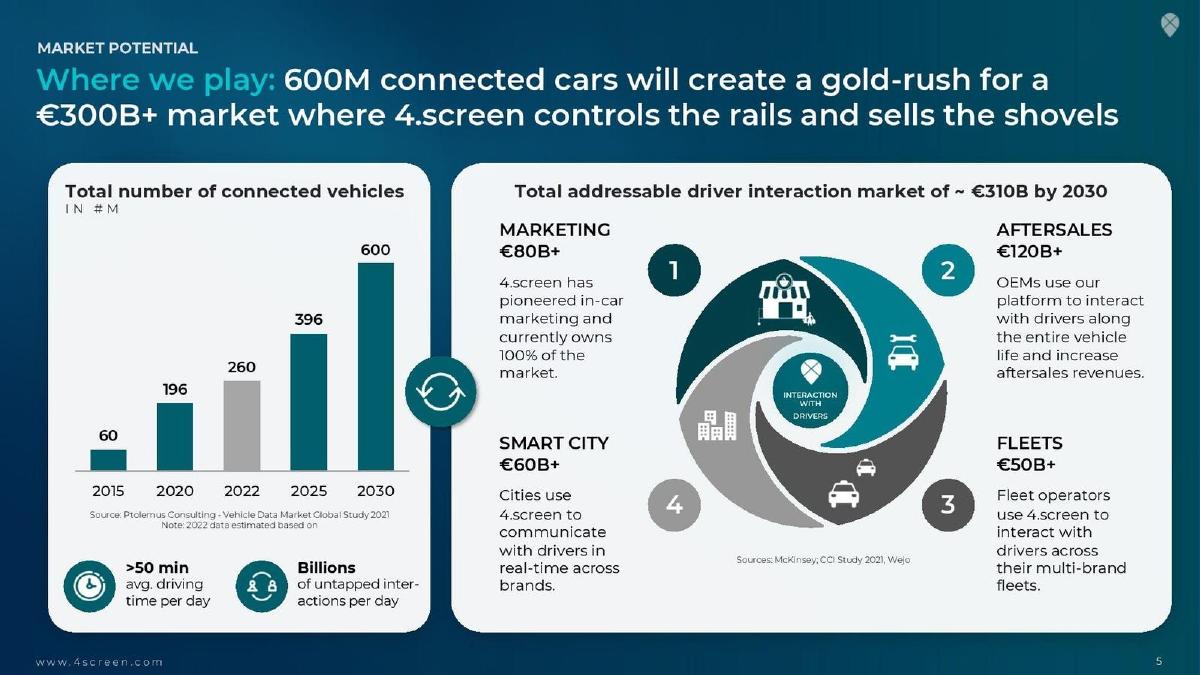
- The deck identifies a total addressable driver interaction market of ~€310B by 2030, split across marketing, aftersales, fleets, and smart cities (Slide 5).
- All three co-founders (Fabian Beste, Simon Hecker, and Christoph Mahlert) are former BMW leads in AI, digital strategy, and tech (Slide 11).
- The startup claims to currently own 100% of the in-car marketing market, positioning themselves as the pioneer of the space (Slide 5).
- The business model relies on a revenue-share agreement where car brands connect vehicles to the platform and share in the campaign revenue (Slide 7).
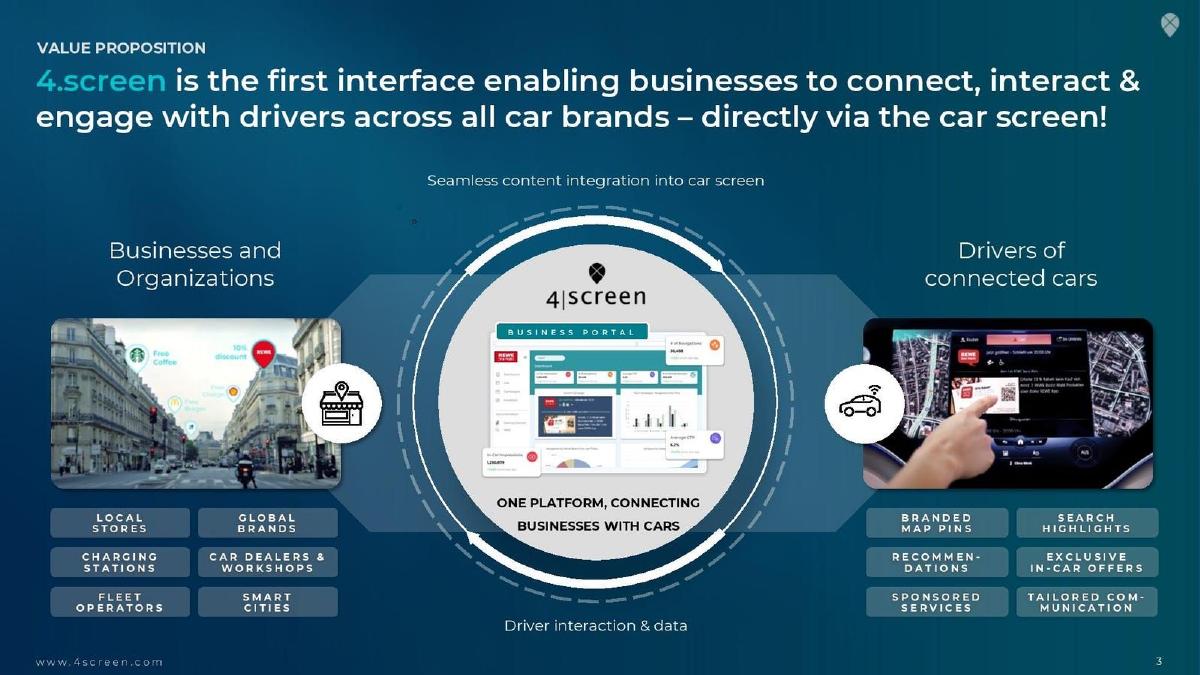
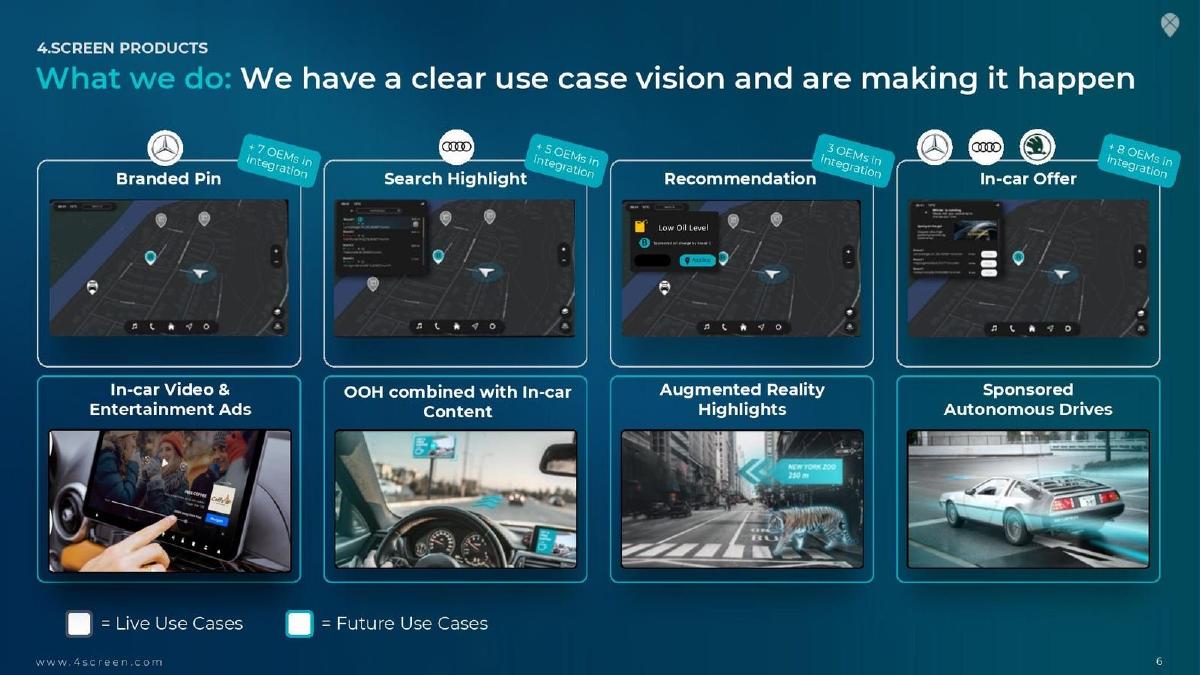
- The platform enables specific ad formats including branded map pins, search highlights, and exclusive in-car offers (Slide 3).
- The deck highlights a projected growth of connected vehicles from 60M in 2015 to 600M by 2030 (Slide 5).
- Strategic investors and advisors include the former CEO of VW (Matthias Müller) and the former CEO of Audi (Bram Schot), providing significant industry credibility (Slide 11).
- The deck omits traditional financial metrics such as current ARR, burn rate, or specific customer acquisition costs.
Slide 1: Title Slide
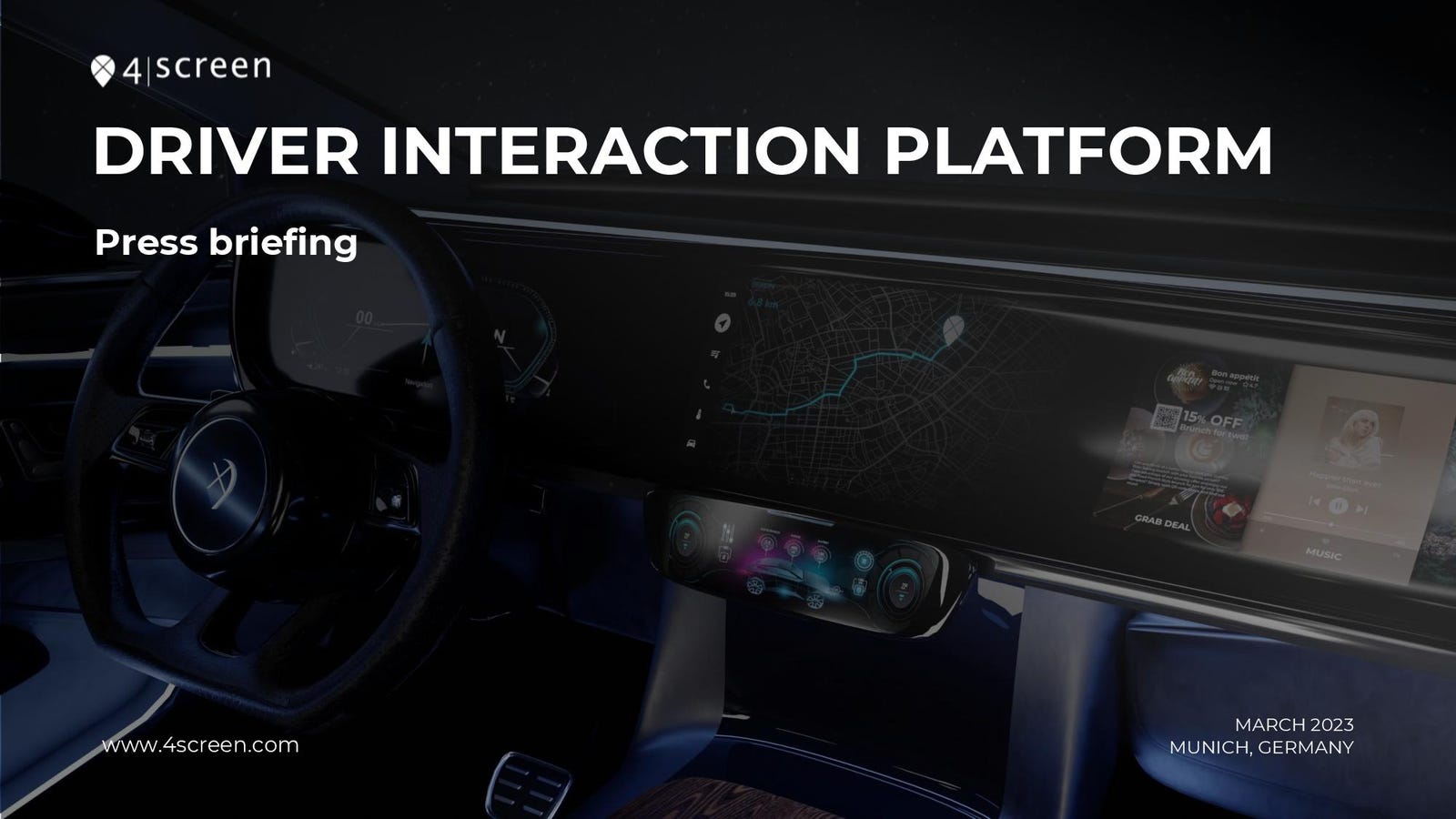
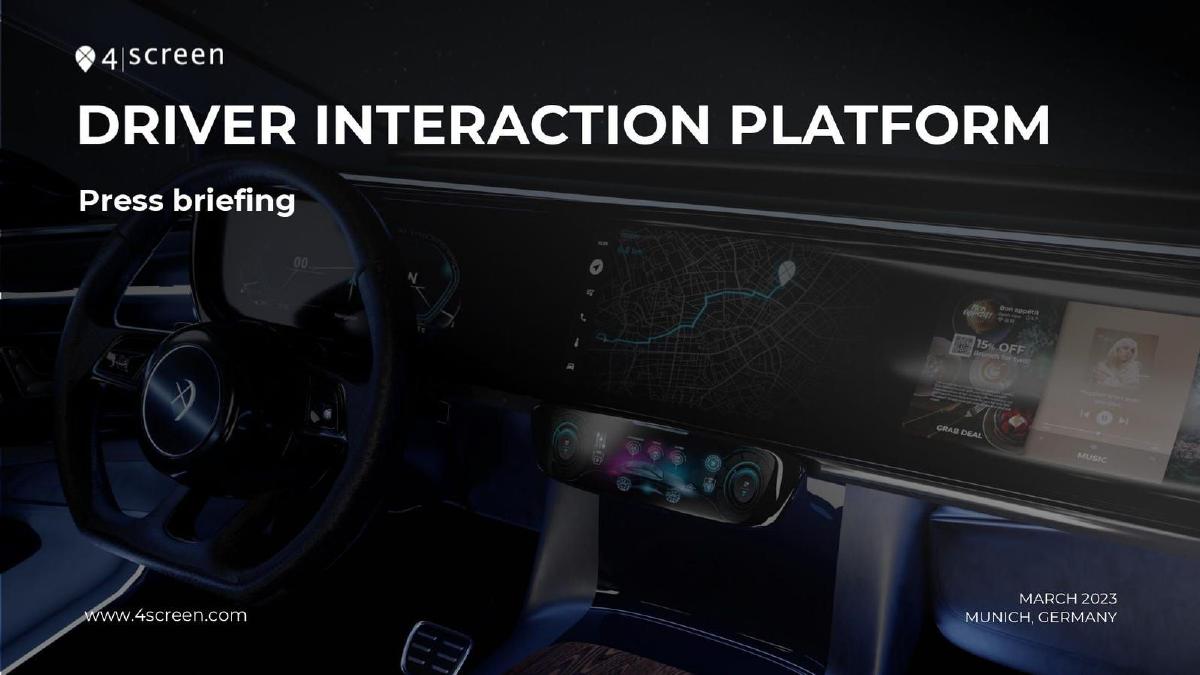
The deck opens with a high-fidelity visualization of a modern car cockpit. The headline identifies 4.screen as a 'Driver Interaction Platform.' The sub-header notes this is a 'Press briefing' from March 2023, based in Munich, Germany. The visual emphasizes the digital real-estate available on modern dashboards, showing a navigation map and a '15% OFF' brunch offer integrated into the right-side display.
Slide 2: The Brand Identity
This slide is a minimalist transition or branding slide featuring only the number '4' and the company logo. It serves as a visual break before diving into the value proposition.
Slide 3: Value Proposition
Slide 3 defines the company's core mission: '4.screen is the first interface enabling businesses to connect, interact & engage with drivers across all car brands – directly via the car screen!' The slide uses a three-part diagram. On the left are 'Businesses and Organizations' (local stores, global brands, charging stations). In the center is the '4.screen Business Portal,' described as the 'One platform, connecting businesses with cars.' On the right are 'Drivers of connected cars.' The slide lists specific interaction types: Branded Map Pins, Search Highlights, Recommendations, Exclusive In-Car Offers, Sponsored Services, and Tailored Communication. This slide establishes 4.screen as the middleman in a two-sided marketplace.
Slide 4: Brand Reinforcement
Another minimalist transition slide featuring the number '4'. The repetition of these slides suggests a deck designed for a live presentation where the speaker provides the narrative weight.
Slide 5: Market Potential
This is the 'Big Market' slide. The headline claims 600M connected cars will create a 'gold-rush' for a €300B+ market where 4.screen 'controls the rails and sells the shovels.' A bar chart shows the growth of connected vehicles from 60M in 2015 to a projected 600M in 2030. To the right, the €310B Total Addressable Market (TAM) is broken down: Aftersales (€120B+), Marketing (€80B+), Smart City (€60B+), and Fleets (€50B+). Notably, the slide claims 4.screen 'currently owns 100% of the market' for in-car marketing. It also highlights that drivers spend an average of >50 minutes driving per day, creating 'billions of untapped interactions.'
Slide 6: Brand Reinforcement
Slide 7: Value-Add and Ecosystem
Slide 7 explains 'How it helps' by detailing the benefits for three stakeholders. For Businesses & Organizations , it offers enhanced reach and store traffic (they 'Pay for campaigns'). For Drivers , it offers time/money savings and 'trip safety' (they 'Engage with content'). For Car Brands , it unlocks a new profit pool with 'very low additional cost' (they 'Connect vehicles... & get rev. share'). The slide describes this as a 'self-reinforcing ecosystem,' implying network effects where more drivers attract more brands, which in turn attracts more OEMs.
Slide 8-10: Brand Reinforcement
Three consecutive minimalist slides (Slides 8, 9, and 10) each featuring the number '4'. In a standard 11-slide deck, this is an unusual amount of filler, likely indicating that the version of the deck released to the public has had several content slides (such as traction, financials, or product roadmap) removed for confidentiality.
Slide 11: The Team and Investors
The final slide focuses on 'The people behind' the company. It highlights a 'World-class team with automotive & tech expertise.' The three founders—Fabian Beste (CEO), Simon Hecker (CRO), and Christoph Mahlert (CTO)—are all listed as 'Ex-BMW' with specific roles in AI, digital strategy, and tech leadership. The slide mentions a '60+ team' from companies like Google, Uber, and Mercedes-Benz. The 'Selected Investors' section is particularly strong, featuring mobility specialist 'co-pace' and adtech specialist 'S4S.' Most importantly, it lists Matthias Müller (Ex-CEO VW) and Bram Schot (Ex-CEO Audi) as investors/advisors, providing massive institutional validation within the German automotive industry.
What 4.screen Does Well
The deck excels at ecosystem positioning . Instead of just being an 'adtech' company, 4.screen positions itself as the infrastructure ('the rails') for the entire automotive industry. By creating a clear win-win-win scenario on Slide 7, they address the primary friction point for in-car ads: why would an OEM allow ads on their dashboard? The answer provided—revenue sharing and enhanced driver UX—is a compelling pitch for conservative car manufacturers.
The pedigree of the team is another high point. In the automotive world, being an outsider is a disadvantage. By highlighting three ex-BMW founders and two ex-CEOs of major German car brands, 4.screen signals to investors that they have the 'insider' status required to navigate the complex, slow-moving procurement cycles of OEMs like Volkswagen, Audi, and BMW.
What is Missing from the Deck
The most glaring omission is traction and financial data . While the publisher reports a $23M Series A, the deck shown here contains zero information on current revenue, number of active vehicles connected, or specific brand partnerships already in place. There is no mention of the 'burn rate' or how the $23M will be allocated. Furthermore, the 'Competition' slide is entirely absent. While they claim to 'own 100% of the market,' they do not address the threat of Apple CarPlay or Android Auto, which are the most direct competitors for driver attention and dashboard real estate.
The product roadmap is also missing. The deck explains what the platform does today (map pins and offers), but it doesn't detail how the technology will evolve as cars become more autonomous or how they handle data privacy regulations (GDPR), which is a critical concern for location-based advertising in Europe.
Founder Takeaways
Use 'Industry Titans' for Validation: If you are operating in a legacy industry (like automotive or healthcare), your advisor/investor list is often as important as your product. 4.screen’s inclusion of the former CEOs of VW and Audi is a 'trust shortcut' that likely did more to close the round than any individual metric slide could have.
Frame the Market Growth: Slide 5 is a perfect example of how to use a macro trend to justify a startup's existence. They don't just say 'ads are good'; they show the explosion of 'connected vehicles' (from 60M to 600M) and then place their solution at the center of that growth curve. This makes the investment feel like a bet on an inevitable trend rather than just a bet on a single company.
Define the Ecosystem Early: If your business requires multiple parties to cooperate (brands, drivers, and OEMs), you must clearly articulate the value for each. Slide 7 does this effectively by using a circular flow, showing that the company isn't just taking a piece of the pie, but growing the pie for everyone involved.
Frequently asked questions
- What is the core product 4.screen is selling?
- 4.screen sells a 'Driver Interaction Platform' that acts as an interface between businesses and connected cars. It allows retailers and brands to place sponsored content, such as branded map pins and exclusive offers, directly onto the vehicle's dashboard screen in real-time based on location data.
- How does 4.screen make money according to the deck?
- Slide 7 indicates a revenue-share model. Businesses pay for advertising campaigns to increase store traffic, and car brands (OEMs) receive a share of that revenue in exchange for connecting their vehicles to the 4.screen platform and integrating the content into their user interface.
- Who are the key people behind the company?
- The company was founded by three former BMW employees: Fabian Beste (CEO), Simon Hecker (CRO), and Christoph Mahlert (CTO). Their expertise spans AI recommendations, digital strategy, and technical leadership. They are supported by a team of over 60 people from companies like Google, Uber, and Mercedes-Benz.
- What market size is 4.screen targeting?
- The deck targets a total addressable market of €310B by 2030. This is broken down into four segments: Aftersales (€120B+), Marketing (€80B+), Smart City (€60B+), and Fleets (€50B+). They cite McKinsey and Ptolemus Consulting as sources for these figures.
- What specific advertising features does the platform offer?
- As shown on Slide 3, the platform supports branded map pins, search highlights, tailored recommendations, sponsored services, exclusive in-car offers, and tailored communication. These are integrated 'seamlessly' into the existing car screen interface.