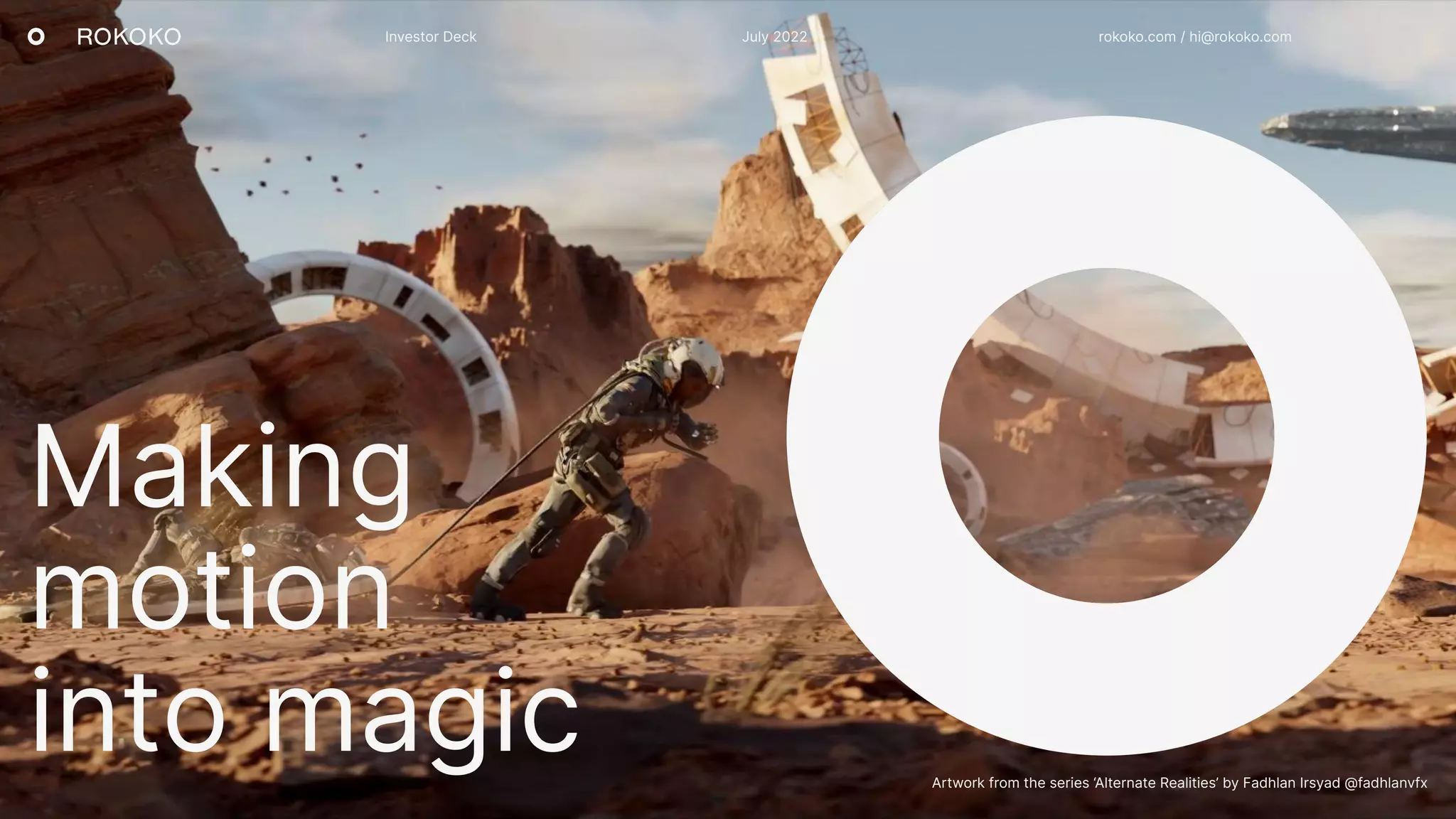
Rokoko’s July 2022 investor deck presents a compelling case for the democratization of motion capture. Originally known for high-end hardware, the company rebrands as a 'one-stop-shop for digital movement,' leveraging a flywheel of hardware, SaaS, and a motion asset marketplace. The deck highlights a significant shift in focus toward the creator economy, citing platforms like Roblox and Fortnite as primary growth drivers, while maintaining a secondary focus on professional studios like Netflix and Disney. With a stated pre-money valuation of $80M for their 2022 strategic round, Rokoko emphasi…
Key takeaways
- The company positions itself as a vertically integrated platform encompassing hardware, software (SaaS), and a marketplace (Slide 2).
- Rokoko identifies 'internet creators' on platforms like Roblox and TikTok as their primary growth focus (Slide 3).
- The hardware business carries a high Average Order Value (AOV) of $3500+ for body, hand, and face capture kits (Slide 4).
- The 'Rokoko Motion Library' already boasts over 80,000 registered users as of the deck's publication (Slide 4).
- The company is diversifying into the health sector with 'Rokoko Care,' already sold to Copenhagen Municipality (Slide 5).
- A massive data moat is being built, with a goal to reach 90 million user-created assets per year by 2024 (Slide 6).
- The 2022 strategic round was raised at a $80M pre-money valuation, double the 2021 Series A valuation of $40M (Slide 8).
- The deck projects a $25M Series B round for 2023, though specific use of funds is not detailed in the provided slides (Slide 8).
Executive Summary: The Democratization of Motion
Rokoko’s July 2022 investor deck represents a company at a pivotal transition point. While the brand was built on accessible inertial motion capture suits, this deck argues that the real value lies in the data and the platform. By positioning themselves as the 'one-stop-shop for digital movement,' Rokoko is attempting to move away from the 'hardware-only' label and toward a high-margin SaaS and marketplace model. The deck is visually polished and leans heavily into the 'Creator Economy' narrative that dominated the 2021-2022 investment landscape.
Slide 1: Title and Vision
The opening slide sets a cinematic tone with high-quality 3D artwork from the 'Alternate Realities' series. The tagline 'Making motion into magic' is aspirational rather than descriptive. It establishes the brand's aesthetic—professional, creative, and high-tech. Notably, the slide includes contact information and a date (July 2022), which provides essential context for the market conditions at the time of the raise.
Slide 2: The Solution - A Vertically Integrated Platform
Slide 2 defines the 'Solution' not as a suit, but as a 'one-stop-shop for digital movement.' The graphic uses concentric circles to show the layers of their ecosystem: a core Motion Engine (API), surrounded by single-camera capture, high-end hardware, editing software, and a marketplace. The outer ring mentions 'Reinforced learning with motion data,' signaling to investors that this is an AI-play. This slide is crucial because it attempts to justify a tech valuation rather than a hardware manufacturing multiple.
Slide 3: Market Opportunity - The Creator Economy
Rokoko splits its market focus into two categories. The 'Primary focus' is the emerging creator economy, featuring logos like Roblox, TikTok, Fortnite, and Meta. The claim that 'a new content creator is born each second' highlights the scale. The 'Secondary focus' is the professional studio market (Netflix, Disney+, etc.), which they value at $27B with a 15% CAGR. By labeling the pro market as secondary, Rokoko is telling investors they are chasing the higher-volume, 'long-tail' opportunity of the metaverse.
Slide 4: The Commercial Flywheel
This slide explains how Rokoko makes money. It lists three revenue pillars: Hardware (Body + hands + face) with an AOV of $3500+; SaaS (Rokoko Studio) with tiers at $20/m and $50/m; and the Motion Library (Marketplace) which already has 80,000+ registered users. The 'Leading indicator' for the business is identified as the number of assets hosted in their Studio software. This is a sophisticated way to show how hardware sales feed into recurring software revenue.
Slide 5: New Verticals - Rokoko Care
To prove the versatility of their tech, Slide 5 introduces 'Rokoko Care.' This is a healthcare application designed for physiotherapists. The slide claims they have already sold to the Copenhagen Municipality and are in talks with eight others. This adds a 'stability' element to the pitch—while the creator economy might be volatile, government-backed healthcare contracts provide reliable, long-term revenue.
Slide 6: The Data Moat
Slide 6 is perhaps the most aggressive in terms of projections. It shows a bar chart of 'mocap systems in the market' alongside a line graph of 'assets created by our users per year.' The target for 2024 is a staggering 90 million assets. The text claims they have the 'world’s most powerful dataset of human motion.' In the world of AI, the company with the best training data wins, and Rokoko is positioning itself as that winner for human movement.
Slide 7: Financial Projections (Redacted)
Slide 7 is titled 'Financial projections 2022-2025.' Unfortunately, in this public version of the deck, the table is blurred and overlaid with the word 'Redacted.' However, the structure of the table is visible, showing they track revenue by product line (Smartsuit, Smartgloves, Face Capture, SaaS, and Care). This indicates a disciplined approach to tracking multi-stream revenue, even if the specific numbers are withheld from the general public.
Slide 8: Fundraising History and Valuation
This is the 'money slide.' It shows a clear valuation trajectory: 2019: $7M raised at a >$20M valuation. 2021: $3M Series A at a $40M valuation. 2022: A 'Strategic round' of $3M at an $80M pre-money valuation. It also forecasts a 2023 Series B of $25M. The doubling of the valuation from 2021 to 2022 (from $40M to $80M) despite raising the same amount of capital ($3M) suggests high investor confidence or significant hitting of milestones between those years.
Slide 9: External Resource
The final slide in this set is a promotional slide for 'bestpitchdeck.com' and does not contain information about Rokoko. It serves as a call to action for the platform hosting the deck teardown.
What Works Well in This Deck
Clarity of Ecosystem: Rokoko does an excellent job of explaining that they are not just a 'suit company.' The flywheel on Slide 4 clearly illustrates how hardware, software, and the marketplace interact to create a sticky user base. Investors love ecosystems because they are harder to disrupt than single products.
Market Segmentation: By distinguishing between 'Internet Creators' and 'Pro Studios,' Rokoko shows they understand their customers. They aren't just saying 'everyone who makes video'; they are identifying specific platforms (Roblox, Snap AR) where their growth will come from.
The Data Play: Slide 6 addresses the 'moat' question. In a world where hardware can be commoditized, Rokoko argues that their massive dataset of human motion—collected from thousands of suits in the wild—is an asset that competitors cannot easily replicate.
What Is Missing or Omitted
The Team: In the provided slides, there is no 'Team' slide. For a company at an $80M valuation, the pedigree of the engineering and leadership team is vital. We don't see who is building the AI or who is leading the expansion into healthcare.
Unit Economics: While the AOV of $3500+ is mentioned for hardware, there is no mention of Customer Acquisition Cost (CAC) or Lifetime Value (LTV). For a company moving into SaaS, these metrics are the standard by which they are judged.
Competitive Landscape: The deck assumes a vacuum. There is no mention of competitors like OptiTrack, Xsens, or even low-cost AI-only solutions that don't require hardware. A 'Competitor Matrix' slide is a glaring omission for a strategic round.
Use of Funds: Slide 8 mentions a $25M Series B in 2023, but it doesn't explain what that money will be used for. Will it go toward R&D for new hardware, marketing to creators, or scaling the healthcare vertical?
What Founders Should Copy
The 'Flywheel' Visualization: If your company has multiple revenue streams, use a flywheel graphic like Slide 4. It helps investors understand how a one-time hardware sale turns into a long-term software relationship.
Vertical Expansion Proof: Slide 5 is a masterclass in showing 'optionality.' By showing a real-world use case in healthcare (with a named customer like Copenhagen Municipality), Rokoko proves their tech isn't a one-trick pony. Founders should always include one 'future vertical' that is already being tested.
Valuation Trajectory: Slide 8 is very effective. Showing a consistent increase in valuation over several years builds a narrative of 'inevitable success.' It shows that previous investors have been rewarded with paper gains, which makes new investors more comfortable with a higher entry price.
Focus on 'Leading Indicators': Don't just show revenue. Show the metric that leads to revenue. Rokoko identifying 'assets hosted in Studio' as their leading indicator shows they understand the mechanics of their own growth.
Frequently asked questions
- What is Rokoko's core product offering?
- Rokoko offers a vertically integrated motion capture ecosystem. This includes high-end hardware for body, hands, and face capture (AOV $3500+), the Rokoko Studio SaaS platform with tiers ranging from free to $50/month, and a Motion Library marketplace where assets are traded. They aim to be a 'one-stop-shop' for digital movement, moving beyond just being a hardware manufacturer.
- How does Rokoko plan to grow beyond the film and gaming industry?
- The deck outlines a major expansion into 'Rokoko Care,' a health-tech vertical. This application helps physiotherapists with patient compliance and exercise monitoring. They have already secured the Copenhagen Municipality as a client and are in dialogue with eight others, demonstrating that their motion capture technology has significant utility in medical rehabilitation and remote health monitoring.
- What is the 'Commercial Flywheel' mentioned in the deck?
- The flywheel (Slide 4) centers on assets hosted in Rokoko Studio. Hardware sales lead to asset creation; these assets are then shared or traded in the Motion Library, which brings in more users. As more users join the library (80,000+ registered), it drives further hardware adoption and SaaS subscriptions, creating a self-reinforcing cycle of growth and data collection.
- What are the key market drivers for Rokoko's technology?
- Rokoko identifies two main drivers: the explosive growth of the creator economy (Metaverse, Roblox, Snap AR) where a 'new content creator is born each second,' and the 'fierce competition' in the professional streaming market (Netflix, Disney+, HBO Max). They prioritize the emerging internet creator segment due to the unprecedented speed and volume of content production in that space.
- What financial information is disclosed in the deck?
- The deck provides a fundraising history (Slide 8) showing a progression from a $20M valuation in 2019 to an $80M pre-money valuation in 2022. While there is a 'Financial Projections 2022-2025' slide (Slide 7), the specific numbers are redacted/blurred in this version, though it clearly shows line items for Smartsuit, Smartgloves, and SaaS revenue streams.