Rokoko’s July 2022 deck serves as a masterclass in narrative expansion. While the company began as a hardware-focused motion capture startup, this presentation positions them as a data-centric ecosystem. By leveraging a 'Commercial Flywheel' that connects high-end hardware with a SaaS-based studio and a massive motion library, Rokoko demonstrates how to build a competitive moat around proprietary datasets. The deck highlights significant traction, including 50,000+ users and a customer list featuring Sony, Microsoft, and Netflix. Despite redacting specific financial figures in the public vers…
Key takeaways
- The company positions itself as a 'one-stop-shop for digital movement,' integrating hardware, software, and a marketplace (Slide 3).
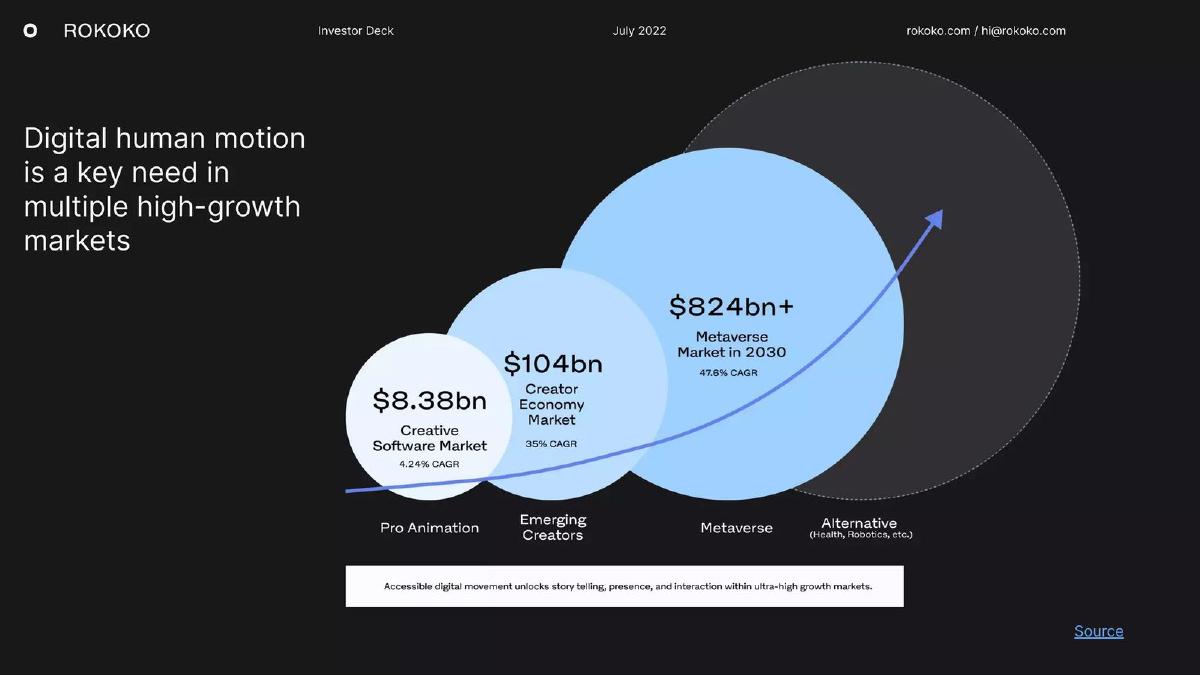
- Rokoko identifies a massive market expansion opportunity, moving from an $8.38bn creative software market to an $824bn+ Metaverse market by 2030 (Slide 6).
- The 'Commercial Flywheel' relies on hardware as an entry point (AOV $3500+) to drive users into the Rokoko Studio SaaS platform (Slide 7).
- The company has achieved significant enterprise penetration with customers including Airbus, Sony, Meta, and Disney (Slide 14).
- A strong emphasis is placed on the proprietary dataset, claiming to collect motion data that 'exponentially improves' their machine learning models (Slide 11).
- The management team and board include high-level expertise from Roblox, Unity, and Nordisk Film (Slide 10).
- The deck outlines a clear fundraising history, showing a valuation jump from $40M in 2021 to an $80M pre-money valuation for the 2022 strategic round (Slide 15).
- Vertical expansion is already underway, with 'Rokoko Care' already sold to the Copenhagen Municipality for physiotherapy compliance (Slide 9).
Introduction: The Evolution of Motion Capture
Rokoko’s July 2022 investor deck represents a pivotal moment for the Danish startup. Founded in 2014, the company spent years perfecting affordable, high-quality motion capture hardware. However, this deck, used for a $3M strategic round, signals a shift in identity. Rokoko is no longer just a hardware vendor; it is positioning itself as a vertically integrated data platform. By framing human motion as the fundamental building block of the 'digital presence,' Rokoko expands its potential reach from niche VFX studios to the entire Metaverse, robotics, and healthcare industries.
Slide 1: Title Slide
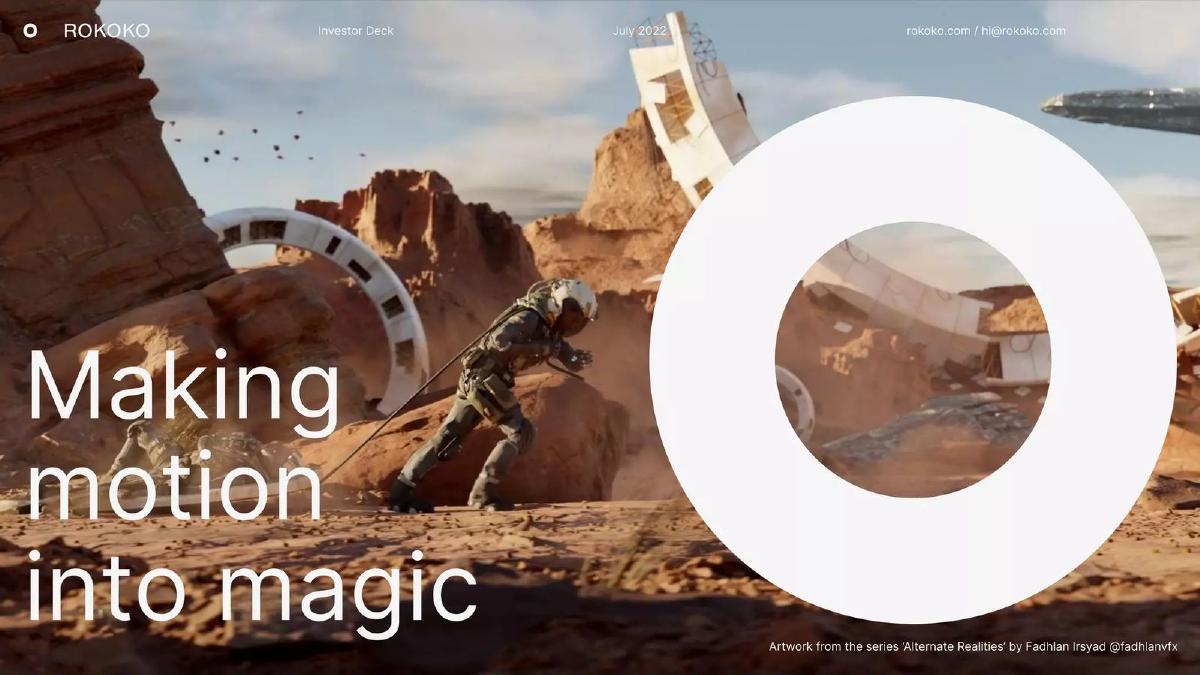
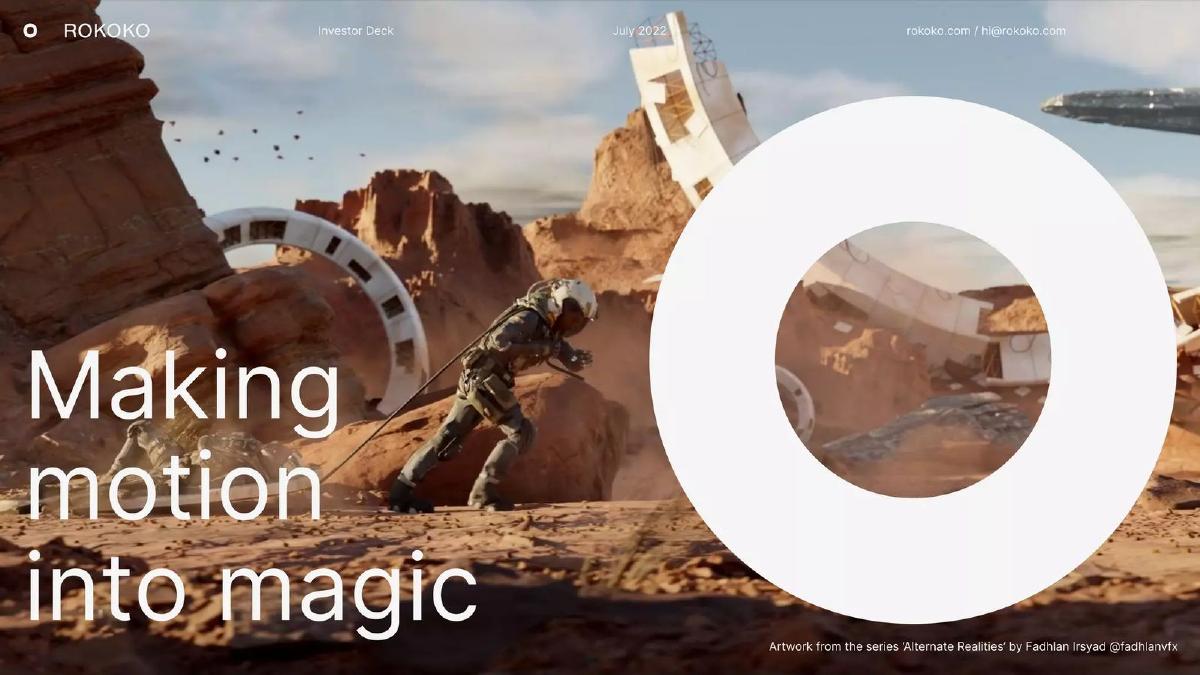
The deck opens with a high-fidelity visual from the 'Alternate Realities' series by Fadhlan Irsyad. The tagline, "Making motion into magic," is aspirational rather than technical. This sets the tone for a presentation focused on the creative and experiential outcomes of the technology rather than just the specifications of the sensors.
Slide 2: The Problem - The Barrier to Digital Presence
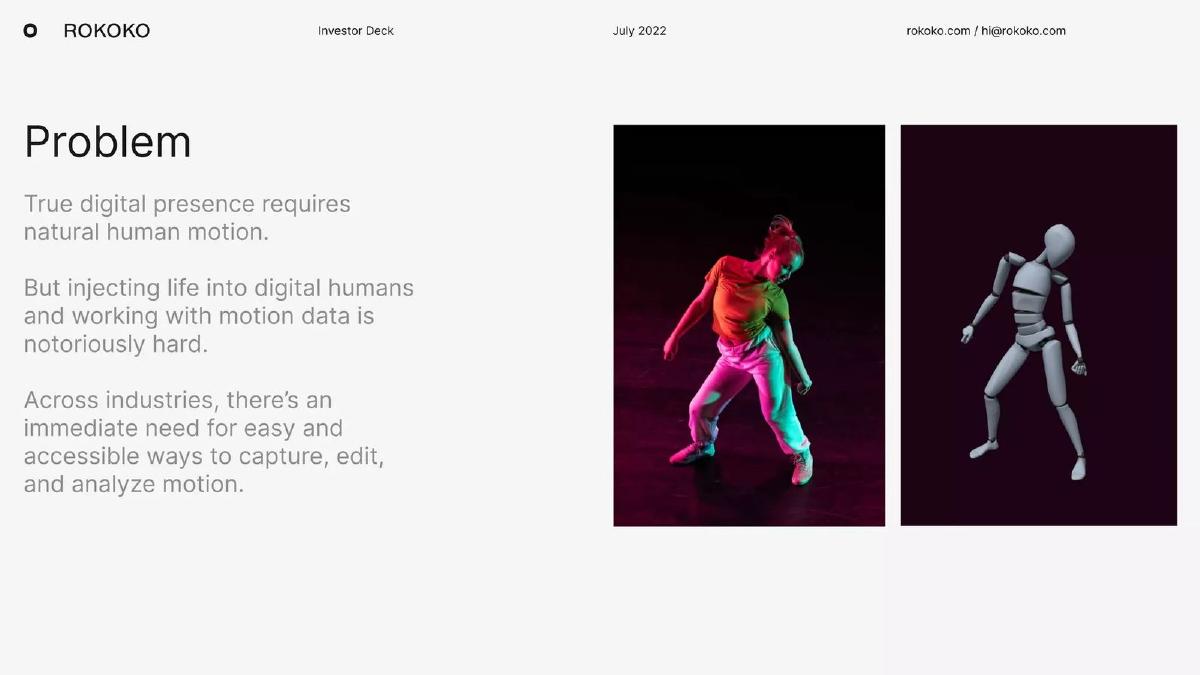
Rokoko defines the problem as a creative bottleneck. They state that "True digital presence requires natural human motion," but achieving this is "notoriously hard." By highlighting the need for 'easy and accessible' ways to capture and edit motion, they identify a gap between the high demand for digital content and the technical complexity of existing tools. This slide effectively broadens the problem from a technical animation issue to a universal requirement for the next generation of the internet.
Slide 3: The Solution - A Vertically Integrated Platform
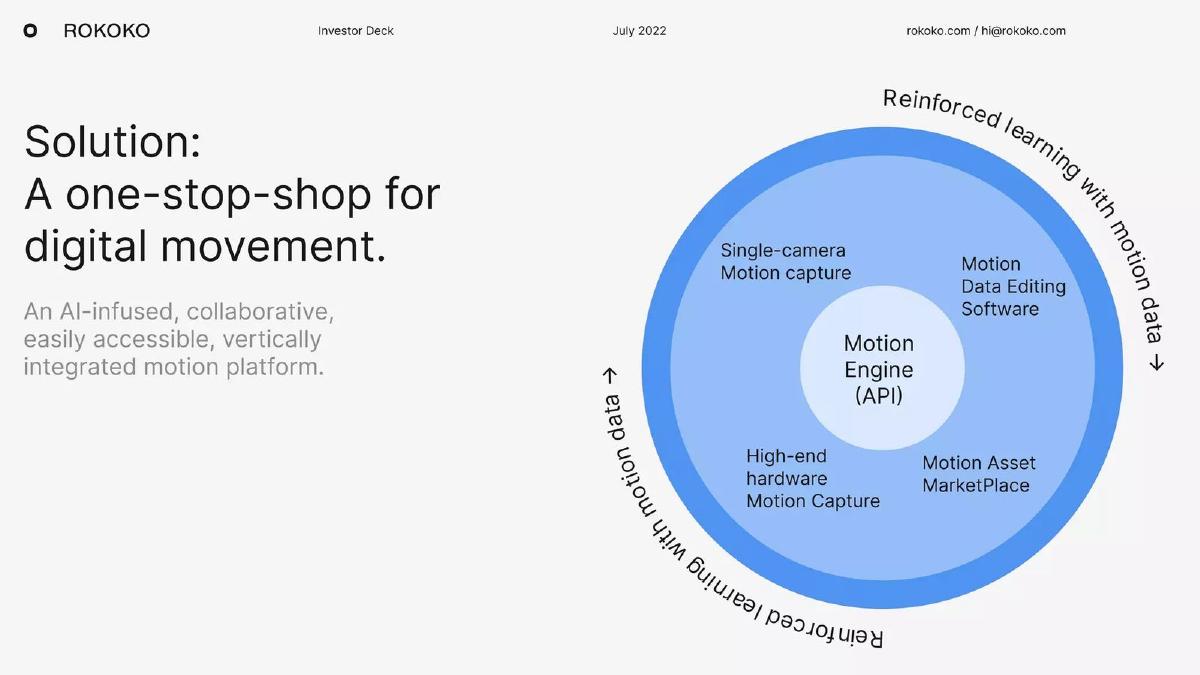
The solution is described as a "one-stop-shop for digital movement." A concentric circle diagram illustrates their ecosystem: at the core is the "Motion Engine (API)," surrounded by single-camera capture, high-end hardware, editing software, and an asset marketplace. The outer ring mentions "Reinforced learning with motion data," suggesting that the entire platform is a feedback loop that improves with use. This slide establishes Rokoko as a platform player rather than a single-product company.
Slide 4: Vision - From Creators to Infrastructure
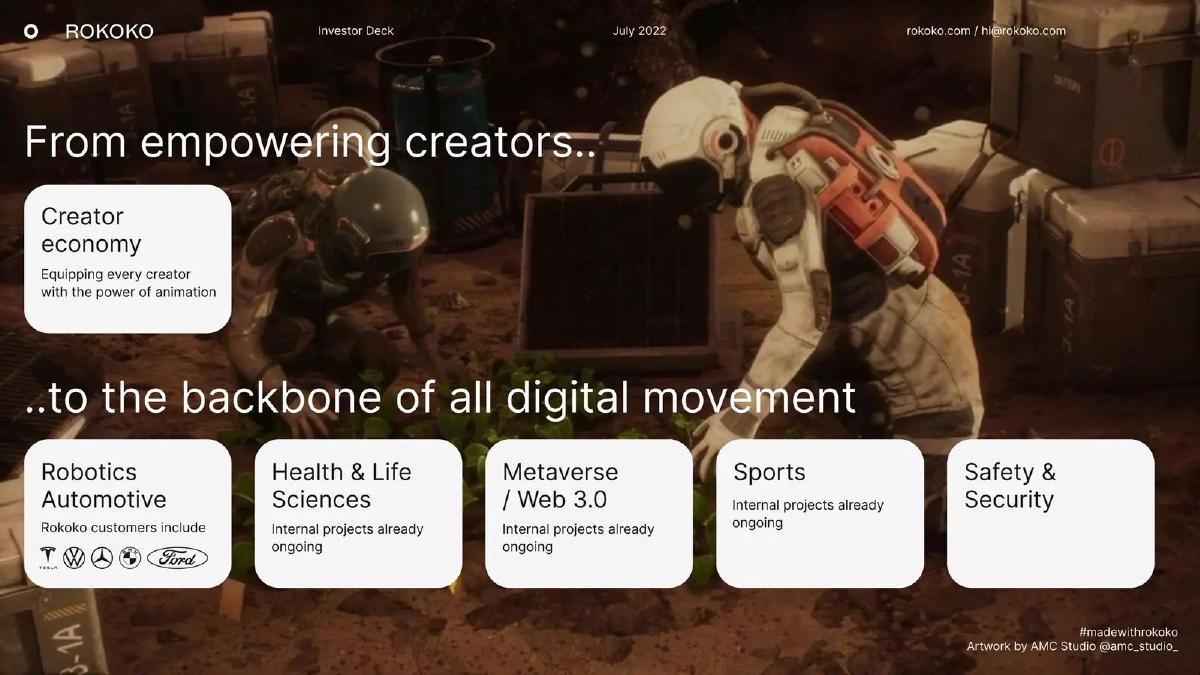
This slide visualizes the company’s trajectory. It starts with "empowering creators" in the creator economy and moves toward becoming the "backbone of all digital movement." They list several high-value verticals where internal projects are already ongoing: Robotics/Automotive, Health & Life Sciences, Metaverse/Web 3.0, Sports, and Safety & Security. The inclusion of logos like Tesla, Volkswagen, and Ford under the automotive section provides immediate credibility for these expansion plans.
Slide 5: The Creator Economy Opportunity
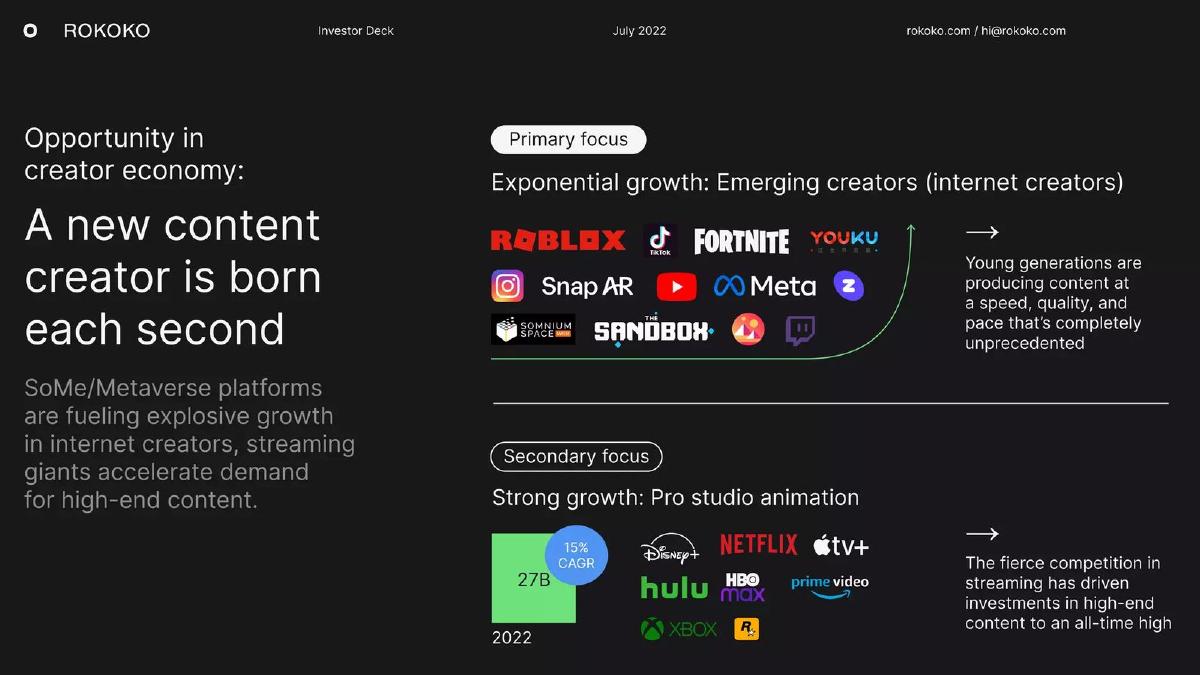
Rokoko leans into the 'Why Now' by citing the explosive growth of internet creators. They note that "A new content creator is born each second." The slide displays logos of major platforms like Roblox, TikTok, Fortnite, and Meta. Below, they address the "Secondary focus" : Pro studio animation, which they value at $27B in 2022 with a 15% CAGR , driven by the 'fierce competition' among streaming giants like Netflix, Disney+, and HBO Max.
Slide 6: Market Size and Growth
This slide provides a quantitative look at the opportunity. They segment the market into three tiers: the Creative Software Market ($8.38bn) , the Creator Economy Market ($104bn) , and the Metaverse Market ($824bn+ by 2030) . By showing a 47.6% CAGR for the Metaverse, Rokoko justifies why a strategic investment now is timed to catch a massive upcoming wave. A fourth, unquantified circle for 'Alternative' markets (Health, Robotics) suggests even further upside.
Slide 7: The Commercial Flywheel
This is one of the most important slides for understanding Rokoko’s business model. It explains how their different products interact to create a self-sustaining business. The "Motion capture" hardware (Body + hands + face) has an AOV of $3500+ , acting as the primary acquisition tool. This leads to "Assets created," which are then hosted in "ROKOKO Studio (SaaS)," where pricing ranges from a free 'Starter' tier to $50/month per seat for 'Pro.' Finally, the "Rokoko Motion Library" (with 80,000+ registered users) facilitates the trading of assets. This flywheel demonstrates how hardware sales drive recurring software revenue and marketplace activity.
Slide 8: The Platform Roadmap
Slide 8 shows "The Rokoko Platform in 2 years." While much of the diagram is redacted in the public version, it clearly distinguishes between "Existing" (blue) and "New" (green) components. The roadmap includes expanding inputs to third-party hardware and scenes, and creating primary value through live interactions and an "animations for Marketplace with NFT layer." This indicates an intent to integrate more deeply with Web3 and third-party developer ecosystems.
Slide 9: Vertical Expansion - Rokoko Care
To prove their ability to enter new markets, Rokoko highlights "Rokoko Care," a tool for professional physiotherapists. The slide shows a mobile interface for personalized recovery journeys and exercise instructions. Crucially, they state it has "Already sold to Copenhagen Municipality" and that they are in "dialogue with 8 other municipalities." This is a strong piece of evidence that their motion technology has life-saving and cost-saving applications outside of entertainment.
Slide 10: Management and Governance
The team slide is impressive, featuring not just the founders but a high-caliber Board of Directors. Jakob Balslev (CEO) and Matias Søndergaard (CPO) are joined by Mikkel Lucas Overby (COO/CFO) . The board includes Stefano Corazza (Head of Roblox Studio) , Brett Bibby (Former CPO of Unity) , and Rikke Crosby (CSO of Nordisk Film) . Having the heads of the world's leading 3D and animation platforms on the board is a massive signal of industry trust.
Slide 11: The Data Moat
Rokoko claims to "move on the world’s most powerful dataset of human motion." A bar chart shows the growth of "mocap systems in the market" (projected to reach 80K by 2024) and the "number of assets created by our users per year" (projected to reach 90M). They argue that this massive fleet allows them to collect data that "exponentially improves our ability to distill digital movement through machine learning." This frames their hardware not just as a product, but as a distributed sensor network for data harvesting.
Slide 12: Company Background and Growth
This slide summarizes the company's current state. They highlight 7 patents in their hardware line and their "Cloud-based software suite." While the specific numbers in the "Revenue growth" and "ARR growth" charts are redacted, the visual trend shows consistent upward momentum over the last three years, with a significant forecasted jump for 2022.
Slide 13: Financial Projections 2022-2025
This slide contains a detailed P&L table. Although the numbers are blurred/redacted, the structure shows they are tracking Revenue, COGS, Gross Margin, Fixed Costs, EBITDA, and Profit/Loss across multiple product lines (Smartsuit, Smartgloves, Face Capture, etc.). This level of detail suggests a mature financial planning process typical of a Series B/C stage company.
Slide 14: Rokoko at a Glance
This is a high-impact 'Social Proof' slide. Key stats include: Founded in March 2014 , offices in Copenhagen, Athens, Tokyo, and San Francisco , and more than 50,000 users in 100+ countries . They note that 60-70% of users are 'one-man-army' creators , but their customer list includes Airbus, Sony, Adobe, Microsoft, Meta, Netflix, Disney, and Yale . This proves they have successfully captured both the bottom and the top of the market.
Slide 15: Fundraising History
The deck concludes its data section with a clear fundraising timeline. It shows a $7M funding total in 2019 (at a >$20M valuation), a $3M Series A in 2021 (at a $40M valuation), and the current $3M Strategic round in 2022 (at an $80M pre-money valuation). It also signals a $25M Series B planned for 2023 . This transparency regarding valuation and lead investors (North-East Venture, VF Venture) helps anchor the current 'ask' in a logical progression of value creation.
Slide 16-17: Closing and Attribution
The deck ends with a simple contact slide featuring another high-quality render and the website URL. The final slide is an attribution slide for the pitch deck library.
What Works in This Deck
Strategic Narrative: The transition from a hardware company to a 'motion data backbone' is handled expertly. It justifies a higher valuation multiple by moving the business into the SaaS and Data categories. · Social Proof: The customer list (Slide 14) and the Board of Directors (Slide 10) are world-class. For a strategic round, showing that the CPOs of Roblox and Unity are involved is a massive validator. · The Flywheel: Slide 7 clearly explains how they make money and how the different parts of the business reinforce each other. This reduces the perceived risk of the hardware business by showing its role in driving high-margin software revenue. · Vertical Validation: By showing 'Rokoko Care' and its sale to a municipality, they prove that their technology isn't just for 'fun'—it has serious industrial and medical utility.
What Is Missing or Could Be Improved
Unit Economics: While the AOV and SaaS pricing are mentioned, the deck lacks specific data on Customer Acquisition Cost (CAC), Lifetime Value (LTV), or churn rates for the Rokoko Studio platform. · Competitive Landscape: There is no explicit competitor slide. While Rokoko positions itself as unique, investors would want to see how they stack up against traditional high-end systems (like Vicon) or newer AI-only camera solutions (like Move.ai). · Technical Depth: For a 'strategic' round, a bit more detail on the 7 patents or the specific 'AI infused motion engine' would have helped technical due diligence.
What Other Founders Should Copy
The 'At a Glance' Slide: Slide 14 is a perfect example of how to combine history, scale, and social proof into a single, high-impact visual. · Market Tiering: Instead of just one 'TAM' number, Rokoko shows how they fit into three different, growing markets (Slide 6). This makes the opportunity feel more grounded and less like a single-bet gamble. · Visual Consistency: The use of high-quality 'Made with Rokoko' artwork throughout the deck serves as a continuous product demo without needing a video. · The Fundraising Timeline: Being transparent about previous valuations and future capital needs (Slide 15) builds trust and shows a clear path to an exit or a much larger round.
Frequently asked questions
- What is Rokoko's primary business model?
- Rokoko employs a hybrid business model. It sells high-end motion capture hardware (suits, gloves, and face capture) with an Average Order Value (AOV) of over $3,500. This hardware serves as a gateway to their 'Rokoko Studio' SaaS platform, which offers tiered pricing from a free 'Starter' level to $50/month for 'Pro' users. Additionally, they operate a motion library and marketplace for digital assets.
- How does Rokoko plan to expand beyond the animation industry?
- The deck outlines a strategy to become the 'backbone of all digital movement.' This involves moving into 'Alternative' markets such as Health (physiotherapy compliance), Robotics and Automotive (human-machine interaction), and Sports. They have already launched 'Rokoko Care,' a dedicated vertical for healthcare, and have secured the Copenhagen Municipality as a customer.
- What is the significance of Rokoko's data strategy?
- Rokoko views its hardware 'fleet' as a data collection engine. By having thousands of systems in the market, they collect a proprietary dataset of human motion. They claim this is the 'world's most powerful dataset,' which they use to train machine learning models to improve their motion engine, creating a technical moat that is difficult for software-only competitors to replicate.
- Who are Rokoko's key customers and partners?
- The company boasts an impressive list of blue-chip customers across several sectors. Notable names include technology giants (Microsoft, Meta, Sony), entertainment leaders (Netflix, Disney, Sony, Twitch), and industrial players (Airbus, Ford, Volkswagen). This diverse list validates the cross-industry utility of their motion capture technology.
- What were the financial terms of the 2022 fundraising round?
- According to Slide 15, the July 2022 'Strategic round' sought to raise $3M at a pre-money valuation of $80M. This followed a 2021 Series A that raised $3M at a $40M pre-money valuation. The deck also forecasts a Series B in 2023 aiming for $25M, indicating a rapid scaling trajectory.