Romit’s 2015 Seed deck is a masterclass in lead-loading traction to justify a pivot. The company, which originated as the Bitcoin ATM provider Robocoin, used its existing infrastructure to attack the $7 trillion merchant banking market. The deck focuses heavily on two metrics: a 52% month-over-month growth rate and a chargeback rate of just 0.0079%, which is orders of magnitude lower than the 1.2% industry average. While the deck is light on technical architecture and specific unit economics, it successfully frames the existing payment giants like PayPal and Stripe as capturing less than 5% o…
Key takeaways
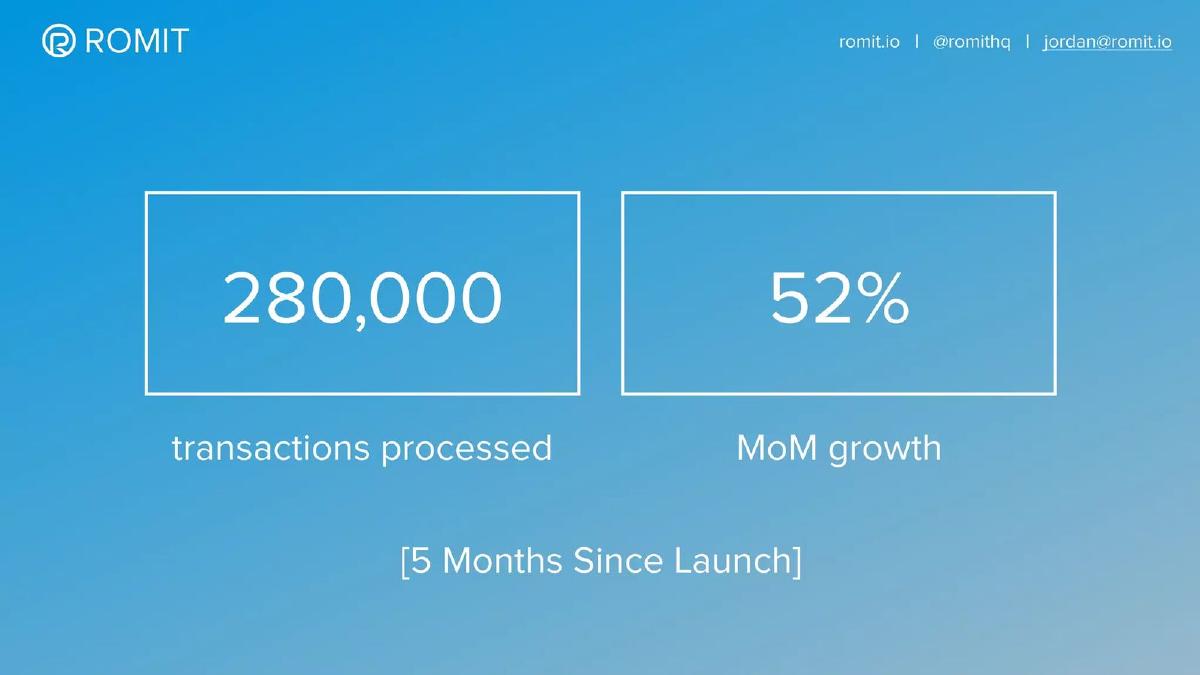
- The deck leads with immediate traction, citing 280,000 transactions processed within five months of launch on slide 2.
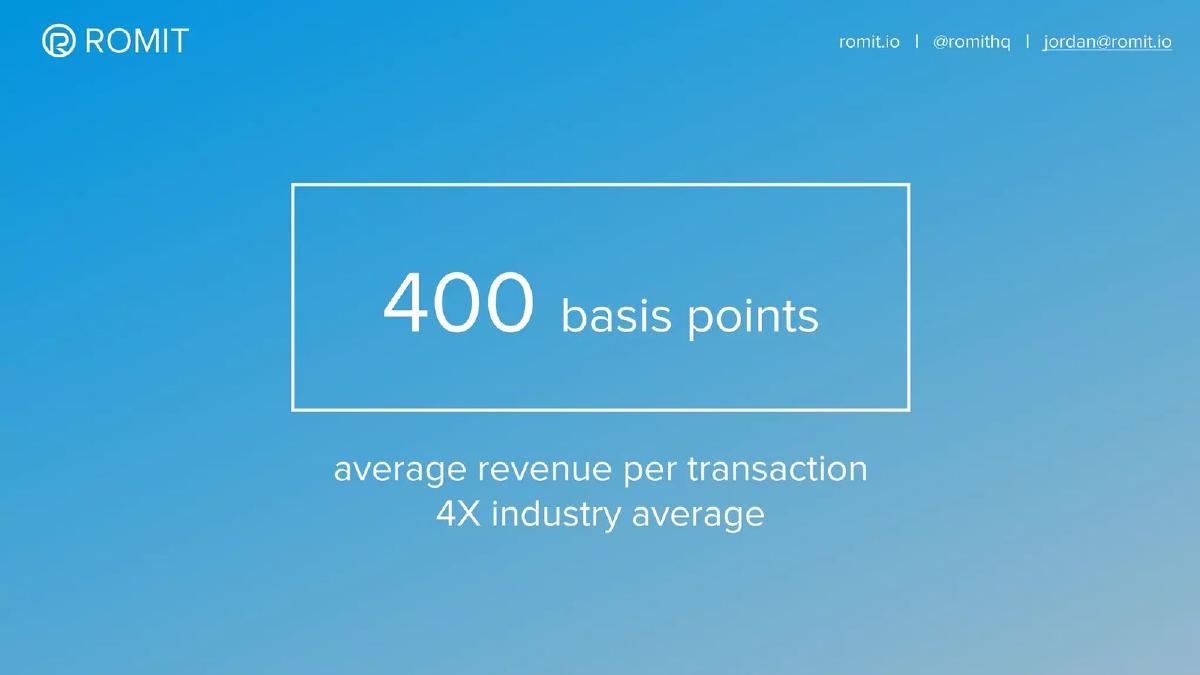
- Romit claims an average revenue per transaction of 400 basis points, which it states is 4x the industry average on slide 3.
- The market opportunity is defined by the $7 trillion processed annually by merchant acquiring banks on slide 4.
- Romit positions PayPal and Stripe as minor players, claiming they represent less than 5% of total credit card volume on slide 5.
- The core value proposition is fraud reduction, contrasting a 1.2% industry chargeback rate against Romit's 0.0079% on slide 8.
- The team leverages significant 'ex-Bitcoin' experience, having previously transacted $150M across 18 countries and 14 currencies as shown on slide 9.
- Slide 10 notes that the company had already raised $945K prior to this specific presentation.
- The deck lists three specific merchant banking partners—Merrick Bank, BMO Harris Bank, and Esquire Bank—with their respective assets totaling over $50 billion on slide 12.
The Lead-Load: Hooking Investors with Immediate Traction
Romit’s deck is unconventional because it doesn't start with a problem or a vision. It starts with proof. In the high-risk world of fintech and cryptocurrency in 2015, credibility was the rarest currency. By placing their most impressive numbers on slides 2 and 3, Romit attempts to bypass the skepticism often directed at early-stage payment startups.
Slides 1-3: The Traction Hook
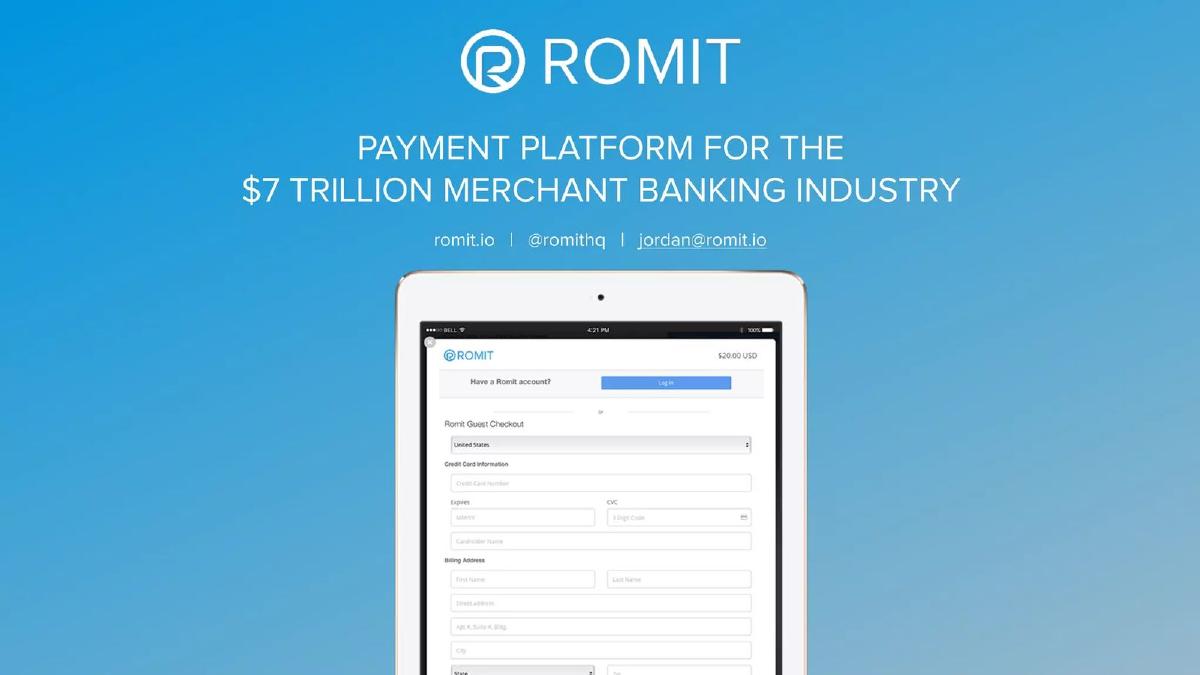
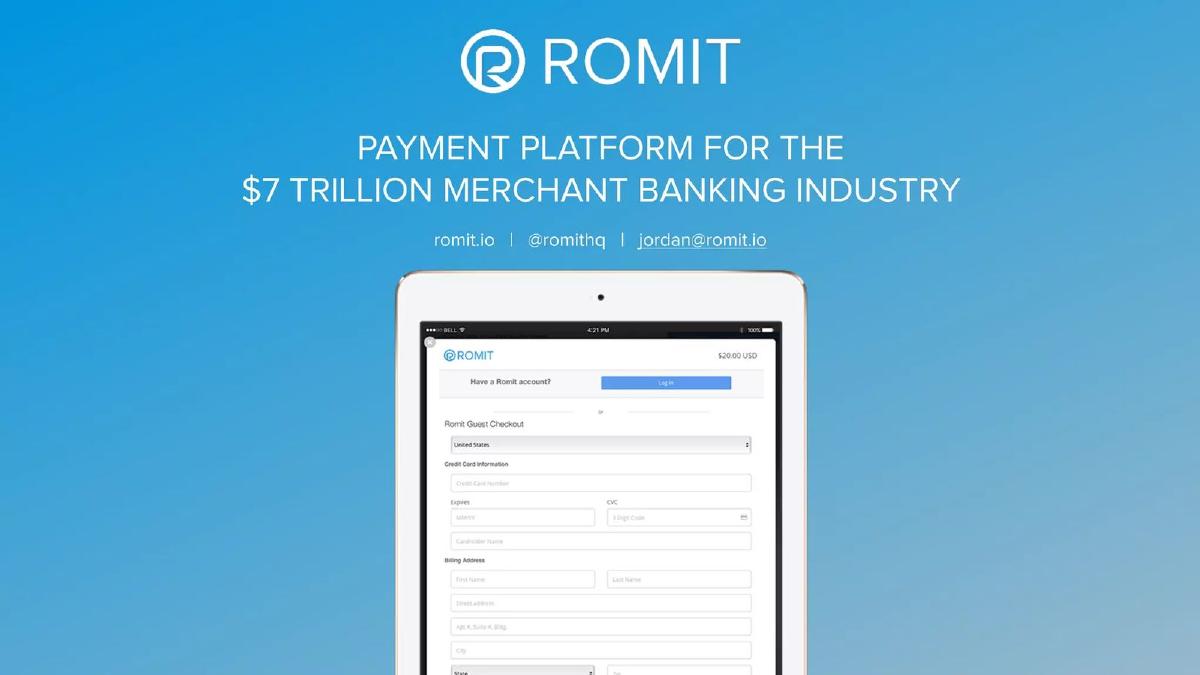
Slide 1 introduces Romit as a 'Payment platform for the $7 trillion merchant banking industry.' This is a bold opening that immediately sets the scale. The inclusion of a mobile checkout interface on an iPad mockup suggests a product that is ready for the consumer-facing market.
Slide 2 is the 'Traction' slide. It states that in the 5 months since launch, the company has processed 280,000 transactions and is maintaining a 52% month-over-month (MoM) growth rate. For a seed-stage company, these are exceptional numbers. It signals that the product has already found a pocket of high-velocity usage.
Slide 3 focuses on unit economics, claiming 400 basis points as the average revenue per transaction. The slide explicitly states this is '4X industry average.' This is a critical point; Romit isn't just growing fast; they are claiming to be significantly more profitable per transaction than the incumbents. This sets the stage for a discussion on how their technology enables such high margins.
Slides 4-6: Defining the $7 Trillion Gap
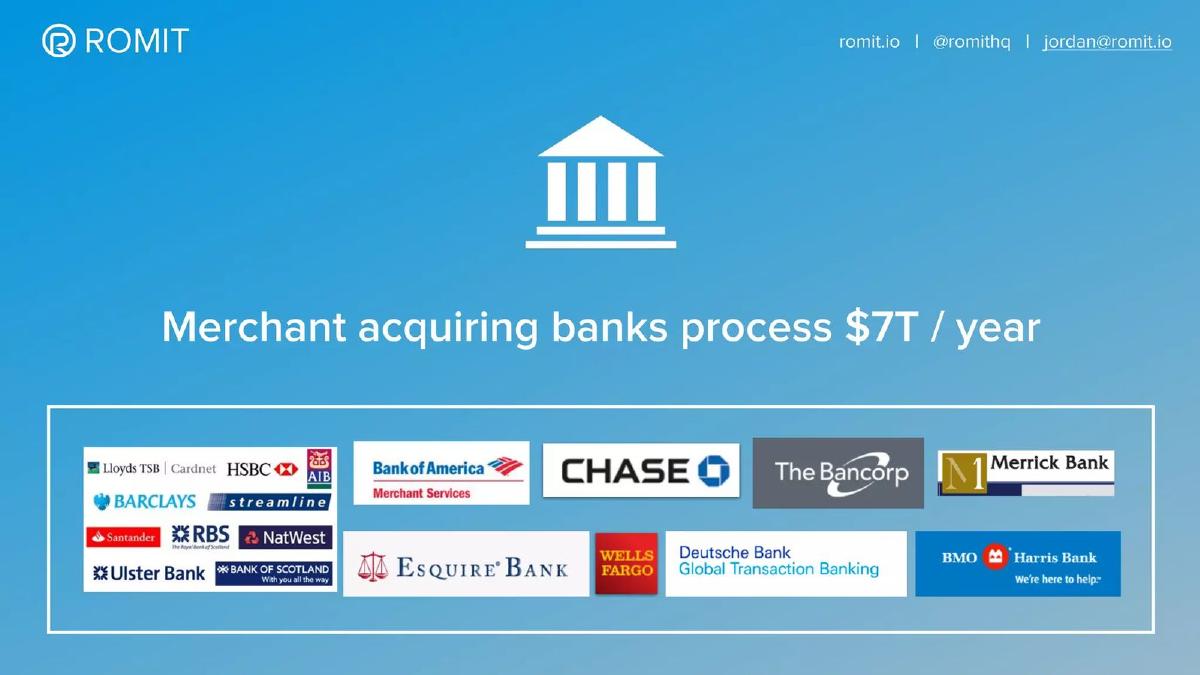
Slide 4 visualizes the 'Merchant acquiring banks' that process $7 trillion a year. It features a logo cloud including Bank of America, Chase, Wells Fargo, and HSBC. This slide serves to define the 'Old Guard' and the sheer scale of the money moving through traditional systems.
Slide 5 provides a reality check on the current 'disruptors.' It shows PayPal and Stripe logos and notes they represent less than 5% of total credit card volume. This is a brilliant strategic move. It tells the investor, 'Even if you think Stripe has won, they’ve only won a tiny sliver of the pie.' It reframes the competition from 'Stripe vs. Romit' to 'The 95% vs. Romit.'
Slide 6 identifies why the other 95% of the market is vulnerable. Romit labels them as 'Low Tech' and 'High Fraud.' This creates a clear opening for a technology-first solution that can bridge the gap between traditional banking volume and modern software efficiency.
Slides 7-8: The Solution and the 'Magic' Metric
Slide 7 shows the product in action. The 'High Tech Solutions for the 95%' are illustrated through a mobile app interface showing a 'Connect with Romit' permission screen. It lists capabilities like accessing payment methods, initiating transfers, and updating identity information. This suggests a platform that acts as an identity and payment layer sitting on top of traditional accounts.
Slide 8 is arguably the most important slide in the deck. It addresses the 'High Fraud' problem mentioned earlier. It uses a simple bar chart to compare merchant chargebacks. The 'Before Romit' rate is 1.2%, while the 'After Romit' rate is a staggering 0.0079%. In the payments world, reducing chargebacks by this margin is the equivalent of finding a 'holy grail.' It explains how they can achieve the 400 basis point revenue mentioned on slide 3—by losing significantly less money to fraud, they keep more of the transaction fee.
Slides 9-12: Team, History, and Partnerships
Slide 9 introduces the team: Jordan Kelley (CEO), John Russell (CTO), Chris Yoder, and Darin Rogers. The headline 'EX-BITCOIN TEAM' is supported by a mention of $150M transacted across 18 countries. The slide also includes press clippings from Time and TechCrunch regarding 'Robocoin,' the team's previous venture. This provides the 'how' behind their tech—they are applying lessons learned from the high-stakes, high-fraud world of Bitcoin ATMs to general merchant processing.
Slide 10 is a transition slide with the phrase 'WE ARE EATING THE PAYMENTS SPACE' and a note that $945K has been raised. This serves as a social proof marker, showing that other investors have already bought into the vision.
Slide 11 lists 'Partners' including Authorize.Net, Apriva, and Vantiv. These are major players in the payment gateway and processing space, indicating that Romit is not building in a vacuum but is integrated into the existing financial ecosystem.
Slide 12 concludes with 'Merchant Banking Partners Today,' listing Merrick Bank ($24.6B in assets), BMO Harris Bank ($22.2B), and Esquire Bank ($4.6B). By ending on these specific, large-scale banking partnerships, Romit reinforces the idea that they are already operating within the 95% of the market they identified as their target.
What Romit Does Well
The Romit deck excels at quantifying the pain and the gain . Most decks use vague adjectives like 'efficient' or 'secure.' Romit uses '0.0079% chargeback rate' and '400 basis points.' These are metrics that a fintech investor can model. By grounding their pitch in these specific numbers, they move the conversation away from 'what if' and toward 'how do we scale this?'
Furthermore, the market segmentation on slide 5 is a masterstroke. By positioning Stripe and PayPal as small players in the grand scheme of total credit card volume, they make the opportunity feel much larger and less crowded. It changes the narrative from 'fighting for the 5%' to 'upgrading the 95%.'
What is Missing from the Romit Deck
The most glaring omission is a detailed technical explanation of how they achieve a 0.0079% chargeback rate. While they mention 'High Tech,' they don't explain if this is due to blockchain-based verification, proprietary AI, or a specific identity layer. For a seed round, investors usually want to see the 'secret sauce' that makes these numbers possible.
There is also no 'Ask' slide . We know from the catalogue facts they raised $125K in this specific instance (and $945K previously), but the deck doesn't state what they need now or what milestones the next round of funding will hit. A clear roadmap of how the next $X million gets them to $Y billion in volume is missing.
Finally, the business model is a bit opaque. They mention 400 basis points of revenue, but they don't break down the take rate versus the cost of goods sold (COGS). In payments, the spread is everything, and without seeing the payout to the banking partners listed on slide 12, it's hard to judge the true scalability of their margins.
Founder's Guide: What to Copy
Lead with Traction: If you have processed 280,000 transactions in 5 months, don't wait until slide 10 to say it. Put it on slide 2. It changes how the investor reads every subsequent slide. · The '95%' Strategy: If you are entering a market with a dominant incumbent (like Stripe), find a metric where the incumbent is actually small. Reframing the market makes you look like a pioneer rather than a copycat. · Benchmark Against the Industry: Don't just say your product is good; say it is '4X the industry average' or '0.0079% vs 1.2%.' Comparative data is much more persuasive than isolated data. · Leverage Past Failures/Pivots: The team used their Robocoin experience to prove they could handle global volume. Even if your previous startup didn't exit, the volume and complexity you handled there is a valid asset for your new venture.
Frequently asked questions
- What is Romit's primary competitive advantage according to the deck?
- Romit’s primary advantage is its drastically lower chargeback rate. On slide 8, they show an industry average of 1.2% compared to their own rate of 0.0079%. They attribute this to their 'high tech' approach, which they contrast against the 'low tech' and 'high fraud' environment of traditional merchant acquiring banks that process the remaining 95% of market volume not touched by Stripe or PayPal.
- How does Romit define its market size?
- Romit targets the 'Merchant Banking Industry,' which they value at $7 trillion per year on slide 4. They specifically identify that while modern players like Stripe and PayPal are well-known, they handle less than 5% of total credit card volume (slide 5), leaving a massive opportunity to provide technology to the banks handling the other 95%.
- What is the team's background?
- The team, led by CEO Jordan Kelley and CTO John Russell, has a background in the cryptocurrency space. Slide 9 highlights their experience with Robocoin, noting they have already transacted $150 million across 18 countries and 14 currencies. This 'Ex-Bitcoin Team' branding is used to establish credibility in handling complex, global financial transactions.
- What revenue model does Romit use?
- While the catalogue facts mention a subscription model, the deck emphasizes a transactional revenue model. Slide 3 highlights an average revenue of 400 basis points (4%) per transaction. They claim this is four times the industry average, suggesting they are able to capture more value per dollar processed than traditional competitors.
- Does the deck include a specific funding ask?
- No, the deck does not include a slide detailing the specific amount they are looking to raise in this round or how the funds will be allocated. It does, however, mention on slide 10 that they have previously raised $945K, providing a baseline for their current capitalization.